
Agricultural Economics What is Agricultural Economics There at
- Slides: 18
Agricultural Economics
What is Agricultural Economics? • There at least two important characteristics that make the agricultural industry unique. • Do you know what they are? • One is the cyclical nature of production. This is caused primarily by physical and biological factors. • The other is price instability resulting from the effects of changes caused both within the market for agricultural products and physically.
Two Characteristics • One was because of the cyclical nature of production caused primarily by physical and biological factors. • What are physical and biological factors? • The cyclical nature of production can be seen in the cattle industry. • Ex – When there is a long gap between the time when increasing beef prices motivate producers to increase production and when the results of their decisions show up at the meat counter of the local grocery store.
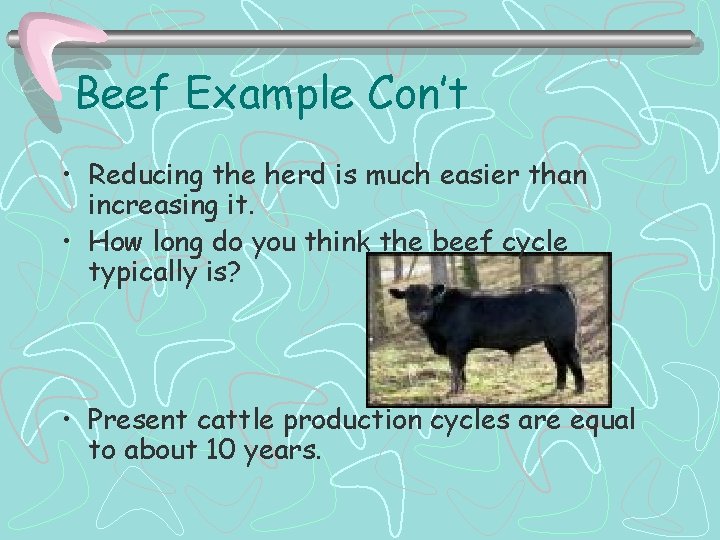
Example of the beef cycle • It takes almost one and a half years from breeding a cow to weaning her heifer calf (assuming she has a heifer) • It then takes another year before the heifer can be bred • Another year is required before the heifer’s calf can be started on the way to slaughter. • An additional year and a half is needed to fatten and market the first offspring from the now larger beef herd.
Beef Example Con’t • Reducing the herd is much easier than increasing it. • How long do you think the beef cycle typically is? • Present cattle production cycles are equal to about 10 years.
Example of price instability • What causes price instability? – Climate conditions – Diseases • These two factors cause price and income fluctuations • An example is the corn blight problem the U. S. encountered in 1970 • What is corn blight? • It’s a fungus that affects corn during wet, humid years.
Example of price instability con’t • Only about 20% of the corn crop was affected • Corn increased from $1. 07 to $1. 43 a bushel as the news of the disease spread • There was also concern the disease would affect next years crop, so scientists worked on blight resistant varieties, to prevent this from happening again.
Agricultural Economics • Certain market characteristics also have an impact on prices. • Ag. in general is relatively competitive. • Can you think where it is the most competitive? – Beef – Hogs – Food and feed grains • There are many producers that individually do not produce a large enough volume to have any influence on market prices. • The products of these firms are like the commodities produced by other firms, either because of the characteristics or the product
Agricultural Economics • Also entry barriers are so low that it’s easy for producers to change to the most profitable enterprise. • These conditions cause the total supply and demand for each product to influence its price • Consumers of agricultural products also change their buying habits as relative prices change
Agricultural Economics • Ex. of changing buying habits – You go to the store to buy a pound of ground beef and see it is $2. 75/lb. You then notice that you can buy a pound of ground turkey for $1. 25. Which one will you buy? • These factors cause wide fluctuations in agricultural prices • This results in the boom or bust nature of agricultural incomes.
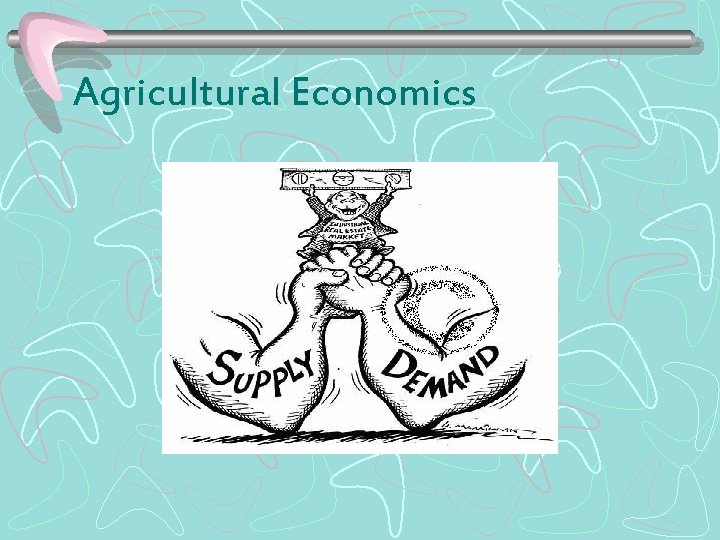
Agricultural Economics • Price in the United States is also effected by the world market • Ex. – The U. S. produces soybeans. Who else produces them? – South America. Do you think they have any impact on our market? – The impact is huge. If it rains overnight there, the prices will change.
Choice and its economic meaning • A problem remains, not only for individuals, but nations as well. It affects nations that utilize both free markets or total government control. • The problem is scarcity • Scarcity – A basic economics condition in which our wants exceed the resources available to satisfy those wants
Choice and its economic meaning • A good or service is scarce when we must give up (or sacrifice) some amount of one thing to get some of another good or service • When we realize that a valued good or service is being sacrificed to gain something else, we become aware of the economic meaning of the word cost
Choice and its economic meaning • These costs are called Opportunity Costs • Opportunity Costs – The value of other opportunities given up in order to produce or consume any good. • What determines worth? • It’s not the physical amount of something we give up, but how we value it. • We value goods and services because of the satisfaction we get from them.
Eggs & T-Bones • Example – Lets say you have many, many eggs, and very little steak. You would place a high value on steak (willing to give quite a few eggs in exchange for one steak) • But if you have no eggs at all and a freezer full of T-Bones, you’d likely give quite a few steaks in exchange for only a few eggs. • The value is strictly by your preference
Example of Opportunity Cost • RJR Nabisco has 3 choices: 1. – Make cookies; earn a $30 mil. profit 2. – Make chips; earn a $25 mil. Profit 3. – Make chips and cookies and earn a $35 million profit. Which of these is the best choice and why? • #3 is the best choice because it is the most economical • The opportunity cost in this example is $30 million • This is because this is the amount that is forgone, since it is the next best choice
Were you paying attention? • What are the 2 characteristics that make agriculture unique? – Cyclical Nature • Physical & Biological Factors – Price Instability • What is scarcity? – A basic economics condition in which our wants exceed the resources available to satisfy those wants • What are Opportunity Costs? – The value of other opportunities given up in order to produce or consume any good.
Were you paying attention? • Can you give me an example of an Opportunity Cost? (Not one we used in class) • What determines worth?