
Agricultural Development Economics Division ESA AGRIBUSINESS PPPs AND
Agricultural Development Economics Division (ESA) AGRIBUSINESS PPPs AND TERRITORIALLY-BOUND INVESTMENT INSTRUMENTS FOR AGROINDUSTRIAL DEVELOPMENT SESSION 3 (Part two) AGRO-BASED CLUSTERS http: //www. fao. org/economic/esa
Agricultural Development Economics Division (ESA) LEARNING OBJECTIVES You will: • Better understand what is an agro-based cluster. • Know about policies and governance mechanisms that can foster success. • Understand challenges and success factors. • Know about other territorial tools. http: //www. fao. org/economic/esa
Agricultural Development Economics Division (ESA) WARMING UP EXERCISE From your experience… • Are you familiar with any type of cluster? • Does your country have or promote this tool specifically in agriculture? • Do you think your country has potential subsectors that would benefit from cluster development initiatives? http: //www. fao. org/economic/esa
Agricultural Development Economics Division (ESA) CONTENT 1. Rationale and characteristics of an agro-based cluster. 2. Implementing successful agro-cluster initiatives: A roadmap. 3. Challenges and other important things to consider. 4. Other territorial tools. http: //www. fao. org/economic/esa

Agricultural Development Economics Division (ESA) 1. RATIONALE AND CHARACTERISTICS OF AN AGRO-BASED CLUSTER http: //www. fao. org/economic/esa
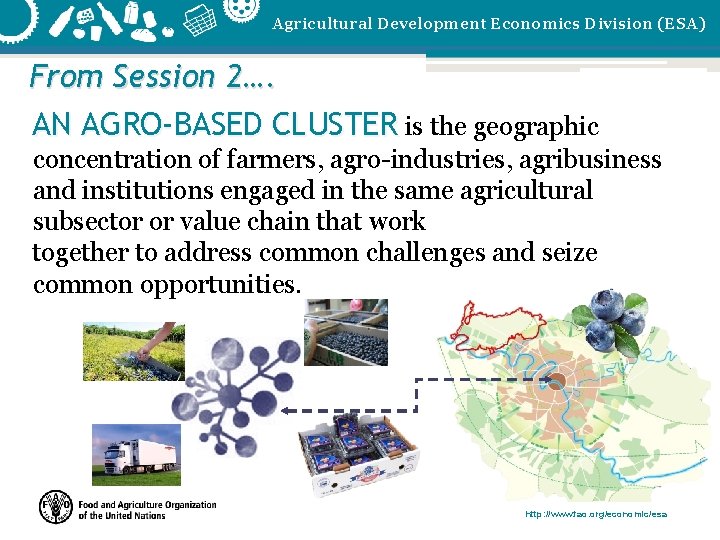
Agricultural Development Economics Division (ESA) From Session 2…. AN AGRO-BASED CLUSTER is the geographic concentration of farmers, agro-industries, agribusiness and institutions engaged in the same agricultural subsector or value chain that work together to address common challenges and seize common opportunities. http: //www. fao. org/economic/esa
Agricultural Development Economics Division (ESA) CLUSTER INITIATIVES • Agroclusters emerge on their own. • BUT their growth and development can be actively promoted by governments, private companies and the global community through: • CLUSTER INITIATIVES identify the binding constraints to competitiveness and implement effective solutions http: //www. fao. org/economic/esa
Agricultural Development Economics Division (ESA) WHY TO PROMOTE CLUSTER INITIATIVES? Ø Comprehensive approach to sustainable and resilient agribusiness value chains; Ø Boost industrialization; Ø Facilitate the spread of innovations; Ø Attract foreign investors; Ø Provide a pathway of coordination among a variety of agricultural actors; Ø Foster inclusive growth and reduction of poverty; Ø Help building social capital and productive public -private dialogue. http: //www. fao. org/economic/esa
Agricultural Development Economics Division (ESA) CHARACTERISTICS OF AGRO-BASED CLUSTERS • They concentrate geographically multiple agents and create inclusive value networks (horizontal, vertical, support. . . ) • Size: Variable (1000 - 15 000 ha), usually associated with a province or region • They are usually called after the name of the production area and product around which they develop: the Lemon Tecumán cluster (Colima, Mexico), the Mossoró melon cluster (Rio Grande do Norte, Brazil). . . http: //www. fao. org/economic/esa
Agricultural Development Economics Division (ESA) THE ACTORS • • Agro-processing firms; Retailers; Farmers and their associations; Input suppliers; Governments; NGOs; Research institutes and universities; • Other facilitating organizations. http: //www. fao. org/economic/esa
Agricultural Development Economics Division (ESA) THE PROMOTERS • Cluster initiatives can be lead by various kinds of players: ▫ Private sector value chain actors and input supplier (especially for high-value products). This model seems more dynamic and market-focused than others; ▫ Governments, prevalent in commodities that are key to the economy and in domestic food staples; ▫ Local governments and local economic development agencies; ▫ Economic development agencies and financial institutions (usually crucial for small-scale producers since they increase productivity and enable entry into a higher value-added global market). http: //www. fao. org/economic/esa
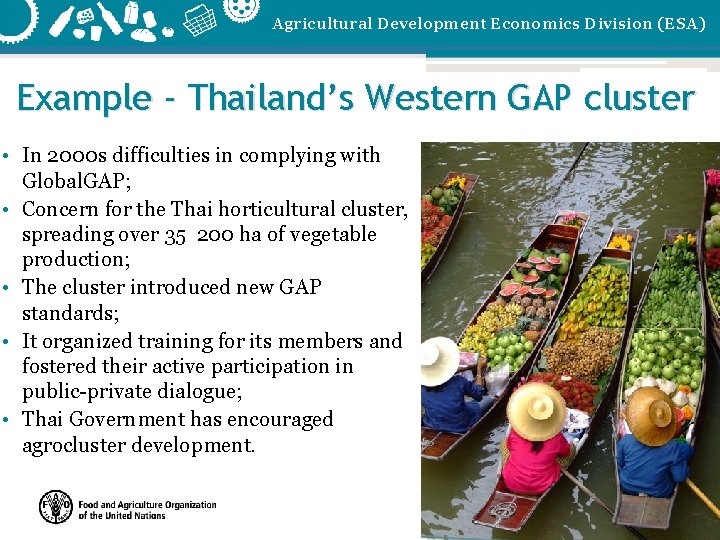
Agricultural Development Economics Division (ESA) Example - Thailand’s Western GAP cluster • In 2000 s difficulties in complying with Global. GAP; • Concern for the Thai horticultural cluster, spreading over 35 200 ha of vegetable production; • The cluster introduced new GAP standards; • It organized training for its members and fostered their active participation in public-private dialogue; • Thai Government has encouraged agrocluster development. http: //www. fao. org/economic/esa
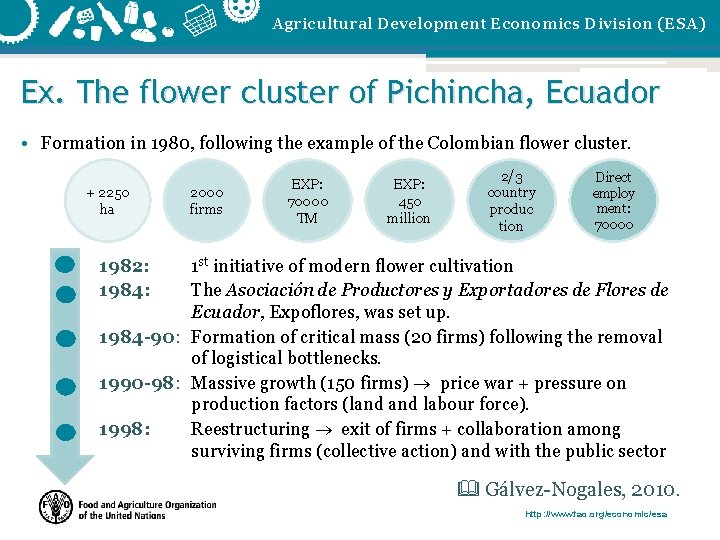
Agricultural Development Economics Division (ESA) Ex. The flower cluster of Pichincha, Ecuador • Formation in 1980, following the example of the Colombian flower cluster. + 2250 ha 2000 firms EXP: 70000 TM EXP: 450 million 2/3 country produc tion Direct employ ment: 70000 1982: 1984: 1 st initiative of modern flower cultivation The Asociación de Productores y Exportadores de Flores de Ecuador, Expoflores, was set up. 1984 -90: Formation of critical mass (20 firms) following the removal of logistical bottlenecks. 1990 -98: Massive growth (150 firms) price war + pressure on production factors (land labour force). 1998: Reestructuring exit of firms + collaboration among surviving firms (collective action) and with the public sector Gálvez-Nogales, 2010. http: //www. fao. org/economic/esa
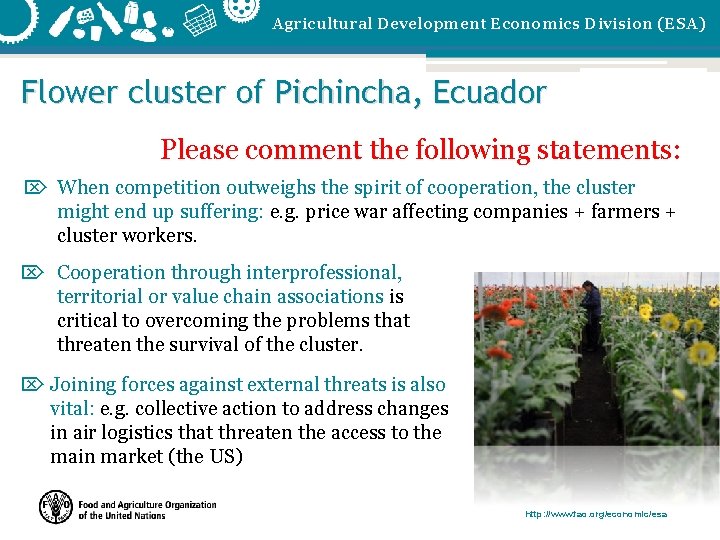
Agricultural Development Economics Division (ESA) Flower cluster of Pichincha, Ecuador Please comment the following statements: Ö When competition outweighs the spirit of cooperation, the cluster might end up suffering: e. g. price war affecting companies + farmers + cluster workers. Ö Cooperation through interprofessional, territorial or value chain associations is critical to overcoming the problems that threaten the survival of the cluster. Ö Joining forces against external threats is also vital: e. g. collective action to address changes in air logistics that threaten the access to the main market (the US) http: //www. fao. org/economic/esa
Agricultural Development Economics Division (ESA) 2. IMPLEMENTING SUCCESSFUL AGRO-CLUSTER INITIATIVES: A ROADMAP http: //www. fao. org/economic/esa
Agricultural Development Economics Division (ESA) STEPS FOR CLUSTER DEVELOPMENT • Initial phase: Observe and map the existing cluster network; Convene the cluster and establish the right psychological contract; Conduct relevant studies. • Implementation phase: Identify strategic initiatives; Finance the agrocluster initiatives and mobilize investment; Monitor and evaluate results; Ensure sustainability. http: //www. fao. org/economic/esa
Agricultural Development Economics Division (ESA) 3. CHALLENGES AND OTHER IMPORTANT THINGS TO CONSIDER http: //www. fao. org/economic/esa
Agricultural Development Economics Division (ESA) CHALLENGES AND SOLUTIONS • Weak structure and linkages of firms and clusters in developing countries. Solution: Continuous training and strengthening at all levels of the cluster. • Advantage of foreign competitors. Solution: Supportive public policies, investments and incentives. • Weak and corrrupted public institutions. Institutions (particularly governmental institutions) should not dominate clusters; a decentralized approach is to be preferred. http: //www. fao. org/economic/esa
Agricultural Development Economics Division (ESA) Last things to consider… • It is difficult to “create” clusters. • Effective public-private dialogue happens when an industry speaks as one voice. • Agrocluster development initiatives in basic staples seem more challenging. http: //www. fao. org/economic/esa
Agricultural Development Economics Division (ESA) 4. OTHER TERRITORIAL TOOLS http: //www. fao. org/economic/esa
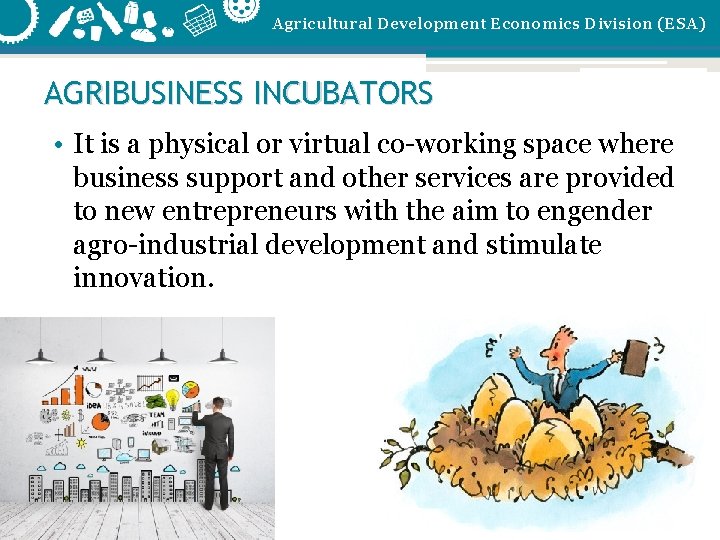
Agricultural Development Economics Division (ESA) AGRIBUSINESS INCUBATORS • It is a physical or virtual co-working space where business support and other services are provided to new entrepreneurs with the aim to engender agro-industrial development and stimulate innovation. http: //www. fao. org/economic/esa
Agricultural Development Economics Division (ESA) CHARACTERISTICS OF AGBIZ INCUBATORS • An agbiz incubator encourages and supports the development of new agribusiness and agro-industrial entrepreneurs with growth potential and competitiveness. • It promotes business development and innovation. • It offers shared space & services to tenant companies: mentoring and support to develop business ideas, market access, technology, financial services + support for business networking. • It often has links to universities & research centres • Surface: between 500 and 2 000 sqm (2 000 sqm enough for 20 entrepreneurs). • A type of third-generation incubator called business accelerator has rapidly proliferated in recent years. http: //www. fao. org/economic/esa
Agricultural Development Economics Division (ESA) http: //www. fao. org/economic/esa
- Slides: 23