
Agri GES Research projects on Precision Livestock Farming
- Slides: 1
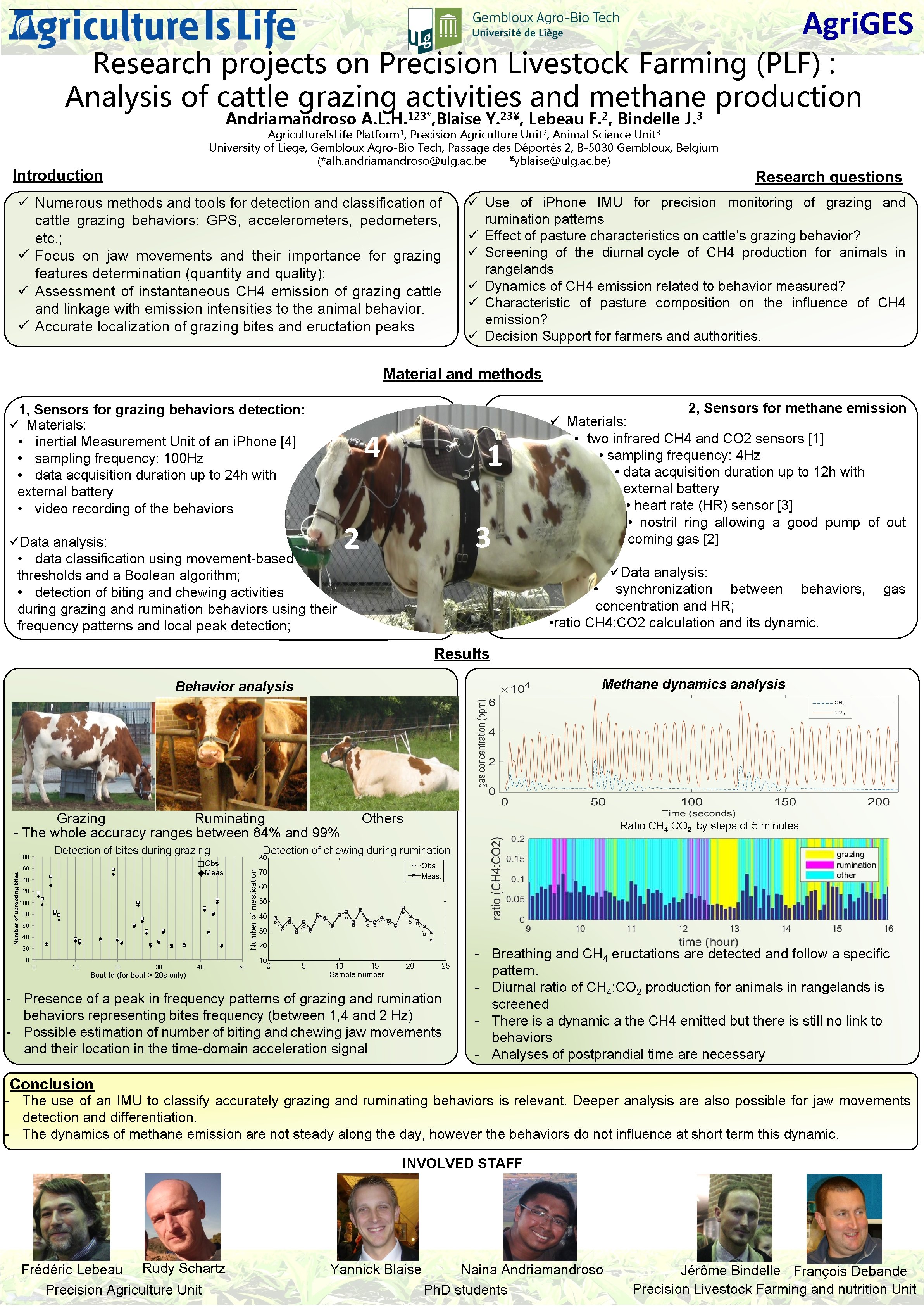
Agri. GES Research projects on Precision Livestock Farming (PLF) : Analysis of cattle grazing activities and methane production Andriamandroso A. L. H. 123*, Blaise Y. 23¥, Lebeau F. 2, Bindelle J. 3 Agriculture. Is. Life Platform 1, Precision Agriculture Unit 2, Animal Science Unit 3 University of Liege, Gembloux Agro-Bio Tech, Passage des Déportés 2, B-5030 Gembloux, Belgium ¥yblaise@ulg. ac. be) (*alh. andriamandroso@ulg. ac. be Introduction Research questions ü Numerous methods and tools for detection and classification of cattle grazing behaviors: GPS, accelerometers, pedometers, etc. ; ü Focus on jaw movements and their importance for grazing features determination (quantity and quality); ü Assessment of instantaneous CH 4 emission of grazing cattle and linkage with emission intensities to the animal behavior. ü Accurate localization of grazing bites and eructation peaks ü Use of i. Phone IMU for precision monitoring of grazing and rumination patterns ü Effect of pasture characteristics on cattle’s grazing behavior? ü Screening of the diurnal cycle of CH 4 production for animals in rangelands ü Dynamics of CH 4 emission related to behavior measured? ü Characteristic of pasture composition on the influence of CH 4 emission? ü Decision Support for farmers and authorities. Material and methods 2, Sensors for methane emission 1, Sensors for grazing behaviors detection: ü Materials: • inertial Measurement Unit of an i. Phone [4] • sampling frequency: 100 Hz • data acquisition duration up to 24 h with external battery • video recording of the behaviors 4 üData analysis: • data classification using movement-based thresholds and a Boolean algorithm; • detection of biting and chewing activities during grazing and rumination behaviors using their frequency patterns and local peak detection; 1 3 2 ü Materials: • two infrared CH 4 and CO 2 sensors [1] • sampling frequency: 4 Hz • data acquisition duration up to 12 h with external battery • heart rate (HR) sensor [3] • nostril ring allowing a good pump of out coming gas [2] üData analysis: • synchronization between behaviors, concentration and HR; • ratio CH 4: CO 2 calculation and its dynamic. gas Results Methane dynamics analysis Behavior analysis Grazing Ruminating - The whole accuracy ranges between 84% and 99% Detection of bites during grazing 180 Ratio CH 4: CO 2 by steps of 5 minutes Detection of chewing during rumination Obs Meas 160 Number of uprooting bites Others 140 120 100 80 60 40 20 0 0 10 20 30 40 50 Bout Id (for bout > 20 s only) - Presence of a peak in frequency patterns of grazing and rumination behaviors representing bites frequency (between 1, 4 and 2 Hz) - Possible estimation of number of biting and chewing jaw movements and their location in the time-domain acceleration signal - Breathing and CH 4 eructations are detected and follow a specific pattern. - Diurnal ratio of CH 4: CO 2 production for animals in rangelands is screened - There is a dynamic a the CH 4 emitted but there is still no link to behaviors - Analyses of postprandial time are necessary Conclusion - The use of an IMU to classify accurately grazing and ruminating behaviors is relevant. Deeper analysis are also possible for jaw movements detection and differentiation. - The dynamics of methane emission are not steady along the day, however the behaviors do not influence at short term this dynamic. INVOLVED STAFF Frédéric Lebeau Rudy Schartz Precision Agriculture Unit Yannick Blaise Naina Andriamandroso Ph. D students Jérôme Bindelle François Debande Precision Livestock Farming and nutrition Unit