
Agreement All processes start with an initial value
- Slides: 16
Agreement All processes start with an initial value from some set V • Every process has to decide on a value in V such that: – Agreement: no two processes decide on different values – Validity: if all processes start with the same value v, then no process decides on a value different from v – Termination: all non-faulty processes decide within finite time 1
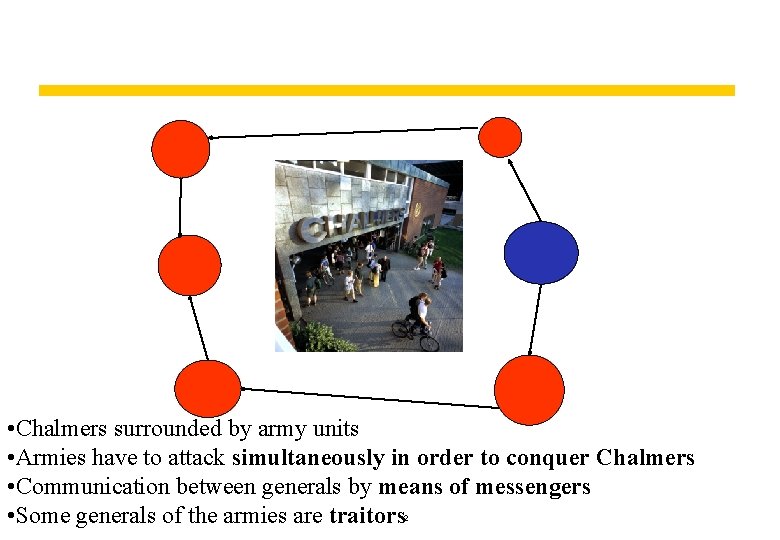
• Chalmers surrounded by army units • Armies have to attack simultaneously in order to conquer Chalmers • Communication between generals by means of messengers • Some generals of the armies are traitors 2
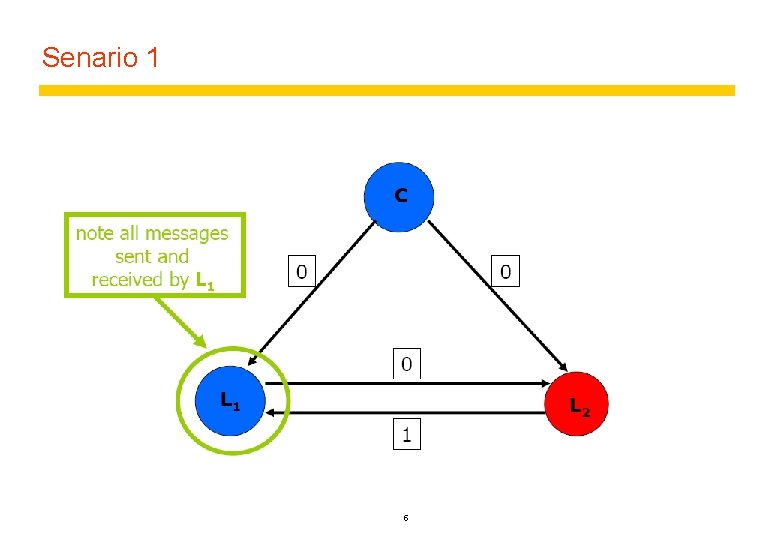
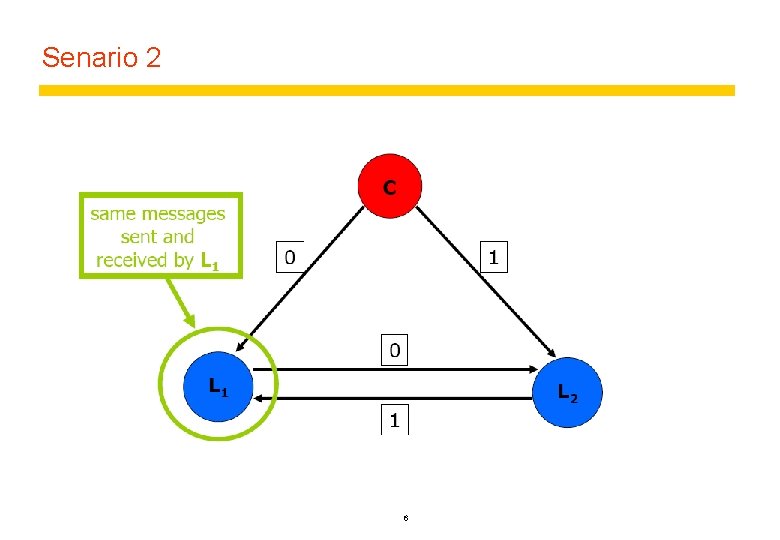
The Byzantine agreement problem One process(the source or commander) starts with a binary value • Each of the remaining processes (the lieutenants) has to decide on a binary value such that: • Agreement: all non-faulty processes agree on the same value • Validity: if the source is non-faulty, then all non-faulty processes agree on the initial value of the source • Termination: all processes decide within finite time • So if the source is faulty, the non-faulty processes can agree on any value • It is irrelevant on what value a faulty process decides 3
Conditions for a solution for Byzantine faults • Number of processes: n • Maximum number of possibly failing processes: f • Necessary and sufficient condition for a solution to Byzantine agreement: f<n/3 • Minimal number of rounds in a deterministic solution: f+1 • There exist randomized solutions with a lower expected number of rounds 4
Senario 1 5
Senario 2 6
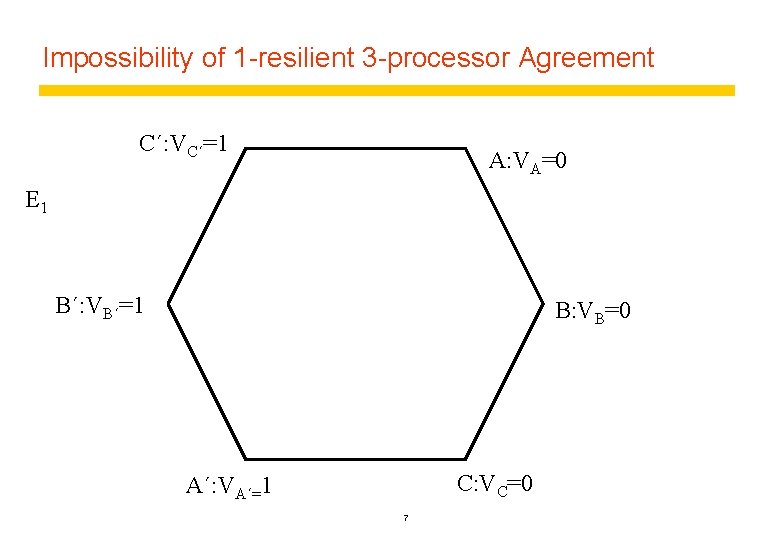
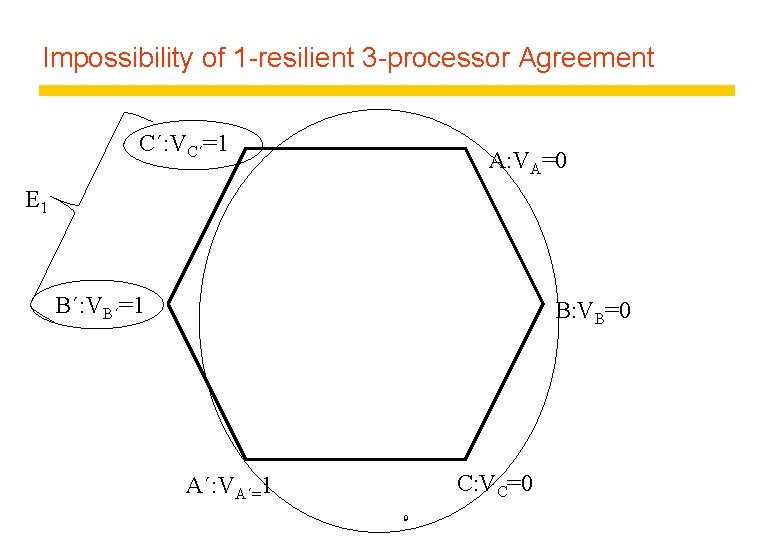
Impossibility of 1 -resilient 3 -processor Agreement C´: VC´=1 A: VA=0 E 1 B´: VB´=1 B: VB=0 C: VC=0 A´: VA´=1 7
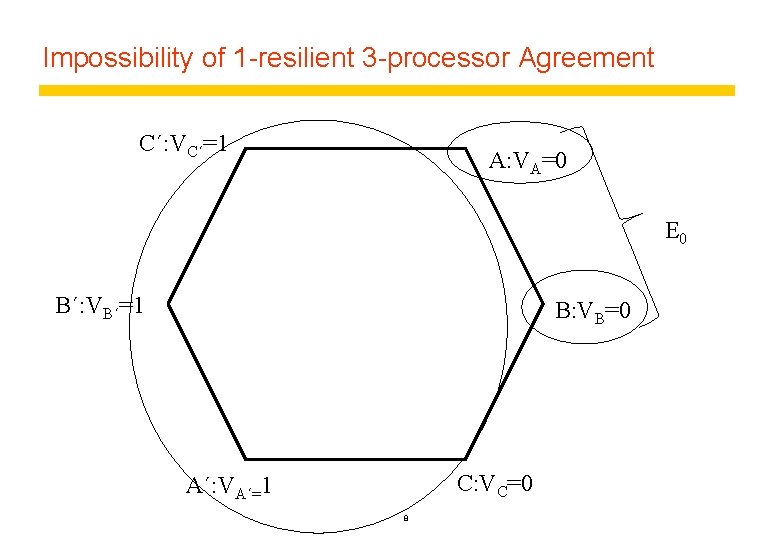
Impossibility of 1 -resilient 3 -processor Agreement C´: VC´=1 A: VA=0 E 0 B´: VB´=1 B: VB=0 C: VC=0 A´: VA´=1 8
Impossibility of 1 -resilient 3 -processor Agreement C´: VC´=1 A: VA=0 E 1 B´: VB´=1 B: VB=0 C: VC=0 A´: VA´=1 9
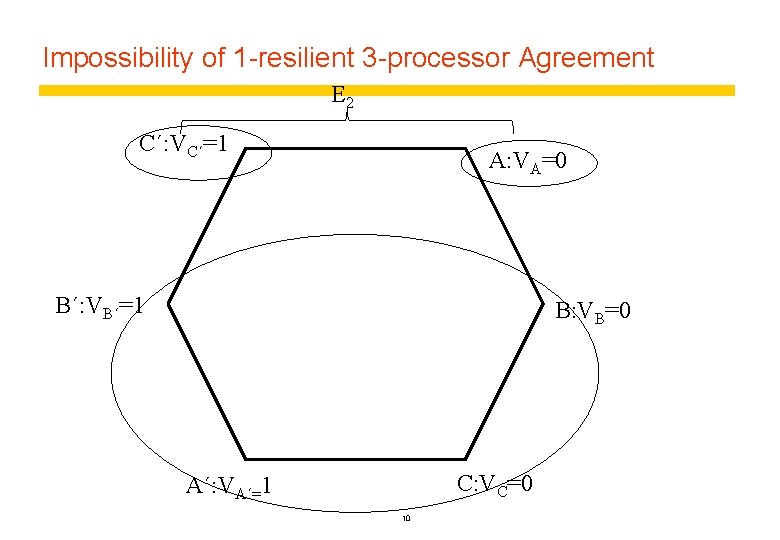
Impossibility of 1 -resilient 3 -processor Agreement E 2 C´: VC´=1 A: VA=0 B´: VB´=1 B: VB=0 C: VC=0 A´: VA´=1 10
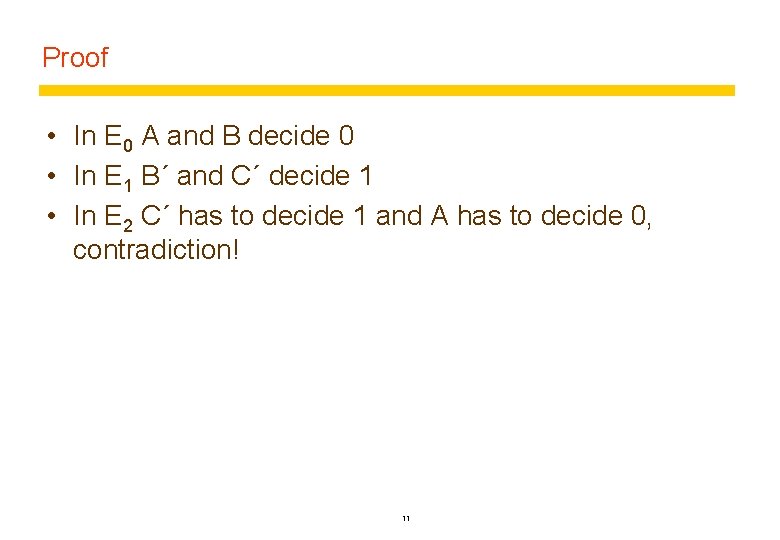
Proof • In E 0 A and B decide 0 • In E 1 B´ and C´ decide 1 • In E 2 C´ has to decide 1 and A has to decide 0, contradiction! 11
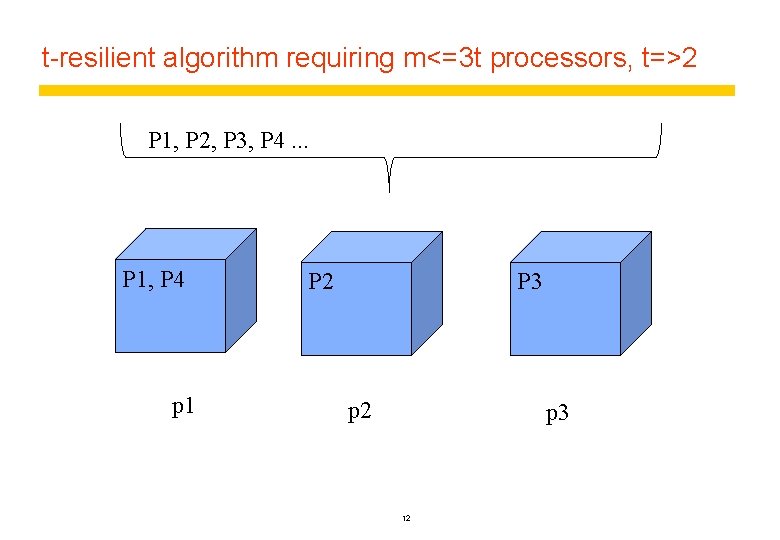
t-resilient algorithm requiring m<=3 t processors, t=>2 P 1, P 2, P 3, P 4. . . P 1, P 4 p 1 P 2 P 3 p 2 p 3 12
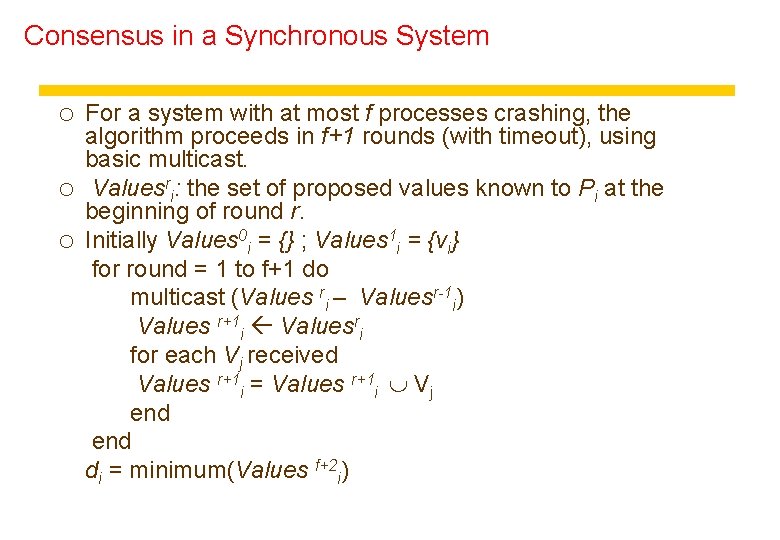
Consensus in a Synchronous System o For a system with at most f processes crashing, the o o algorithm proceeds in f+1 rounds (with timeout), using basic multicast. Valuesri: the set of proposed values known to Pi at the beginning of round r. Initially Values 0 i = {} ; Values 1 i = {vi} for round = 1 to f+1 do multicast (Values ri – Valuesr-1 i) Values r+1 i Valuesri for each Vj received Values r+1 i = Values r+1 i Vj end di = minimum(Values f+2 i)
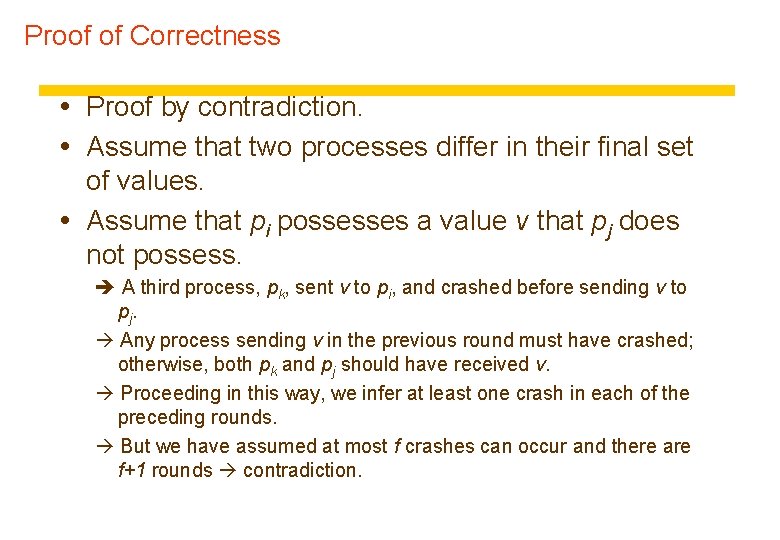
Proof of Correctness Proof by contradiction. Assume that two processes differ in their final set of values. Assume that pi possesses a value v that pj does not possess. A third process, pk, sent v to pi, and crashed before sending v to pj. Any process sending v in the previous round must have crashed; otherwise, both pk and pj should have received v. Proceeding in this way, we infer at least one crash in each of the preceding rounds. But we have assumed at most f crashes can occur and there are f+1 rounds contradiction.
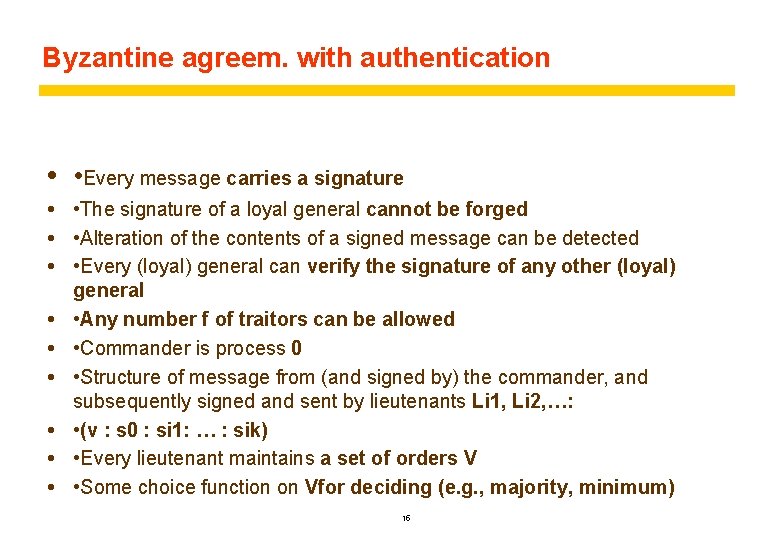
Byzantine agreem. with authentication • Every message carries a signature • The signature of a loyal general cannot be forged • Alteration of the contents of a signed message can be detected • Every (loyal) general can verify the signature of any other (loyal) general • Any number f of traitors can be allowed • Commander is process 0 • Structure of message from (and signed by) the commander, and subsequently signed and sent by lieutenants Li 1, Li 2, …: • (v : s 0 : si 1: … : sik) • Every lieutenant maintains a set of orders V • Some choice function on Vfor deciding (e. g. , majority, minimum) 15
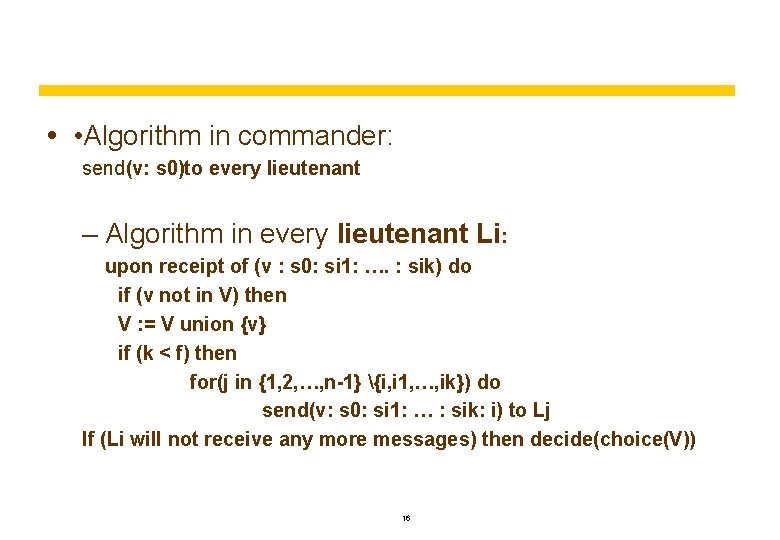
• Algorithm in commander: send(v: s 0)to every lieutenant – Algorithm in every lieutenant Li: upon receipt of (v : s 0: si 1: …. : sik) do if (v not in V) then V : = V union {v} if (k < f) then for(j in {1, 2, …, n-1} {i, i 1, …, ik}) do send(v: s 0: si 1: … : sik: i) to Lj If (Li will not receive any more messages) then decide(choice(V)) 16