
Agreeableness and expressing affection in romantic relationships Sherman
Agreeableness and expressing affection in romantic relationships Sherman S. M. Kwok, Joanne V. Wood, John G. Holmes 1
Agreeable people have good relationships (e. g. , Heller et al. , 2004), why? How do agreeable people translate communal motivations into behaviors that foster relational harmony? 2
Agreeableness • Dispositions manifested as differences in being likeable, pleasant, and harmonious in relationships (Graziano & Tobin, 2013) • Agreeable people are more satisfied in romantic relationships (Heller et al. , 2004). • Person X Situation perspective • Constructive in conflicts (Jensen-Campbell & Graziano, 2001) • Cooperative in competitions (Graziano et al. , 1997) • Prosocially and communally motivated (Graziano & Eisenberg, 1997; Wiggins, 1991) 3
Agreeableness • Why do agreeable people have satisfying relationships? • How do such prosocial and communal motivations translate into day-to-day behaviors that foster harmony in romantic relationships? • Expressing affection may be a crucial means through which agreeable people translate communal motivations into behaviors. 4
What are expressions of affection? • Behaviors through which people convey love, caring and positive regard to another person (Floyd, 2015). • Positively associated with relationship satisfaction (Floyd et al. , 2005; Horan & Booth-Butterfield, 2010). • Expressing affection should foster intimacy and closeness in relationships. 5
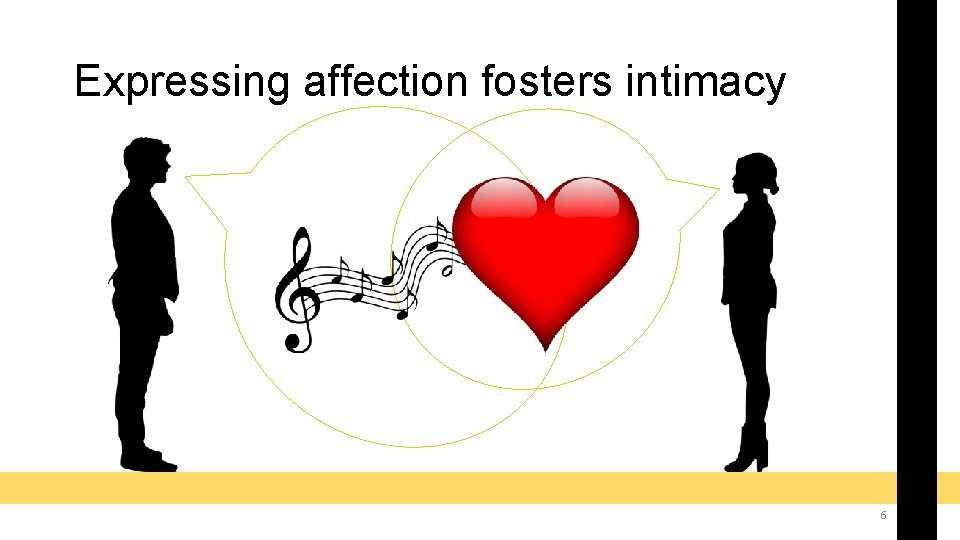
Expressing affection fosters intimacy 6
Expressing affection and agreeableness • Agreeableness should be associated with expressions of affection in two ways: • Frequency of expressing affection • Characteristics of expressions 7
Expressing affection and agreeableness • We predict that • agreeableness is positively associated with frequency of expressing affection. • Frequency should mediate agreeableness and satisfaction. 8
Expressing affection and agreeableness • We predict that agreeable people express affection in especially responsive ways • Being responsive is key to building intimacy (Reis et al. , 2004) • Responsiveness requires willingness and accurate understanding (Feeney & Collins, 2001) • Agreeable people are: • communally motivated (e. g. , Cortes et al. , 2014) • High perspective-takers (Graziano et al. , 2007) 9
Overview • Study 1 (and 1 a) • Do agreeable people express affection more frequently and more responsively than disagreeable people? • Does frequency of expressions mediate agreeableness and satisfaction? • Study 2 • Fix issues with Study 1 • Study 3 • Are agreeable people’s expressions especially responsive? 10
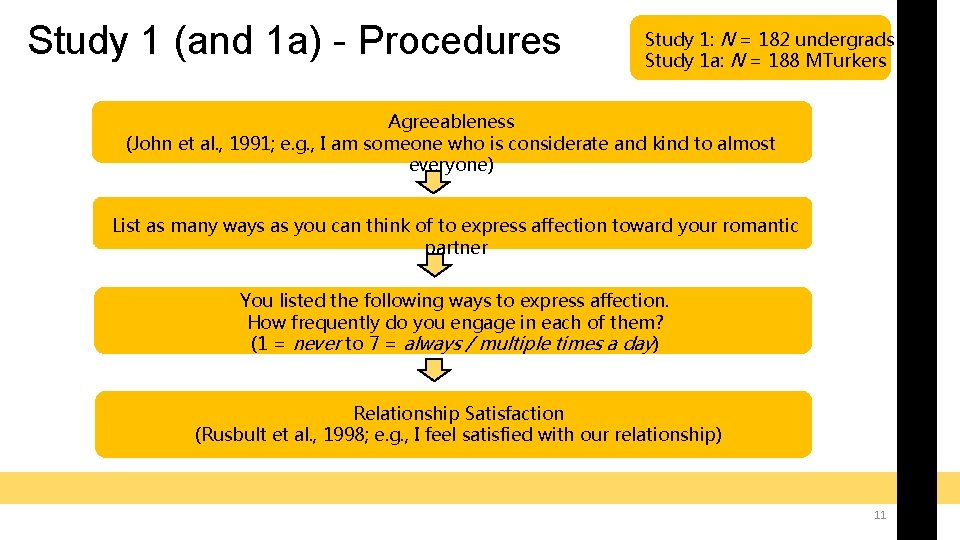
Study 1 (and 1 a) - Procedures Study 1: N = 182 undergrads Study 1 a: N = 188 MTurkers Agreeableness (John et al. , 1991; e. g. , I am someone who is considerate and kind to almost everyone) List as many ways as you can think of to express affection toward your romantic partner You listed the following ways to express affection. How frequently do you engage in each of them? (1 = never to 7 = always / multiple times a day) Relationship Satisfaction (Rusbult et al. , 1998; e. g. , I feel satisfied with our relationship) 11
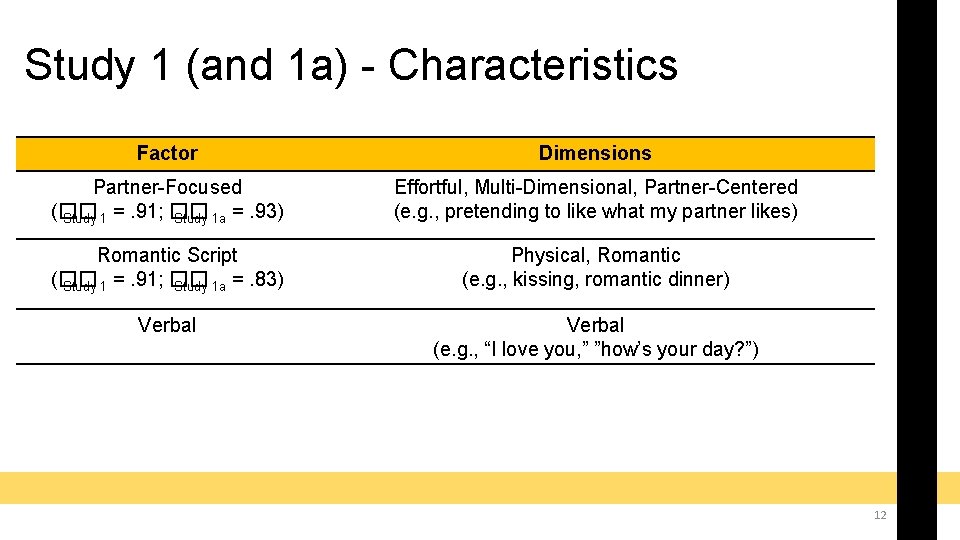
Study 1 (and 1 a) - Characteristics Factor Dimensions Partner-Focused (�� Study 1 =. 91; �� Study 1 a =. 93) Effortful, Multi-Dimensional, Partner-Centered (e. g. , pretending to like what my partner likes) Romantic Script (�� Study 1 =. 91; �� Study 1 a =. 83) Physical, Romantic (e. g. , kissing, romantic dinner) Verbal (e. g. , “I love you, ” ”how’s your day? ”) 12
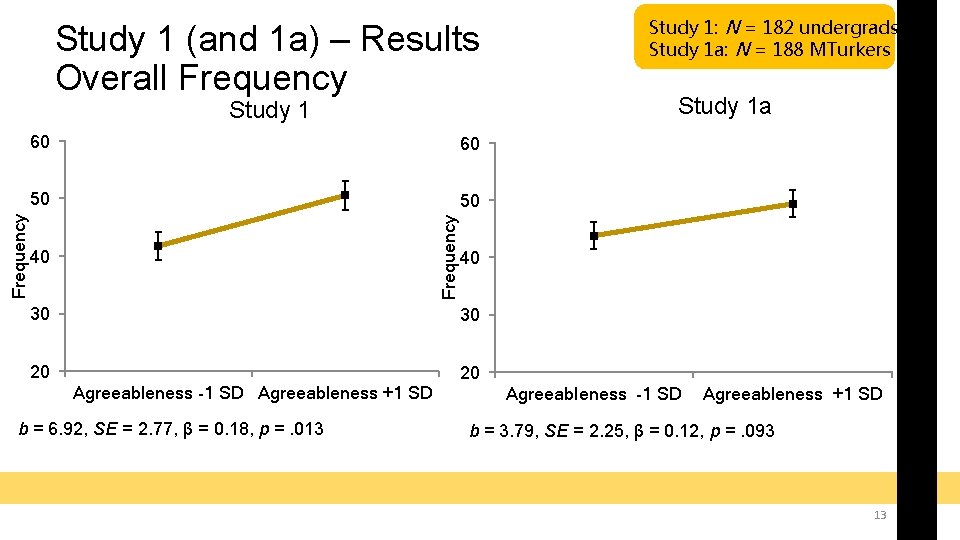
Study 1 (and 1 a) – Results Overall Frequency 60 60 50 50 Frequency Study 1 40 30 20 20 b = 6. 92, SE = 2. 77, β = 0. 18, p =. 013 Study 1 a 40 30 Agreeableness -1 SD Agreeableness +1 SD Study 1: N = 182 undergrads Study 1 a: N = 188 MTurkers Agreeableness -1 SD Agreeableness +1 SD b = 3. 79, SE = 2. 25, β = 0. 12, p =. 093 13
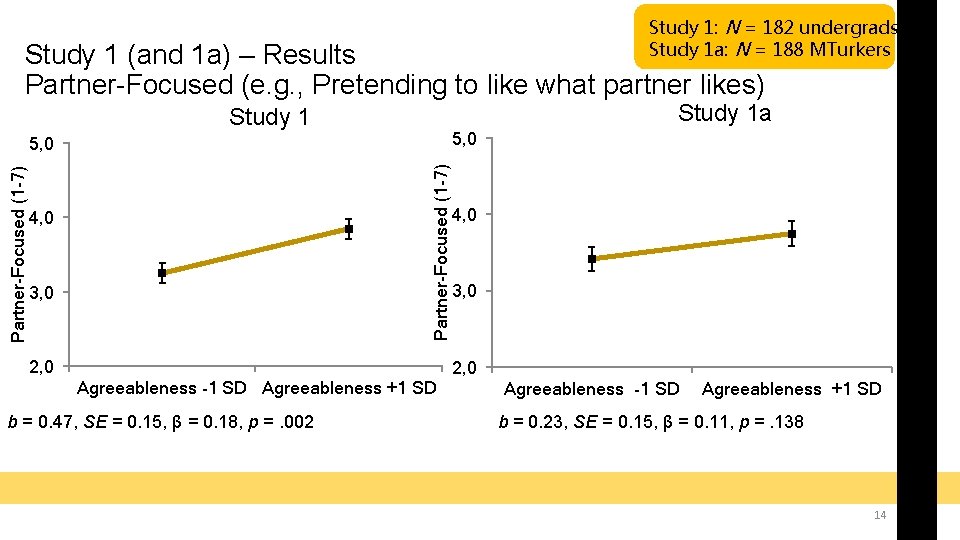
Study 1: N = 182 undergrads Study 1 a: N = 188 MTurkers Study 1 (and 1 a) – Results Partner-Focused (e. g. , Pretending to like what partner likes) Study 1 a Study 1 5, 0 Partner-Focused (1 -7) 5, 0 4, 0 3, 0 2, 0 Agreeableness -1 SD Agreeableness +1 SD b = 0. 47, SE = 0. 15, β = 0. 18, p =. 002 Agreeableness -1 SD Agreeableness +1 SD b = 0. 23, SE = 0. 15, β = 0. 11, p =. 138 14
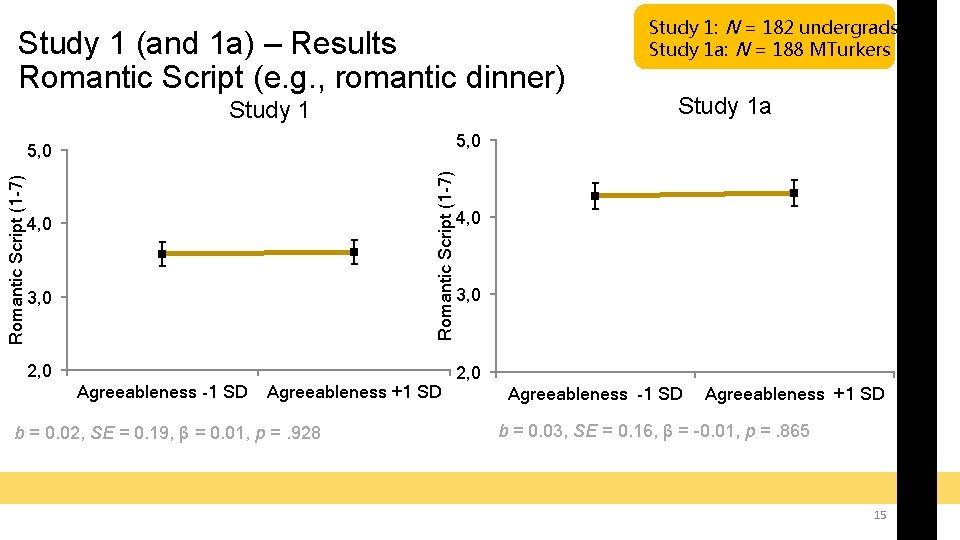
Study 1 (and 1 a) – Results Romantic Script (e. g. , romantic dinner) Study 1 a 5, 0 Romantic Script (1 -7) Study 1: N = 182 undergrads Study 1 a: N = 188 MTurkers 4, 0 3, 0 2, 0 Agreeableness -1 SD Agreeableness +1 SD b = 0. 02, SE = 0. 19, β = 0. 01, p =. 928 4, 0 3, 0 2, 0 Agreeableness -1 SD Agreeableness +1 SD b = 0. 03, SE = 0. 16, β = -0. 01, p =. 865 15
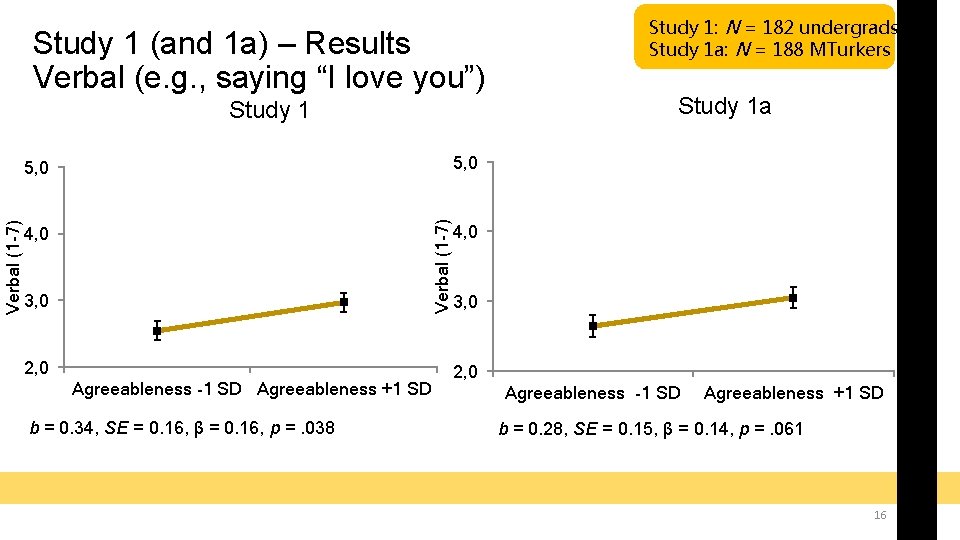
Study 1 (and 1 a) – Results Verbal (e. g. , saying “I love you”) Study 1 a 5, 0 Verbal (1 -7) Study 1: N = 182 undergrads Study 1 a: N = 188 MTurkers 4, 0 3, 0 2, 0 Agreeableness -1 SD Agreeableness +1 SD b = 0. 34, SE = 0. 16, β = 0. 16, p =. 038 4, 0 3, 0 2, 0 Agreeableness -1 SD Agreeableness +1 SD b = 0. 28, SE = 0. 15, β = 0. 14, p =. 061 16
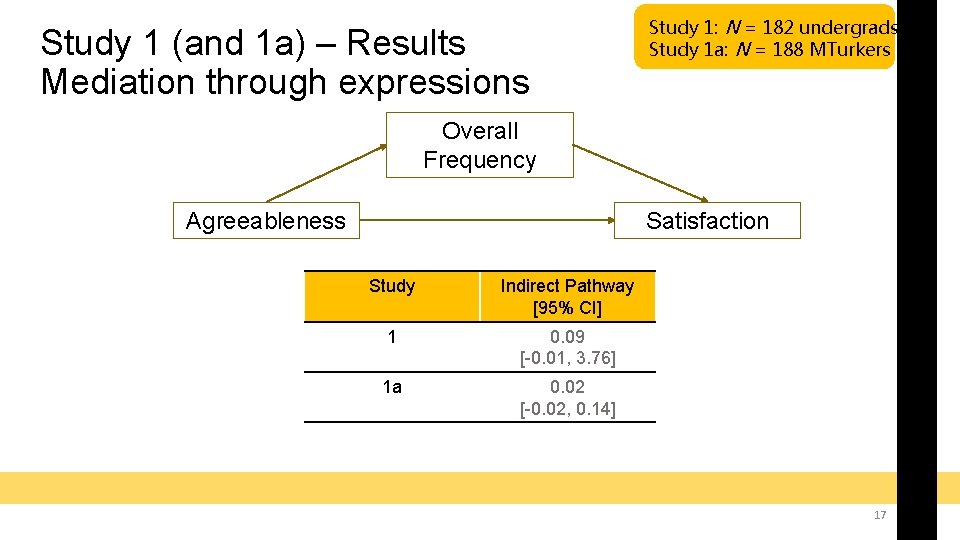
Study 1 (and 1 a) – Results Mediation through expressions Study 1: N = 182 undergrads Study 1 a: N = 188 MTurkers Overall Frequency Satisfaction Agreeableness Study Indirect Pathway [95% CI] 1 0. 09 [-0. 01, 3. 76] 1 a 0. 02 [-0. 02, 0. 14] 17
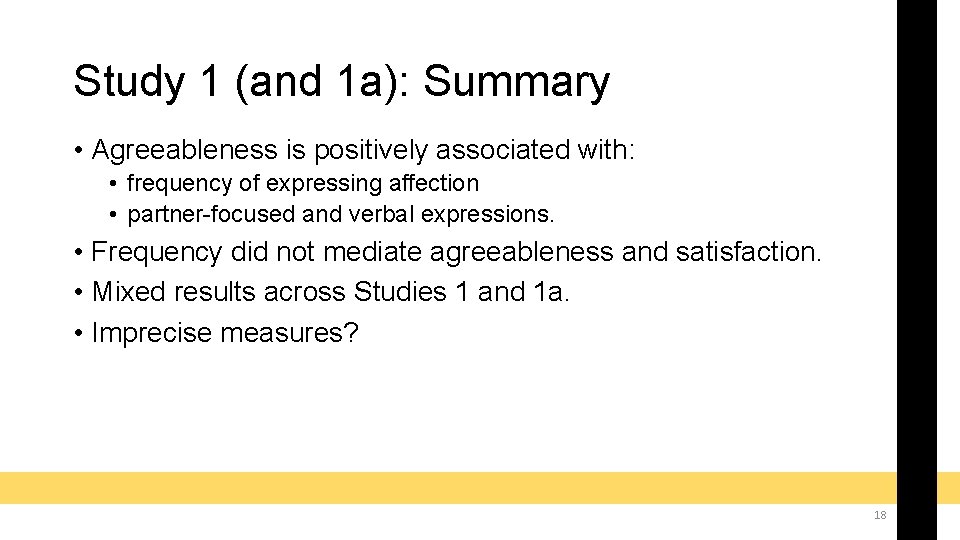
Study 1 (and 1 a): Summary • Agreeableness is positively associated with: • frequency of expressing affection • partner-focused and verbal expressions. • Frequency did not mediate agreeableness and satisfaction. • Mixed results across Studies 1 and 1 a. • Imprecise measures? 18
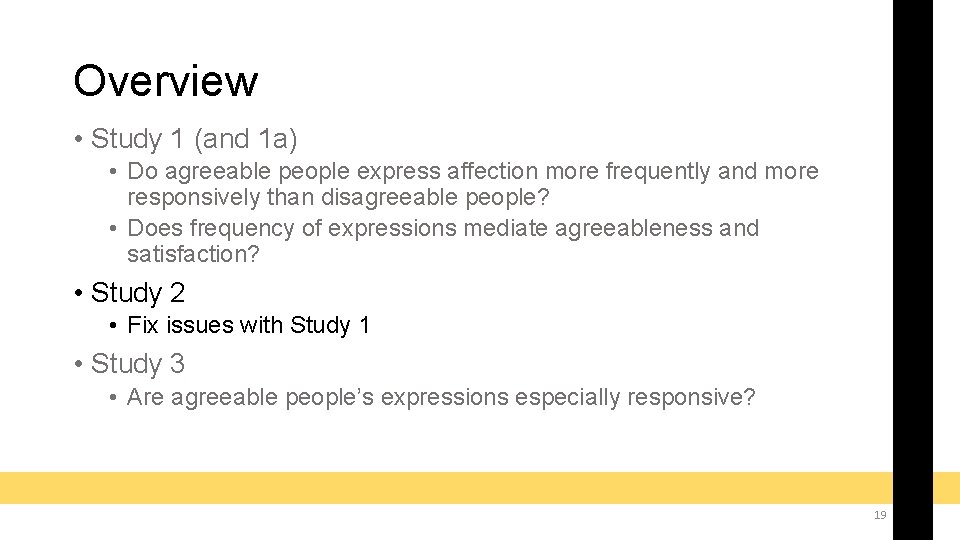
Overview • Study 1 (and 1 a) • Do agreeable people express affection more frequently and more responsively than disagreeable people? • Does frequency of expressions mediate agreeableness and satisfaction? • Study 2 • Fix issues with Study 1 • Study 3 • Are agreeable people’s expressions especially responsive? 19
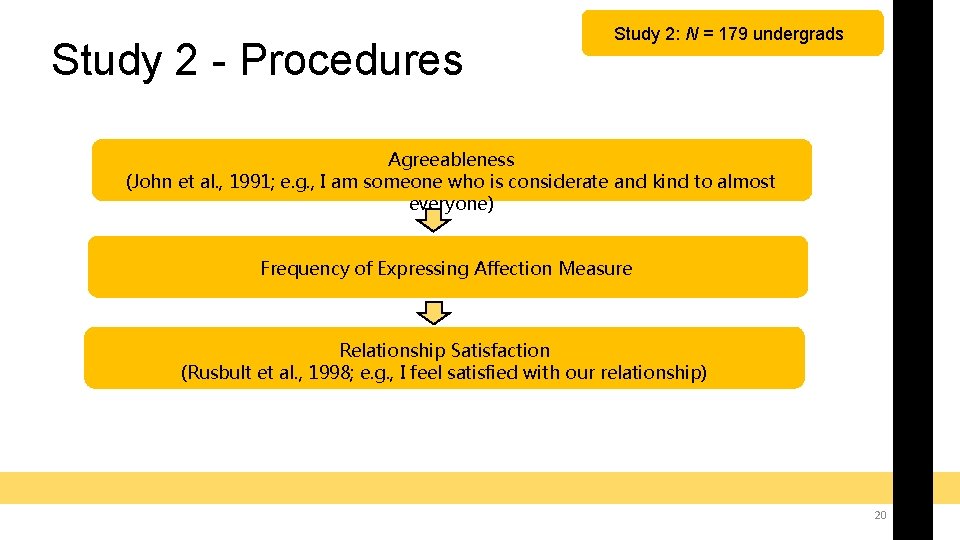
Study 2 - Procedures Study 2: N = 179 undergrads Agreeableness (John et al. , 1991; e. g. , I am someone who is considerate and kind to almost everyone) Frequency of Expressing Affection Measure Relationship Satisfaction (Rusbult et al. , 1998; e. g. , I feel satisfied with our relationship) 20
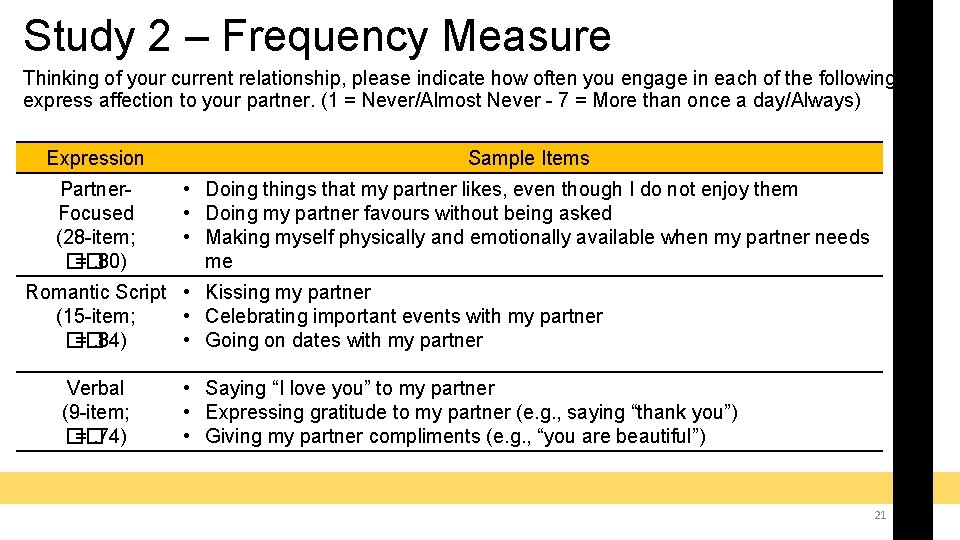
Study 2 – Frequency Measure Thinking of your current relationship, please indicate how often you engage in each of the following to express affection to your partner. (1 = Never/Almost Never - 7 = More than once a day/Always) Expression Sample Items Partner. Focused (28 -item; �� =. 80) • Doing things that my partner likes, even though I do not enjoy them • Doing my partner favours without being asked • Making myself physically and emotionally available when my partner needs me Romantic Script • Kissing my partner (15 -item; • Celebrating important events with my partner �� =. 84) • Going on dates with my partner Verbal (9 -item; �� =. 74) • Saying “I love you” to my partner • Expressing gratitude to my partner (e. g. , saying “thank you”) • Giving my partner compliments (e. g. , “you are beautiful”) 21
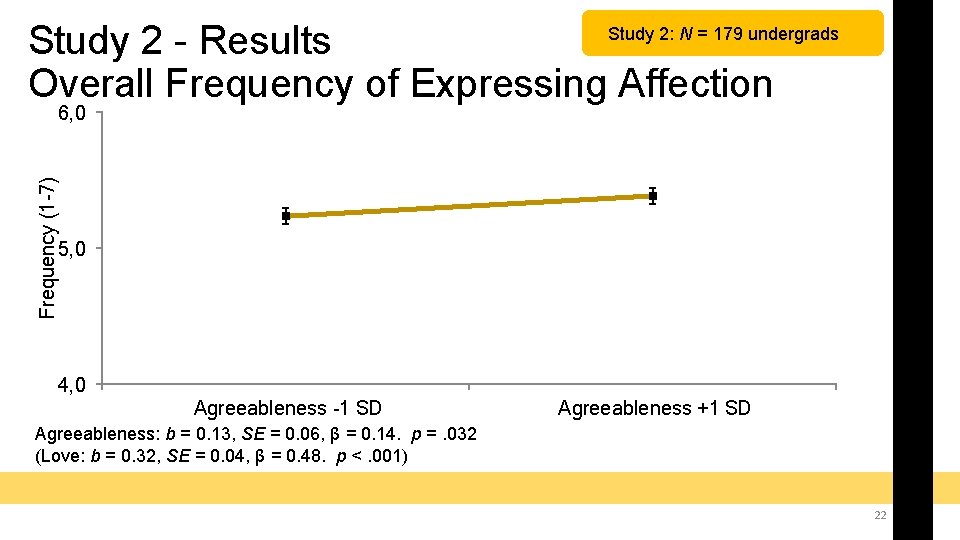
Study 2 - Results Overall Frequency of Expressing Affection Study 2: N = 179 undergrads Frequency (1 -7) 6, 0 5, 0 4, 0 Agreeableness -1 SD Agreeableness +1 SD Agreeableness: b = 0. 13, SE = 0. 06, β = 0. 14. p =. 032 (Love: b = 0. 32, SE = 0. 04, β = 0. 48. p <. 001) 22
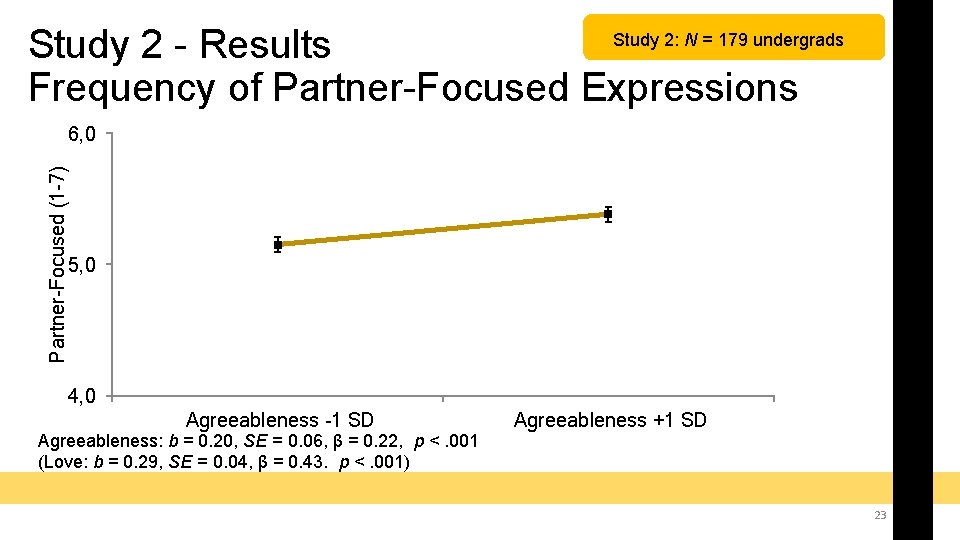
Study 2: N = 179 undergrads Study 2 - Results Frequency of Partner-Focused Expressions Partner-Focused (1 -7) 6, 0 5, 0 4, 0 Agreeableness -1 SD Agreeableness: b = 0. 20, SE = 0. 06, β = 0. 22, p <. 001 (Love: b = 0. 29, SE = 0. 04, β = 0. 43. p <. 001) Agreeableness +1 SD 23
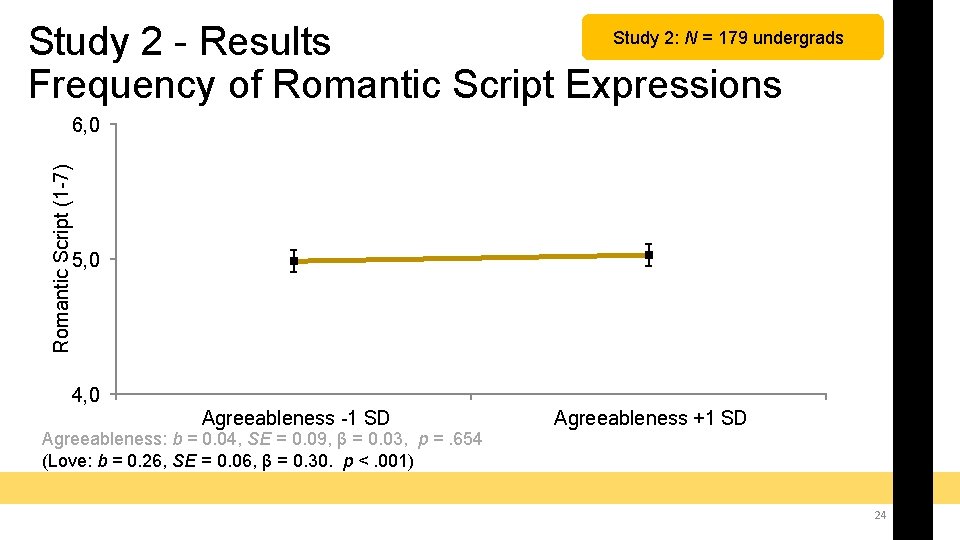
Study 2: N = 179 undergrads Study 2 - Results Frequency of Romantic Script Expressions Romantic Script (1 -7) 6, 0 5, 0 4, 0 Agreeableness -1 SD Agreeableness: b = 0. 04, SE = 0. 09, β = 0. 03, p =. 654 (Love: b = 0. 26, SE = 0. 06, β = 0. 30. p <. 001) Agreeableness +1 SD 24
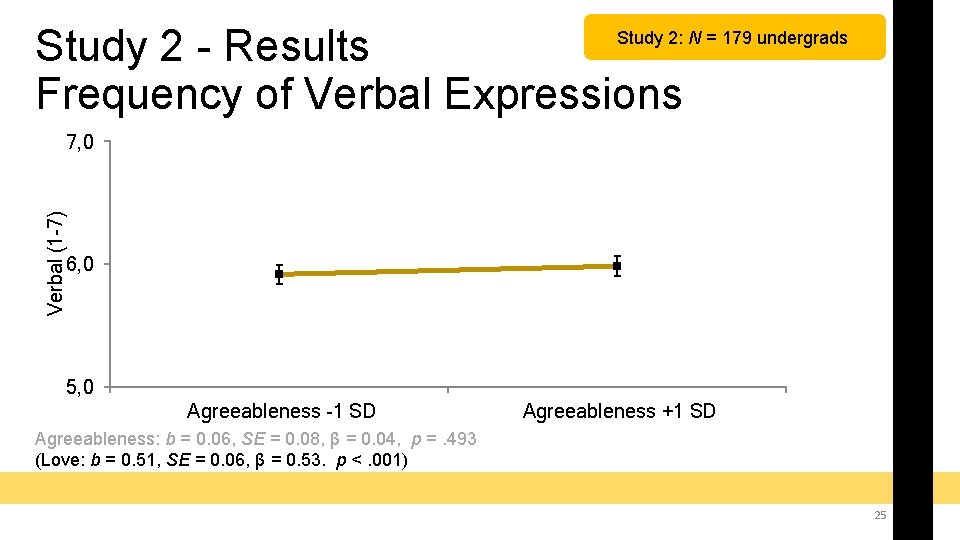
Study 2 - Results Frequency of Verbal Expressions Study 2: N = 179 undergrads Verbal (1 -7) 7, 0 6, 0 5, 0 Agreeableness -1 SD Agreeableness +1 SD Agreeableness: b = 0. 06, SE = 0. 08, β = 0. 04, p =. 493 (Love: b = 0. 51, SE = 0. 06, β = 0. 53. p <. 001) 25
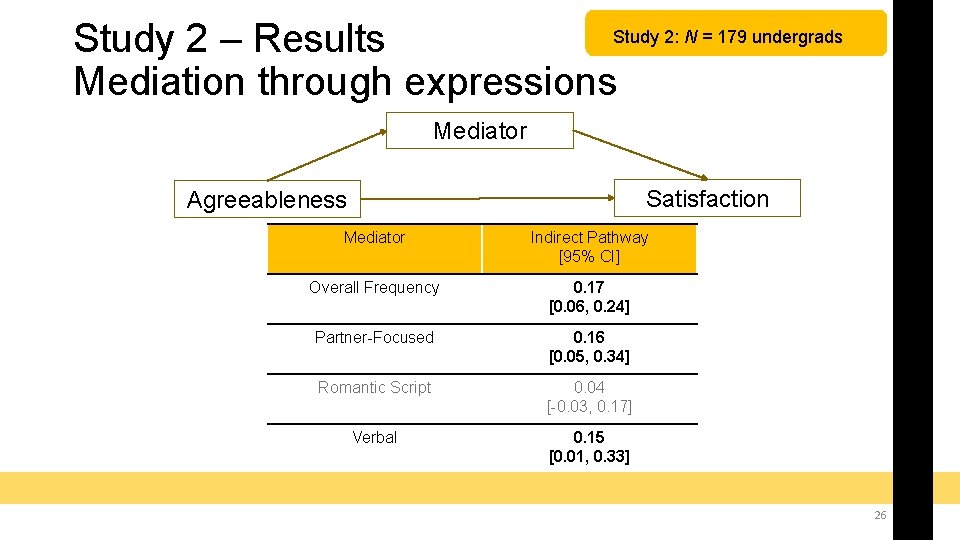
Study 2: N = 179 undergrads Study 2 – Results Mediation through expressions Mediator Satisfaction Agreeableness Mediator Indirect Pathway [95% CI] Overall Frequency 0. 17 [0. 06, 0. 24] Partner-Focused 0. 16 [0. 05, 0. 34] Romantic Script 0. 04 [-0. 03, 0. 17] Verbal 0. 15 [0. 01, 0. 33] 26
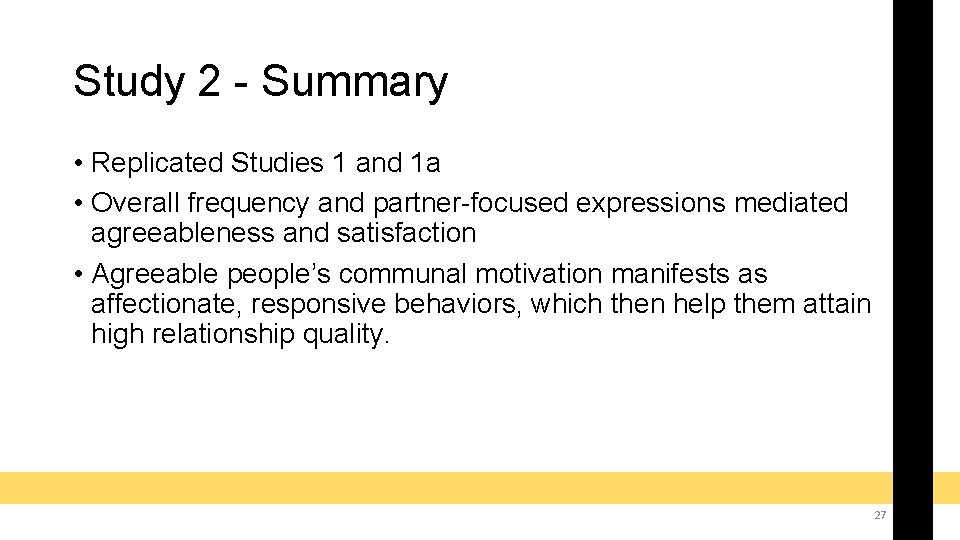
Study 2 - Summary • Replicated Studies 1 and 1 a • Overall frequency and partner-focused expressions mediated agreeableness and satisfaction • Agreeable people’s communal motivation manifests as affectionate, responsive behaviors, which then help them attain high relationship quality. 27
Overview • Study 1 (and 1 a) • Do agreeable people express affection more frequently and more responsively than disagreeable people? • Does frequency of expressions mediate agreeableness and satisfaction? • Study 2 • Fix issues with Study 1 • Study 3 • Are agreeable people’s expressions especially responsive? 28
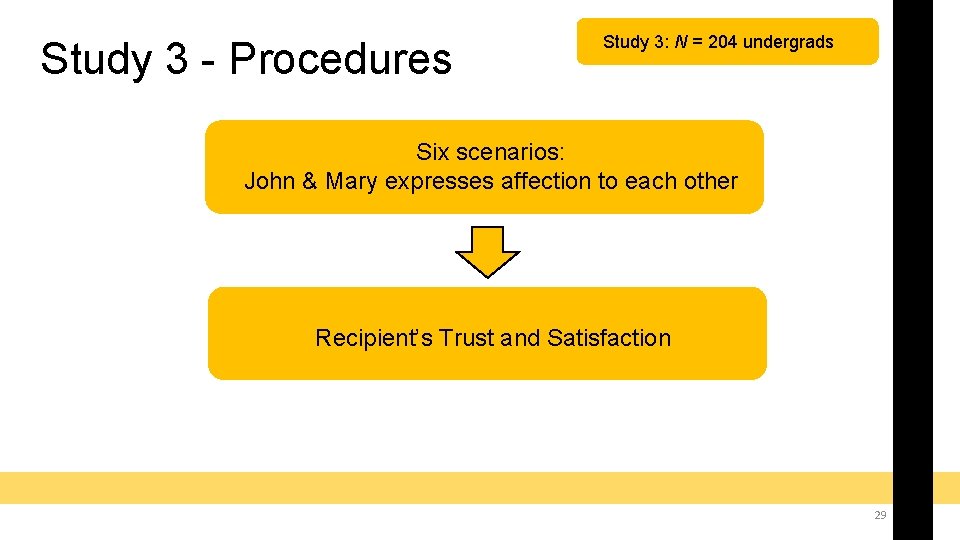
Study 3 - Procedures Study 3: N = 204 undergrads Six scenarios: John & Mary expresses affection to each other Recipient’s Trust and Satisfaction 29
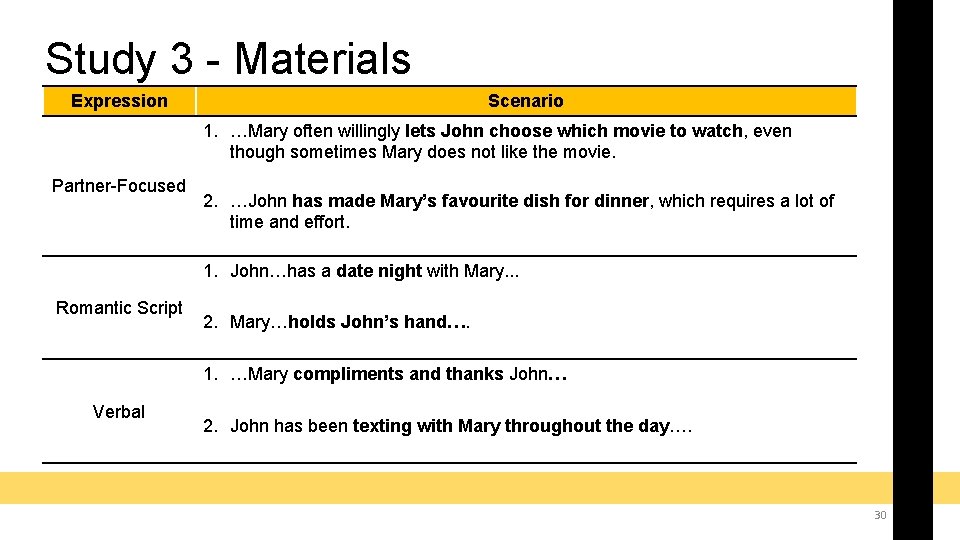
Study 3 - Materials Expression Scenario 1. …Mary often willingly lets John choose which movie to watch, even though sometimes Mary does not like the movie. Partner-Focused 2. …John has made Mary’s favourite dish for dinner, which requires a lot of time and effort. 1. John…has a date night with Mary. . . Romantic Script 2. Mary…holds John’s hand…. 1. …Mary compliments and thanks John… Verbal 2. John has been texting with Mary throughout the day…. 30
![Study 3 – Materials In this scenario, [John/Mary] will react to [Mary/John]’s actions by:](http://slidetodoc.com/presentation_image_h2/b1e72a7b2905084c0eff96b24d19c3e5/image-31.jpg "Study 3 – Materials In this scenario, [John/Mary] will react to [Mary/John]’s actions by:")
Study 3 – Materials In this scenario, [John/Mary] will react to [Mary/John]’s actions by: Variable Recipient’s Trust (9 -item; �� s =. 88) Recipient’s Satisfaction (2 -item; �� s =. 91) Sample Items • Feeling accepted unconditionally • Feeling that [Mary/John] is concerned about [his/her] welfare • Being more committed to the relationship than before • Feeling more satisfied with [his/her] relationship more than before 31
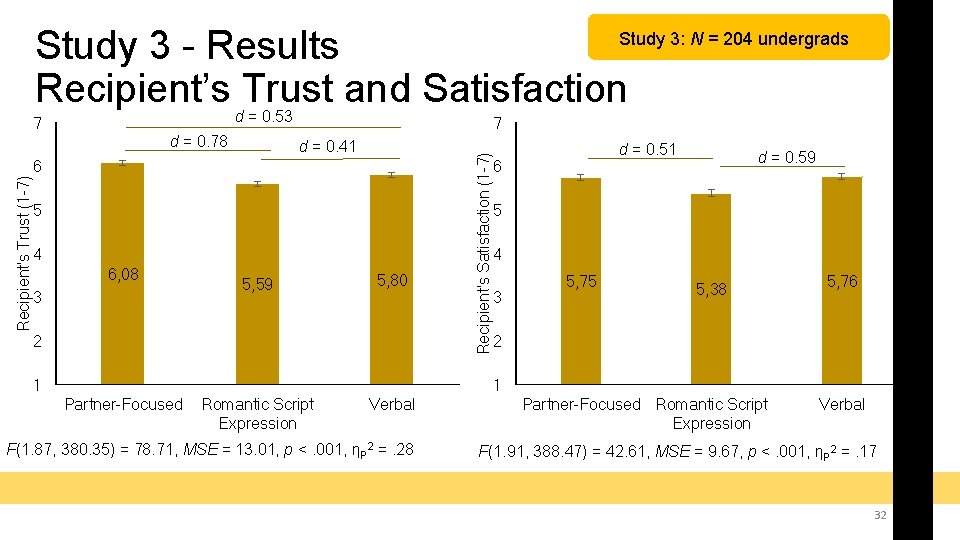
Study 3: N = 204 undergrads Study 3 - Results Recipient’s Trust and Satisfaction d = 0. 53 Recipient's Trust (1 -7) d = 0. 78 7 d = 0. 41 6 5 4 6, 08 3 5, 59 5, 80 2 1 Recipient's Satisfaction (1 -7) 7 d = 0. 51 6 d = 0. 59 5 4 3 5, 75 5, 38 5, 76 2 1 Partner-Focused Romantic Script Expression Verbal F(1. 87, 380. 35) = 78. 71, MSE = 13. 01, p <. 001, ηP 2 =. 28 Partner-Focused Romantic Script Expression Verbal F(1. 91, 388. 47) = 42. 61, MSE = 9. 67, p <. 001, ηP 2 =. 17 32
Study 3 - Summary • Partner-focused expressions are more effective in fostering partner’s trust and satisfaction than other expressions. 33
Implications • Understanding of agreeableness • Illustrate behavioral translations of agreeable people’s communal motivations • Address why agreeable people experience higher relationship satisfaction • Expressions of affection literature • Identify and categorize expressions of affection in romantic relationships 34
Thank you very much! Dr. Joanne V. Wood Dr. John G. Holmes 35
- Slides: 35