
AGO Aims Goal Objectives Leslie Owen Wilson Going
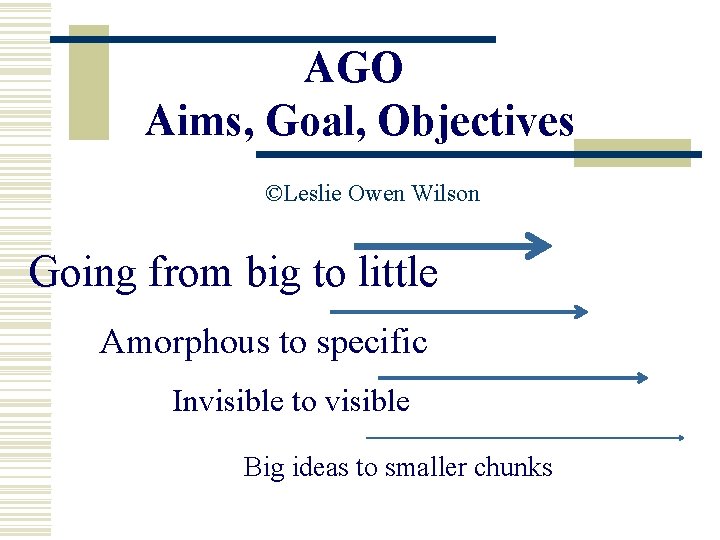
AGO Aims, Goal, Objectives ©Leslie Owen Wilson Going from big to little Amorphous to specific Invisible to visible Big ideas to smaller chunks
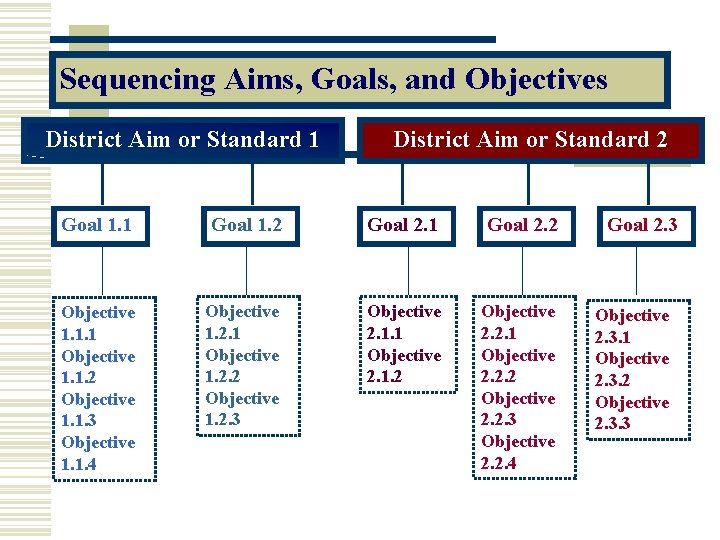
Sequencing Aims, Goals, and Objectives District Aim or Standard 1 District Aim or Standard 2 Goal 1. 1 Goal 1. 2 Goal 2. 1 Goal 2. 2 Objective 1. 1. 1 Objective 1. 1. 2 Objective 1. 1. 3 Objective 1. 1. 4 Objective 1. 2. 1 Objective 1. 2. 2 Objective 1. 2. 3 Objective 2. 1. 1 Objective 2. 1. 2 Objective 2. 2. 1 Objective 2. 2. 2 Objective 2. 2. 3 Objective 2. 2. 4 Goal 2. 3 Objective 2. 3. 1 Objective 2. 3. 2 Objective 2. 3. 3
Aims are general statements that provide direction or intent to educational action. • Aims are usually written in broad, amorphous terms using words like: learn, know, understand, appreciate. • Generally these types of words are not directly measurable. • Aims may serve as organizing principles giving educational direction for more than one grade. • Indeed these organizing principles may encompass the continuum of educational direction for entire programs, subject areas, or for a whole school system. • Aims may also be in the form of a state, or national standard.
Example of an aim: 1. Students will become proficient at finding, examining, and solving problems. • This aim is very broad and nonspecific. • In this form it is amorphous and may be broadly applicable to all grades, K-12. • It is open to numerous interpretations, and may be easily incorporated into any number of disciplines.
Another example of an aim -one geared to a specific age group: Students will improve their motor skills abilities. (K-6) • Again, this aim has very broad educational intentions. • However, this one is more specific to certain disciplines that deal with the development of fine and gross muscles like: physical education (hopping), or some areas using skilled movements like music (bowing a cello), art (controlling clay on a potter’s wheel), or science (dissection).
Goals are statements of educational intention that are more specific than aims. • Goals too may encompass an entire program, subject area, or multiple grade levels. • They may be in either amorphous language, or in more specific behavioral terms.
An example of a goal w Students will improve their gross motor skills by practicing rudimentary movements like hopping, skipping, stepping, walking, and running.
Objectives are usually detailed statements of educational intention which delineate either general or specific outcomes. w Objectives can be written in a number of ways, but currently, most objectives are written in behavioral terms. w Behavioral objectives usually employ observable verbiage and can be divided into specific domains according to intentions and activities - -- cognitive, affective, and physical.
Examples of Holistic Planning Through Mixed Objectives w Cognitive objective - Students will recognize the rhythmic pattern in a series claps and indicate recognition and understanding by hopping on the 3 rd beat. w Physical objective – Mimicking the practiced 3 rd beat hops, students will hop in rhythmic time through a maze without stopping. w Affective objective – Students observing other students’ efforts will be expected to voice emotional support by cheering peers on.
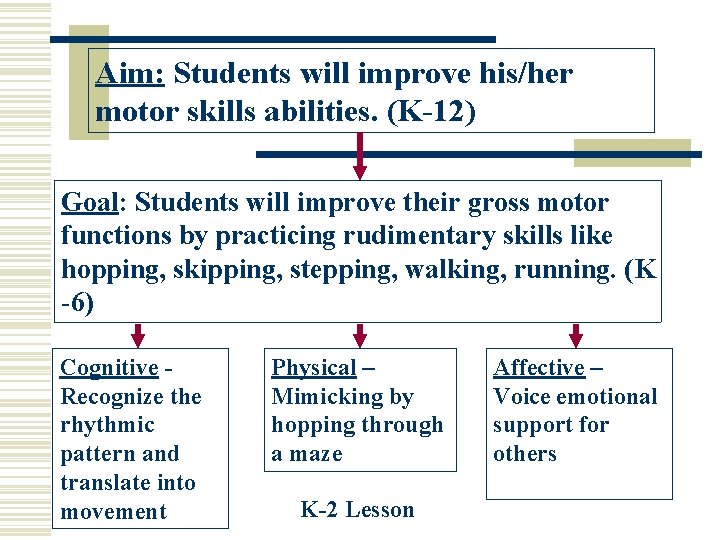
Aim: Students will improve his/her motor skills abilities. (K-12) Goal: Students will improve their gross motor functions by practicing rudimentary skills like hopping, skipping, stepping, walking, running. (K -6) Cognitive Recognize the rhythmic pattern and translate into movement Physical – Mimicking by hopping through a maze K-2 Lesson Affective – Voice emotional support for others
- Slides: 10