
Aging of the Skeleton Osteoporosis An Evolutionary and
- Slides: 26
Aging of the Skeleton: Osteoporosis An Evolutionary and Biocultural Perspective
Major Functions of the Skeleton • • • Body Support Body Movement Storage of Calcium and other minerals: • Storage of Calcium provides upon request Calcium to blood. • Blood Calcium is important for regulating numerous cellular activities • Maintenance of Acid/Base balance in association with lungs and kidneys • Regulation and phosphate and carbonate for buffers • Storage of bone marrow
Skeleton Includes: Bones Tendons Joints (or articulations)
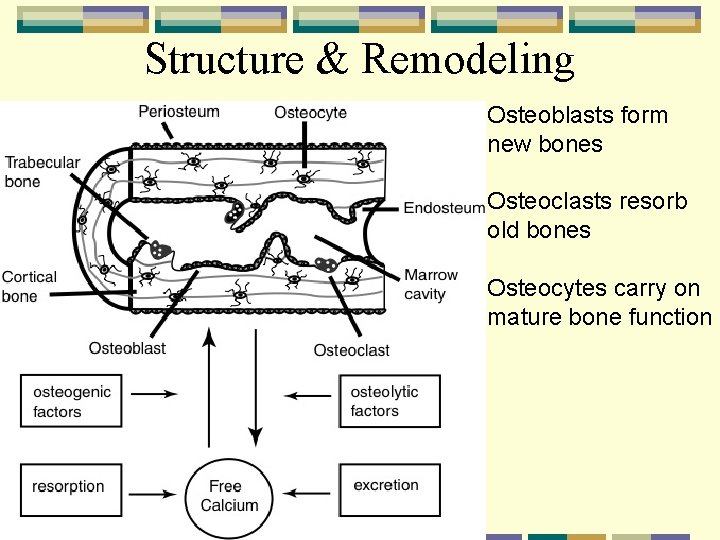
Structure & Remodeling Osteoblasts form new bones Osteoclasts resorb old bones Osteocytes carry on mature bone function
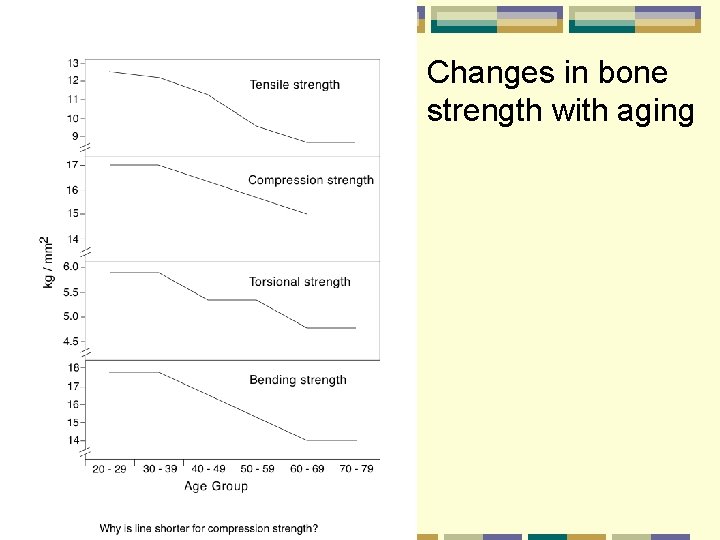
Changes in bone strength with aging
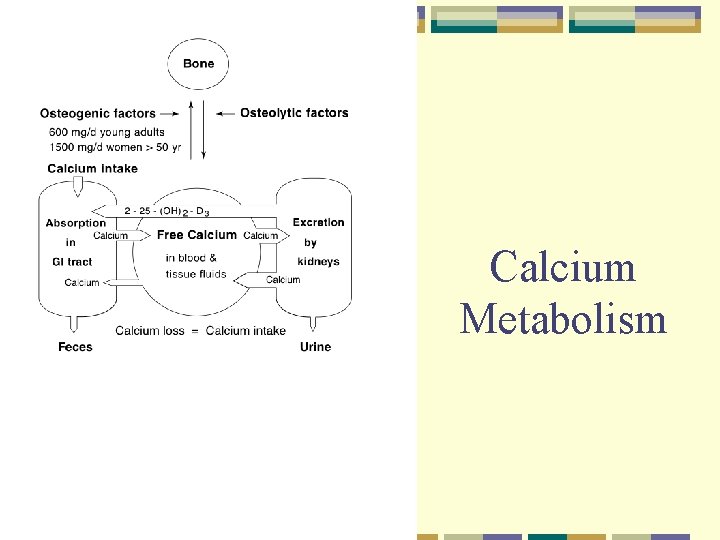
Calcium Metabolism
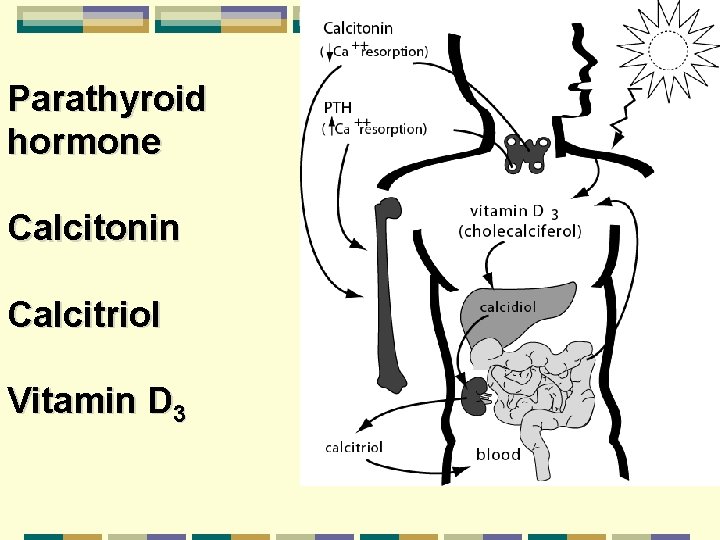
Parathyroid hormone Calcitonin Calcitriol Vitamin D 3
Major Hormones • • • Parathyroid hormone increases bone resorption to mobilize calcium, thereby increasing plasma calcium Calcitonin increases intestinal calcium absorption and decreases renal excretion Calcitriol increases intestinal calcium absorption and increases renal excretion
Osteoporosis • A reduction in bone mass and deterioration bone microstructure • Clinically recognized as bone fragility with an increased susceptibility to fracture • Osteopenia vs. osteoporosis • Serious health concern in western aging populations: 1/2 women and 1/4 men > age of 50 will have an osteoporosis-related fracture. Women 4 x times more likely than men
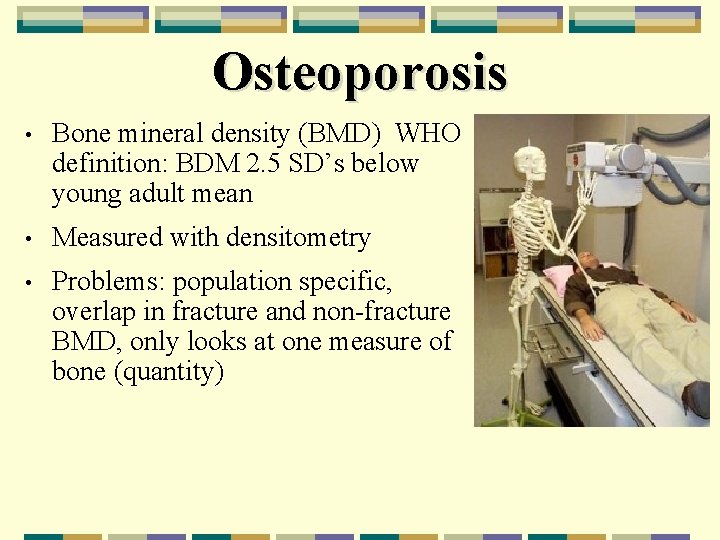
Osteoporosis • Bone mineral density (BMD) WHO definition: BDM 2. 5 SD’s below young adult mean • Measured with densitometry • Problems: population specific, overlap in fracture and non-fracture BMD, only looks at one measure of bone (quantity)
Osteoporosis • • Fractures hip, distal forearm, vertebral and hip fractures bone resorption > bone formation
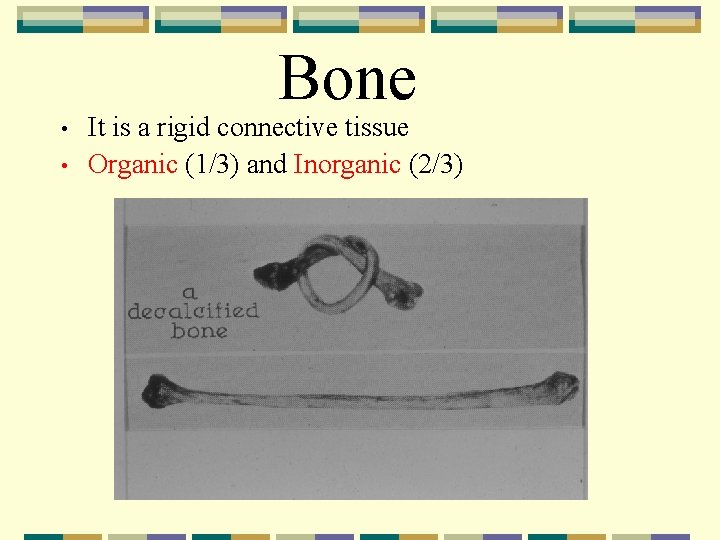
Bone • • It is a rigid connective tissue Organic (1/3) and Inorganic (2/3)
Adult bone: dynamic, active and plastic
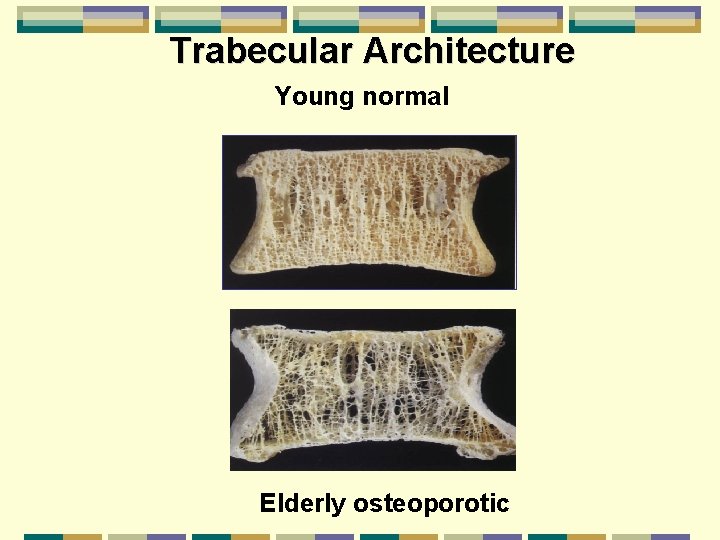
Trabecular Architecture Young normal Elderly osteoporotic
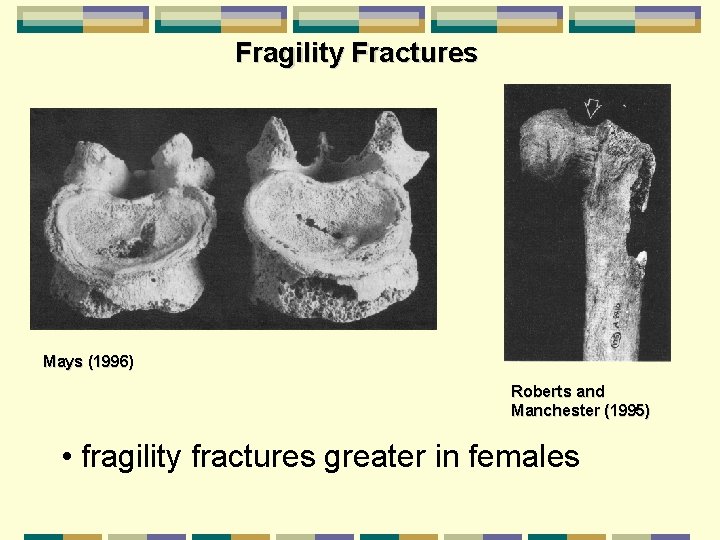
Fragility Fractures Mays (1996) Roberts and Manchester (1995) • fragility fractures greater in females
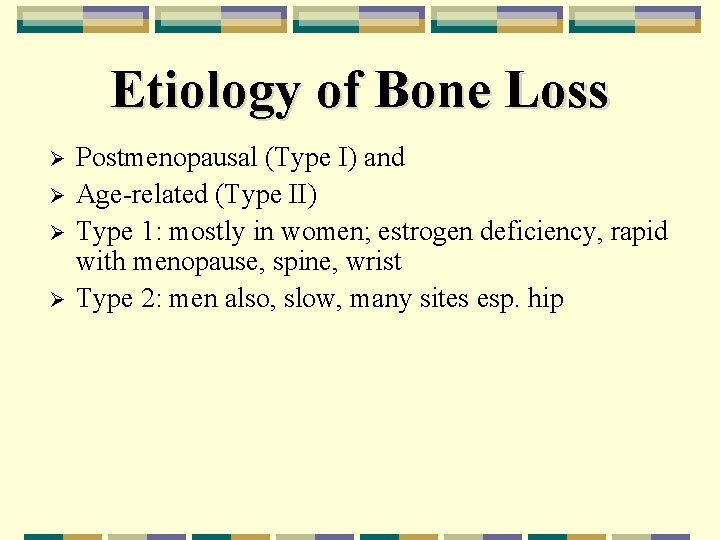
Etiology of Bone Loss Ø Ø Postmenopausal (Type I) and Age-related (Type II) Type 1: mostly in women; estrogen deficiency, rapid with menopause, spine, wrist Type 2: men also, slow, many sites esp. hip
Age-related Bone Loss • • Senescence of osteoblasts (impaired function) Also increase in PTH levels (due to decrease renal and Ca re-absorption and intestinal Ca absorption that occurs in elderly - as less Vit D exposure, less synthesis of calcitrol, or vit. D resistance? )
Multifactorial Etiology ØNumber of factors that play a role in peak bone mass and loss: § § § Genetics and ethnicity Lifestyle: alcohol, smoking, drugs diet/nutrition mechanical usage (physical activity) reproductive factors (pregnancy, parity and lactation) • Since multifactorial interest to look at its evolution and variation in different populations
Osteoporosis in Past Populations Historical populations unique model to study bone loss • Many studies of bone loss in various archaeological populations: - pattern of bone loss and fragility in the past is different than in clinical osteoporosis today - mostly bone mass • - few studies of bone quality trabecular architecture
Medieval Results • • Both sexes: significant change in trabecular architecture by middle age No sex difference Low prevalence of fracture Different patterns than seen in modern populations
What is Going On? Nutrition/diet: - maybe sub-optimal conditions - no evidence for calcium or vitamin D deficiency - Vitamin D is likely important: Vitamin D insufficiency - Is Calcium really the big story in bone loss? ? ? •
What is Going On? • Physical activity: - rural farming population: both sexes involved in similar arduous activity - Could have protected both sexes from bone loss in old age
What is Going On? Both diet and activity do not fully explain atypical patterns seen in females • Reproductive Factors: pregnancy and lactation
Pregnancy and Lactation • • • metabolically active states in bone loss during pregnancy long-term bone fragility? unlikely With lactation recovery of bone loss Evolutionary perspective: reproduction should not be bad for skeleton
Reproductive Behaviors Rural Medieval vs. Modern • extended lactation (maybe also wet nursing) and later age at weaning • parity (estimate 5 -10 offspring) • likely later menarche and slightly earlier menopause =different hormonal environment
Perspective • Osteoporosis is a heterogeneous disorder: lifestyle factors clearly important • Cannot understand female bone maintenance without considering role of reproductive patterns • A combined biocultural, evolutionary and life history approach is vital to get at natural history of bone loss and fragility • In taking this approach we improve our understanding of the disease today