
Aging of the reactor pressure vessel Neutron embrittlement
Aging of the reactor pressure vessel - Neutron embrittlement and pressure vessel integrity Dr. Ilse Tweer and Dr. Wolfgang Kromp INRAG Study – “Risks of lifetime extensions of old nuclear power plants”, April 26, Online
Reactor pressure vessel – structural integrity ▪ The reactor pressure vessel (RPV) is the central component of a nuclear reactor, - for safe operation of the NPP throughout service life RPV failure has to be „practically“ excluded, because safety systems are not designed to cope with RPV failure ▪ The first level of the defense-in-depth approach is the requirement of superior material quality that has to be maintained throughout service life ▪ Periodic in-service (ultrasonic) inspections have to ensure that the RPV steel does not contain cracks of a critical size ▪ Surveillance irradiation programs are supposed to monitor neutron induced material embrittlement ▪ The structural integrity of the RPV has to be demonstrated until end of life (EOL) taking into account material aging and radiation embrittlement (Pressurized Thermal Shock analysis) INRAG Study - “Risks of lifetime extensions of old nuclear power plants” 2
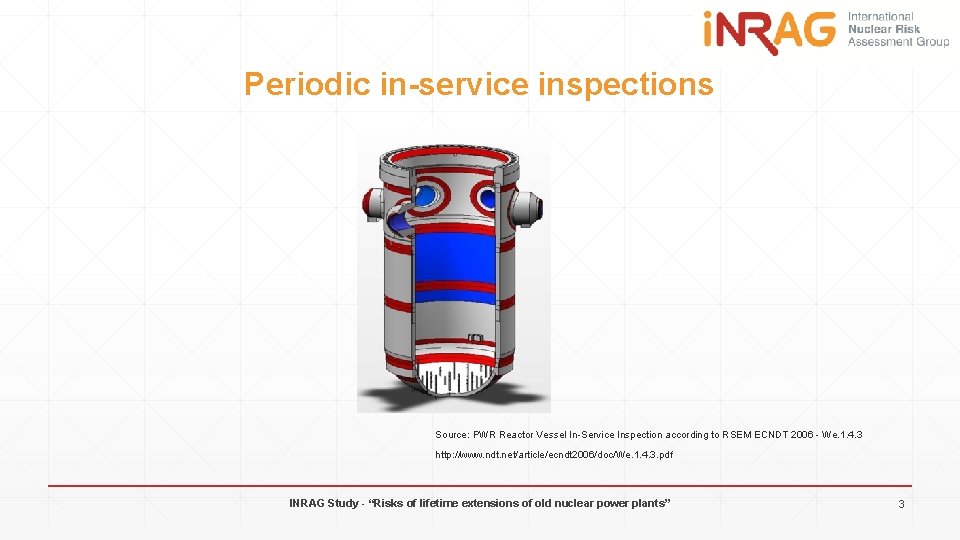
Periodic in-service inspections Source: PWR Reactor Vessel In-Service Inspection according to RSEM ECNDT 2006 - We. 1. 4. 3 http: //www. ndt. net/article/ecndt 2006/doc/We. 1. 4. 3. pdf INRAG Study - “Risks of lifetime extensions of old nuclear power plants” 3
Periodic in-service inspections ▪ Worldwide the standard requirements for periodic (4 years interval) in-service inspections covered only the welded joints with the heat-affected zone and a small part of the base metal ▪ Every 10 years the inside of the RPV specific tests for under-clad cracks are required ▪ In 2012 thousands of indications were found per chance in the base metal of the core shells of Doel-3 and Tihange 2 The operator stated that the indications are hydrogen flakes resulting from manufacture (accepted by the national authority FANC) ▪ In 2016 hundreds of indications were found in the base metal of the core shells in Beznau 1/2 The operator stated that the indications were due to aluminium oxide precipitations (accepted by the national authority ENSI) ▪ Due to the lack of archive material the clarification of the real nature of the defects in the base metal in all these cases (Doel, Tihange, Beznau) would need destructíve testing INRAG Study - “Risks of lifetime extensions of old nuclear power plants” 4
RPV materials aging - neutron embrittlement RPV steels are brittle at low temperatures, toughness (ductility) is reached at higher temperatures For the operational temperature range the steel has to be ductile to cope with thermomechanical loads Aging processes affecting the mechanical characteristics of the steel (strength, elasticity, toughness, hardness) include: ▪ Thermomechanical fatigue (fatigue crack evolution, more important for the leak-before-break concept in coolant pipings) ▪ Corrosion (inner surface degradation) ▪ Radiation effects, mainly neutron embrittlement The most important radiation effect is the shift of the brittle-ductile transition to higher temperatures INRAG Study - “Risks of lifetime extensions of old nuclear power plants” 5
RPV materials aging - neutron embrittlement The national standards contain the so-called trend curves (based on the US NRC Reg. Guide 1. 99) describing the expected effect of neutron irradiation on the fracture toughness/temperature curve of the RPV steel, i. e. the shift of the ductile-brittle transition temperature depending on the chemical composition of the steel The trend curves are based on a large amount of steel samples with different chemical composition irradiated in research reactors Surveillance irradiation programs using archive material during reactor operation are supposed to control the embrittlement and verify the trend curves The ductile-brittle transition temperature of the irradiated samples is determined by ▪ Charpy Test (the only procedure used in the past, during licensing of most operated NPPs) ▪ Master Curve approach (less conservative, adopted in ASME in the beginning of this century) INRAG Study - “Risks of lifetime extensions of old nuclear power plants” 6

RPV materials aging - neutron embrittlement some experiences – open questions ▪ Copper and phosphorus impurities increase the embrittlement: many old US reactors (meanwhile decommissioned), VVER 440 reactors (Bohunice, Greifswald), Germany: NPPs Obrigheim and Stade (decommissioned), use of „optimized“ steels in later RPVs ▪ The surveillance program in Doel 1 showed an higher embrittlement than expected by the Reg. Guide 1. 99 trend curve, up to now there exists no explanation ▪ Irradiation experiments using hydrogen flakes containing samples (safety case Doel 3 and Tihange 2) showed an higher embrittlement than expected, - this was denoted to „an unknown radiation effect“ ▪ Research results indicated that high nickel contents increase embrittlement, surveillance results in VVER-1000 reactors did not verify these expectations, this was denoted to an effect of manganese ▪ Studies concerning the effect of carbon for embrittlement are still missing (Milan Brumovsky) ▪ Experiments (Viehrig, Rossendorf) indicate that the embrittlement might increase inside the vessel wall INRAG Study - “Risks of lifetime extensions of old nuclear power plants” 7
Reactor pressure vessel (RPV) integrity – Pressurized thermal shock (PTS) analysis The structural integrity of the RPV has to be demonstrated until end of life (EOL) taking into account material aging and radiation embrittlement (pressurized thermal shock analysis): ▪ For the most severe accident transients - for instance a loss of coolant accident (LOCA) with emergency cooling water impingement on the hot reactor pressure wall the resulting temperature distribution in the wall is calculated using thermal hydraulic codes ▪ Fracture mechanical calculations allow to determine the load on a hypothetical crack in the material (load path) ▪ This load path is compared with the actual ductility of the material, - this ductility has always to be above the load path to avoid spontaneous growth of the crack INRAG Study - “Risks of lifetime extensions of old nuclear power plants” 8
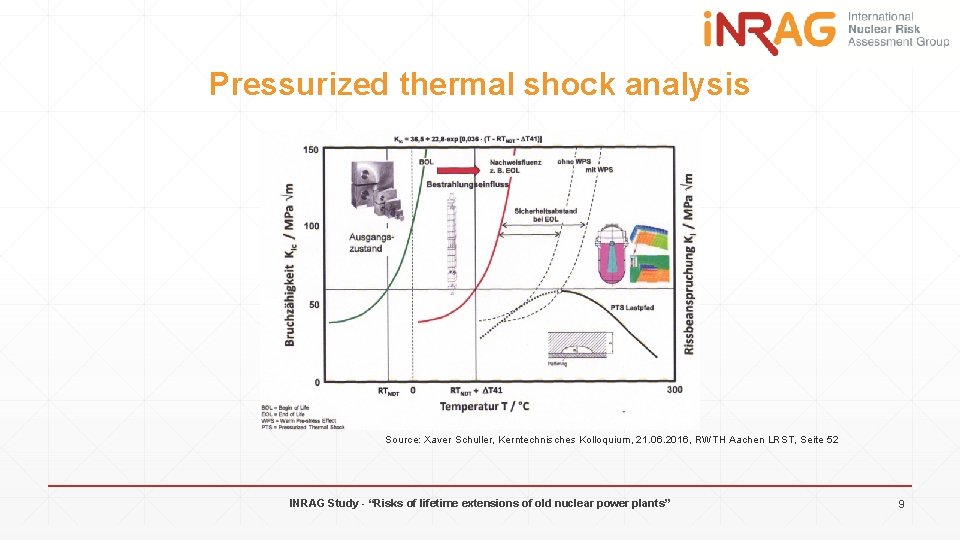
Pressurized thermal shock analysis Source: Xaver Schuller, Kerntechnisches Kolloquium, 21. 06. 2016, RWTH Aachen LRST, Seite 52 INRAG Study - “Risks of lifetime extensions of old nuclear power plants” 9
Conclusions: RPV embrittlement, RPV integrity ▪ Neutron embrittlement mechanisms are still not known in sufficient detail to predict reliably the materials characteristics degradation due to operational irradiation ▪ Destructive testing of RPV samples from decommissioned NPPs could provide valuable information for the validity of current assumptions concerning RPV embrittlement ▪ The uncertainties concerning the materials characteristics are increasing with the age of the power plants, especially with respect to the interaction of radiation damage and other degradation mechanisms (segregation, impurity diffusion, precipitation, defect growth, etc. ) ▪ It is doubtful that the periodic in-service inspections allow credible information on crack evolution during operation ▪ The pressurized thermal shock (PTS) analysis is based on codes that cannot be validated by true to scale experiments under realistic conditions; therefore the demonstration of structural integrity throughout RPV lifetime includes many assumptions and uncertainties, thus its credibility is on shaky ground ▪ In other words: the reality might be worse than the safety analyses indicate INRAG Study - “Risks of lifetime extensions of old nuclear power plants” 10
- Slides: 10