
AGING AND THE DREAM OF IMMORTALITY JeanDavid Ponci

- Slides: 22
AGING AND THE DREAM OF IMMORTALITY Jean-David Ponci Doctor of Philosophy of Science
SUMMARY Theological part Let's clear up some misunderstandings: It's not necessarily a bad thing to want to be immortal. . . - Death is evil, immortality is what corresponds to our nature. . . - Death is not as such a required passage to heaven St Thomas The Virgin Mary The last Judgment Biological part Change of Paradigm about ageing The modern paradigm of aging 2 theories to explain ageing The importance of predation rate Conclusions How are we doing in the possibility to become immortal?
St Thomas, On evil, Q. V, a. 5 The dissolution resulting from a necessity of matter is in a special way unbefitting the form that is the rational soul. For other forms can pass away at least incidentally, but the rational soul can pass away neither intrinsically nor incidentally. nd so if there could be in nature a body composed of elements, and the body were to be indissoluble, such a body would undoubtedly be naturally suitable for the soul. Just so, if one could find iron incapable of breaking or rusting, it would be most suitable matter for a saw, and a blacksmith would seek it [. . . ]. And likewise, since there can be no body composed of elements that is by the nature of matter indissoluble, an organic but dissoluble body is by nature suitable for the soul that cannot pass away. But since God, who creates human beings, could by his omnipotence prevent this necessity of matter from coming about, his power conferred on human beings before sin A that they be preserved from death, until they by sinning proved themselves unworthy of such a benefit. Just so, a blacksmith, if he could, would endow the iron he molds with the incapacity to break.
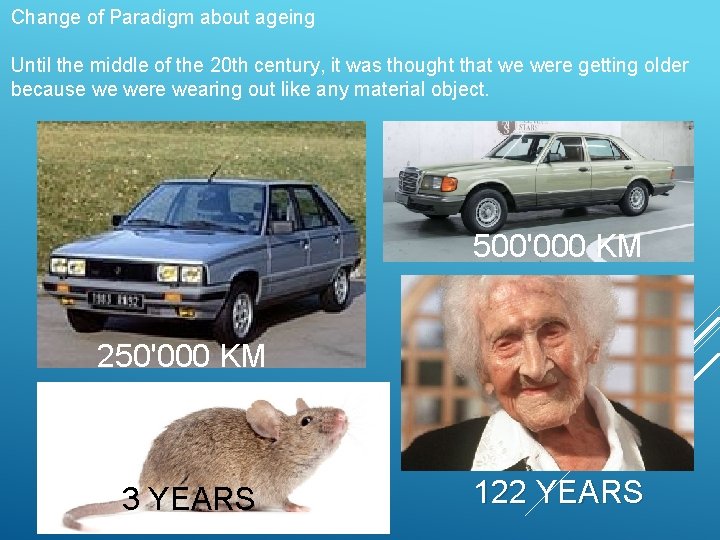
Change of Paradigm about ageing Until the middle of the 20 th century, it was thought that we were getting older because we were wearing out like any material object. 500'000 KM 250'000 KM 3 YEARS 122 YEARS
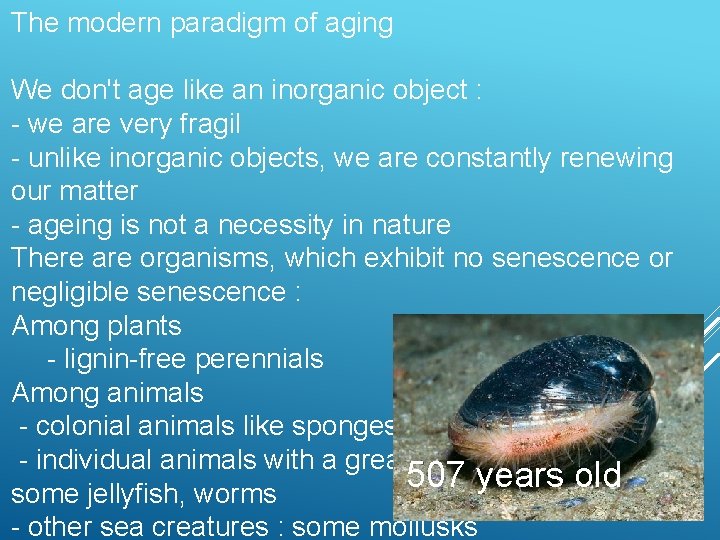
The modern paradigm of aging We don't age like an inorganic object : - we are very fragil - unlike inorganic objects, we are constantly renewing our matter - ageing is not a necessity in nature There are organisms, which exhibit no senescence or negligible senescence : Among plants - lignin-free perennials Among animals - colonial animals like sponges - individual animals with a great capacity of reneration : 507 years old some jellyfish, worms - other sea creatures : some mollusks
507 years old
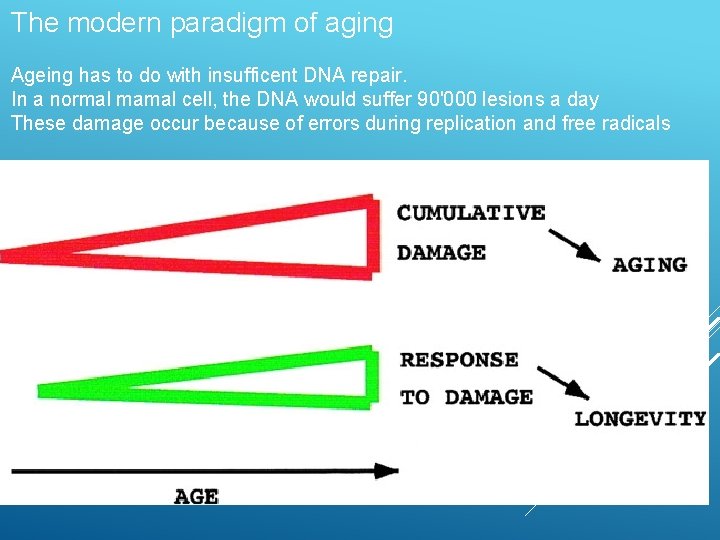
The modern paradigm of aging Ageing has to do with insufficent DNA repair. In a normal mamal cell, the DNA would suffer 90'000 lesions a day These damage occur because of errors during replication and free radicals
Thanks to the many repair mechanisms, we are almost immortal. . . The cell has the entire pharmacopoeia to fix everything. We know, a little bit, how we age but not why we age. Ageing doesn't appear anymore as inevitable. 2 ways of thinking: - Ageing is a set of genetic deseases, we can cure - Ageing is an adaptation, so we cannot reverse it without consequences
2 Theories to explain ageing Antogonistic pleiotropy hypothesis states that if a gene caused both increased reproduction in early life and aging in later life, then this gene will be selected and kept in the genetic pool of the species.
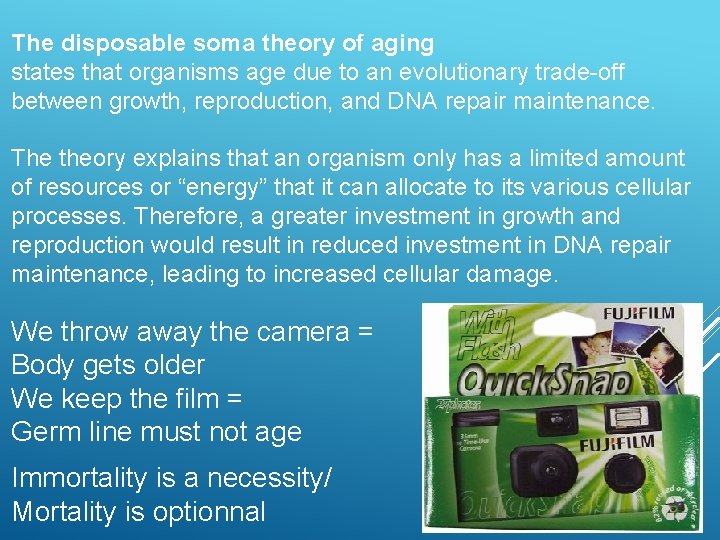
The disposable soma theory of aging states that organisms age due to an evolutionary trade-off between growth, reproduction, and DNA repair maintenance. The theory explains that an organism only has a limited amount of resources or “energy” that it can allocate to its various cellular processes. Therefore, a greater investment in growth and reproduction would result in reduced investment in DNA repair maintenance, leading to increased cellular damage. We throw away the camera = Body gets older We keep the film = Germ line must not age Immortality is a necessity/ Mortality is optionnal
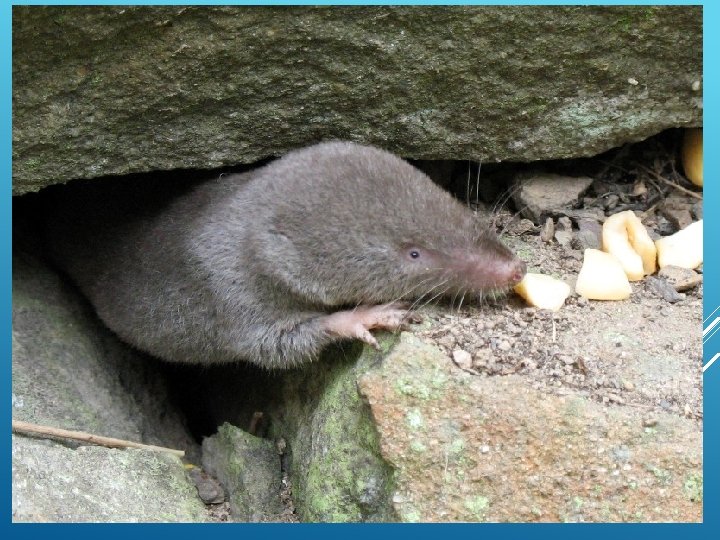
The importance of predation rate When there are few predators on the outside, the species tends to live longer. Ex. The mammal with the shortest lifespan The northern short-tailed shrew has a lot of predators
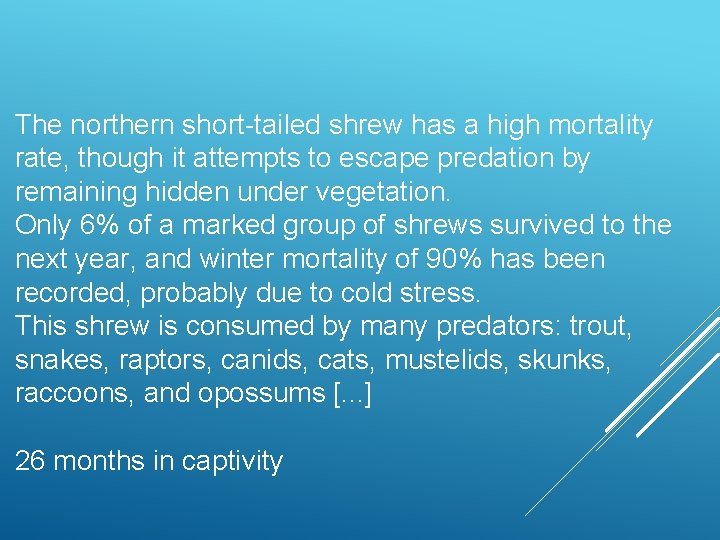
The northern short-tailed shrew has a high mortality rate, though it attempts to escape predation by remaining hidden under vegetation. Only 6% of a marked group of shrews survived to the next year, and winter mortality of 90% has been recorded, probably due to cold stress. This shrew is consumed by many predators: trout, snakes, raptors, canids, cats, mustelids, skunks, raccoons, and opossums [. . . ] 26 months in captivity
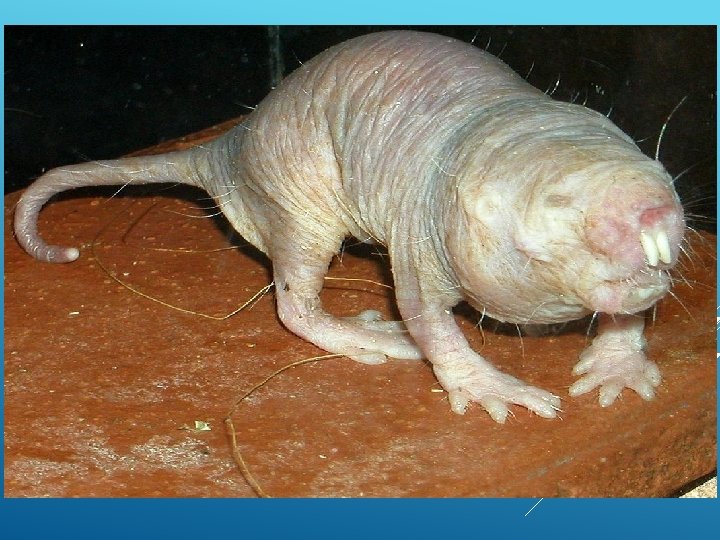
It doesn't have any predator. It stays underground and eats only tubers : Naked mole -rat. 32 years old
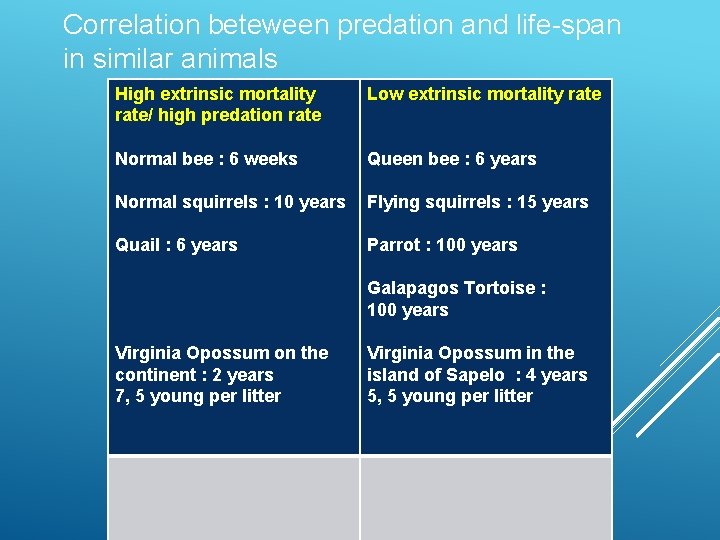
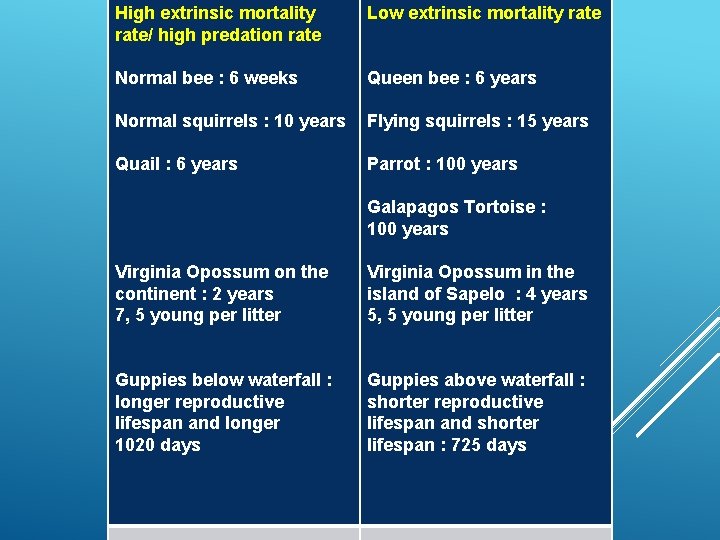
Correlation beteween predation and life-span in similar animals High extrinsic mortality rate/ high predation rate Low extrinsic mortality rate Normal bee : 6 weeks Queen bee : 6 years Normal squirrels : 10 years Flying squirrels : 15 years Quail : 6 years Parrot : 100 years Galapagos Tortoise : 100 years Virginia Opossum on the continent : 2 years 7, 5 young per litter Virginia Opossum in the island of Sapelo : 4 years 5, 5 young per litter
Conclusions Aging is a malleable process that depends on extrinsic parameters: the rate of predation, but also on the diet, . . . on intrinsics parameters : size, metabolism, temperature. It is not intellectually “prudent” to consider aging only as a set of diseases that appear after the reproductive period and that we could cure. . . Rather, aging is seen as a strategy to improve reproductive success. There are too many unanswered questions to consider becoming immortal. - basically, we don't know why we grow old. We don't know the mechanism which regulates the trade-off between DNA repairs and reproductiv processes.
How are we doing in the possibility to become immortal? The Methuselah Mouse Prize (Mprize) was created to increase interest in longevity research by awarding [. . . ] one to the research team that broke the world record for the oldest-ever mouse. In 2005, the record was held by a mouse whose growth hormone receptor had been rendered inoperable: 1819 days (almost 5 years) instead three years.
Death is not a required passage to heaven. One understands that one can go to heaven without dying by contemplating the Assumption of the Virgin Mary and the Ascension of Christ. The dogma of Assumption, as Pius XII defined it, leaves the question of whether the Virgin Mary died open. What Catholics must believe is that the Immaculate Mother of God, the ever Virgin Mary, having completed the course of her earthly life, was assumed body and soul into heavenly glory.
I, Thessalonian, 4, 16 -18 For the Lord himself will come down from heaven, with a loud command, with the voice of the archangel and with the trumpet call of God, and the dead in Christ will rise first. After that, we who are still alive and are left will be caught up together with them in the clouds to meet the Lord in the air. And so we will be with the Lord forever.
High extrinsic mortality rate/ high predation rate Low extrinsic mortality rate Normal bee : 6 weeks Queen bee : 6 years Normal squirrels : 10 years Flying squirrels : 15 years Quail : 6 years Parrot : 100 years Galapagos Tortoise : 100 years Virginia Opossum on the continent : 2 years 7, 5 young per litter Virginia Opossum in the island of Sapelo : 4 years 5, 5 young per litter Guppies below waterfall : longer reproductive lifespan and longer 1020 days Guppies above waterfall : shorter reproductive lifespan and shorter lifespan : 725 days