
Aging and Reproductive health Female Reproductive lifespan Subfecundity

Aging and Reproductive health

Female Reproductive lifespan Subfecundity Menarche= Onset of menstruation Subfecundity menopause Absence of menses 12 consecutive months
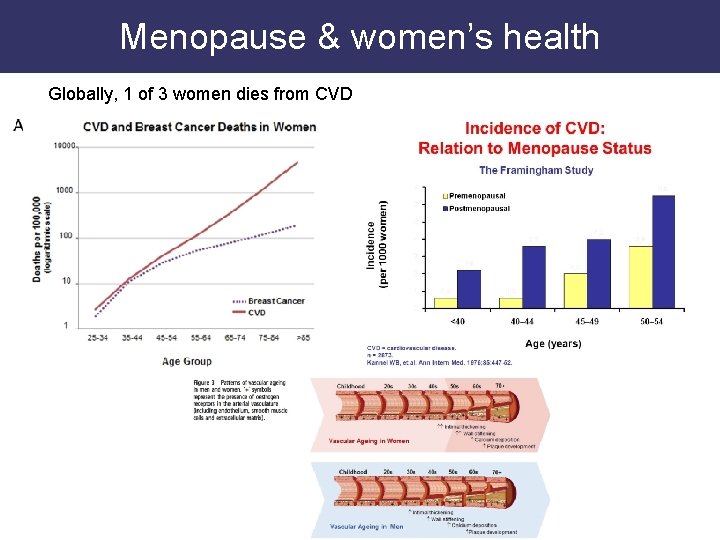
Menopause & women’s health Globally, 1 of 3 women dies from CVD
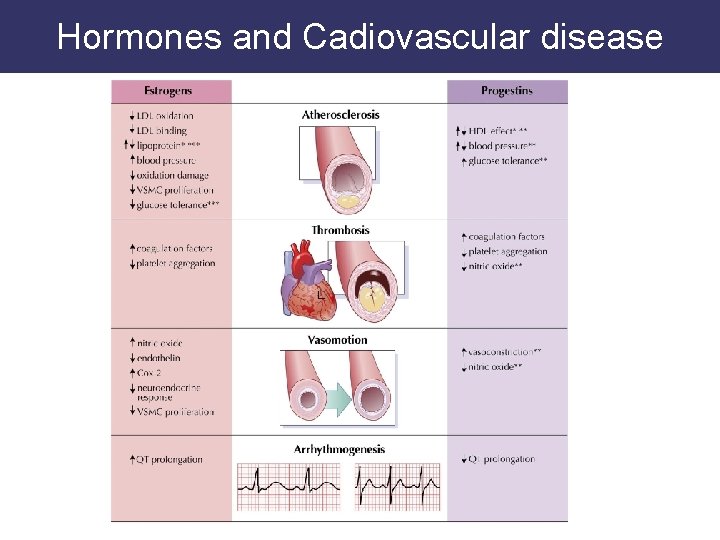
Hormones and Cadiovascular disease
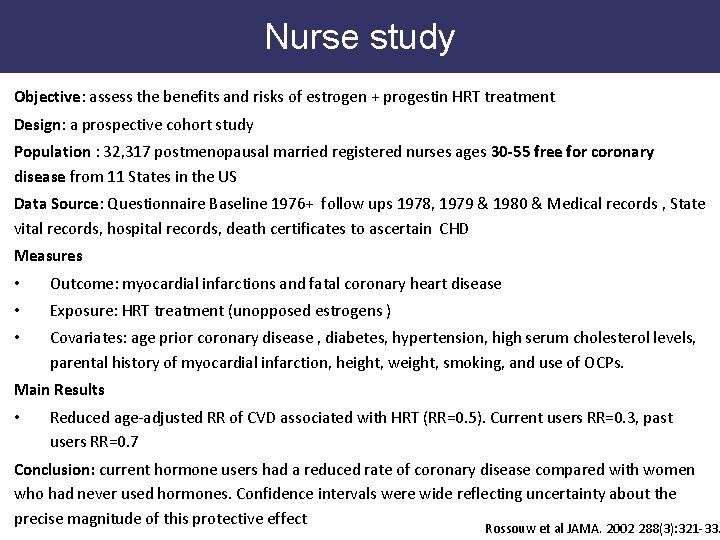
Nurse study Objective: assess the benefits and risks of estrogen + progestin HRT treatment Design: a prospective cohort study Population : 32, 317 postmenopausal married registered nurses ages 30 -55 free for coronary disease from 11 States in the US Data Source: Questionnaire Baseline 1976+ follow ups 1978, 1979 & 1980 & Medical records , State vital records, hospital records, death certificates to ascertain CHD Measures • Outcome: myocardial infarctions and fatal coronary heart disease • Exposure: HRT treatment (unopposed estrogens ) • Covariates: age prior coronary disease , diabetes, hypertension, high serum cholesterol levels, parental history of myocardial infarction, height, weight, smoking, and use of OCPs. Main Results • Reduced age-adjusted RR of CVD associated with HRT (RR=0. 5). Current users RR=0. 3, past users RR=0. 7 Conclusion: current hormone users had a reduced rate of coronary disease compared with women who had never used hormones. Confidence intervals were wide reflecting uncertainty about the precise magnitude of this protective effect Rossouw et al JAMA. 2002 288(3): 321 -33.
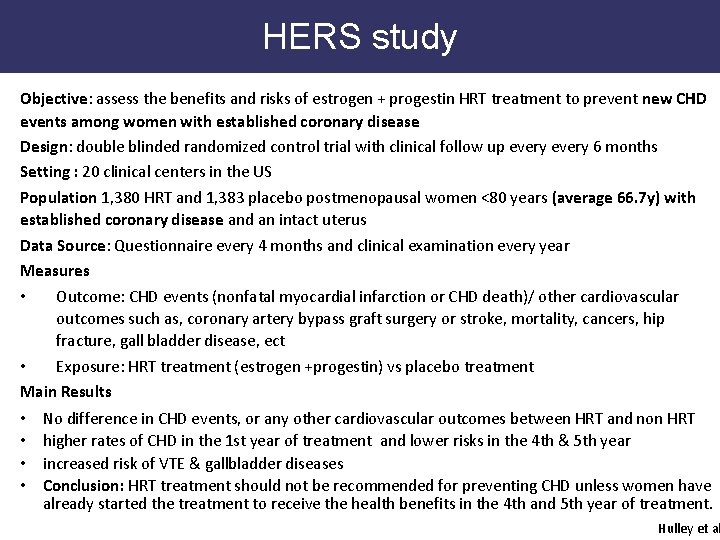
HERS study Objective: assess the benefits and risks of estrogen + progestin HRT treatment to prevent new CHD events among women with established coronary disease Design: double blinded randomized control trial with clinical follow up every 6 months Setting : 20 clinical centers in the US Population 1, 380 HRT and 1, 383 placebo postmenopausal women <80 years (average 66. 7 y) with established coronary disease and an intact uterus Data Source: Questionnaire every 4 months and clinical examination every year Measures • Outcome: CHD events (nonfatal myocardial infarction or CHD death)/ other cardiovascular outcomes such as, coronary artery bypass graft surgery or stroke, mortality, cancers, hip fracture, gall bladder disease, ect • Exposure: HRT treatment (estrogen +progestin) vs placebo treatment Main Results • • No difference in CHD events, or any other cardiovascular outcomes between HRT and non HRT higher rates of CHD in the 1 st year of treatment and lower risks in the 4 th & 5 th year increased risk of VTE & gallbladder diseases Conclusion: HRT treatment should not be recommended for preventing CHD unless women have already started the treatment to receive the health benefits in the 4 th and 5 th year of treatment. Hulley et al
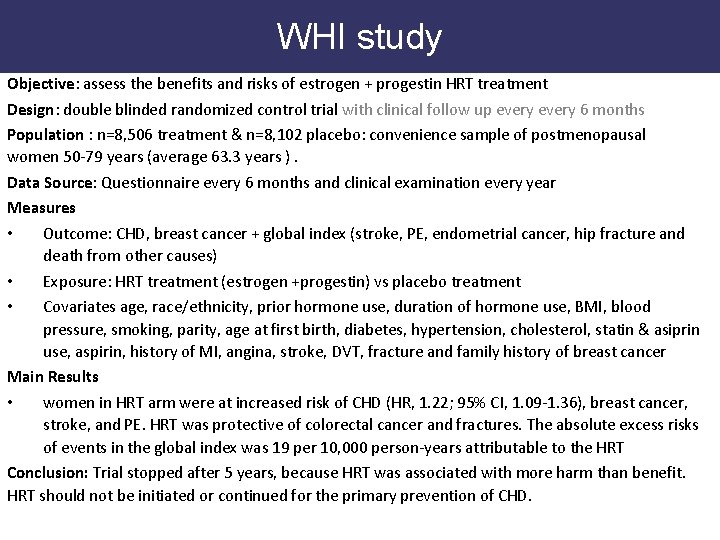
WHI study Objective: assess the benefits and risks of estrogen + progestin HRT treatment Design: double blinded randomized control trial with clinical follow up every 6 months Population : n=8, 506 treatment & n=8, 102 placebo: convenience sample of postmenopausal women 50 -79 years (average 63. 3 years ). Data Source: Questionnaire every 6 months and clinical examination every year Measures • Outcome: CHD, breast cancer + global index (stroke, PE, endometrial cancer, hip fracture and death from other causes) • Exposure: HRT treatment (estrogen +progestin) vs placebo treatment • Covariates age, race/ethnicity, prior hormone use, duration of hormone use, BMI, blood pressure, smoking, parity, age at first birth, diabetes, hypertension, cholesterol, statin & asiprin use, aspirin, history of MI, angina, stroke, DVT, fracture and family history of breast cancer Main Results • women in HRT arm were at increased risk of CHD (HR, 1. 22; 95% CI, 1. 09 -1. 36), breast cancer, stroke, and PE. HRT was protective of colorectal cancer and fractures. The absolute excess risks of events in the global index was 19 per 10, 000 person-years attributable to the HRT Conclusion: Trial stopped after 5 years, because HRT was associated with more harm than benefit. HRT should not be initiated or continued for the primary prevention of CHD.

WHI study Study Age CVD risk factors Type of HRT treatment Nurse 30 -55 Exclude women with previous MI or angina Missing info from original Q Oestrogen alone HERS Average 66. 7 Women with CVD : MI, coronary artery bypass graft surgery, percutaneous coronary revascularization, or 50% occlusion of at least 1 major coronary artery WHI Average 63 years Oestrogen + Progestin
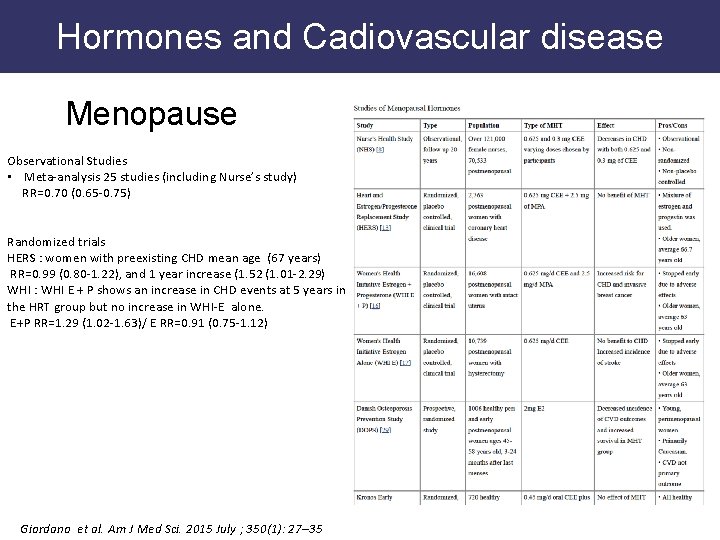
Hormones and Cadiovascular disease Menopause Observational Studies • Meta-analysis 25 studies (including Nurse’s study) RR=0. 70 (0. 65 -0. 75) Randomized trials HERS : women with preexisting CHD mean age (67 years) RR=0. 99 (0. 80 -1. 22), and 1 year increase (1. 52 (1. 01 -2. 29) WHI : WHI E + P shows an increase in CHD events at 5 years in the HRT group but no increase in WHI-E alone. E+P RR=1. 29 (1. 02 -1. 63)/ E RR=0. 91 (0. 75 -1. 12) Giordano et al. Am J Med Sci. 2015 July ; 350(1): 27– 35
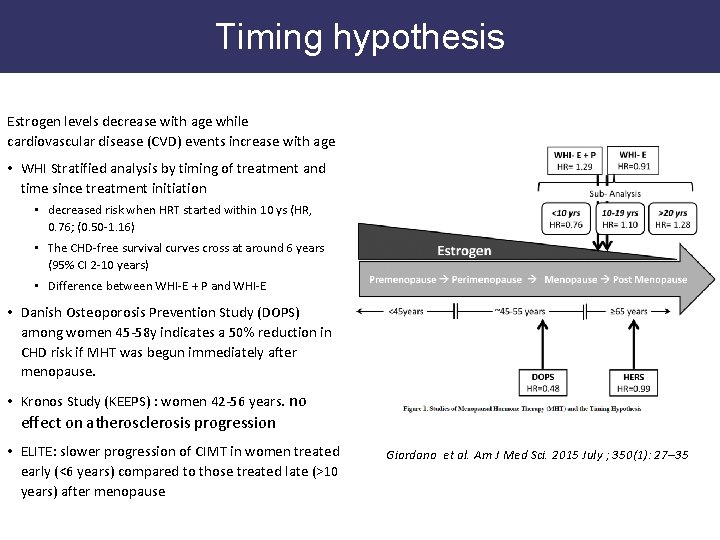
Timing hypothesis Estrogen levels decrease with age while cardiovascular disease (CVD) events increase with age • WHI Stratified analysis by timing of treatment and time since treatment initiation • decreased risk when HRT started within 10 ys (HR, 0. 76; (0. 50 -1. 16) • The CHD-free survival curves cross at around 6 years (95% CI 2 -10 years) • Difference between WHI-E + P and WHI-E • Danish Osteoporosis Prevention Study (DOPS) among women 45 -58 y indicates a 50% reduction in CHD risk if MHT was begun immediately after menopause. • Kronos Study (KEEPS) : women 42 -56 years. no effect on atherosclerosis progression • ELITE: slower progression of CIMT in women treated early (<6 years) compared to those treated late (>10 years) after menopause Giordano et al. Am J Med Sci. 2015 July ; 350(1): 27– 35
The role of Estrogen in the cardiovascular system supports the timing hypothesis Animal Models E 2 inhibits the vascular injury response (inhibitory effects on inflammation & neointima formation in injured arteries ) • E 2 (17 β-estradiol) delays CVD progression and attenuates the inflammatory response to acute vascular injury in animal models, • MPA blocks the vaso-protective effects of E 2 in response to vascular injury(align with WHI-E + P findings) E 2 has age dependent effects on neointima formation and inflammation in vivo and in vitro— differential effects of E 2 in young and aged animals Translational Studies Human uterine arteries have differential responses to E 2 dependent on time since menopause: Increasing pro-inflammatory response to E 2 of the arteries with increasing time post menopause supports the timing hypothesis Giordano et al. Am J Med Sci. 2015 July ; 350(1): 27– 35
- Slides: 11