
Aging and Disability Resource Centers A National Movement
Aging and Disability Resource Centers: A National Movement Susan C. Reinhard Co-Director Rutgers Center for State Health Policy Michigan’s LTC Conference Detroit, Michigan March 23 -24, 2006 1
Goals l Highlight key developments in the Aging and Disability Resource Center movement across the country. l Offer state examples of best practices. l Learn from Michigan. 2
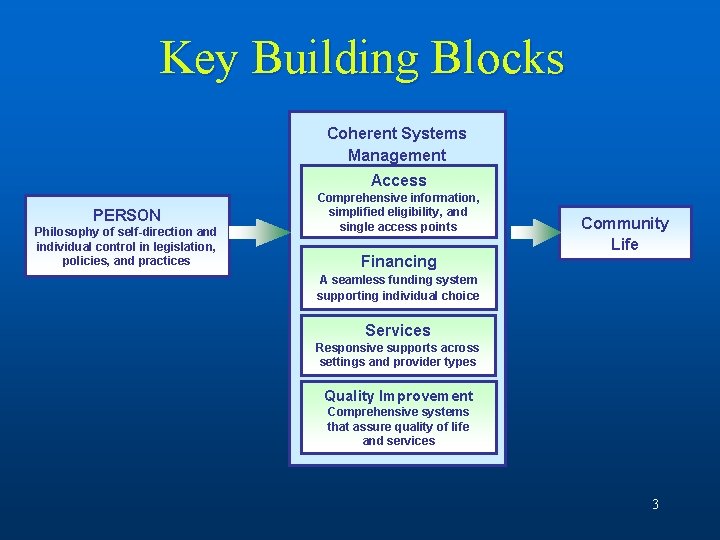
Key Building Blocks Coherent Systems Management Access PERSON Philosophy of self-direction and individual control in legislation, policies, and practices Comprehensive information, simplified eligibility, and single access points Financing Community Life A seamless funding system supporting individual choice Services Responsive supports across settings and provider types Quality Improvement Comprehensive systems that assure quality of life and services 3
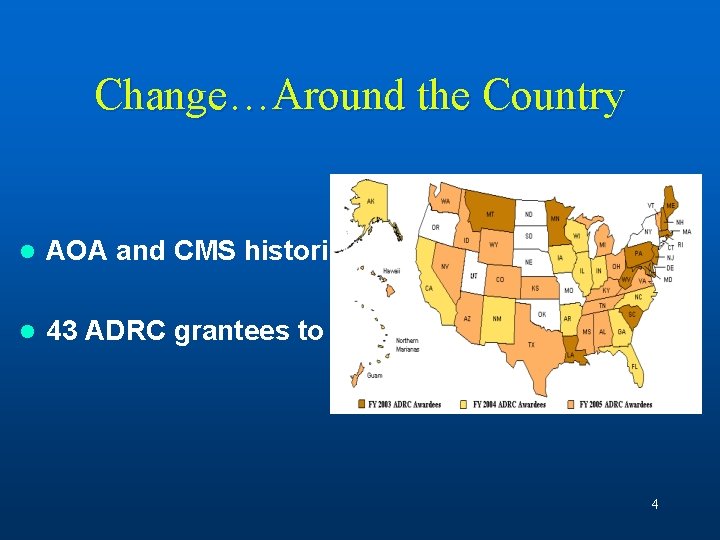
Change…Around the Country l AOA and CMS historic collaboration l 43 ADRC grantees to date 4
What is the ADRC Initiative? l An HHS initiative jointly developed and administered by the Administration on Aging (AOA) and the Centers for Medicare & Medicaid Services (CMS). l 1 st Partnership of this significance between CMS and Ao. A. l Develop a national framework for a single point of entry system in states. l Awards to state agencies coupled with a National Technical Assistance Program led by Lewin and includes Rutgers CSHP. 5
Aging and Disability Resource Center Vision Create a single, coordinated system of information and access for all persons seeking long-term support to minimize confusion, enhance individual choice, and support informed decision-making. 6
Why a Single Point of Entry? l Long-term care system in many states is fragmented and disjointed with many public and private programs and services delivered by a variety of agencies and organizations. l Navigating the long-term care system can be confusing and frustrating for persons with disabilities of all ages and their family members. l Many may be placed in an institutional facility because they and their family members were unaware of, or could not easily access, home and community-based long term care services. 7
Key Questions for States l What is “entry”? l A system that enables consumers to access long-term and supportive services through one agency or organization? l 42 CEPs in 32 states and DC. l Different functions performed. 8
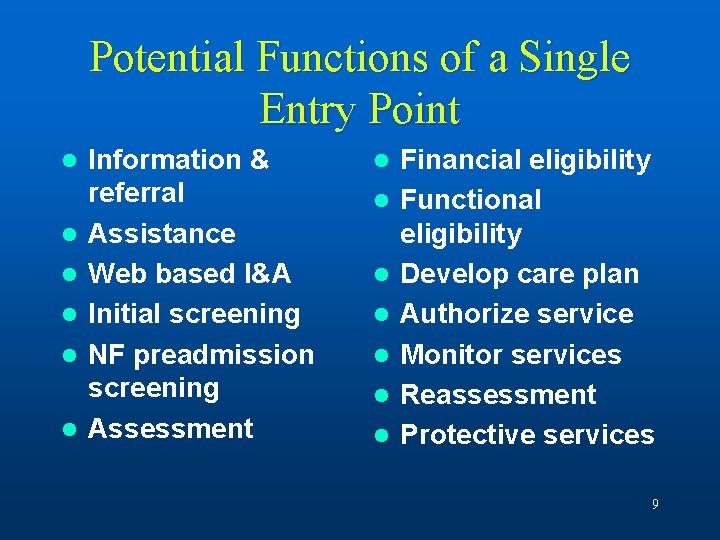
Potential Functions of a Single Entry Point l l l Information & referral Assistance Web based I&A Initial screening NF preadmission screening Assessment l l l l Financial eligibility Functional eligibility Develop care plan Authorize service Monitor services Reassessment Protective services 9
ADRC Role l Provide information and assistance to public and private-pay individuals. l “Entry” point to publicly administered long-term supports. l Target individuals at imminent risk of admission to an institution by creating linkages with the pathways to long-term care. 10
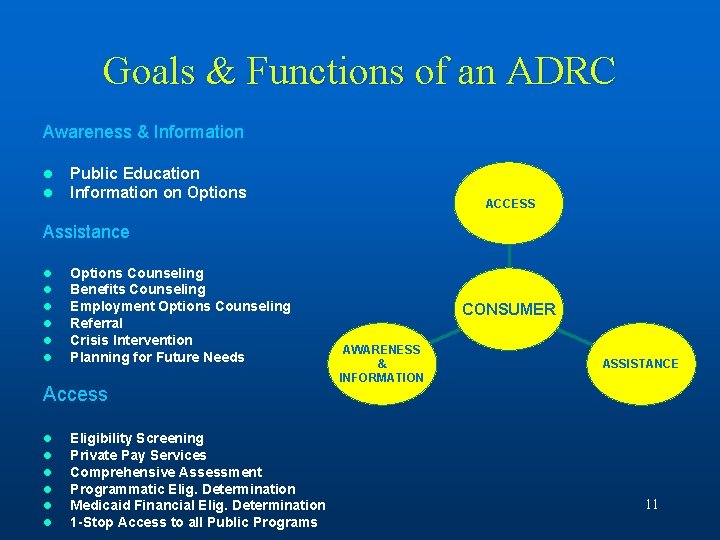
Goals & Functions of an ADRC Awareness & Information l l Public Education Information on Options ACCESS Assistance l l l Options Counseling Benefits Counseling Employment Options Counseling Referral Crisis Intervention Planning for Future Needs Access l l l Eligibility Screening Private Pay Services Comprehensive Assessment Programmatic Elig. Determination Medicaid Financial Elig. Determination 1 -Stop Access to all Public Programs CONSUMER AWARENESS & INFORMATION ASSISTANCE 11
2003 ADRC Grantees l 12 States (first year): Louisiana Maine Maryland Massachusetts Minnesota Montana l New Hampshire New Jersey Pennsylvania Rhode Island South Carolina West Virginia 3 -year cooperative agreement, sustainability 12
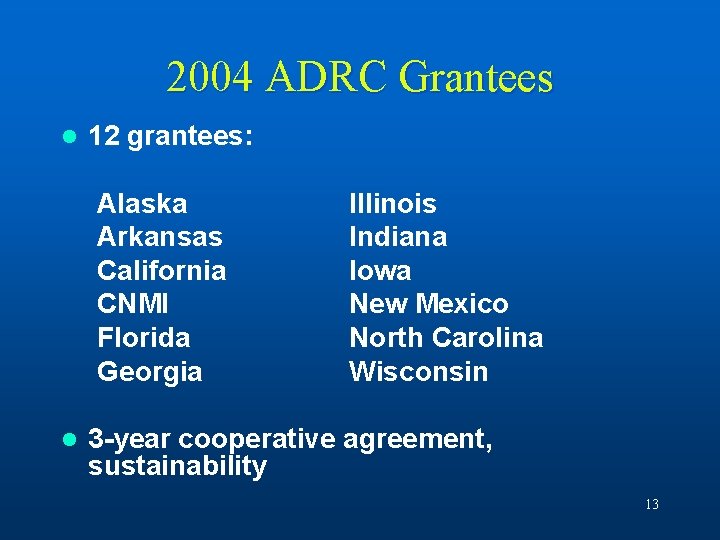
2004 ADRC Grantees l 12 grantees: Alaska Arkansas California CNMI Florida Georgia l Illinois Indiana Iowa New Mexico North Carolina Wisconsin 3 -year cooperative agreement, sustainability 13
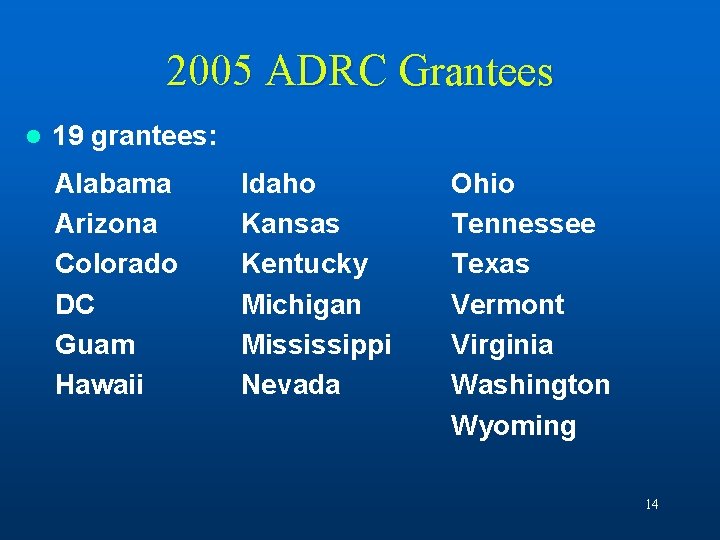
2005 ADRC Grantees l 19 grantees: Alabama Arizona Colorado DC Guam Hawaii Idaho Kansas Kentucky Michigan Mississippi Nevada Ohio Tennessee Texas Vermont Virginia Washington Wyoming 14
Activities of Pilot Sites l Information l Integrated and Referral/Assistance. Management Information Systems. l Public Education and Awareness: – Public websites. – Public web-based searchable resource databases. 15
Activities of Pilot Sites l Streamlining Functional and Financial Eligibility: – Coordination with Medicaid eligibility staff on diversion efforts. – Electronic Medicaid applications. – Series of technical assistance briefs by Rutgers/NASHP (Reinhard/Mollica). l Marketing and Outreach to Target Populations. l Critical Pathway Interventions: – Outreach to hospitals and nursing homes to divert/transition consumers from institutions. 16
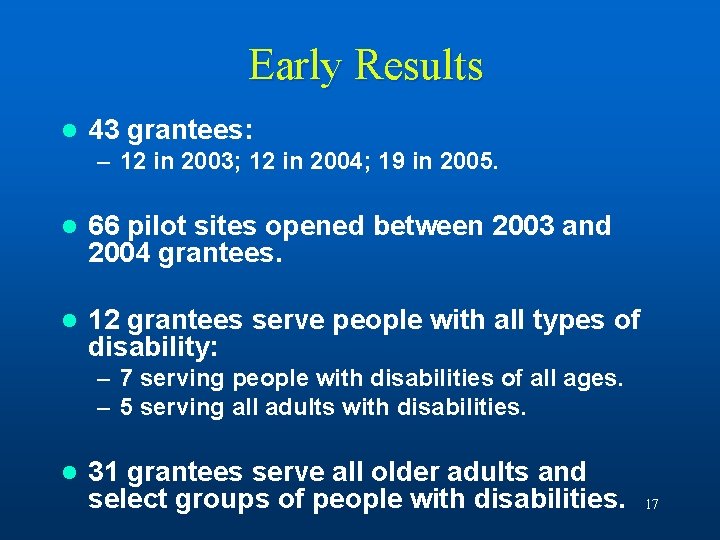
Early Results l 43 grantees: – 12 in 2003; 12 in 2004; 19 in 2005. l 66 pilot sites opened between 2003 and 2004 grantees. l 12 grantees serve people with all types of disability: – 7 serving people with disabilities of all ages. – 5 serving all adults with disabilities. l 31 grantees serve all older adults and select groups of people with disabilities. 17
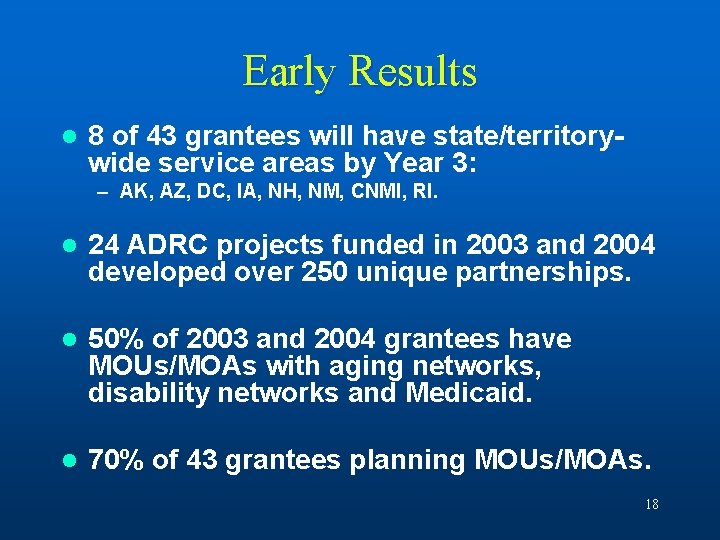
Early Results l 8 of 43 grantees will have state/territorywide service areas by Year 3: – AK, AZ, DC, IA, NH, NM, CNMI, RI. l 24 ADRC projects funded in 2003 and 2004 developed over 250 unique partnerships. l 50% of 2003 and 2004 grantees have MOUs/MOAs with aging networks, disability networks and Medicaid. l 70% of 43 grantees planning MOUs/MOAs. 18
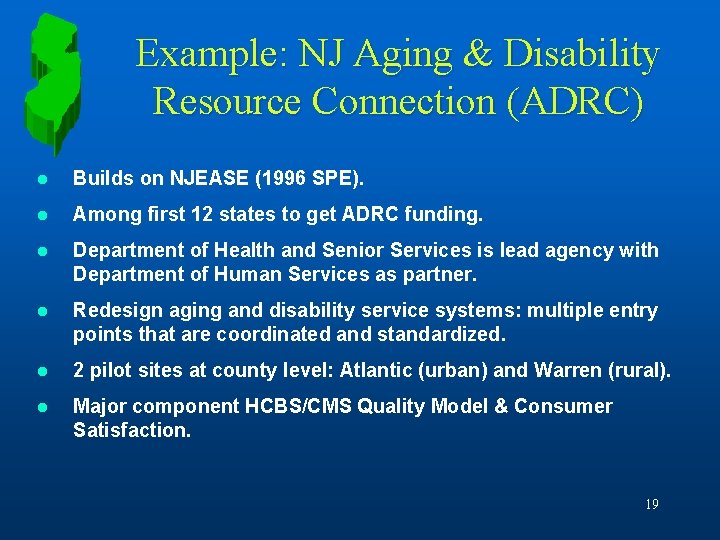
Example: NJ Aging & Disability Resource Connection (ADRC) l Builds on NJEASE (1996 SPE). l Among first 12 states to get ADRC funding. l Department of Health and Senior Services is lead agency with Department of Human Services as partner. l Redesign aging and disability service systems: multiple entry points that are coordinated and standardized. l 2 pilot sites at county level: Atlantic (urban) and Warren (rural). l Major component HCBS/CMS Quality Model & Consumer Satisfaction. 19
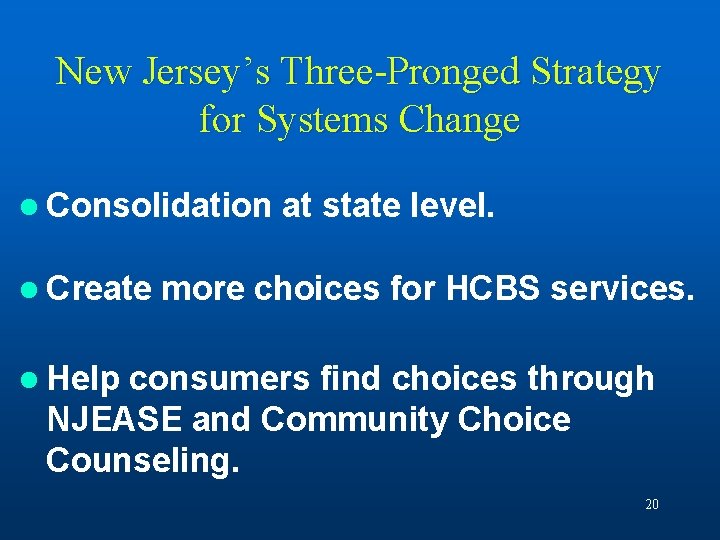
New Jersey’s Three-Pronged Strategy for Systems Change l Consolidation l Create at state level. more choices for HCBS services. l Help consumers find choices through NJEASE and Community Choice Counseling. 20
ADRC Target Populations l Year 1: – 60 and older. l Years 2 and 3: – 60 and older; – Adults with physical disabilities. l Special focus on hard-to-serve and underserved populations. 21
NJ ADRC Goals l Bring Aging and Disability together. l Improve pathways to obtain information, determine financial and functional eligibility, and receive services. l Build on NJ EASE as visible, responsive, and trusted sole source for home and community-based services available 24/7/365. 22
Community Choice Counseling l One of largest nursing home transition programs in the nation. l State staff members crosstrained to do Pre-admission screening, options counseling, and transition support. 23
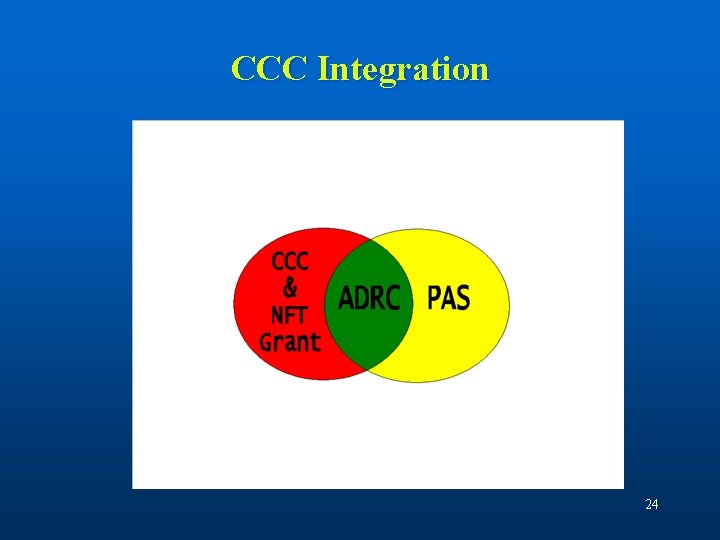
CCC Integration 24
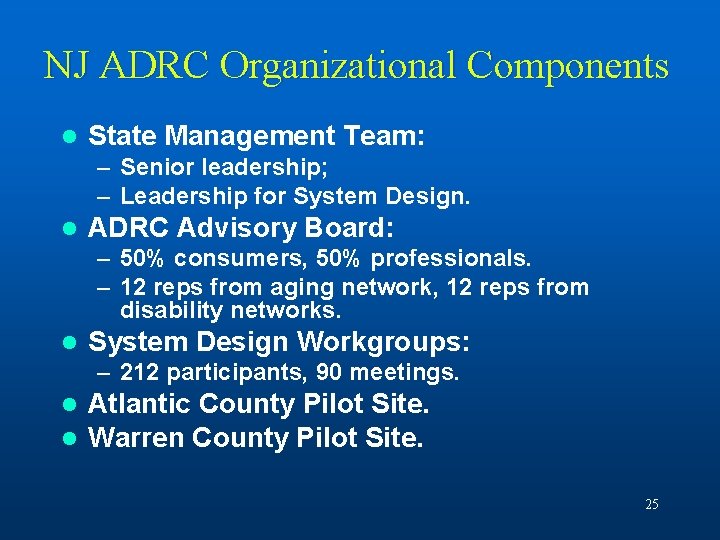
NJ ADRC Organizational Components l State Management Team: – Senior leadership; – Leadership for System Design. l ADRC Advisory Board: – 50% consumers, 50% professionals. – 12 reps from aging network, 12 reps from disability networks. l System Design Workgroups: – 212 participants, 90 meetings. l l Atlantic County Pilot Site. Warren County Pilot Site. 25
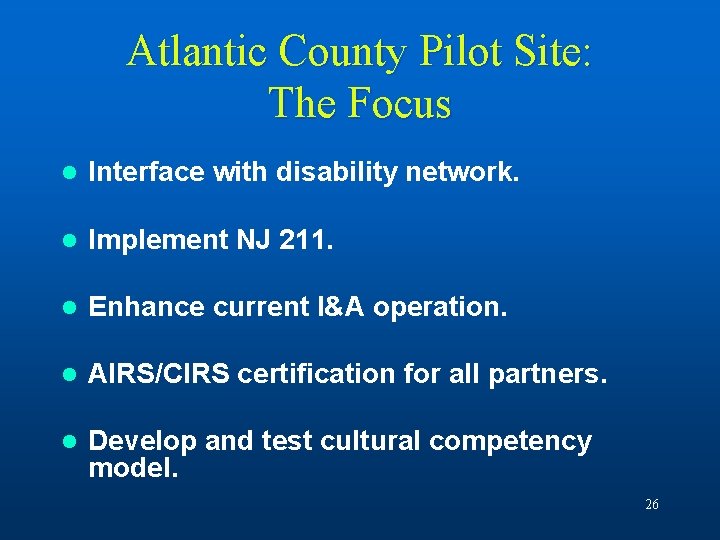
Atlantic County Pilot Site: The Focus l Interface with disability network. l Implement NJ 211. l Enhance current I&A operation. l AIRS/CIRS certification for all partners. l Develop and test cultural competency model. 26
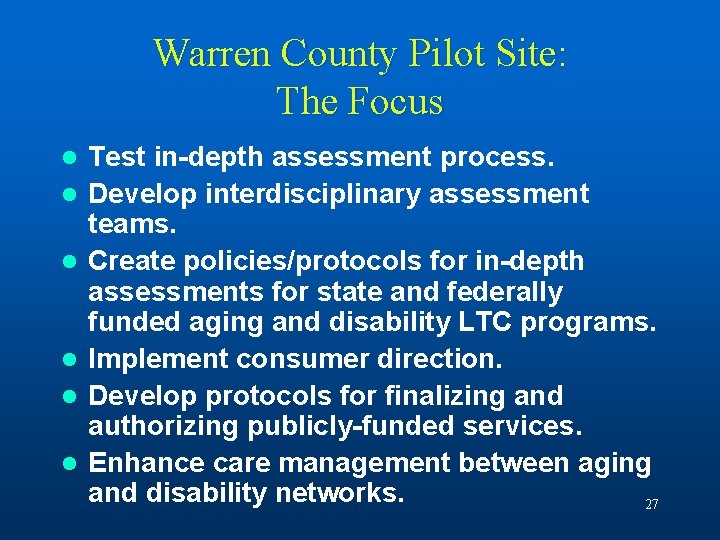
Warren County Pilot Site: The Focus l l l Test in-depth assessment process. Develop interdisciplinary assessment teams. Create policies/protocols for in-depth assessments for state and federally funded aging and disability LTC programs. Implement consumer direction. Develop protocols for finalizing and authorizing publicly-funded services. Enhance care management between aging and disability networks. 27
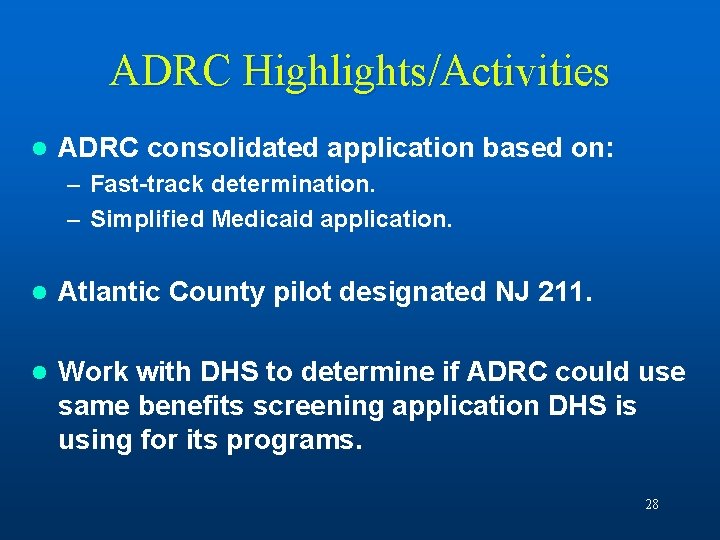
ADRC Highlights/Activities l ADRC consolidated application based on: – Fast-track determination. – Simplified Medicaid application. l Atlantic County pilot designated NJ 211. l Work with DHS to determine if ADRC could use same benefits screening application DHS is using for its programs. 28
ADRC Highlights/Activities l Definition of cultural competency approved. – Will serve as guide for training curriculum development. l Public awareness campaign: – Surveys sent to service providers statewide; – 6 focus groups in Atlantic County to learn about how residents hear about ADRC services, their needs and priorities. 29
Lessons Learned l Interdependency between Medicaid and aging and disability networks. l Communications and face-to-face dialogue with stakeholders (AAAs, LTC providers) are key. l Message control and revision need to be on-going during ADRC implementation. 30
Example: Wisconsin’s Aging and Disability Resource Centers l l l 3 -year FY 04 grant of $800, 000. Lead agency: Wisconsin Department of Health and Family Services. Expand geographic coverage of fullservice ADRCs. Develop capacity for all target groups. Develop infrastructure to support statewide expansion. 31
WI ADRC Goals/Activities l Develop state-level infrastructure to support current and future development of statewide ADRC system. – 2 toolkits: one for public awareness; one for LTC options counseling. – Identify and implement information management system solutions for consistent state and local data collection and reporting. l Merge department responsible for Medicaid financial eligibility (formerly Department of Workforce Development) with Department of Health and Family Services. l Develop MOUs with financial eligibility units to establish roles of ADRC in coordinating financial eligibility process. 32
WI ADRC Goals/Activities Statewide web-based resource database. l Integration of functional screen with financial eligibility database and I&A data. l Functional screen web development for children and people with mental health issues. l Greater collaboration between county agencies and community resources. l 33
WI ADRC Target Populations l Year I: – 60 and older; – At least one other target group (adults with physical disabilities or developmental disabilities. l Year II: – 60 and older; – Adults with physical disabilities and/or developmental disabilities. l Year III: – 60 and older; – Adults with physical and/or developmental disabilities; – Adults with mental health needs. 34
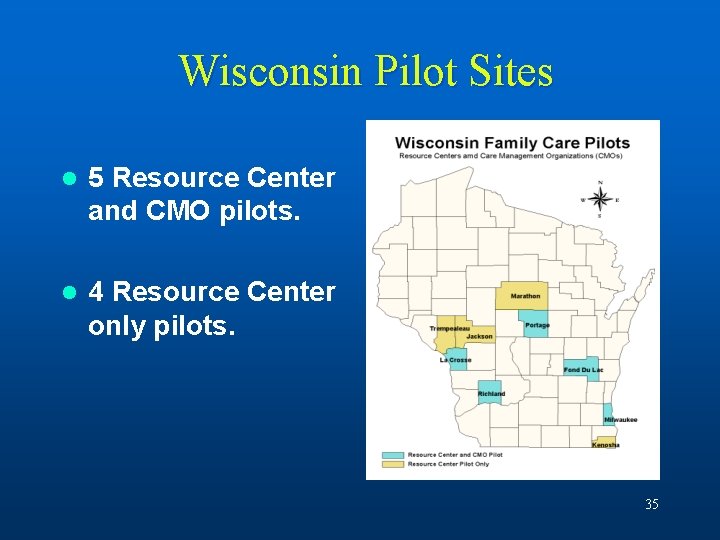
Wisconsin Pilot Sites l 5 Resource Center and CMO pilots. l 4 Resource Center only pilots. 35
Wisconsin’s Family Care Program l. A redesign of WI’s LTC system. l Gives people better choices about where to live and what services/supports to receive. l Improves access to services. l Improves quality through focus on health and social outcomes. l Creates a cost-effective system. 36
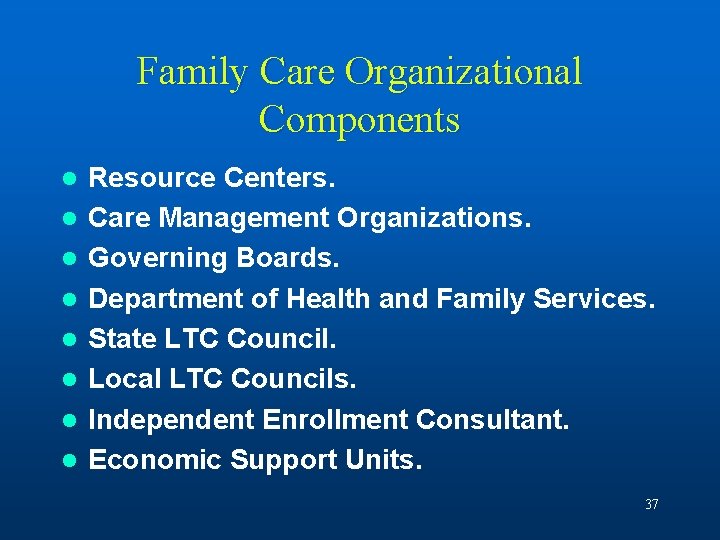
Family Care Organizational Components l l l l Resource Centers. Care Management Organizations. Governing Boards. Department of Health and Family Services. State LTC Council. Local LTC Councils. Independent Enrollment Consultant. Economic Support Units. 37
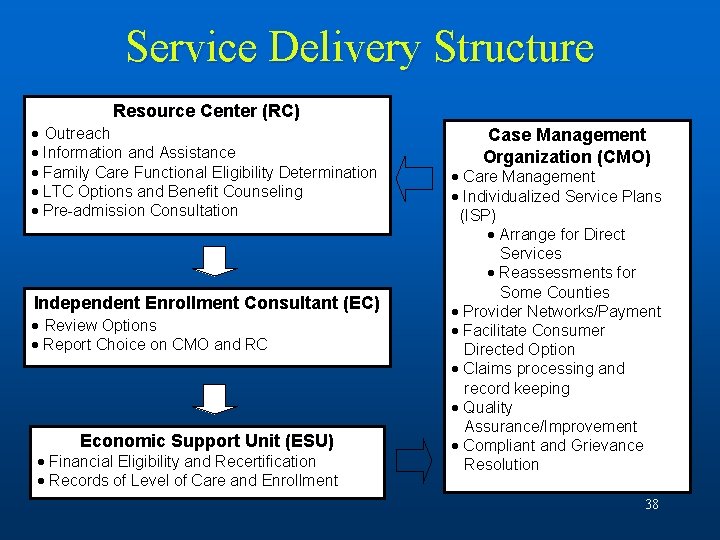
Service Delivery Structure · Outreach Resource Center (RC) · Information and Assistance · Family Care Functional Eligibility Determination · LTC Options and Benefit Counseling · Pre-admission Consultation Independent Enrollment Consultant (EC) · Review Options · Report Choice on CMO and RC Economic Support Unit (ESU) · Financial Eligibility and Recertification · Records of Level of Care and Enrollment Case Management Organization (CMO) · Care Management · Individualized Service Plans (ISP) · Arrange for Direct Services · Reassessments for Some Counties · Provider Networks/Payment · Facilitate Consumer Directed Option · Claims processing and record keeping · Quality Assurance/Improvement · Compliant and Grievance Resolution 38
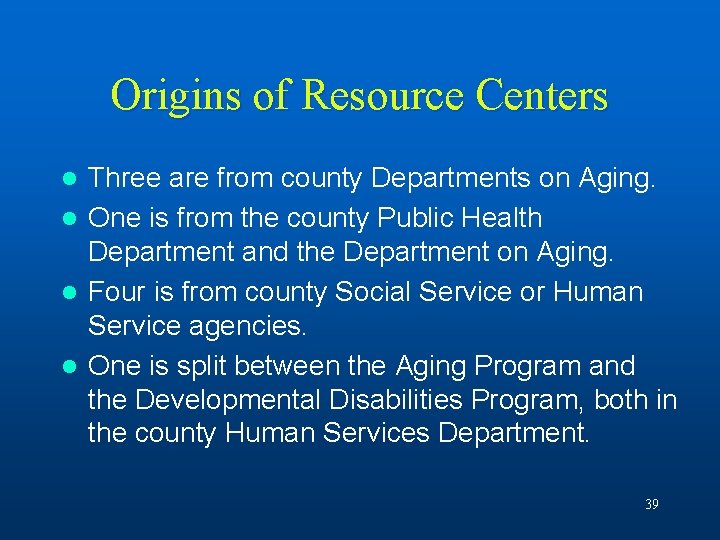
Origins of Resource Centers Three are from county Departments on Aging. l One is from the county Public Health Department and the Department on Aging. l Four is from county Social Service or Human Service agencies. l One is split between the Aging Program and the Developmental Disabilities Program, both in the county Human Services Department. l 39
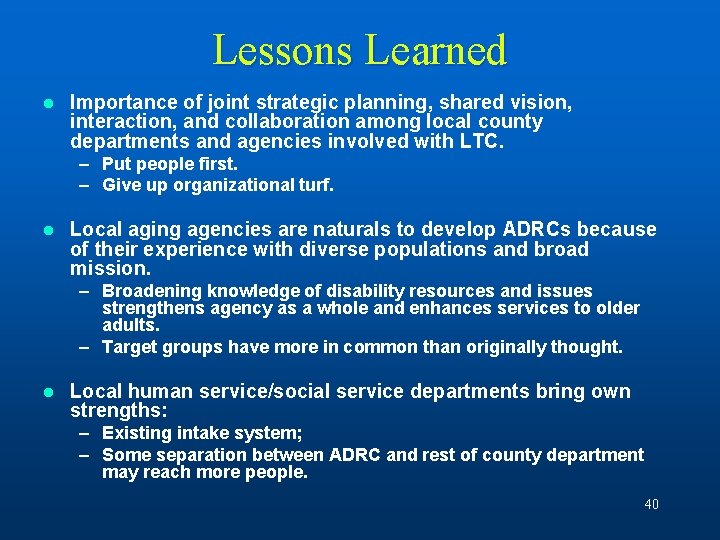
Lessons Learned l Importance of joint strategic planning, shared vision, interaction, and collaboration among local county departments and agencies involved with LTC. – Put people first. – Give up organizational turf. l Local aging agencies are naturals to develop ADRCs because of their experience with diverse populations and broad mission. – Broadening knowledge of disability resources and issues strengthens agency as a whole and enhances services to older adults. – Target groups have more in common than originally thought. l Local human service/social service departments bring own strengths: – Existing intake system; – Some separation between ADRC and rest of county department may reach more people. 40
Lessons Learned l Communication and collaboration between all local entities involved in eligibility is vital to make the process work for consumers. – Having written access plans or MOUs between local entities is helpful in having common ground to refer back to. l Outreach and marketing needs to be ongoing. – Involves all kinds of staff: administrative, nursing, and social work. l Developing, paying for, and continuing to support information systems necessary for I&A is challenging: – Allot ample time to keep resource database updated. – Partner with United Way First Call for Help for assistance in updating. – Pre-existing software packages to establish database may be useful. 41
Lessons Learned l Prevention activities are useful tools for marketing and outreach. l Short-term case management is a natural component of I&A. – Private-pay and publicly-funded people have same short-term needs. – Maintain list of people who provide chore services to increase access to services for private-pay LTC consumers. 42
Lessons Learned l It takes at least a year to fully train I&A specialist. – Mentoring and shadowing experienced staff very effective training tool. l What to look for in I&A staff: – Ability to communicate effectively in person or on the phone. – Interviewing and listening skills. – Ability to focus on consumer’s agenda, not staff’s. – Good observational skills. – Ready to offer short-term services. – Experience/background with target population. – Knowledge of how service system works. 43
Example: Washington Aging and Disability Resource Center l 3 -year FY 05 grant of $800, 000. l Lead agency: Washington Department of Social and Health Services, Aging and Disability Services Administration. l Expand capabilities of I&R/A system to serve people of all ages, disabilities, and financial circumstances. l Connect seamlessly to relevant home and communitybased services and supports. 44
Split SEP System in Washington l State agency staff completes all assessments. l Determines clinical and financial eligibility. l Reviews service options. l Develops initial care plan. l Provides CM for consumers in nursing homes and residential settings. l AAAs provide ongoing CM for in-home clients. 45
WA ADRC Goals/Activities Build partnerships with other state-level agencies, independent living centers, 211, and other associations. l Employ technology for seamless ADRC one-stop operations. l Expand CARE system to assess individuals for non-Medicaid funded programs. l 46
WA ADRC Goals/Activities Use social marketing strategies to actively promote public awareness of both public and private long-term support options and the Resource Center. l Improve connections with NAPIS reporting system and Benefits Check Up. l 47
WA ADRC Target Populations l Year 1: – 60 and older; – Adults with functional disabilities. l Years 2 and 3: – 60 and older; – Adults with functional disabilities; – People of all ages with developmental disabilities. 48
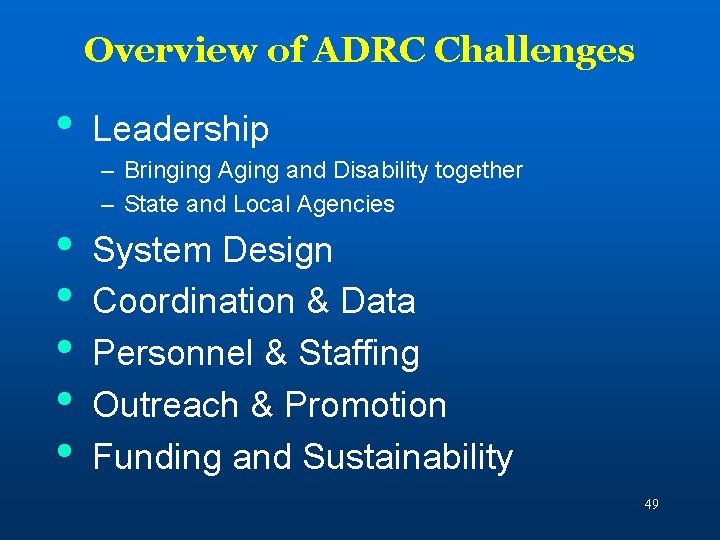
Overview of ADRC Challenges • • • Leadership – Bringing Aging and Disability together – State and Local Agencies System Design Coordination & Data Personnel & Staffing Outreach & Promotion Funding and Sustainability 49
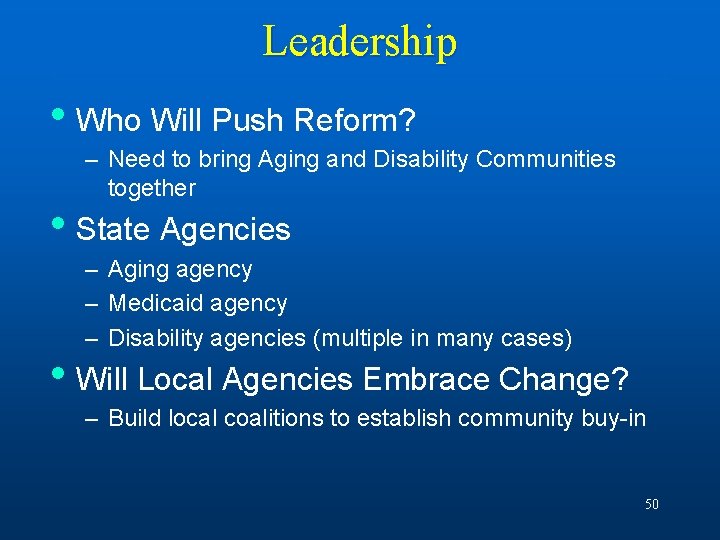
Leadership • Who Will Push Reform? – Need to bring Aging and Disability Communities together • State Agencies – Aging agency – Medicaid agency – Disability agencies (multiple in many cases) • Will Local Agencies Embrace Change? – Build local coalitions to establish community buy-in 50
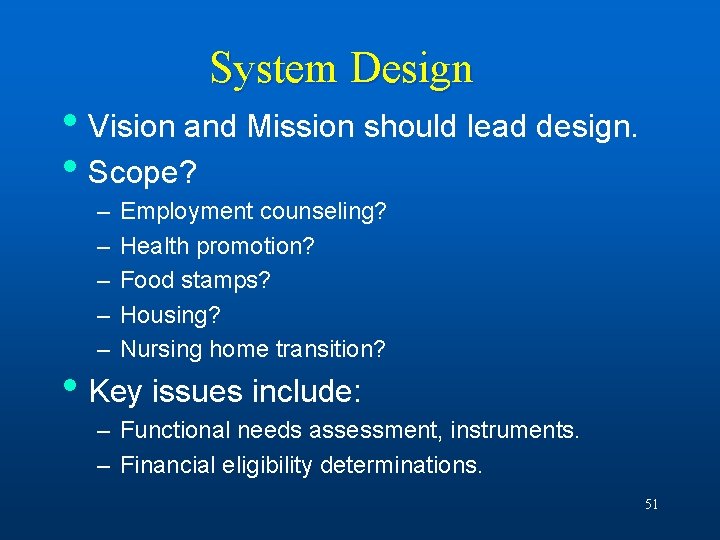
System Design • Vision and Mission should lead design. • Scope? – – – Employment counseling? Health promotion? Food stamps? Housing? Nursing home transition? • Key issues include: – Functional needs assessment, instruments. – Financial eligibility determinations. 51
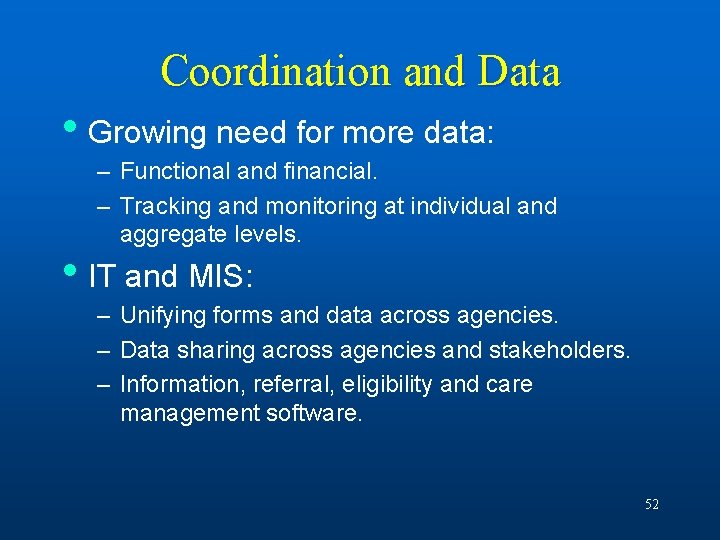
Coordination and Data • Growing need for more data: – Functional and financial. – Tracking and monitoring at individual and aggregate levels. • IT and MIS: – Unifying forms and data across agencies. – Data sharing across agencies and stakeholders. – Information, referral, eligibility and care management software. 52
Personnel & Staffing • Budget challenges. • Skill mix (credentials, unions). • Cross Training (aging and disability, cultural competence, programs). 53
Outreach & Promotion • Reaching all older adults regardless of income. • Reaching persons with disabilities. • Social marketing. • Capacity in relation to outreach. 54
Funding and Sustainability • Business model: – Increasing Service Demand as visibility increases. – Unfamiliar funding streams--private pay and Medicaid in addition to OAA. • How much public funding needed? ? – Political Support. – Details on matching funds. 55
Susan C. Reinhard Co-Director Rutgers Center for State Health Policy Director Community Living Exchange at Rutgers Technical Assistance for Real Systems Change 732 -932 -4649 sreinhard@ifh. rutgers. edu 56
- Slides: 56