
Agile Management Change Why Enterprise Agile is Fragile
- Slides: 35
Agile Management Change: Why Enterprise Agile is Fragile Toby. Elwin. com
Agile Transformation Agile transformation improves when policy, collaboration, and decisionmaking guidance has direct Agile experience The focus is to enable those who: • Create policy • Reorganize the company • Create job roles • Design compensation and rewards – For the individual – For the team – Across departments • Budget • Finance The deck reviews: 1. Impact of Experience and Training on enterprise guidance 2. Transformation Models: 1. Agile Fluency model 2. Scaled Agile Framework Implementation Roadmap 3. Agile Change Management: – – Develop Enable Adapt Own 2
Impact of Experience and Training on Enterprise Guidance The trouble with training: 1. Learning without practice 2. Training and forgetting 3. Experience without context 3
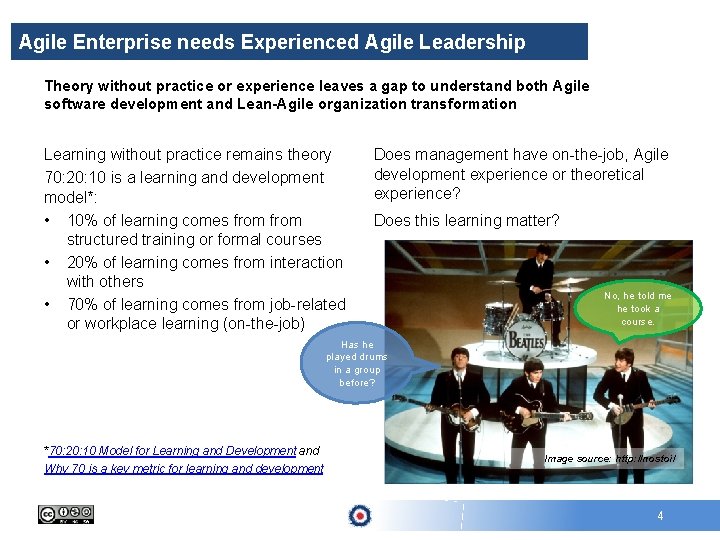
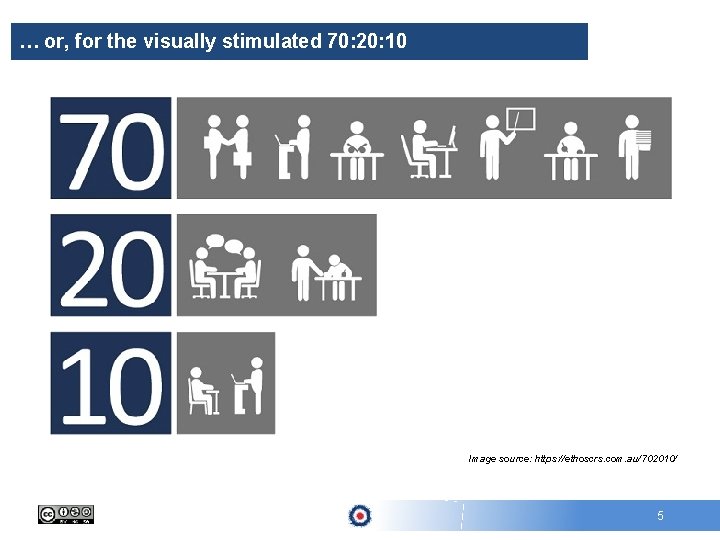
Agile Enterprise needs Experienced Agile Leadership Theory without practice or experience leaves a gap to understand both Agile software development and Lean-Agile organization transformation Learning without practice remains theory 70: 20: 10 is a learning and development model*: • 10% of learning comes from structured training or formal courses • 20% of learning comes from interaction with others • 70% of learning comes from job-related or workplace learning (on-the-job) Does management have on-the-job, Agile development experience or theoretical experience? Does this learning matter? No, he told me he took a course. Has he played drums in a group before? *70: 20: 10 Model for Learning and Development and Why 70 is a key metric for learning and development Image source: http: //nostoi/ 4
… or, for the visually stimulated 70: 20: 10 Image source: https: //ethoscrs. com. au/702010/ 5
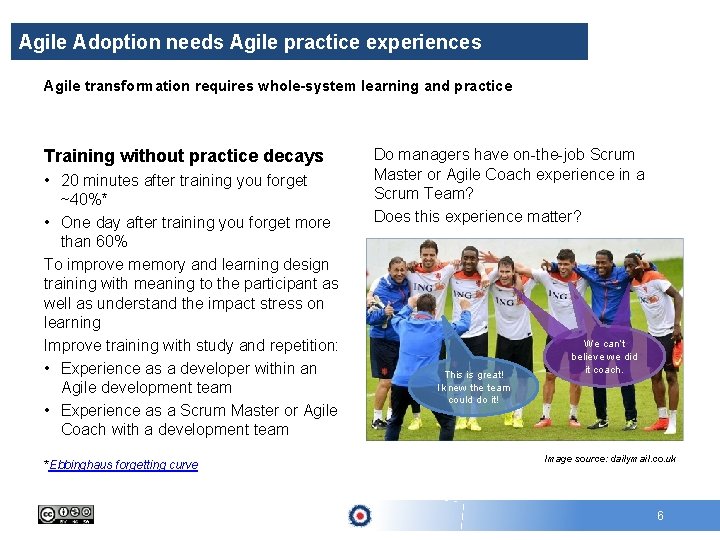
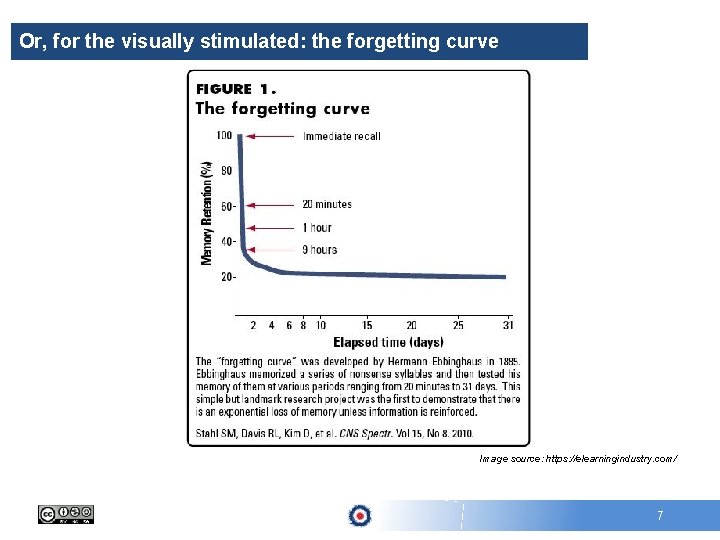
Agile Adoption needs Agile practice experiences Agile transformation requires whole-system learning and practice Training without practice decays • 20 minutes after training you forget ~40%* • One day after training you forget more than 60% To improve memory and learning design training with meaning to the participant as well as understand the impact stress on learning Improve training with study and repetition: • Experience as a developer within an Agile development team • Experience as a Scrum Master or Agile Coach with a development team *Ebbinghaus forgetting curve Do managers have on-the-job Scrum Master or Agile Coach experience in a Scrum Team? Does this experience matter? This is great! I knew the team could do it! We can’t believe we did it coach. Image source: dailymail. co. uk 6
Or, for the visually stimulated: the forgetting curve Image source: https: //elearningindustry. com/ 7
Agile Adoption needs experiences to practice agile Agile transformation requires whole-system learning and practice Policy without experience is conjecture to impact decisions for: 1. Project method: • Sequential, Hybrid, Agile, Scaled Agile Framework, EPMO Does executive-level, management, or team training provide enough context to set policy or organization design? Does context matter? 2. Development frameworks: • Extreme Programming, Lean Development, Acceptance Test Driven Development, Scrum 3. Human Capital: • Job title, management role, performance incentives, staffing 4. Finance: • Budget, Enterprise Resource Planning/Utilization, Sales, Revenue, Contracts Image source: https: //si. com 8
Transformation models Scale with system: 1. Scaled Agile Framework Transformation Roadmap 2. Agile Fluency Model 3. Agile Organization Adoption 9
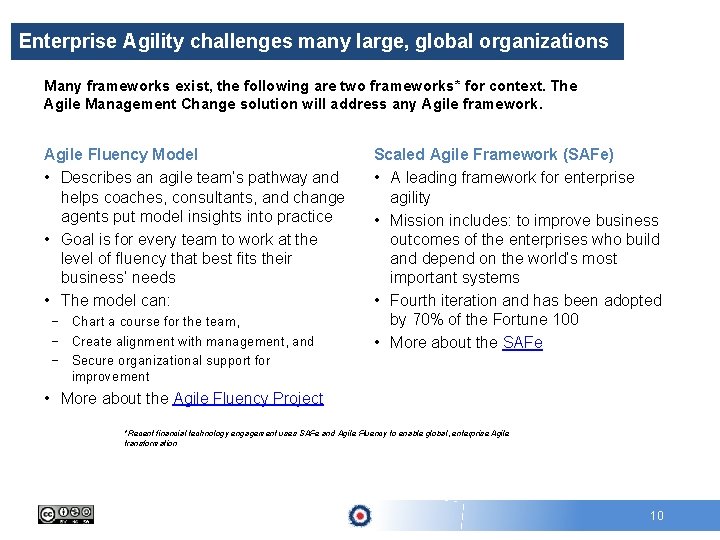
Enterprise Agility challenges many large, global organizations Many frameworks exist, the following are two frameworks* for context. The Agile Management Change solution will address any Agile framework. Agile Fluency Model • Describes an agile team’s pathway and helps coaches, consultants, and change agents put model insights into practice • Goal is for every team to work at the level of fluency that best fits their business’ needs • The model can: − Chart a course for the team, − Create alignment with management, and − Secure organizational support for improvement Scaled Agile Framework (SAFe) • A leading framework for enterprise agility • Mission includes: to improve business outcomes of the enterprises who build and depend on the world’s most important systems • Fourth iteration and has been adopted by 70% of the Fortune 100 • More about the SAFe • More about the Agile Fluency Project *Recent financial technology engagement uses SAFe and Agile Fluency to enable global, enterprise Agile transformation 10
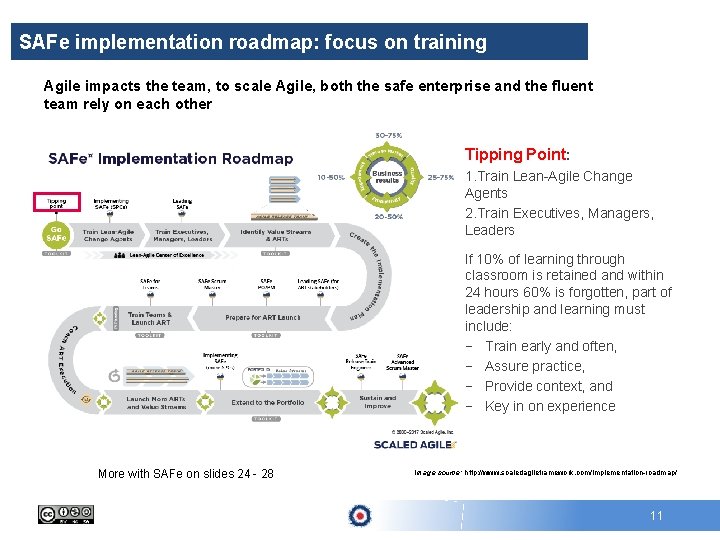
SAFe implementation roadmap: focus on training Agile impacts the team, to scale Agile, both the safe enterprise and the fluent team rely on each other Tipping Point: 1. Train Lean-Agile Change Agents 2. Train Executives, Managers, Leaders If 10% of learning through classroom is retained and within 24 hours 60% is forgotten, part of leadership and learning must include: − Train early and often, − Assure practice, − Provide context, and − Key in on experience More with SAFe on slides 24 - 28 Image source: http: //www. scaledagileframework. com/implementation-roadmap/ 11
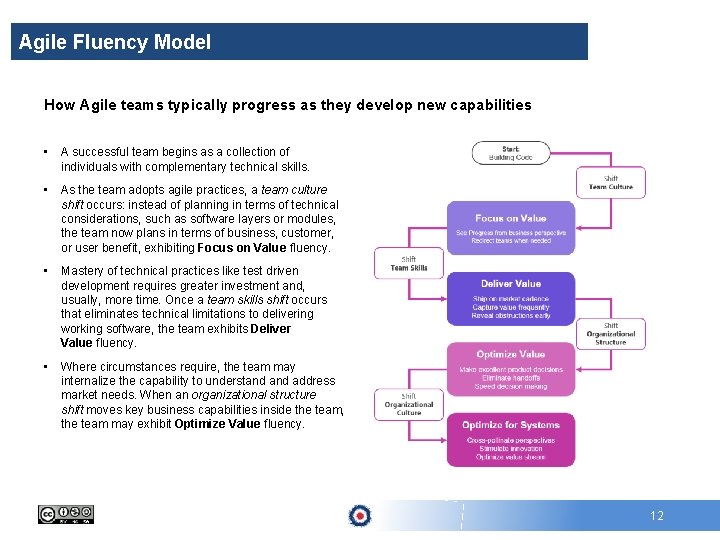
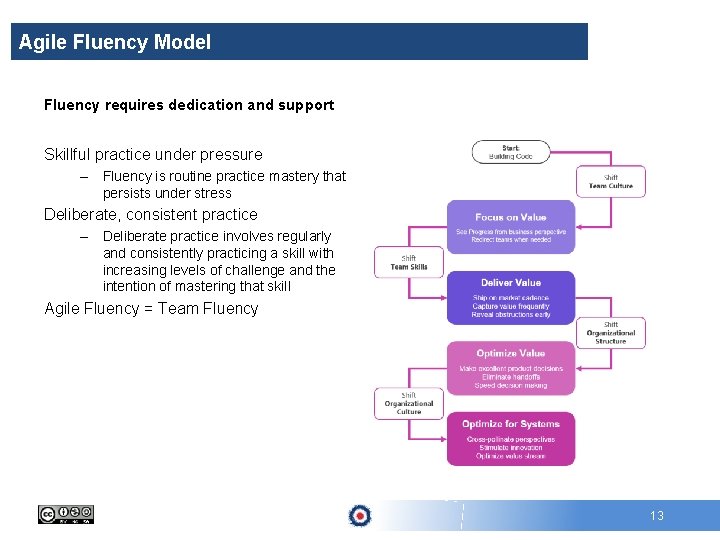
Agile Fluency Model How Agile teams typically progress as they develop new capabilities • A successful team begins as a collection of individuals with complementary technical skills. • As the team adopts agile practices, a team culture shift occurs: instead of planning in terms of technical considerations, such as software layers or modules, the team now plans in terms of business, customer, or user benefit, exhibiting Focus on Value fluency. • Mastery of technical practices like test driven development requires greater investment and, usually, more time. Once a team skills shift occurs that eliminates technical limitations to delivering working software, the team exhibits Deliver Value fluency. • Where circumstances require, the team may internalize the capability to understand address market needs. When an organizational structure shift moves key business capabilities inside the team, the team may exhibit Optimize Value fluency. 12
Agile Fluency Model Fluency requires dedication and support Skillful practice under pressure – Fluency is routine practice mastery that persists under stress Deliberate, consistent practice – Deliberate practice involves regularly and consistently practicing a skill with increasing levels of challenge and the intention of mastering that skill Agile Fluency = Team Fluency 13
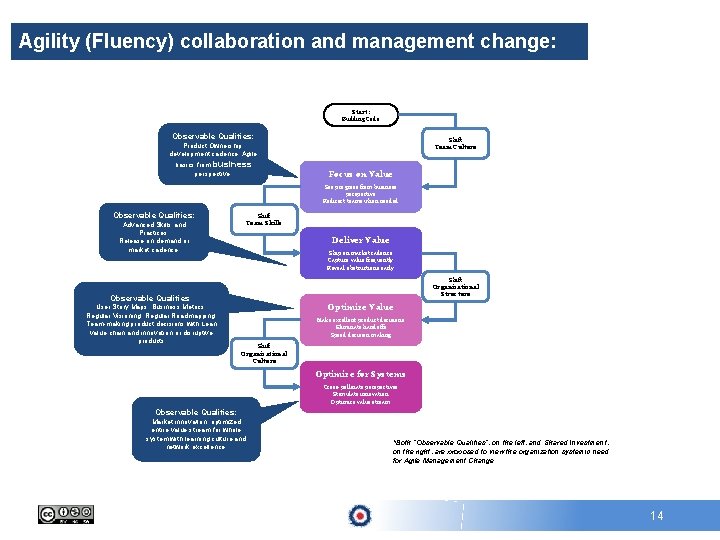
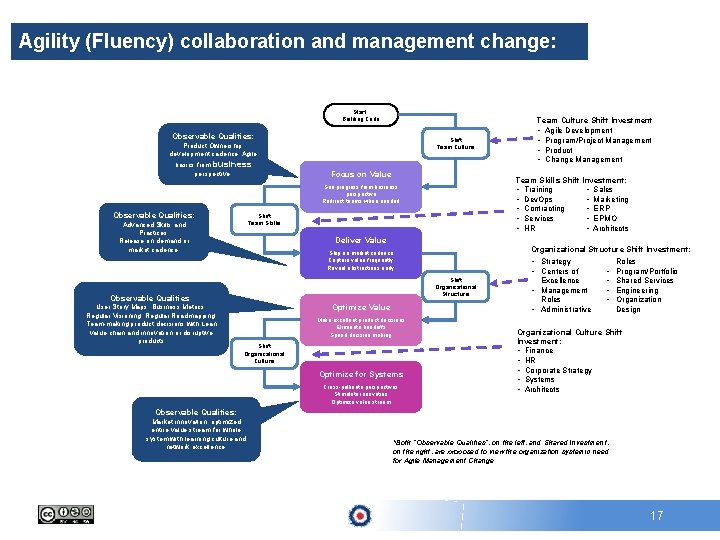
Agility (Fluency) collaboration and management change: Start: Building Code Observable Qualities: Product Ownership, development cadence, Agile basics from business perspective. Shift Team Culture Focus on Value See progress from business perspective Redirect teams when needed Observable Qualities: Advanced Skills and Practices, Release on demand or market cadence. Observable Qualities : User Story Maps, Business Metrics, Regular Visioning, Regular Roadmapping, Team-making product decisions with Lean value chain and innovation or disruptive products Shift Team Skills Deliver Value Ship on market cadence Capture value frequently Reveal obstructions early Shift Organizational Structure Optimize Value Make excellent product decisions Eliminate handoffs Speed decision making Shift Organizational Culture Optimize for Systems Cross-pollinate perspectives Stimulate innovation Optimize value stream Observable Qualities: Market innovation, optimized entire value stream for whole system with learning culture and network excellence. *Both “Observable Qualities”, on the left, and Shared Investment, on the right, are proposed to view the organization systemic need for Agile Management Change. 14
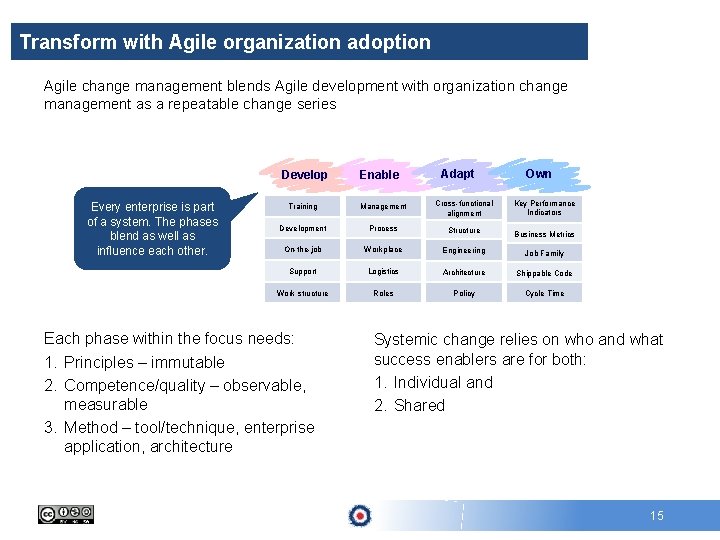
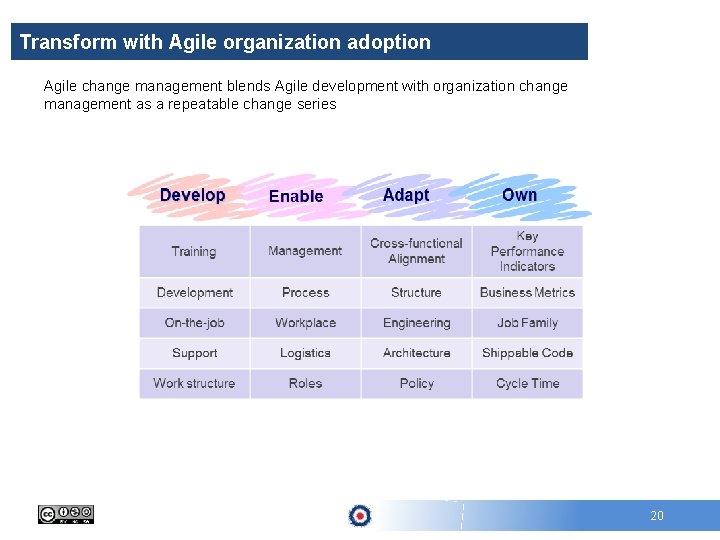
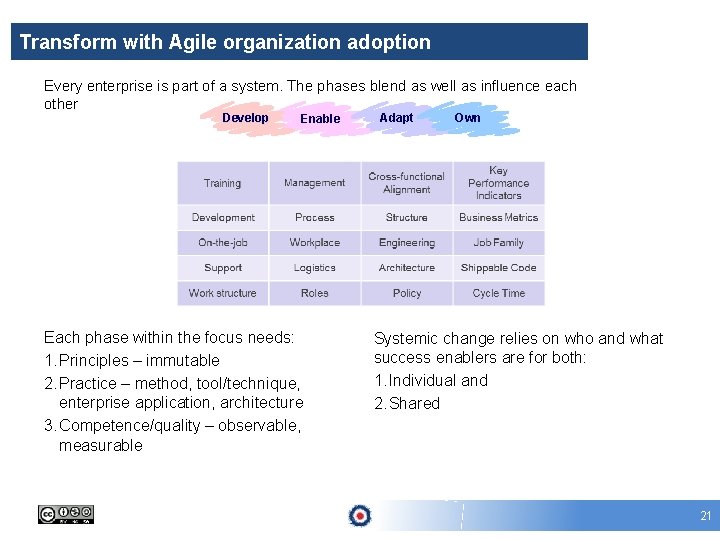
Transform with Agile organization adoption Agile change management blends Agile development with organization change management as a repeatable change series Develop Every enterprise is part of a system. The phases blend as well as influence each other. Enable Adapt Own Training Management Cross-functional alignment Key Performance Indicators Development Process Structure Business Metrics On-the-job Workplace Engineering Job Family Support Logistics Architecture Shippable Code Work structure Roles Policy Cycle Time Each phase within the focus needs: 1. Principles – immutable 2. Competence/quality – observable, measurable 3. Method – tool/technique, enterprise application, architecture Systemic change relies on who and what success enablers are for both: 1. Individual and 2. Shared 15
Agile Change Management Organization Adoption with Agile Development Principles 1. Agile Fluency Model with Develop > Enable > Adapt > Own 2. Scaled Agile Framework 4. 5 models 16
Agility (Fluency) collaboration and management change: Start: Building Code Observable Qualities: Product Ownership, development cadence, Agile basics from business perspective. Shift Team Culture Focus on Value Team Skills Shift Investment: Training • Sales Dev. Ops • Marketing • ERP Contracting • EPMO Services • Architects HR See progress from business perspective Redirect teams when needed Observable Qualities: Advanced Skills and Practices, Release on demand or market cadence. Observable Qualities : User Story Maps, Business Metrics, Regular Visioning, Regular Roadmapping, Team-making product decisions with Lean value chain and innovation or disruptive products Team Culture Shift Investment • Agile Development • Program/Project Management • Product • Change Management • • • Shift Team Skills Deliver Value Ship on market cadence Capture value frequently Reveal obstructions early Shift Organizational Structure Optimize Value Make excellent product decisions Eliminate handoffs Speed decision making Shift Organizational Culture Optimize for Systems Cross-pollinate perspectives Stimulate innovation Optimize value stream Organizational Structure Shift Investment: • Strategy Roles • Centers of • Program/Portfolio • Shared Services Excellence • Engineering • Management • Organization Roles Design • Administrative Organizational Culture Shift Investment: • Finance • HR • Corporate Strategy • Systems • Architects Observable Qualities: Market innovation, optimized entire value stream for whole system with learning culture and network excellence. *Both “Observable Qualities”, on the left, and Shared Investment, on the right, are proposed to view the organization systemic need for Agile Management Change. 17
Agile Change Management Organization Adoption with Agile Development Principles 1. Agile Fluency Model with Develop > Enable > Adapt > Own 2. Scaled Agile Framework 4. 5 models 18
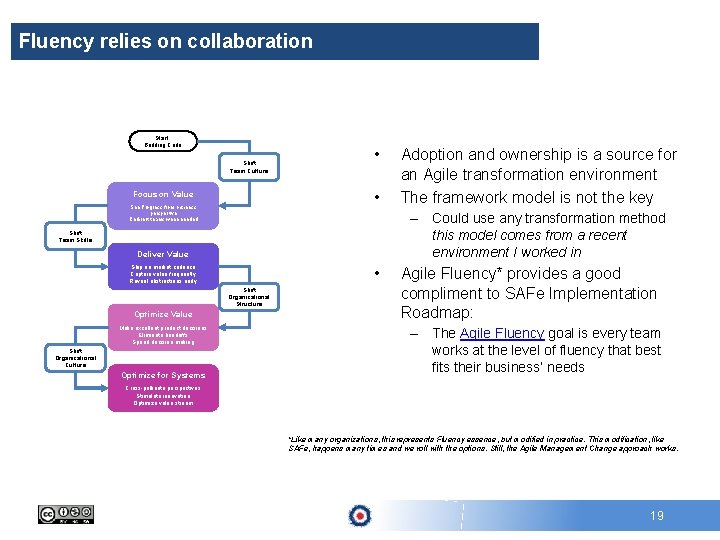
Fluency relies on collaboration Start: Building Code Shift Team Culture • • Focus on Value See Progress from business perspective Redirect teams when needed – Could use any transformation method this model comes from a recent environment I worked in Shift Team Skills Deliver Value Ship on market cadence Capture value frequently Reveal obstructions early • Shift Organizational Structure Optimize Value Make excellent product decisions Eliminate handoffs Speed decision making Shift Organizational Culture Optimize for Systems Adoption and ownership is a source for an Agile transformation environment The framework model is not the key Agile Fluency* provides a good compliment to SAFe Implementation Roadmap: – The Agile Fluency goal is every team works at the level of fluency that best fits their business’ needs Cross-pollinate perspectives Stimulate innovation Optimize value stream *Like many organizations, this represents Fluency essence, but modified in practice. This modification, like SAFe, happens many times and we roll with the options. Still, the Agile Management Change approach works. 19
Transform with Agile organization adoption Agile change management blends Agile development with organization change management as a repeatable change series 20
Transform with Agile organization adoption Every enterprise is part of a system. The phases blend as well as influence each other Develop Enable Each phase within the focus needs: 1. Principles – immutable 2. Practice – method, tool/technique, enterprise application, architecture 3. Competence/quality – observable, measurable Adapt Own Systemic change relies on who and what success enablers are for both: 1. Individual and 2. Shared 21
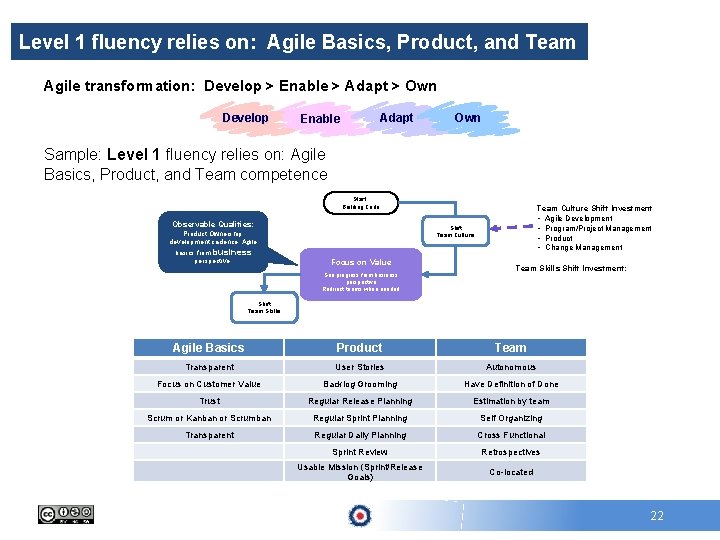
Level 1 fluency relies on: Agile Basics, Product, and Team Agile transformation: Develop > Enable > Adapt > Own Develop Adapt Enable Own Sample: Level 1 fluency relies on: Agile Basics, Product, and Team competence Start: Building Code Observable Qualities: Product Ownership, development cadence, Agile basics from business perspective. Team Culture Shift Investment • Agile Development • Program/Project Management • Product • Change Management Shift Team Culture Focus on Value See progress from business perspective Redirect teams when needed Team Skills Shift Investment: Shift Team Skills Agile Basics Product Team Transparent User Stories Autonomous Focus on Customer Value Backlog Grooming Have Definition of Done Trust Regular Release Planning Estimation by team Scrum or Kanban or Scrumban Regular Sprint Planning Self Organizing Transparent Regular Daily Planning Cross Functional Sprint Review Retrospectives Usable Mission (Sprint/Release Goals) Co-located 22
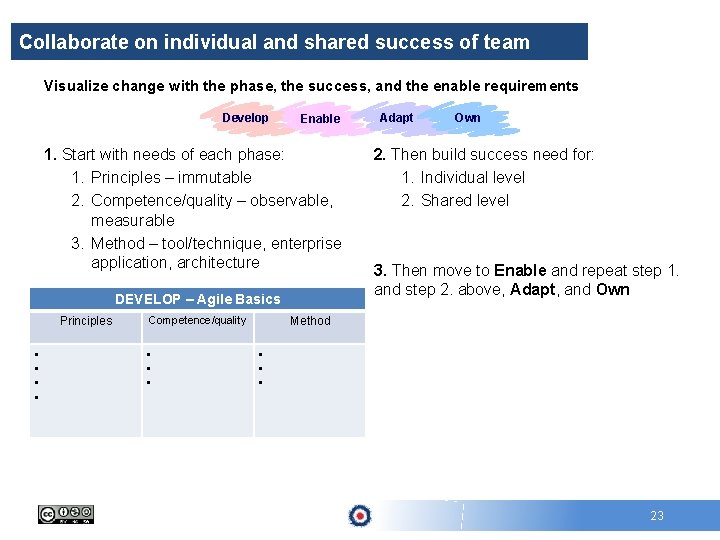
Collaborate on individual and shared success of team Visualize change with the phase, the success, and the enable requirements Develop Enable 1. Start with needs of each phase: 1. Principles – immutable 2. Competence/quality – observable, measurable 3. Method – tool/technique, enterprise application, architecture DEVELOP – Agile Basics • • Principles Competence/quality • • • Adapt Own 2. Then build success need for: 1. Individual level 2. Shared level 3. Then move to Enable and repeat step 1. and step 2. above, Adapt, and Own Method • • • 23
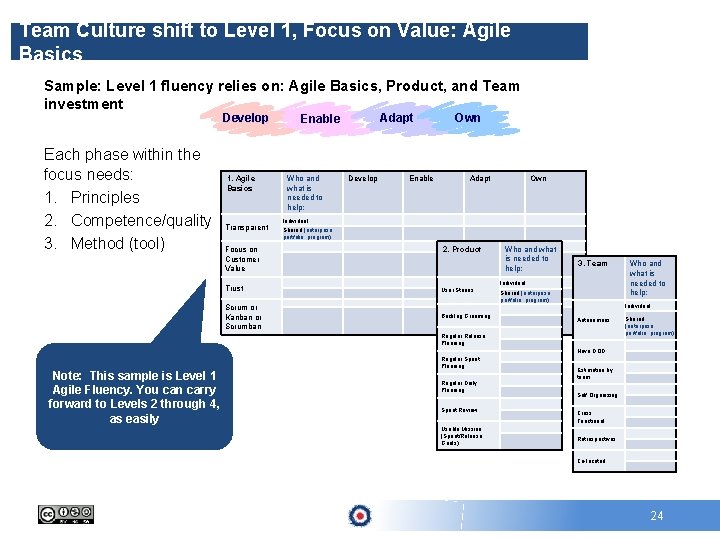
Team Culture shift to Level 1, Focus on Value: Agile Basics Sample: Level 1 fluency relies on: Agile Basics, Product, and Team investment Develop Each phase within the focus needs: 1. Principles 2. Competence/quality 3. Method (tool) 1. Agile Basics Transparent Focus on Customer Value Adapt Enable Who and what is needed to help: Develop Enable Own Adapt Own Individual Shared (enterprise, portfolio, program) 2. Product Who and what is needed to help: 3. Team Individual Trust User Stories Scrum or Kanban or Scrumban Backlog Grooming Shared (enterprise, portfolio, program) Who and what is needed to help: Individual Autonomous Regular Release Planning Shared (enterprise, portfolio, program) Have DOD Note: This sample is Level 1 Agile Fluency. You can carry forward to Levels 2 through 4, as easily Regular Sprint Planning Regular Daily Planning Sprint Review Usable Mission (Sprint/Release Goals) Estimation by team Self Organizing Cross Functional Retrospectives Co-located 24
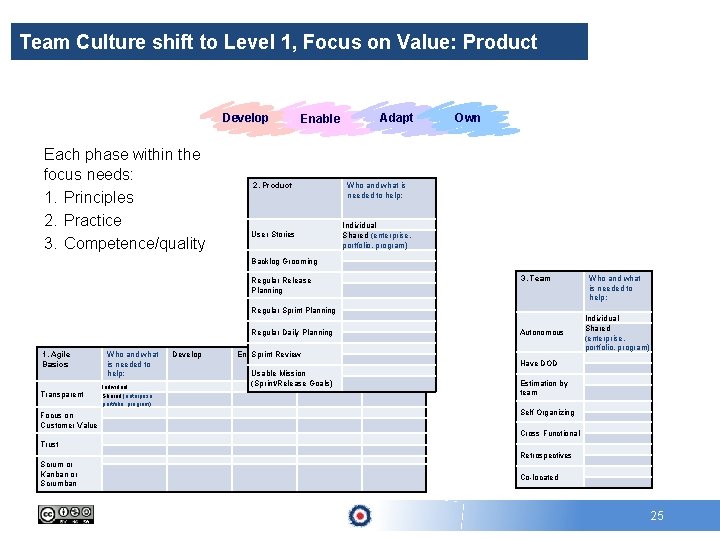
Team Culture shift to Level 1, Focus on Value: Product Develop Each phase within the focus needs: 1. Principles 2. Practice 3. Competence/quality Enable 2. Product User Stories Adapt Own Who and what is needed to help: Individual Shared (enterprise, portfolio, program) Backlog Grooming 3. Team Regular Release Planning Regular Sprint Planning Regular Daily Planning 1. Agile Basics Transparent Focus on Customer Value Who and what is needed to help: Individual Shared (enterprise, portfolio, program) Develop Sprint Review Adapt Enable Autonomous Own Who and what is needed to help: Individual Shared (enterprise, portfolio, program) Have DOD Usable Mission (Sprint/Release Goals) Estimation by team Self Organizing Cross Functional Trust Scrum or Kanban or Scrumban Retrospectives Co-located 25
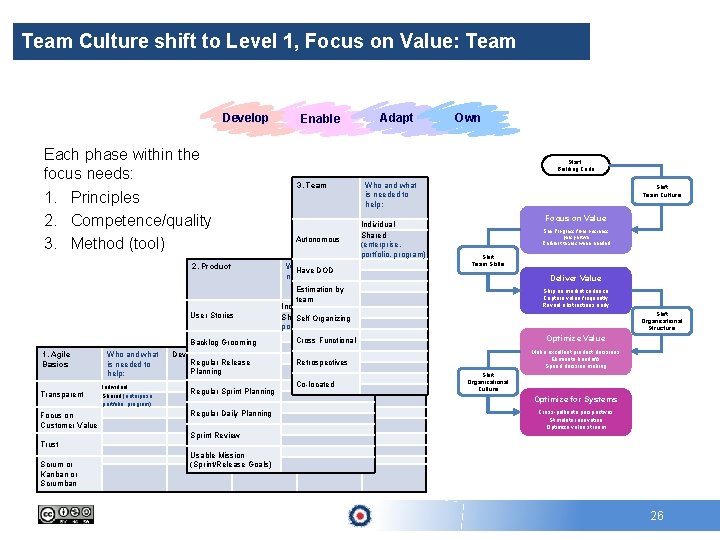
Team Culture shift to Level 1, Focus on Value: Team Develop Each phase within the focus needs: 1. Principles 2. Competence/quality 3. Method (tool) 2. Product User Stories Backlog Grooming 1. Agile Basics Transparent Focus on Customer Value Who and what is needed to help: Individual Shared (enterprise, portfolio, program) Develop Enable Regular Release Planning Regular Sprint Planning Regular Daily Planning Enable Adapt Own Start: Building Code 3. Team Autonomous Who and what is needed to help: Individual Shared (enterprise, portfolio, program) Who and what is Have DOD needed to help: Shift Team Culture Focus on Value See Progress from business perspective Redirect teams when needed Shift Team Skills Deliver Value Estimation by team Individual Shared (enterprise, Self Organizing portfolio, program) Ship on market cadence Capture value frequently Reveal obstructions early Shift Organizational Structure Optimize Value Cross Functional Adapt Retrospectives Co-located Make excellent product decisions Eliminate handoffs Speed decision making Own Shift Organizational Culture Optimize for Systems Cross-pollinate perspectives Stimulate innovation Optimize value stream Sprint Review Trust Scrum or Kanban or Scrumban Usable Mission (Sprint/Release Goals) 26
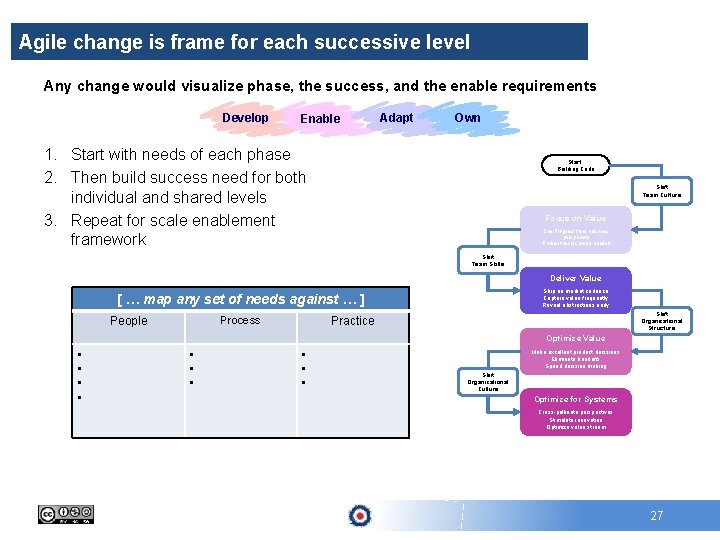
Agile change is frame for each successive level Any change would visualize phase, the success, and the enable requirements Develop Enable Adapt Own 1. Start with needs of each phase 2. Then build success need for both individual and shared levels 3. Repeat for scale enablement framework Start: Building Code Shift Team Culture Focus on Value See Progress from business perspective Redirect teams when needed Shift Team Skills Deliver Value Ship on market cadence Capture value frequently Reveal obstructions early [ … map any set of needs against … ] Process People Shift Organizational Structure Practice Optimize Value • • • Make excellent product decisions Eliminate handoffs Speed decision making Shift Organizational Culture Optimize for Systems Cross-pollinate perspectives Stimulate innovation Optimize value stream 27
Agile Change Management Organization Adoption with Agile Development Principles 1. Agile Fluency Model with Develop > Enable > Adapt > Own 2. Scaled Agile Framework 4. 5 models 28
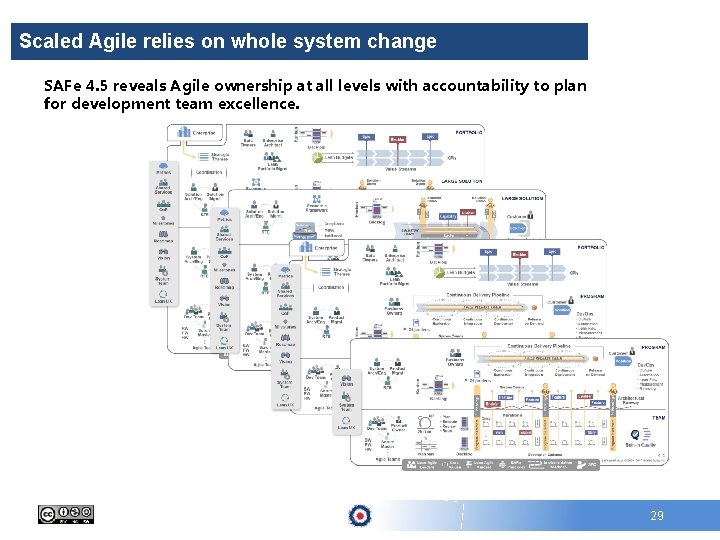
Scaled Agile relies on whole system change SAFe 4. 5 reveals Agile ownership at all levels with accountability to plan for development team excellence. 29
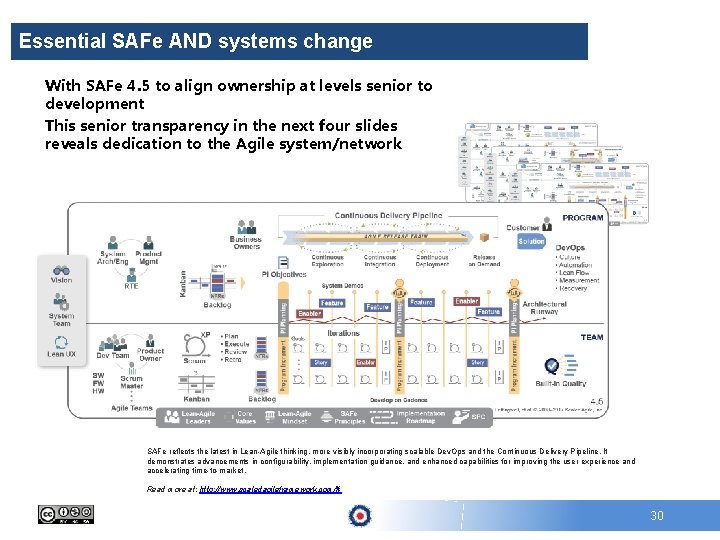
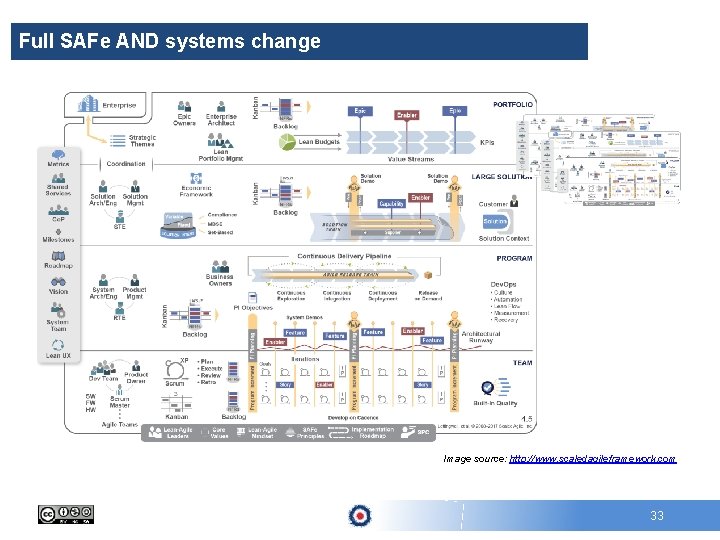
Essential SAFe AND systems change With SAFe 4. 5 to align ownership at levels senior to development This senior transparency in the next four slides reveals dedication to the Agile system/network SAFe reflects the latest in Lean-Agile thinking, more visibly incorporating scalable Dev. Ops and the Continuous Delivery Pipeline. It demonstrates advancements in configurability, implementation guidance, and enhanced capabilities for improving the user experience and accelerating time-to-market. Read more at: http: //www. scaledagileframework. com/# 30
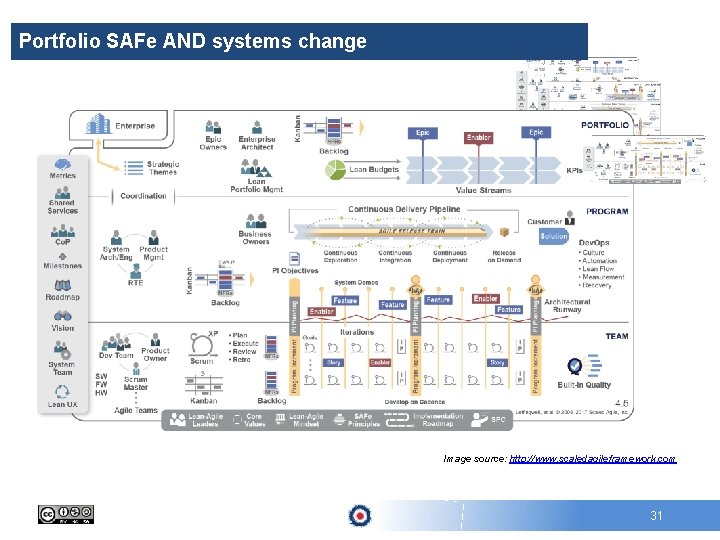
Portfolio SAFe AND systems change Image source: http: //www. scaledagileframework. com 31
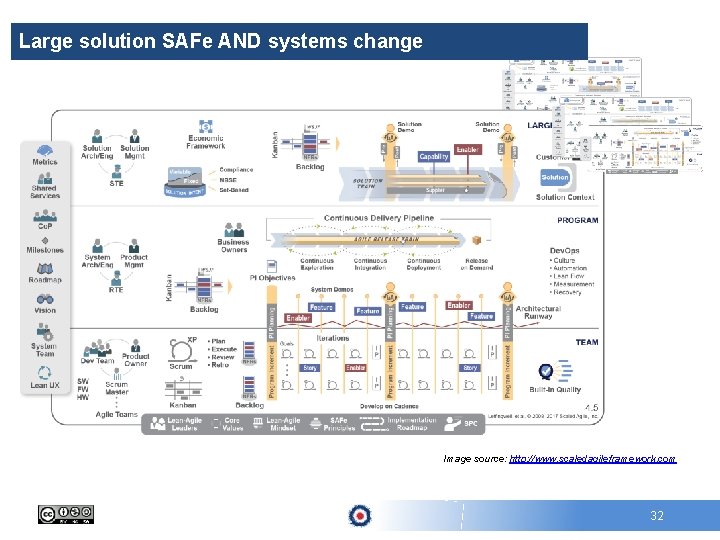
Large solution SAFe AND systems change Image source: http: //www. scaledagileframework. com 32
Full SAFe AND systems change Image source: http: //www. scaledagileframework. com 33
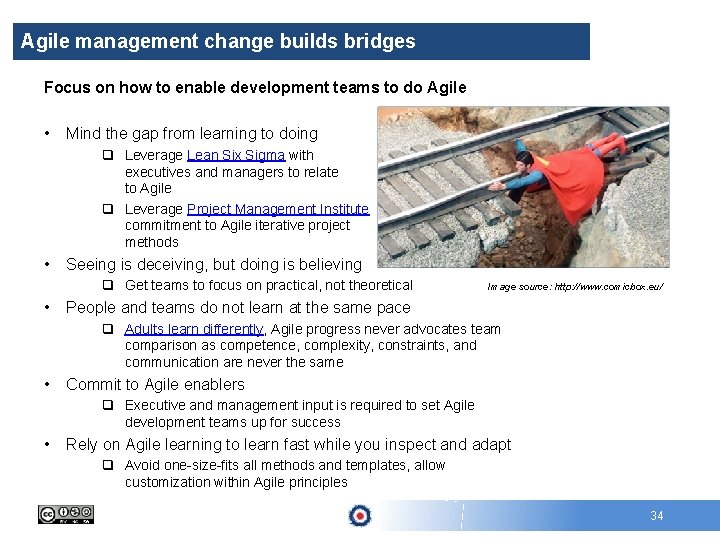
Agile management change builds bridges Focus on how to enable development teams to do Agile • Mind the gap from learning to doing q Leverage Lean Six Sigma with executives and managers to relate to Agile q Leverage Project Management Institute commitment to Agile iterative project methods • Seeing is deceiving, but doing is believing q Get teams to focus on practical, not theoretical • Image source: http: //www. comicbox. eu/ People and teams do not learn at the same pace q Adults learn differently, Agile progress never advocates team comparison as competence, complexity, constraints, and communication are never the same • Commit to Agile enablers q Executive and management input is required to set Agile development teams up for success • Rely on Agile learning to learn fast while you inspect and adapt q Avoid one-size-fits all methods and templates, allow customization within Agile principles 34
Thank You Further Learning and Development resources available email@Toby. Elwin. com https: //Toby. Elwin. com @Toby. Elwin on Twitter 35