
Agile Development Topic 12 Module Summary and Revision
- Slides: 30
Agile Development Topic 12: Module Summary and Revision Guidance V 1. 0 ©
Module Summary and Revision Guidance Topic 12 - 12. 2 Topic 12 Coverage This topic will cover: • Revision of the module objectives • Review of the key elements of the topics covered V 1. 0 ©
Module Summary and Revision Guidance Topic 12 - 12. 3 The Agile Development Module Scope and Coverage The Agile Development module will: • Provide an introduction to the principles, people, processes and practices of Agile development • Prepare students for future trends in software development practices • Reinforce understanding of the information systems development process V 1. 0 ©
Module Summary and Revision Guidance Topic 12 - 12. 4 Module Learning Outcomes By the end of the module students will be able to: • • • Understand the background to Agile development Understand the roles within an Agile development team Understand the various Agile development techniques Understand an Agile development lifecycle Understand the principles associated with an Agile development approach • Be able to apply an Agile development approach to a particular project scenario V 1. 0 ©
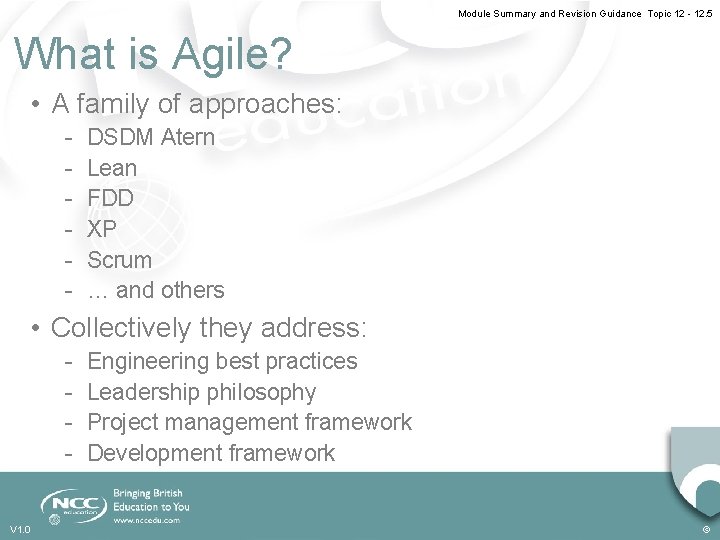
Module Summary and Revision Guidance Topic 12 - 12. 5 What is Agile? • A family of approaches: - DSDM Atern Lean FDD XP Scrum … and others • Collectively they address: V 1. 0 Engineering best practices Leadership philosophy Project management framework Development framework ©
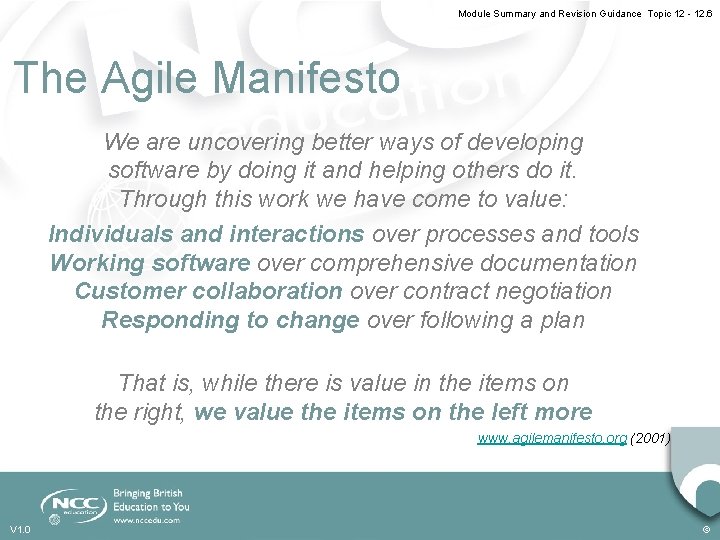
Module Summary and Revision Guidance Topic 12 - 12. 6 The Agile Manifesto We are uncovering better ways of developing software by doing it and helping others do it. Through this work we have come to value: Individuals and interactions over processes and tools Working software over comprehensive documentation Customer collaboration over contract negotiation Responding to change over following a plan That is, while there is value in the items on the right, we value the items on the left more www. agilemanifesto. org (2001) V 1. 0 ©
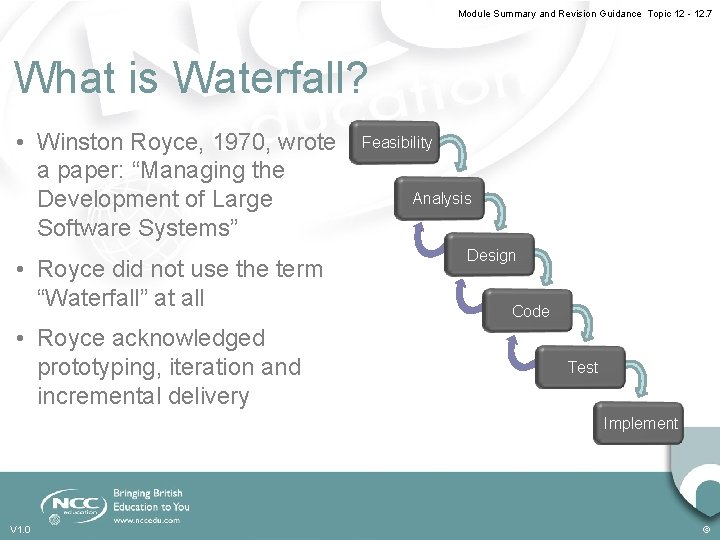
Module Summary and Revision Guidance Topic 12 - 12. 7 What is Waterfall? • Winston Royce, 1970, wrote a paper: “Managing the Development of Large Software Systems” • Royce did not use the term “Waterfall” at all • Royce acknowledged prototyping, iteration and incremental delivery Feasibility Analysis Design Code Test Implement V 1. 0 ©
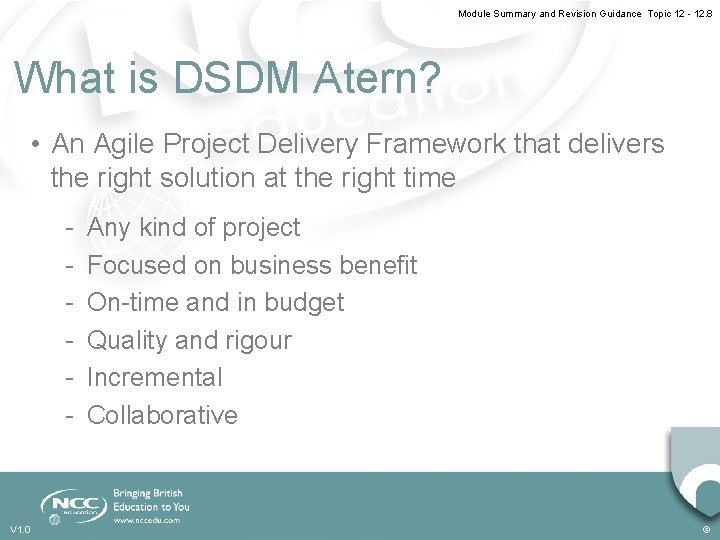
Module Summary and Revision Guidance Topic 12 - 12. 8 What is DSDM Atern? • An Agile Project Delivery Framework that delivers the right solution at the right time - V 1. 0 Any kind of project Focused on business benefit On-time and in budget Quality and rigour Incremental Collaborative ©
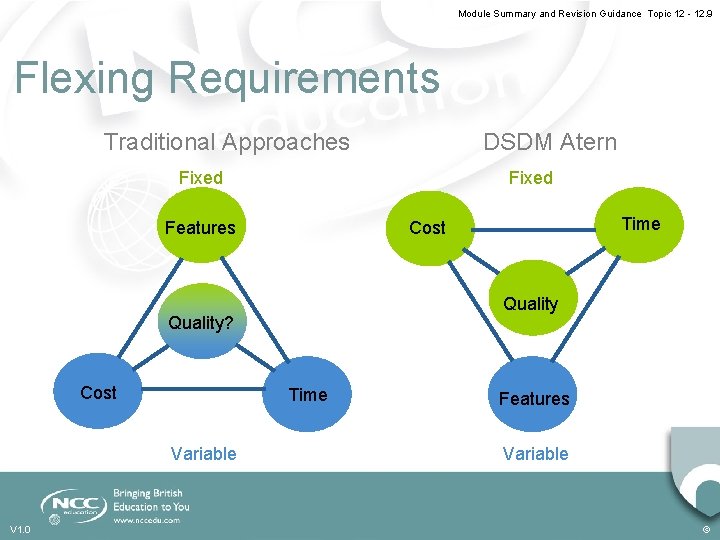
Module Summary and Revision Guidance Topic 12 - 12. 9 Flexing Requirements Traditional Approaches DSDM Atern Fixed Quality? Cost Time Variable V 1. 0 Time Cost Features Variable ©
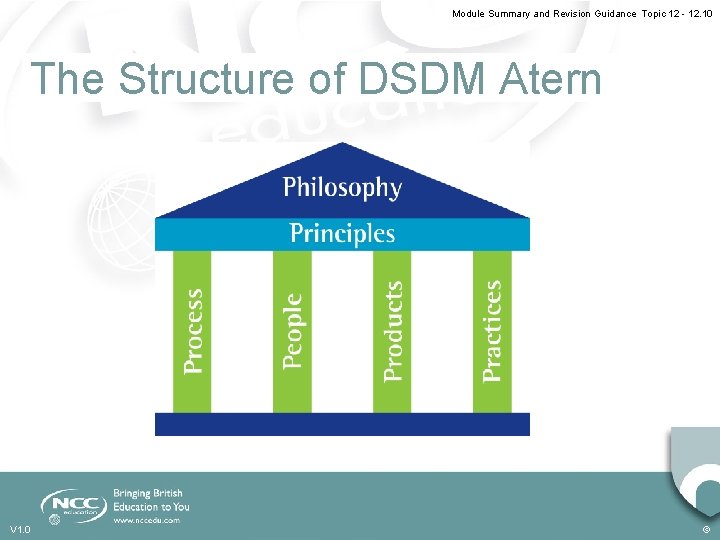
Module Summary and Revision Guidance Topic 12 - 12. 10 The Structure of DSDM Atern V 1. 0 ©
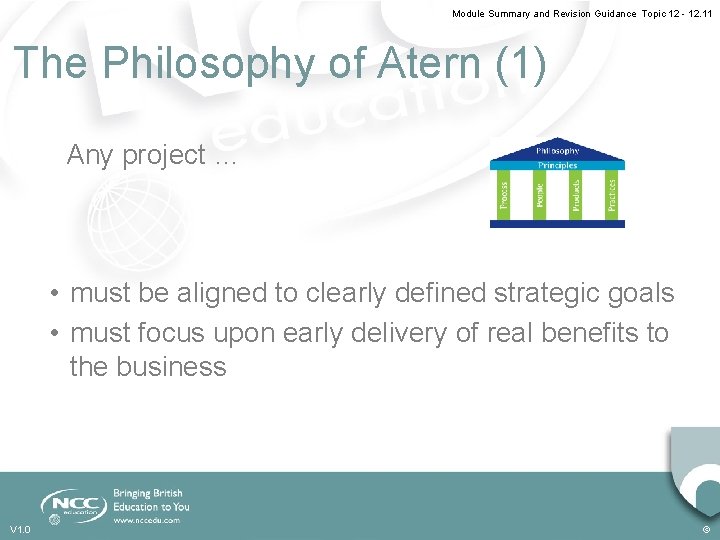
Module Summary and Revision Guidance Topic 12 - 12. 11 The Philosophy of Atern (1) Any project … • must be aligned to clearly defined strategic goals • must focus upon early delivery of real benefits to the business V 1. 0 ©
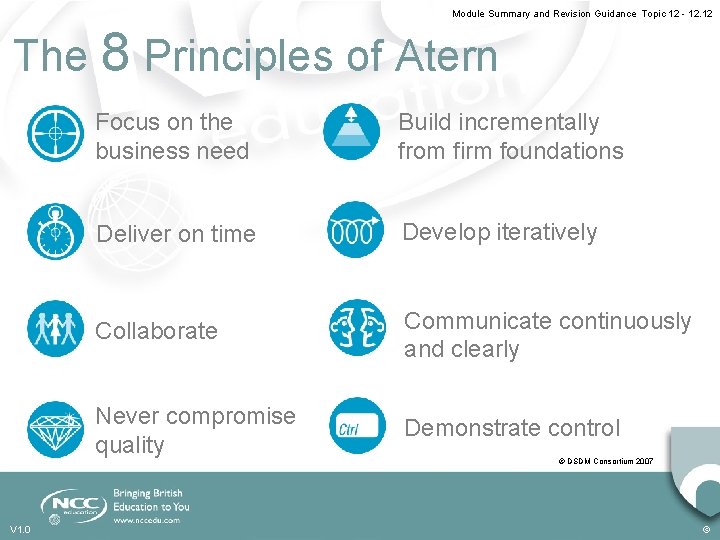
Module Summary and Revision Guidance Topic 12 - 12. 12 The 8 Principles of Atern V 1. 0 Focus on the business need Build incrementally from firm foundations Deliver on time Develop iteratively Collaborate Communicate continuously and clearly Never compromise quality Demonstrate control © DSDM Consortium 2007 ©
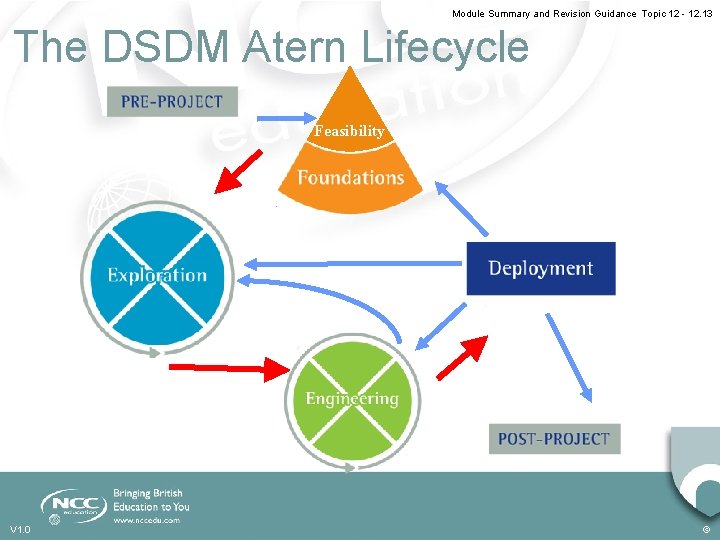
Module Summary and Revision Guidance Topic 12 - 12. 13 The DSDM Atern Lifecycle Feasibility V 1. 0 ©
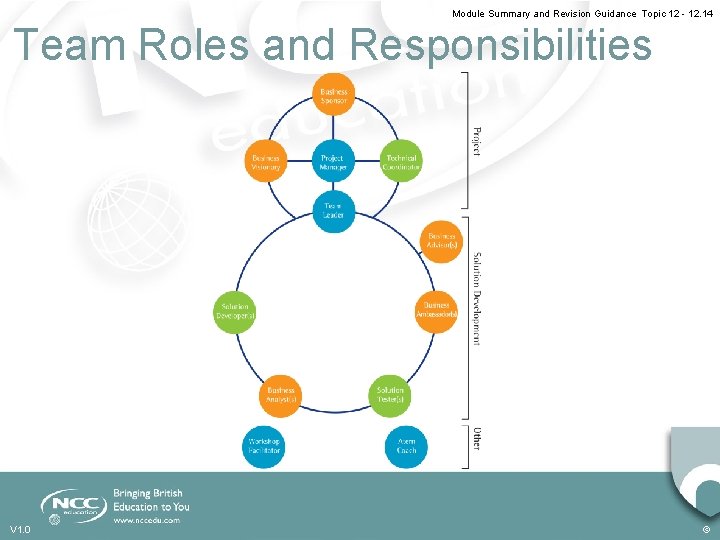
Module Summary and Revision Guidance Topic 12 - 12. 14 Team Roles and Responsibilities V 1. 0 ©
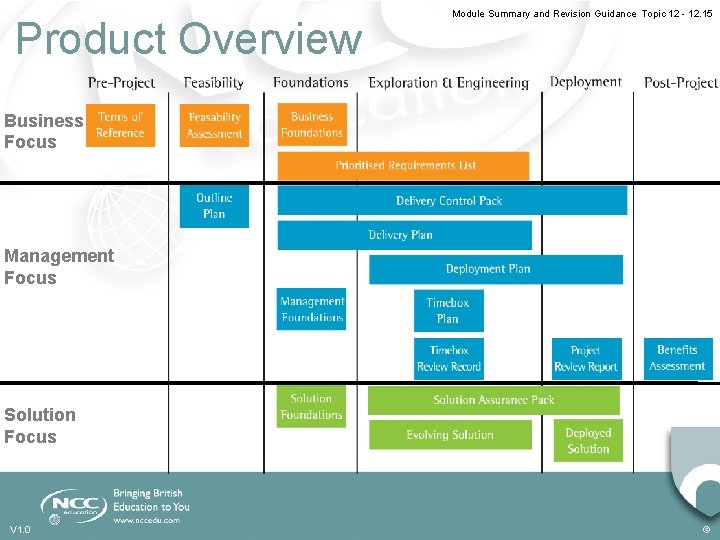
Product Overview Module Summary and Revision Guidance Topic 12 - 12. 15 Business Focus Management Focus Solution Focus V 1. 0 ©
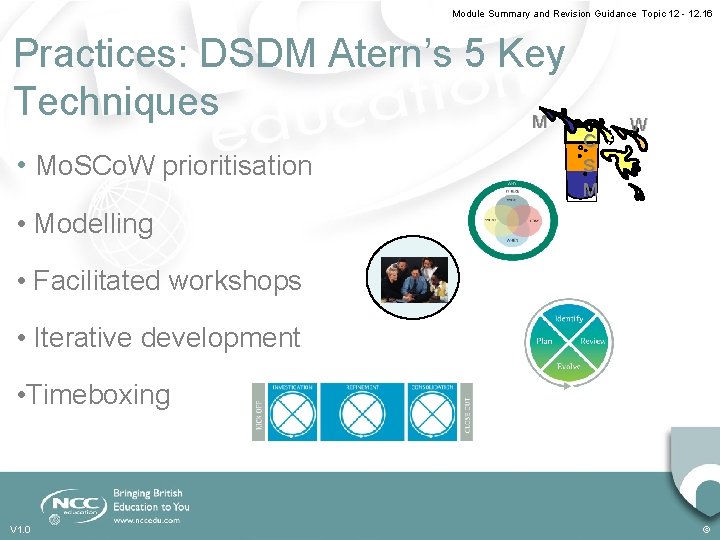
Module Summary and Revision Guidance Topic 12 - 12. 16 Practices: DSDM Atern’s 5 Key Techniques M • Mo. SCo. W prioritisation C S M W • Modelling • Facilitated workshops • Iterative development • Timeboxing V 1. 0 ©
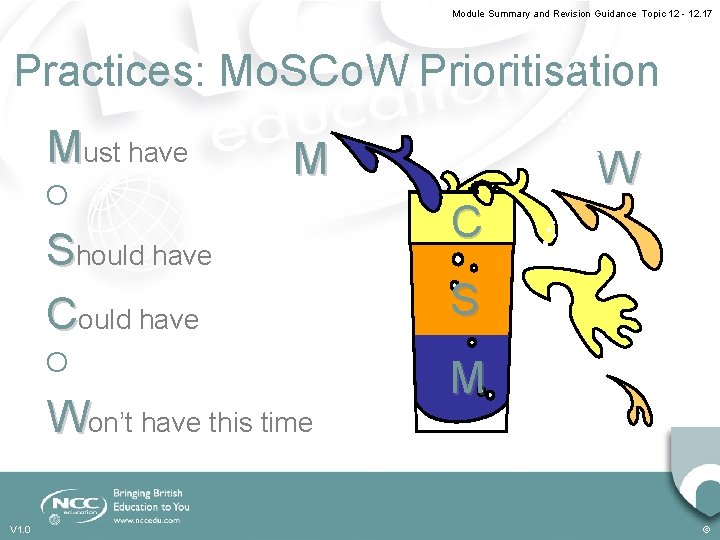
Module Summary and Revision Guidance Topic 12 - 12. 17 Practices: Mo. SCo. W Prioritisation Must have O M Should have Could have O Won’t have this time V 1. 0 W C S M ©
Module Summary and Revision Guidance Topic 12 - 12. 18 Practices: Modelling • Many industries use models (and prototypes) to: - establish requirements - confirm expectations - test the achievability of objectives • Examples of models: - V 1. 0 storyboards diagrams scale models (prototypes) working software (prototypes) ©
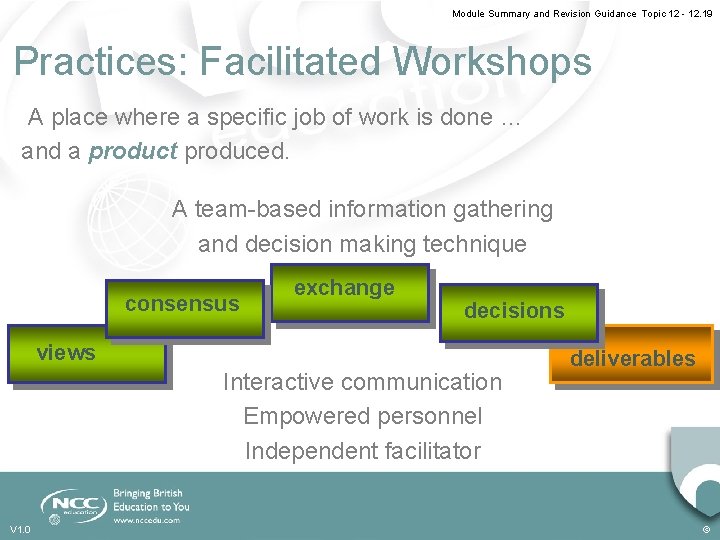
Module Summary and Revision Guidance Topic 12 - 12. 19 Practices: Facilitated Workshops A place where a specific job of work is done … and a product produced. A team-based information gathering and decision making technique consensus exchange decisions views Interactive communication Empowered personnel Independent facilitator V 1. 0 deliverables ©
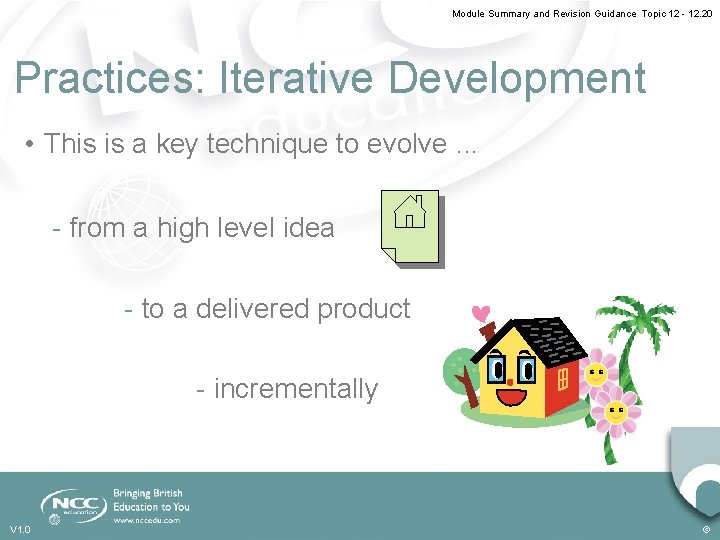
Module Summary and Revision Guidance Topic 12 - 12. 20 Practices: Iterative Development • This is a key technique to evolve. . . - from a high level idea - to a delivered product - incrementally V 1. 0 ©
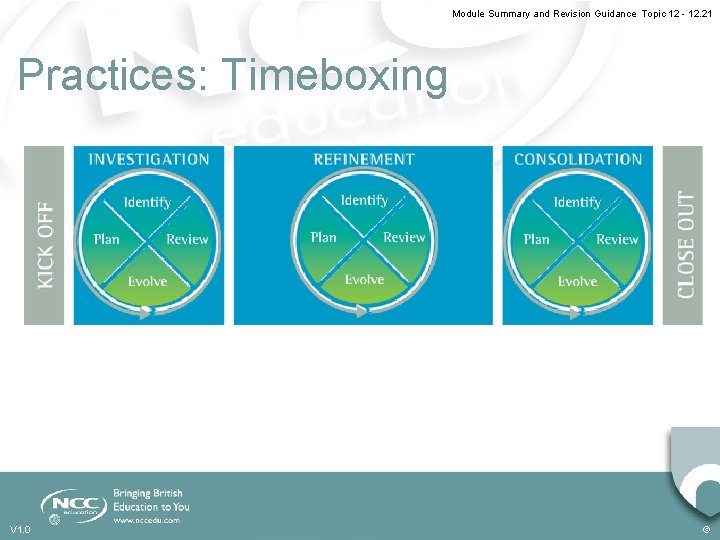
Module Summary and Revision Guidance Topic 12 - 12. 21 Practices: Timeboxing V 1. 0 ©
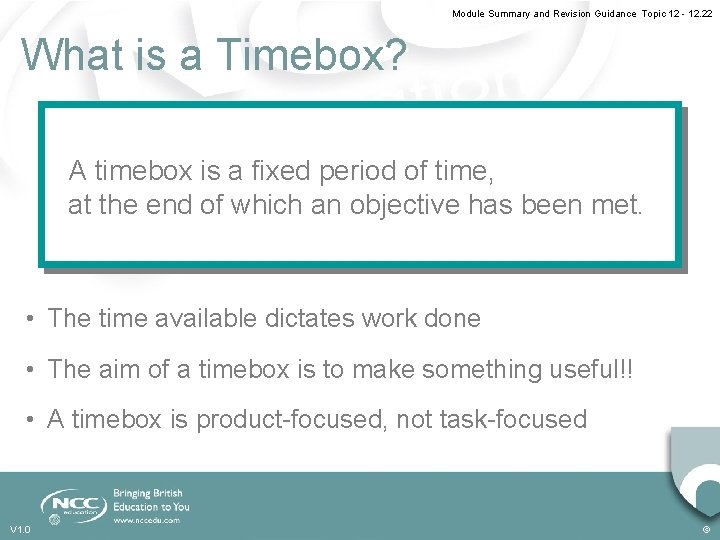
Module Summary and Revision Guidance Topic 12 - 12. 22 What is a Timebox? A timebox is a fixed period of time, at the end of which an objective has been met. • The time available dictates work done • The aim of a timebox is to make something useful!! • A timebox is product-focused, not task-focused V 1. 0 ©
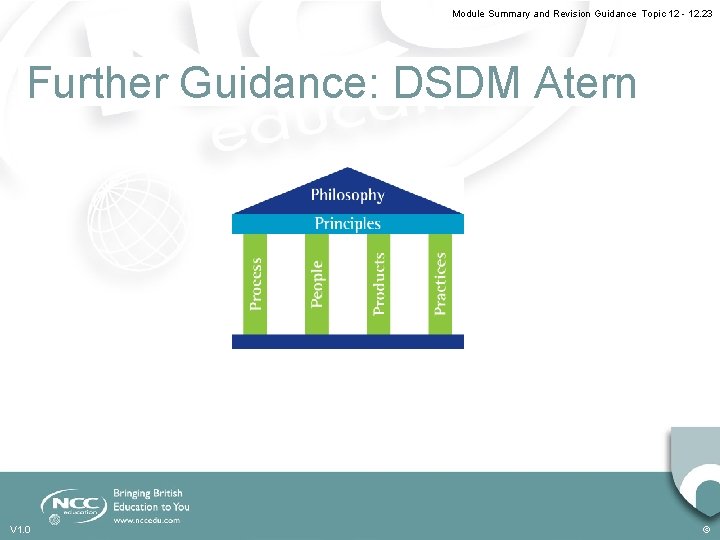
Module Summary and Revision Guidance Topic 12 - 12. 23 Further Guidance: DSDM Atern V 1. 0 ©
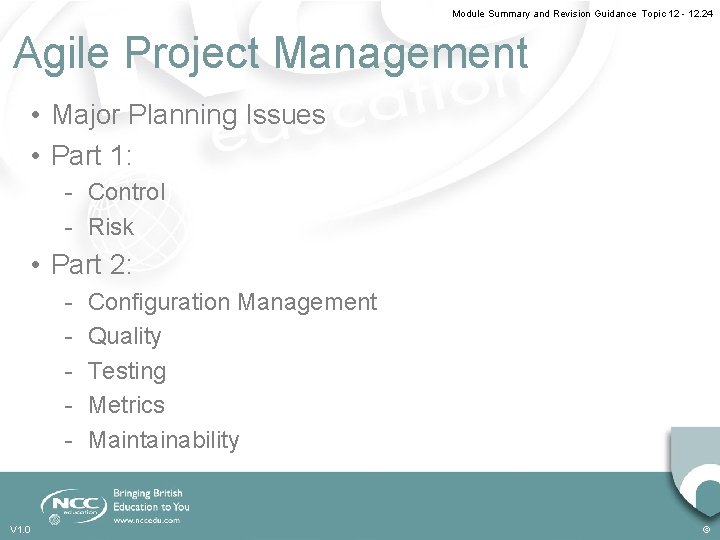
Module Summary and Revision Guidance Topic 12 - 12. 24 Agile Project Management • Major Planning Issues • Part 1: - Control - Risk • Part 2: - V 1. 0 Configuration Management Quality Testing Metrics Maintainability ©
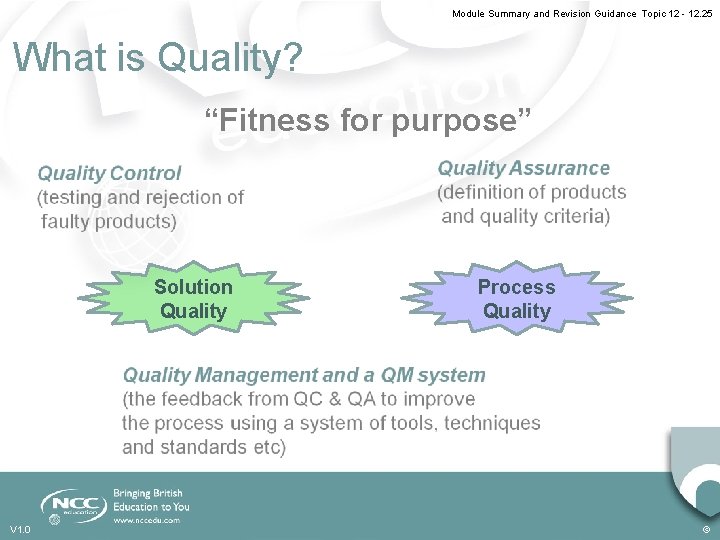
Module Summary and Revision Guidance Topic 12 - 12. 25 What is Quality? “Fitness for purpose” Solution Quality V 1. 0 Process Quality ©
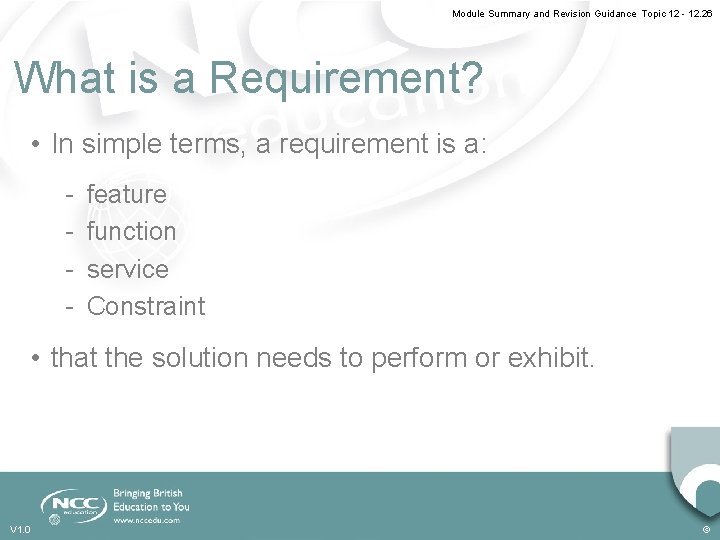
Module Summary and Revision Guidance Topic 12 - 12. 26 What is a Requirement? • In simple terms, a requirement is a: - feature function service Constraint • that the solution needs to perform or exhibit. V 1. 0 ©
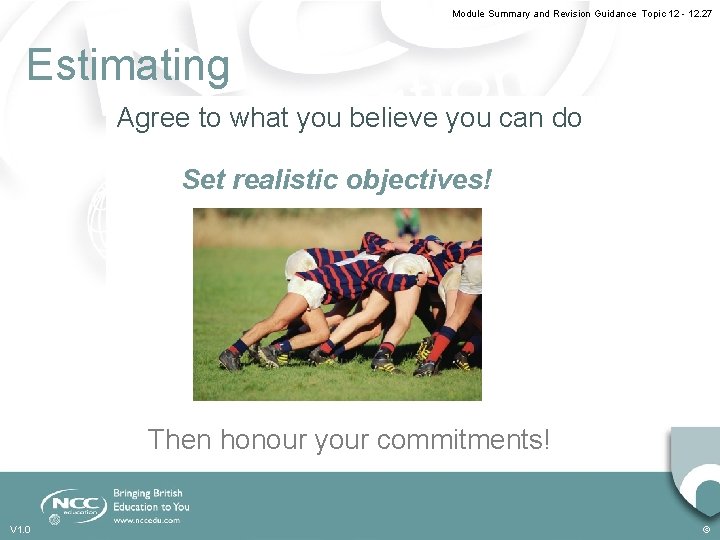
Module Summary and Revision Guidance Topic 12 - 12. 27 Estimating Agree to what you believe you can do Set realistic objectives! Then honour your commitments! V 1. 0 ©
Module Summary and Revision Guidance Topic 12 - 12. 28 Summary • The Agile Development module will: - Provide an introduction to the principles, people, processes and practices of Agile development - Prepare students for future trends in software development practices - Reinforce understanding of the information systems development process V 1. 0 ©
Module Summary and Revision Guidance Topic 12 - 12. 29 Module Learning Outcomes By the end of the module students will be able to: • • • Understand the background to Agile development Understand the roles within an Agile development team Understand the various Agile development techniques Understand an Agile development lifecycle Understand the principles associated with an Agile development approach • Be able to apply an Agile development approach to a particular project scenario V 1. 0 ©
Module Summary and Revision Guidance Topic 12 - 12. 30 Topic 12 – Module Summary and Revision Guidance Any Questions? V 1. 0 © NCC Education Limited