
Agile Building the Ship While Floating in Deep
Agile: Building the Ship While Floating in Deep Waters ETPMI Professional Development Day September 28, 2018 – Session 3, 4: 15 – 5: 15 pm
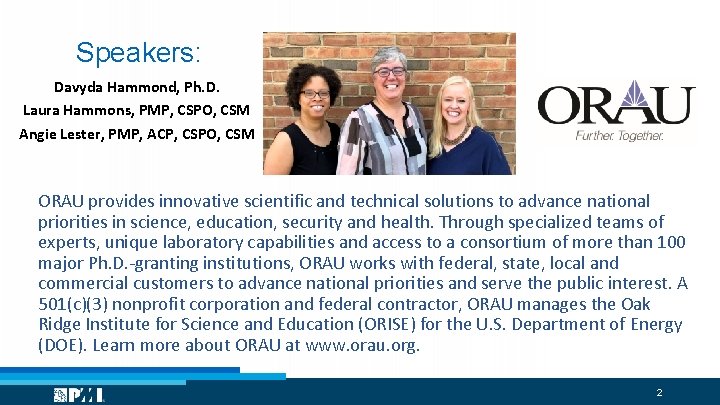
Speakers: Davyda Hammond, Ph. D. Laura Hammons, PMP, CSPO, CSM Angie Lester, PMP, ACP, CSPO, CSM ORAU provides innovative scientific and technical solutions to advance national priorities in science, education, security and health. Through specialized teams of experts, unique laboratory capabilities and access to a consortium of more than 100 major Ph. D. -granting institutions, ORAU works with federal, state, local and commercial customers to advance national priorities and serve the public interest. A 501(c)(3) nonprofit corporation and federal contractor, ORAU manages the Oak Ridge Institute for Science and Education (ORISE) for the U. S. Department of Energy (DOE). Learn more about ORAU at www. orau. org. 2
The Ship (Our Project) • First non-IT project attempted in with an Agile-based framework (Scrum) • Cross-organizational effort born out of a risk analysis • High visibility – CEO was the sponsor and was involved in the details. • Intangible product: improvement, definitions, clarity, risk mitigation for the organization • Specified and constrained duration and staff commitment 3
Outline Rationale for Transition Approach Transition Woes How to start? Execution – Values Treasures at Sea Take Aways 4
Channeling our Inner Navigator Why transition to Agile • Traditional wasn’t working – roadblocks and schedule were impossible to see and define • Complex nature of the work required team and stakeholder buy-in as we went forward, not just at the end. Why NOT transition to an Agile framework? • Large, cross-functional team with limited time (not dedicated) • Reluctant (uneducated) management/stakeholders • Lack of organizational experience or trained personnel in Agile frameworks • We had already started. . . And we had a charter the CEO was very proud of. • Work was evolving • Team was working against a backdrop of competing priorities, agendas, and perceptions of what the deliverables should be 5
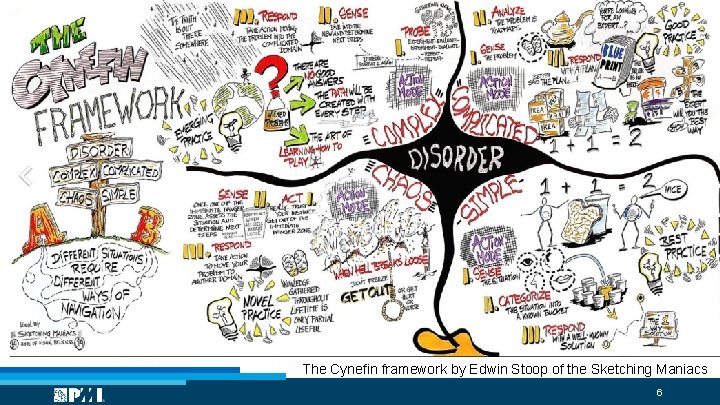
The Cynefin framework by Edwin Stoop of the Sketching Maniacs 6
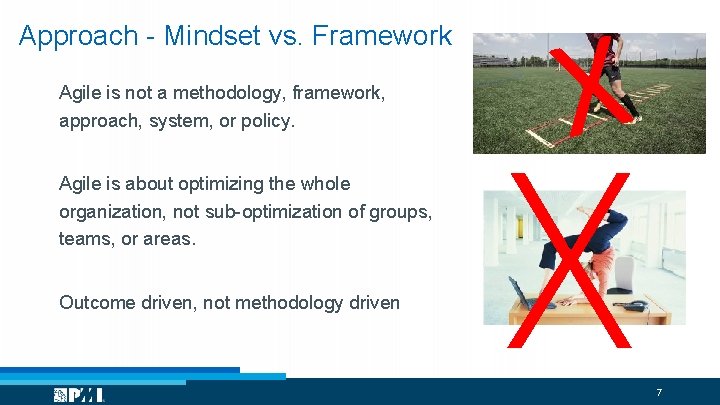
Approach - Mindset vs. Framework Agile is not a methodology, framework, approach, system, or policy. Agile is about optimizing the whole organization, not sub-optimization of groups, teams, or areas. Outcome driven, not methodology driven X X 7
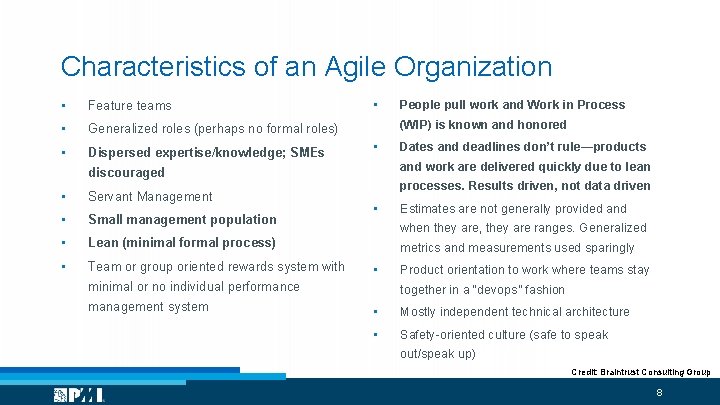
Characteristics of an Agile Organization • Feature teams • Generalized roles (perhaps no formal roles) • Dispersed expertise/knowledge; SMEs • (WIP) is known and honored • Servant Management • Small management population • Lean (minimal formal process) • Team or group oriented rewards system with processes. Results driven, not data driven • Estimates are not generally provided and when they are, they are ranges. Generalized metrics and measurements used sparingly • minimal or no individual performance management system Dates and deadlines don’t rule—products and work are delivered quickly due to lean discouraged • People pull work and Work in Process Product orientation to work where teams stay together in a “devops” fashion • Mostly independent technical architecture • Safety-oriented culture (safe to speak out/speak up) Credit: Braintrust Consulting Group 8
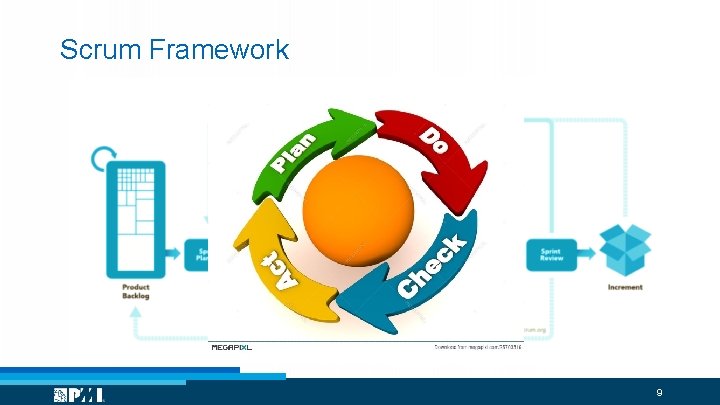
Scrum Framework 9
Transition Woes New Tools New Artifacts (Vision, Backlog, Burn Down, etc. ) Terminology Fog. Bugz (Backlog management) More Meetings 4 Standard Meetings (Standups, Planning, Sprint Review, Retrospective) Billable vs Non-Billable Work (Prioritizing Tension) Stakeholder Lack of Understanding Hold on Charter Self-directed team vs Chartered and managed team Roles of Team Members Product Owner Scrum Master Team Members Expertise area and role vs. broader equal role 10
How to start? Embrace…Casting off Importance of Agile Coach (Values & Principles): Talk the Talk AND Walk the Walk. Be Consistent Call each other out Keep educating ALL levels Have Courage, Be Brave! 11
Execution – Putting the Values in Action Individuals and Interactions Over Processes and Tools Ø Ø Meetings with Stakeholders Talk to people, interviews Throw out waterfall artifacts Innovative approaches (exercises, skits, etc. ) in team meetings and Sprint Reviews – NEWS BULLETIN: Everything doesn’t belong in Power. Point. Working Product Over Comprehensive Documentation Ø Concepts can be Products and Results Ø Iterative is ok, Tactical (How) can come later Ø No Meeting Minutes, appropriate documentation of interactions 12
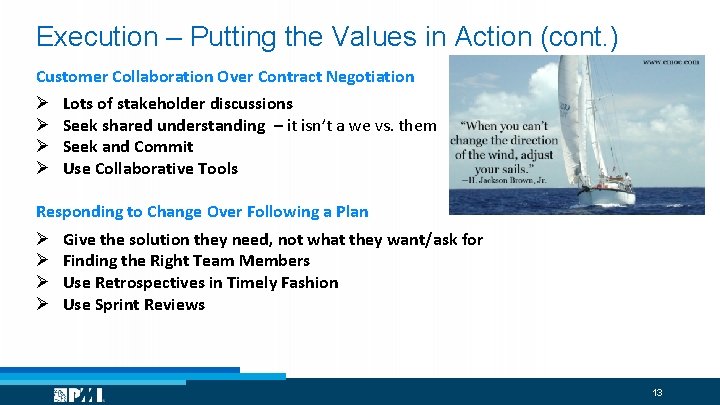
Execution – Putting the Values in Action (cont. ) Customer Collaboration Over Contract Negotiation Ø Ø Lots of stakeholder discussions Seek shared understanding – it isn’t a we vs. them Seek and Commit Use Collaborative Tools Responding to Change Over Following a Plan Ø Ø Give the solution they need, not what they want/ask for Finding the Right Team Members Use Retrospectives in Timely Fashion Use Sprint Reviews 13
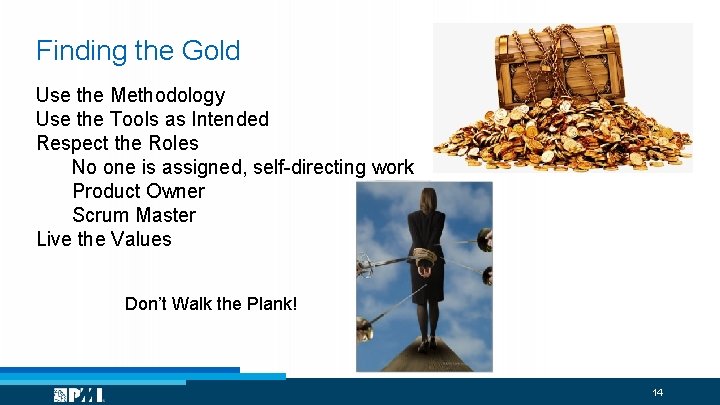
Finding the Gold Use the Methodology Use the Tools as Intended Respect the Roles No one is assigned, self-directing work Product Owner Scrum Master Live the Values Don’t Walk the Plank! 14
More Treasures at Sea: Pearls & Rubies! ü Use your Backlog/Keep it Updated as things evolve (not comprehensive documentation, but documentation) ü Stakeholders can change as you evolve (customer collaboration #3) ü It’s ok to not be perfect, “start in part” • Something is better than nothing • KEY: Take credit for the baby steps, don’t be a teenager and think you are an adult ü Don’t let it become just the shiny new object • Buzzword • Move the organization back if done incorrectly, gives bad taste ü Build Trust • Allows people to speak up in retros and sprint reviews 15
What will you take with you? ? ? 16
About Project Management Institute (PMI) is the world's leading association for those who consider project, program or portfolio management their profession. Founded in 1969, PMI delivers value for more than three million professionals working in nearly every country in the world through global advocacy, collaboration, education and research. We advance careers, improve organizational success and further mature the project management profession through globally-recognized standards, certifications, communities, resources, tools, academic research, publications, professional development courses and networking opportunities. As part of the PMI family, Project. Management. com creates online global communities that deliver more resources, better tools, larger networks and broader perspectives. 17
- Slides: 17