
Agile Acquisitions 101 The Means Behind the Magic
Agile Acquisitions 101 The Means Behind the Magic Presented by Chris Cairns, Managing Director, 18 F Consulting April 22, 2015 Jeffrey Birch, Acting Director www. fai. gov
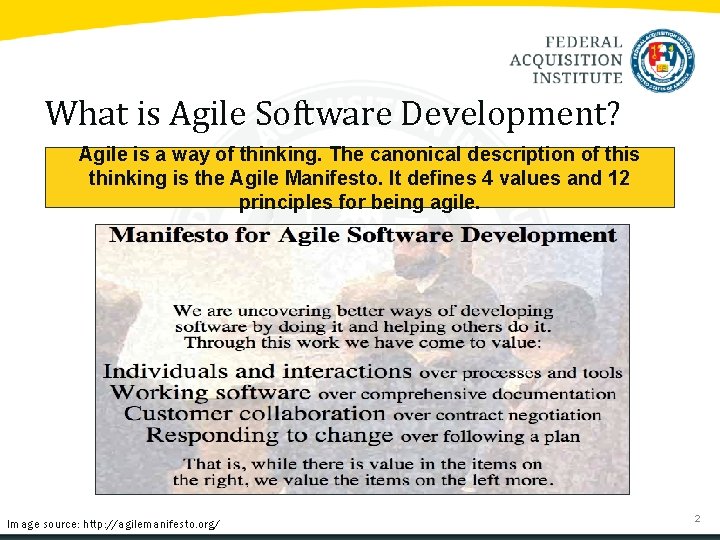
What is Agile Software Development? Agile is a way of thinking. The canonical description of this thinking is the Agile Manifesto. It defines 4 values and 12 principles for being agile. Image source: http: //agilemanifesto. org/ 2
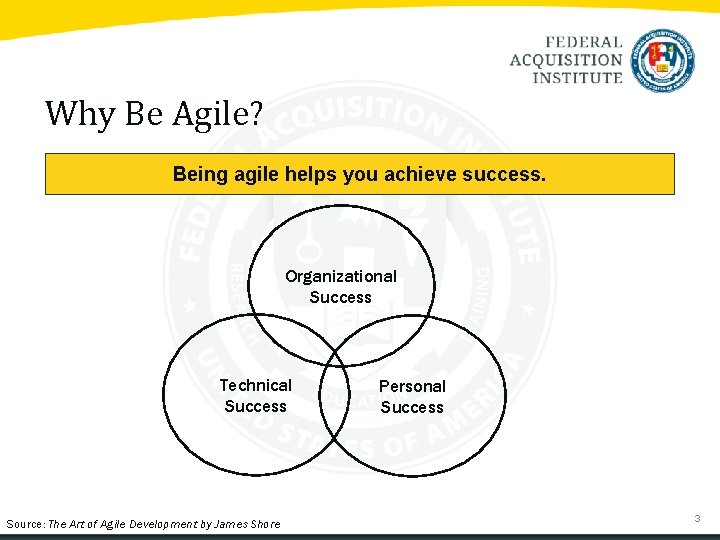
Why Be Agile? Being agile helps you achieve success. Organizational Success Technical Success Source: The Art of Agile Development by James Shore Personal Success 3
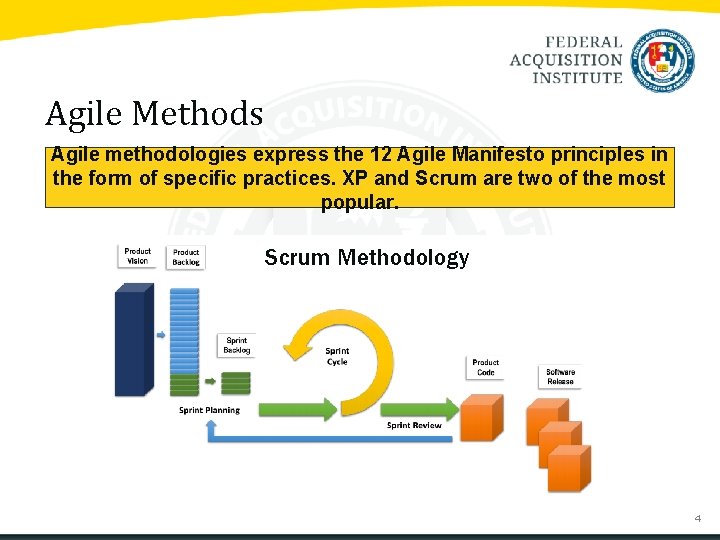
Agile Methods Agile methodologies express the 12 Agile Manifesto principles in the form of specific practices. XP and Scrum are two of the most popular. Scrum Methodology 4
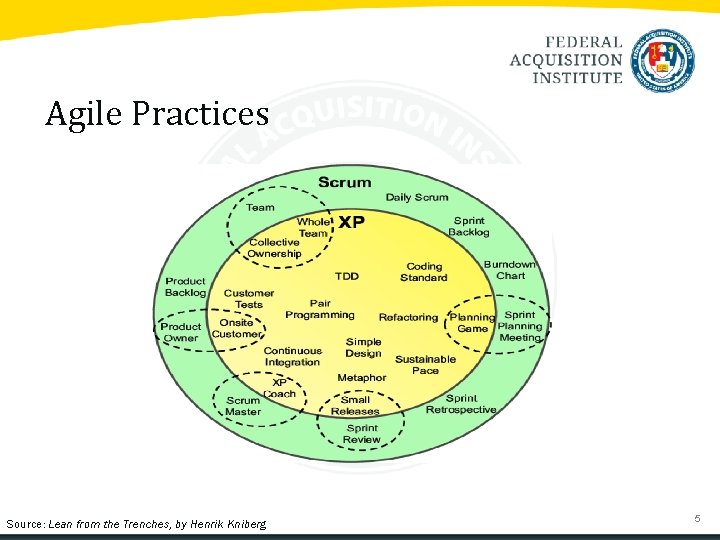
Agile Practices Source: Lean from the Trenches, by Henrik Kniberg 5
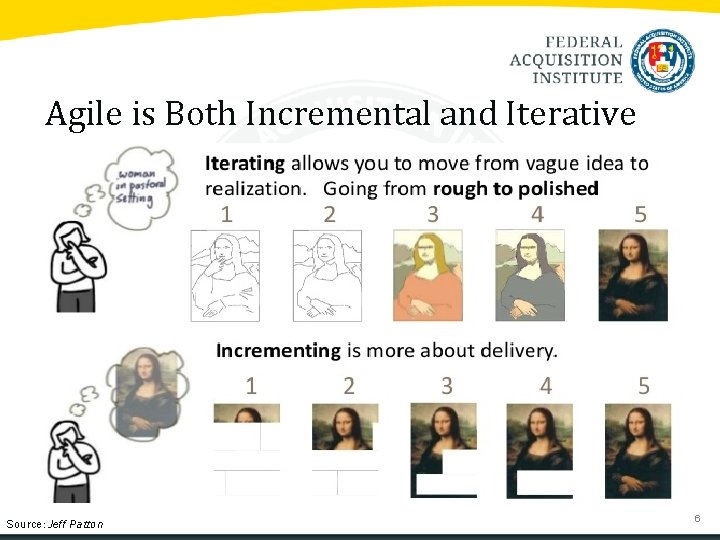
Agile is Both Incremental and Iterative Source: Jeff Patton 6
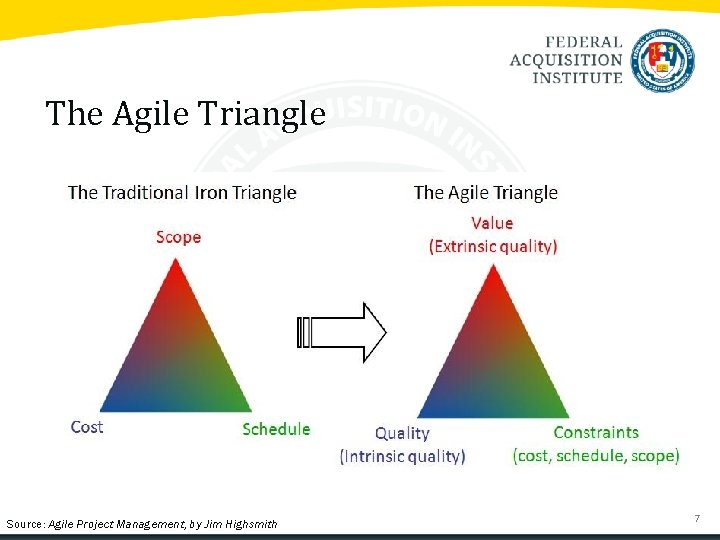
The Agile Triangle Source: Agile Project Management, by Jim Highsmith 7
Examples of Agile Acquisitions/Projects within the Federal Government • All 18 F software development projects (10+) use agile (and lean) methods • DHS/USCIS uses agile across its portfolio of software development projects • 18 F Consulting is working with several agencies to help them develop agile approaches to software acquisition, especially with regards to sound technical practices • GSA/18 F is also in the process of developing a government-wide contract vehicle that will feature vendors who specialize in agile 8
Agile Acquisitions 101 The Means Behind the Magic Presented by Traci Walker and Jonathan Mostowski, Procurement Strike Force Team, United States Digital Service (USDS) April 22, 2015 Jeffrey Birch, Acting Director www. fai. gov
The Road Not Taken “I shall be telling this with a sigh Somewhere ages and ages hence: Two roads diverged in a wood, and I, I took the one less traveled by, And that has made all the difference. ” -Robert Frost 10
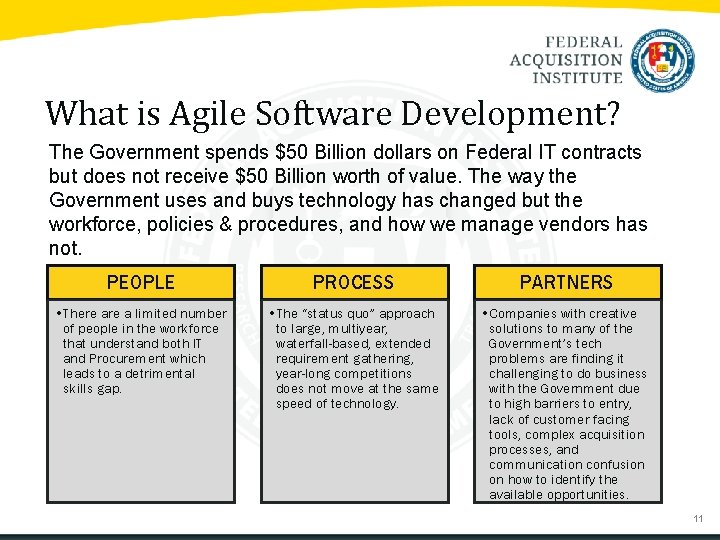
What is Agile Software Development? The Government spends $50 Billion dollars on Federal IT contracts but does not receive $50 Billion worth of value. The way the Government uses and buys technology has changed but the workforce, policies & procedures, and how we manage vendors has not. PEOPLE PROCESS PARTNERS • There a limited number of people in the workforce that understand both IT and Procurement which leads to a detrimental skills gap. • The “status quo” approach to large, multiyear, waterfall-based, extended requirement gathering, year-long competitions does not move at the same speed of technology. • Companies with creative solutions to many of the Government’s tech problems are finding it challenging to do business with the Government due to high barriers to entry, lack of customer facing tools, complex acquisition processes, and communication confusion on how to identify the available opportunities. 11
The Solution • Transform the Government’s most important citizen facing services to be simple, reliable, and delivered quickly for the appropriate price • Develop institutional capacity so this can be a lasting change
Bottom Line • There is a difference between Agile Development and Agile Contracting • Both traditional contracting and agile contracting have defined requirements • The FAR does not preclude agile contracting but rather provides several options for implementing agility in contracting • There is no single answer to achieving agility however Agile Contracting can be innovated through iterative applications of proven concepts 13
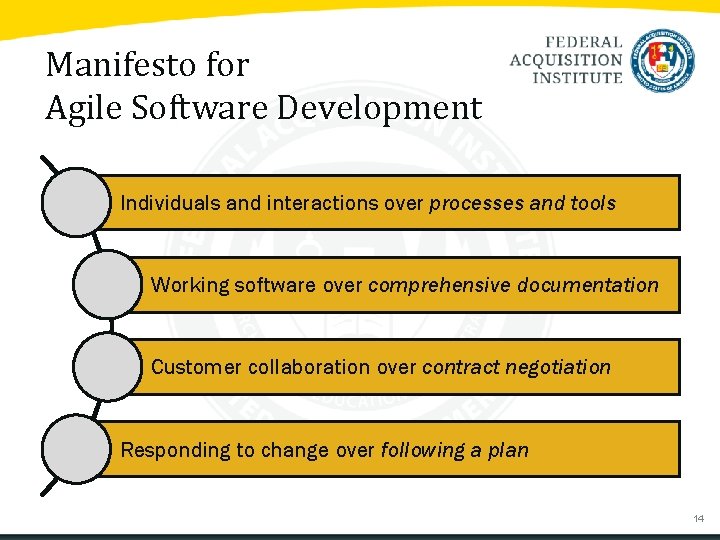
Manifesto for Agile Software Development Individuals and interactions over processes and tools Working software over comprehensive documentation Customer collaboration over contract negotiation Responding to change over following a plan 14
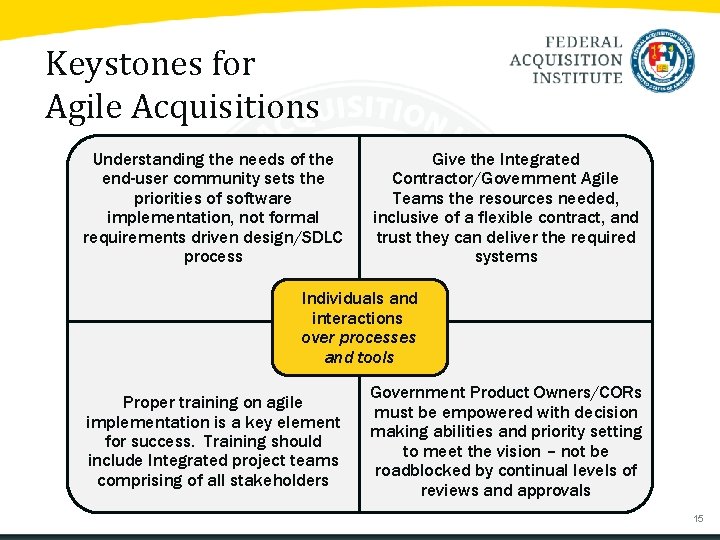
Keystones for Agile Acquisitions Understanding the needs of the end-user community sets the priorities of software implementation, not formal requirements driven design/SDLC process Give the Integrated Contractor/Government Agile Teams the resources needed, inclusive of a flexible contract, and trust they can deliver the required systems Individuals and interactions over processes and tools Proper training on agile implementation is a key element for success. Training should include Integrated project teams comprising of all stakeholders Government Product Owners/CORs must be empowered with decision making abilities and priority setting to meet the vision – not be roadblocked by continual levels of reviews and approvals 15
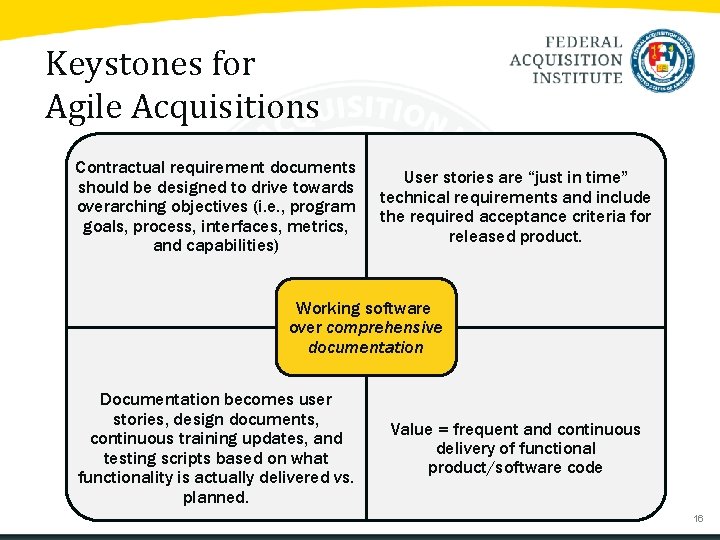
Keystones for Agile Acquisitions Contractual requirement documents should be designed to drive towards overarching objectives (i. e. , program goals, process, interfaces, metrics, and capabilities) User stories are “just in time” technical requirements and include the required acceptance criteria for released product. Working software over comprehensive documentation Documentation becomes user stories, design documents, continuous training updates, and testing scripts based on what functionality is actually delivered vs. planned. Value = frequent and continuous delivery of functional product/software code 16
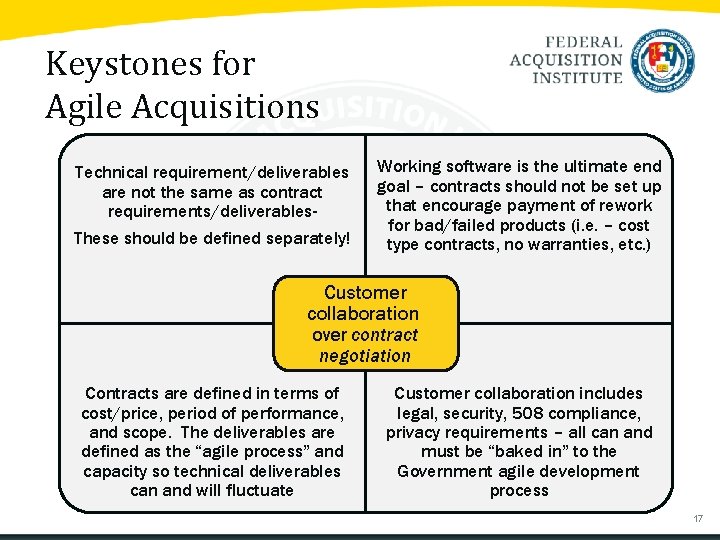
Keystones for Agile Acquisitions Technical requirement/deliverables are not the same as contract requirements/deliverables. These should be defined separately! Working software is the ultimate end goal – contracts should not be set up that encourage payment of rework for bad/failed products (i. e. – cost type contracts, no warranties, etc. ) Customer collaboration over contract negotiation Contracts are defined in terms of cost/price, period of performance, and scope. The deliverables are defined as the “agile process” and capacity so technical deliverables can and will fluctuate Customer collaboration includes legal, security, 508 compliance, privacy requirements – all can and must be “baked in” to the Government agile development process 17
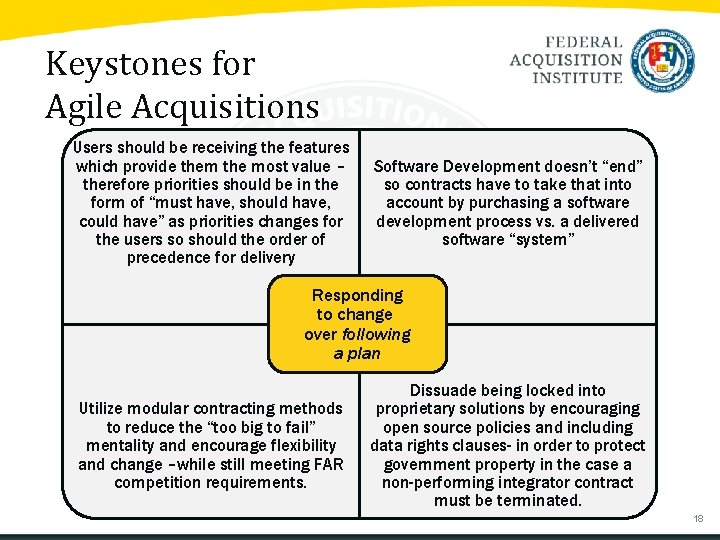
Keystones for Agile Acquisitions Users should be receiving the features which provide them the most value – therefore priorities should be in the form of “must have, should have, could have” as priorities changes for the users so should the order of precedence for delivery Software Development doesn’t “end” so contracts have to take that into account by purchasing a software development process vs. a delivered software “system” Responding to change over following a plan Utilize modular contracting methods to reduce the “too big to fail” mentality and encourage flexibility and change –while still meeting FAR competition requirements. Dissuade being locked into proprietary solutions by encouraging open source policies and including data rights clauses- in order to protect government property in the case a non-performing integrator contract must be terminated. 18
Iron Triangles • Both waterfall and agile have defined contract requirements: Cost, Schedule, & Performance • Waterfall Contracts maintain predictability through fixed delivery schedules and system requirements • Agile Contracts maintain flexibility for the purposes of Quality and End User priorities using trade-offs made within the contractual parameters between cost, schedule, and performance 19
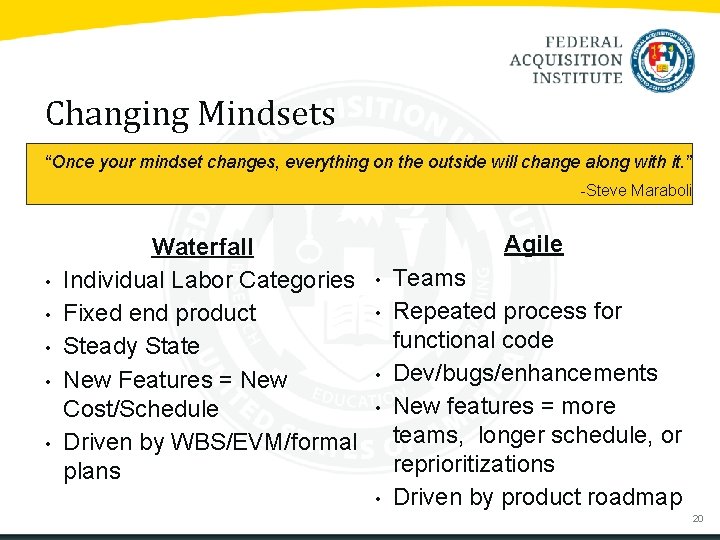
Changing Mindsets “Once your mindset changes, everything on the outside will change along with it. ” -Steve Maraboli • • • Waterfall Individual Labor Categories Fixed end product Steady State New Features = New Cost/Schedule Driven by WBS/EVM/formal plans Agile • • • Teams Repeated process for functional code Dev/bugs/enhancements New features = more teams, longer schedule, or reprioritizations Driven by product roadmap 20
Mona Lisa 21
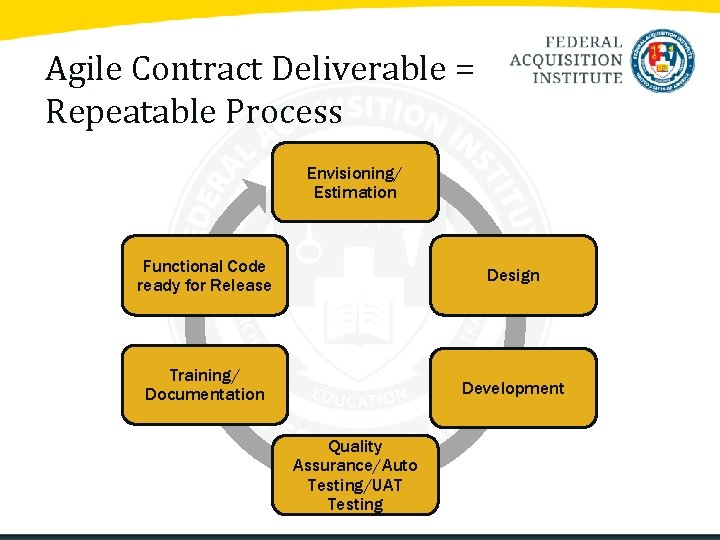
Agile Contract Deliverable = Repeatable Process Envisioning/ Estimation Functional Code ready for Release Design Training/ Documentation Development Quality Assurance/Auto Testing/UAT Testing 22
Where in the FAR? • FAR 8. 4 Federal Supply Schedules • FAR 12 Commercial Contracting • FAR 13. 3 Simplified Acquisition Methods • FAR 13. 5 Test Program for Certain Commercial Items • FAR 16. 202 -2 Firm Fixed Price • FAR 16. 504 Indefinite Delivery Indefinite Quantity • FAR 37. 1 Service Contract • FAR 37. 602 Performance Based Service Acquisitions • FAR 39: Acquisition of IT • FAR 27. 4 Data Rights (52. 227 -14) • FAR 52. 237 -3 Continuity of Services 23
How to Structure Your Contracts “If the only tool you have is a hammer, you tend to see every problem as a nail. ” -Abraham Maslow • • Single Award Indefinite Delivery/Indefinite Quantity FAR 16. 5 Standard “C” contract GWAC Blanket Purchase Agreement • • • GSA FAR 8. 4 BPA FAR 13. 3 • • • Multiple Award Indefinite Delivery/Indefinite Quantity GWAC Blanket Purchase Agreement • • GSA FAR 8. 4 BPA FAR 13. 3 Set Asides: Flexible intro to learn to apply agile and influence culture • Small Business 9. 6 24
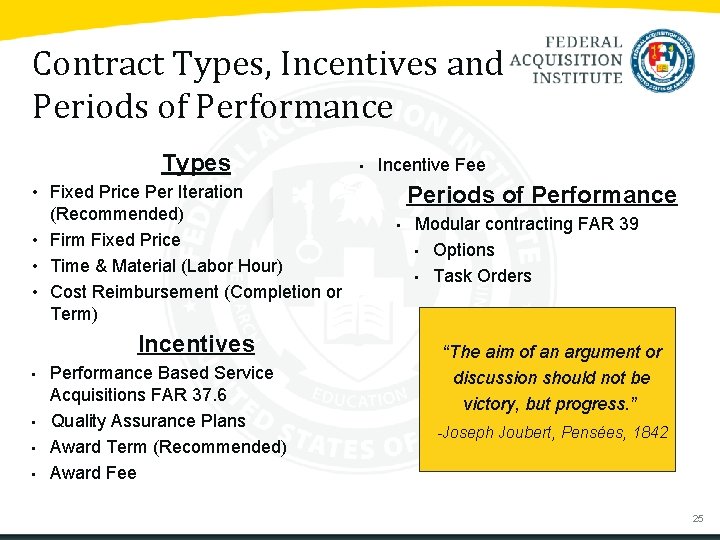
Contract Types, Incentives and Periods of Performance Types • Incentive Fee Periods of Performance • Fixed Price Per Iteration (Recommended) • Firm Fixed Price • Time & Material (Labor Hour) • Cost Reimbursement (Completion or Term) Incentives • • Performance Based Service Acquisitions FAR 37. 6 Quality Assurance Plans Award Term (Recommended) Award Fee • Modular contracting FAR 39 • Options • Task Orders “The aim of an argument or discussion should not be victory, but progress. ” -Joseph Joubert, Pensées, 1842 25
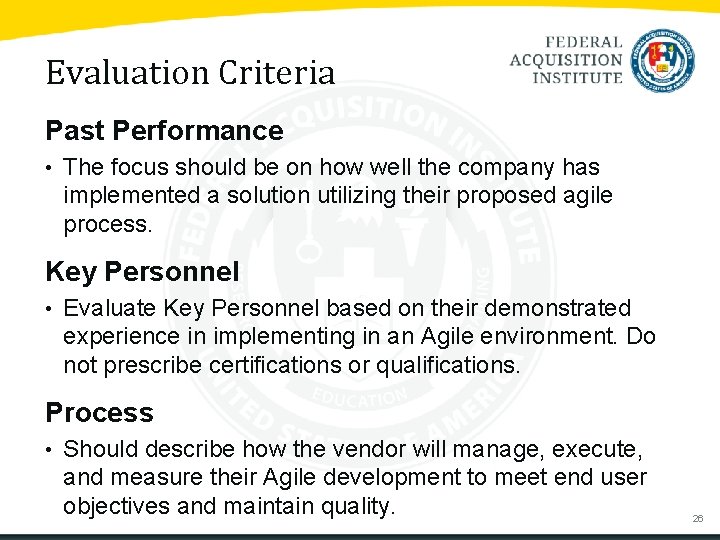
Evaluation Criteria Past Performance • The focus should be on how well the company has implemented a solution utilizing their proposed agile process. Key Personnel • Evaluate Key Personnel based on their demonstrated experience in implementing in an Agile environment. Do not prescribe certifications or qualifications. Process • Should describe how the vendor will manage, execute, and measure their Agile development to meet end user objectives and maintain quality. 26
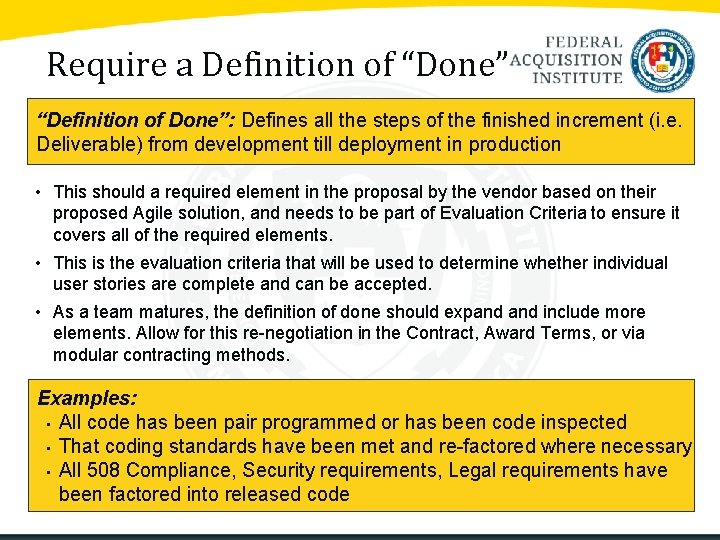
Require a Definition of “Done” “Definition of Done”: Defines all the steps of the finished increment (i. e. Deliverable) from development till deployment in production • This should a required element in the proposal by the vendor based on their proposed Agile solution, and needs to be part of Evaluation Criteria to ensure it covers all of the required elements. • This is the evaluation criteria that will be used to determine whether individual user stories are complete and can be accepted. • As a team matures, the definition of done should expand include more elements. Allow for this re-negotiation in the Contract, Award Terms, or via modular contracting methods. Examples: • All code has been pair programmed or has been code inspected • That coding standards have been met and re-factored where necessary • All 508 Compliance, Security requirements, Legal requirements have been factored into released code 27
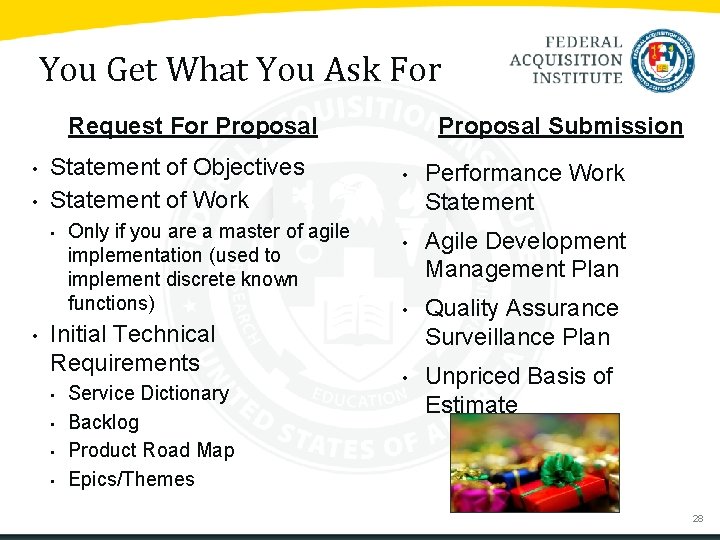
You Get What You Ask For Request For Proposal • • Statement of Objectives Statement of Work • • Only if you are a master of agile implementation (used to implement discrete known functions) Initial Technical Requirements • • Service Dictionary Backlog Product Road Map Epics/Themes Proposal Submission • Performance Work Statement • Agile Development Management Plan • Quality Assurance Surveillance Plan • Unpriced Basis of Estimate 28
Performance Management Be careful what you measure, because that is what you will get Velocity/Throughput Track the trend. As the trend stabilizes, teams can forecast their product backlog. Release planning also becomes easier for the product owner. Defect Density The number of bugs discovered during a sprint. An increasing number of bugs sprint-over-sprint could mean that the team is taking on too much work. A downward trend could point to changes in the definition of done improving quality. Customer Satisfaction The goal is measure satisfaction over time and to also address negative feedback quickly. Team Satisfaction Use the “ 5 Why’s” and other techniques to get to the root cause of whichever way the trend is going. Value Per Iteration This metric measures how much value the scrum team is delivering back to the customer/business/organization. A downward trend in this metric could indicate that lower value features are being implemented and that it is time to stop development on the product. 29
In a Nutshell • Change the way you define requirements • Use Statement of Objectives • Choose appropriate vehicle • Work closely with stakeholders • Monitor effectively “There will be a time when you believe everything is finished. That will be the beginning. ” -Louis L'Amour 30
Agile Acquisitions 101 The Means Behind the Magic Presented by Mark Naggar, Project Manager, HHS Buyers Club April 22, 2015 Jeffrey Birch, Acting Director www. fai. gov
HHS Buyers Club • Problem • • • IT projects >$10 million either challenged or failed According to the 2013 Chaos Manifesto from the Standish Group Solution • • Reengineer acquisition processes to seek better value and outcome for contracted services. Utilize innovative acquisition methods Incentivizing operational and cultural change Evaluate vendor capabilities more than writing skills 32
HHS Buyers Club – Goals/Objectives • Testing innovative acquisition methodologies • • Development of newer, easier, more effective acquisition models and processes • • Development and sharing of Use Cases based on the results for everyone to benefit Markets always change (i. e. Crowd. Sourcing) Engagement of all key stakeholders with effective education/outreach • Acquisition models/processes should work for all 33
HHS Buyers Club – Approach to Leveraging Resources • • HHS Acquisition Decision Diagram (New) HHS Strategy and Execution Plan Op. Div Buyers Club Components Identifying and sharing any: • • Common barriers, Ideas, and solutions, Best Practices, Research, Templates, & Guidance Pitfalls, Lessons Learned, Failures, and/or Opportunities for Collaboration across federal government 34
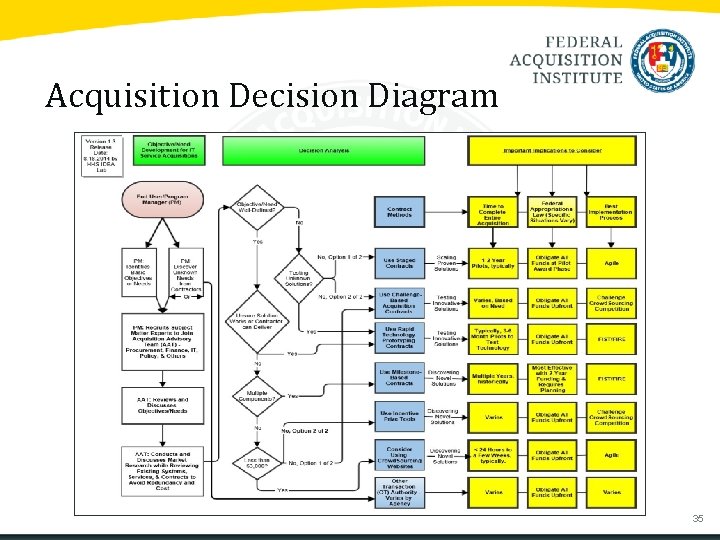
Acquisition Decision Diagram 35
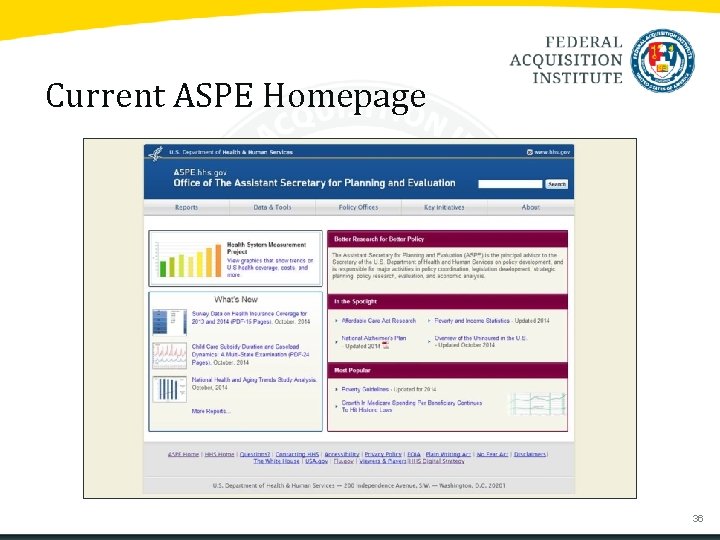
Current ASPE Homepage 36
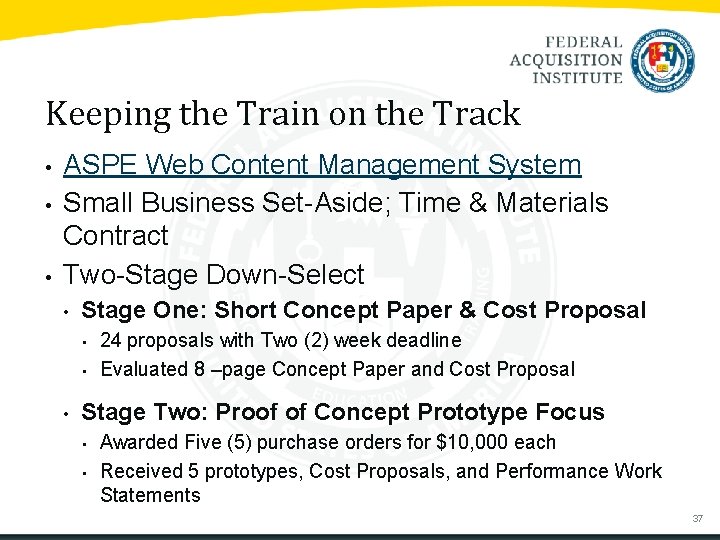
Keeping the Train on the Track • • • ASPE Web Content Management System Small Business Set-Aside; Time & Materials Contract Two-Stage Down-Select • Stage One: Short Concept Paper & Cost Proposal • • • 24 proposals with Two (2) week deadline Evaluated 8 –page Concept Paper and Cost Proposal Stage Two: Proof of Concept Prototype Focus • • Awarded Five (5) purchase orders for $10, 000 each Received 5 prototypes, Cost Proposals, and Performance Work Statements 37
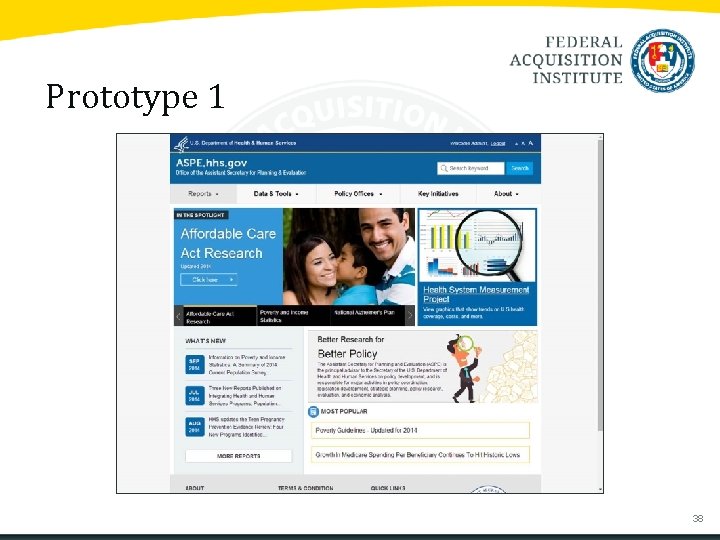
Prototype 1 38
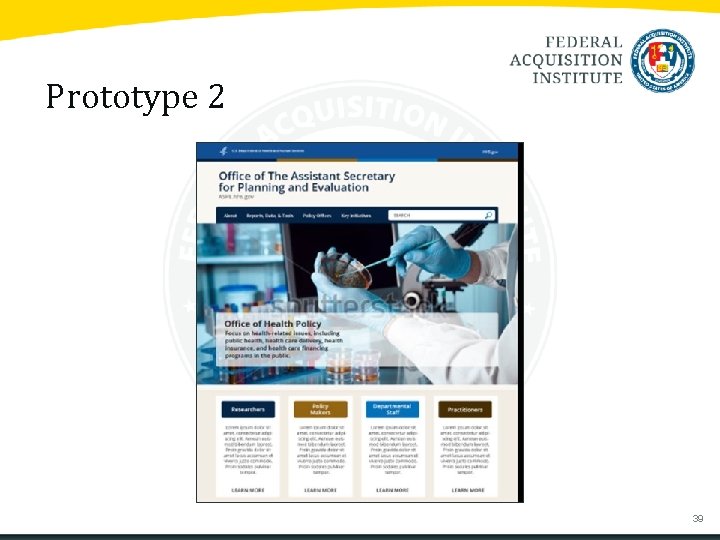
Prototype 2 39
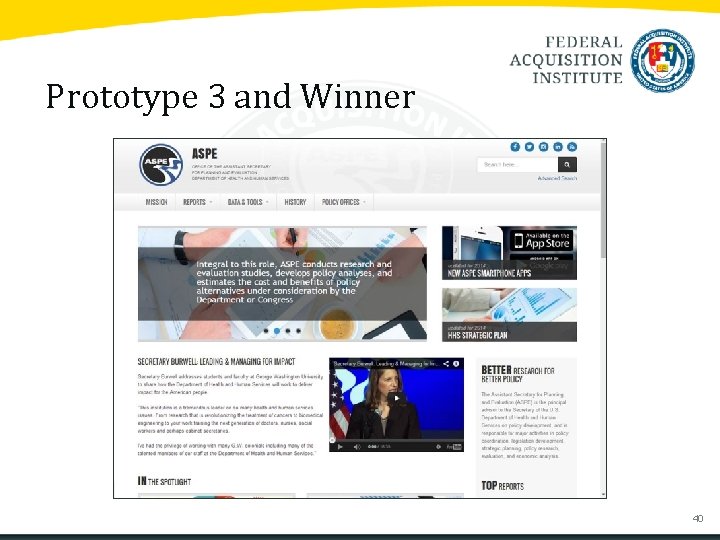
Prototype 3 and Winner 40
Use Case & Stakeholder Feedback Advantages of this approach and why it worked? • • • Staged Solicitation minimizes burden on offerors Concept paper focused on agile methodology and approach to objectives Prototype-driven evaluation allows: • • Offerors to showcase their capabilities; Program End Users to evaluate work product and coding before award Mitigates failure risk and increases likelihood of success Show (prototype) and Tell (text-based) proposals are better than just “Tell” 41
Use Case & Stakeholder Feedback • All stakeholders (including Offerors): • • • Valued this streamlined approach Preferred the prototype-driven approach with staged solicitation Would like oral presentations to be included moving forward 42
The Agile Implementation Process Communication and Ongoing End User Feedback • • Contractor and End User communicate daily Contractor delivers in two-week sprints Allows End User to closely monitor and prioritize work First time this End User’s division has used agile methods • • They’re beyond thrilled with the results even though it requires more effort on their part. The result is a much better value than traditional waterfall method Truly assists End User and Contractor partner together to achieve vision and objectives 43
The Agile Implementation Process Communication and Ongoing End User Feedback • • The Agile Technology Stack (modern IT service delivery tools) Enables consistent interaction and collaboration Desktop sharing and Conference Calls are only basics Mostly free, online tools used on this and other projects • • • Scrum planning & monitoring tool used for user stories, backlog, task monitoring, and priority adjustments Enterprise file sharing (and documentation repository) Version control system; Card sorting tool; Mind mapping tool for taxonomy generation and shared mind map Sharing and online editing of the high-level project planning 44
What’s Next? • Engage with each Op. Div to help them succeed in their acquisition of IT services • Develop Buyers Club SME’s/Working Groups throughout each Op. Div • • • Because each Op. Div is unique and different Share within, throughout HHS, and throughout federal Gather continuous feedback to improve • Including on the Acquisition Decision Diagram 45
- Slides: 45