
AGGRESSIVE BEHAVIOUR CONDUCT DISORDER AND ACADEMIC PERFORMANCE OF
AGGRESSIVE BEHAVIOUR, CONDUCT DISORDER AND ACADEMIC PERFORMANCE OF STUDENTS WITH INTELLECTUAL DISABILITIES IN ILORIN METROPOLIS, KWARA STATE, NIGERIA Olubukola C Dada Ph. D Department of Special Education, College of Education Kwara State University, Malete olubukola. dada@kwasu. edu. ng
Introduction • Students with intellectual disabilities (SID) have difficulties meeting the expectation of general curriculum • Their academic performance tends to be low • SID display aggressive and conduct disorder • SID are characterized by significant limitations both in intellectual functioning and adaptive behaviour • The problem originates before the age 18. Head Start State-based T/TA Office for Arizona A member of the National Head Start Training and Technical Assistance Network

• Etiology of aggression includes a number of medical, neurological, psychiatric and environmental factors. • Aggressive behaviours represent major obstacles to the integration into society of SID and pose significant management issues for carers. • Although higher rates have generally been found among males than females (Harris 1993; Borthwick‐Duffy 1994; Davidson et al. 1994), some studies have found no gender differences (Linaker, 1994).
• Conduct disorder constitutes a major diagnostic category among disruptive disorders in children and adolescents to mental health treatments (Austin & Sciarra, 2010). • Students with conduct disorder engage in a repetitive and persistent pattern of behaviour that violates the basic rights of others or major age-appropriate societal norm. • Children who have conduct disorder are often hard to control and unwilling to follow rules. They act impulsively without considering the consequences of their actions. They also do not take other people’s feelings into consideration.
Statement of the Problem Literature revealed that conduct disorder and aggressive behaviour could hinder students’ academic performance. Unfortunately, previous studies conducted among students with intellectual disabilities and their behavioural characteristics have not yet consider the implication of aggressive tendencies and conduct disorders on academic performance, thereby leaving a research gap to fill. Hence, this study examined the relationship among aggressive behaviour, conduct disorder and academic performance of students with intellectual disabilities.
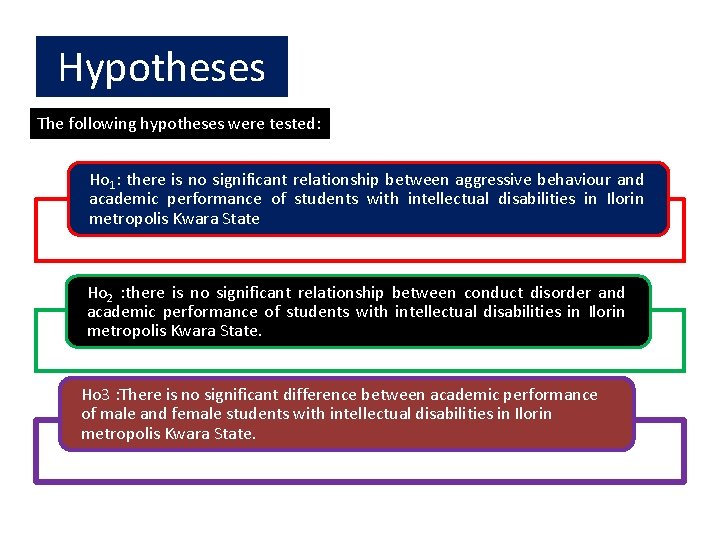
Hypotheses The following hypotheses were tested: Ho 1: there is no significant relationship between aggressive behaviour and academic performance of students with intellectual disabilities in Ilorin metropolis Kwara State Ho 2 : there is no significant relationship between conduct disorder and academic performance of students with intellectual disabilities in Ilorin metropolis Kwara State. Ho 3 : There is no significant difference between academic performance of male and female students with intellectual disabilities in Ilorin metropolis Kwara State.
Methodology Research Design Descriptive survey design of correlation type

The population of this study comprised all teachers of students with intellectual disabilities in Ilorin metropolis Kwara State
Sample and Sampling Procedure sample of the study comprised of 120 teachers of students with intellectual disabilities Purposive sampling technique was used
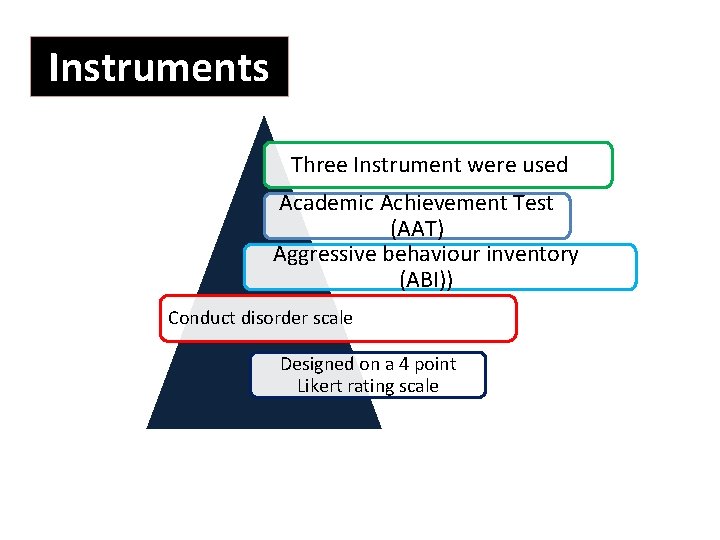
Instruments Three Instrument were used Academic Achievement Test (AAT) Aggressive behaviour inventory (ABI)) Conduct disorder scale Designed on a 4 point Likert rating scale
Method of data analysis Data gathered were analysed using Pearson Product Moment Correlation (PPMC) and t-test.
Findings revealed: That there is significant relationship between aggressive and academic performance of SID. This finding is in line with the finding of Uludag (2013), Caprara et al. (2000) and Barriga et al (2002) who reported that aggression had a significant negative effect on student academic achievement
Also, no significant relationship between conduct disorder and academic performance of SID. This finding negates the report of Frank-Briggs and Alikor (2008), Akpan, Ojinnaka and Ekanem (2010) that conduct disorder influences the academic performance of students.
No significant different between academic performance of male and female SID in Ilorin metropolis, Kwara State. Kumar & Malik (2012) found that level of aggression among adolescent boys were higher than the adolescent girls.
Conclusion In conclusion, little is known regarding the escalation of lower level of aggression and conduct disorder to more severe forms of aggression and conduct disorder, thus, more research is clearly needed to better understand the development of aggressive behaviour and conduct disorder among students with intellectual disabilities.
Recommendation Teacher should use management strategies to control aggressive behaviour and conduct disorder of students with intellectual disabilities so that can have better academic performance.

- Slides: 17