
Aggregation Connector A Tool for Building Large Molecular
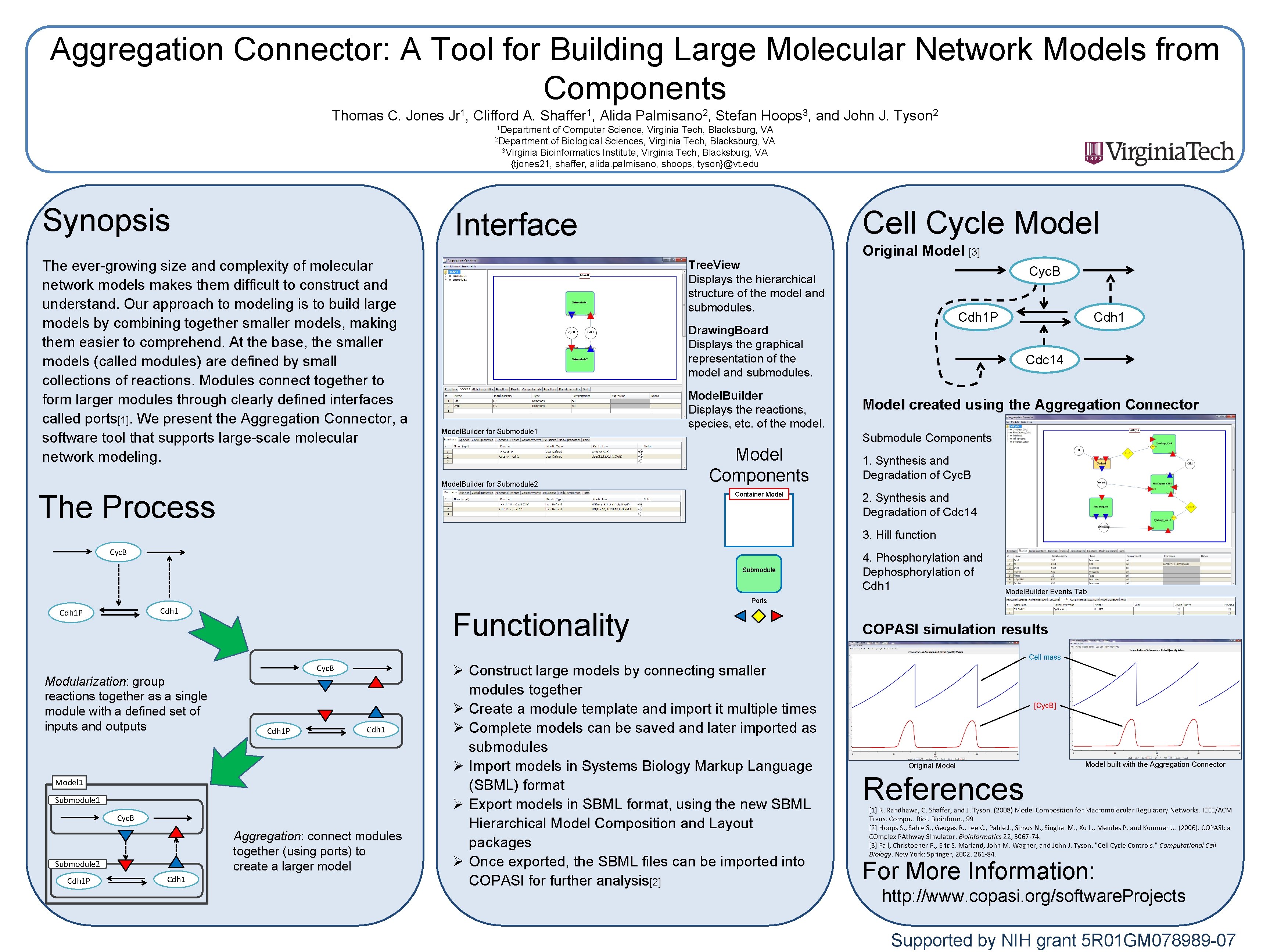
Aggregation Connector: A Tool for Building Large Molecular Network Models from Components Thomas C. Jones Jr 1, Clifford A. Shaffer 1, Alida Palmisano 2, Stefan Hoops 3, and John J. Tyson 2 1 Department of Computer Science, Virginia Tech, Blacksburg, VA 2 Department of Biological Sciences, Virginia Tech, Blacksburg, VA 3 Virginia Bioinformatics Institute, Virginia Tech, Blacksburg, VA {tjones 21, shaffer, alida. palmisano, shoops, tyson}@vt. edu Synopsis Cell Cycle Model Interface The ever-growing size and complexity of molecular network models makes them difficult to construct and understand. Our approach to modeling is to build large models by combining together smaller models, making them easier to comprehend. At the base, the smaller models (called modules) are defined by small collections of reactions. Modules connect together to form larger modules through clearly defined interfaces called ports[1]. We present the Aggregation Connector, a software tool that supports large-scale molecular network modeling. Tree. View Displays the hierarchical structure of the model and submodules. Original Model [3] Cyc. B Cdh 1 P Drawing. Board Displays the graphical representation of the model and submodules. Model. Builder for Submodule 1 Model. Builder for Submodule 2 The Process Model. Builder Displays the reactions, species, etc. of the model. Cdh 1 Cdc 14 Model created using the Aggregation Connector Submodule Components Model Components Container Model 1. Synthesis and Degradation of Cyc. B 2. Synthesis and Degradation of Cdc 14 3. Hill function Cyc. B Submodule 4. Phosphorylation and Dephosphorylation of Cdh 1 Model. Builder Events Tab Ports Cdh 1 P Functionality COPASI simulation results Cell mass Cyc. B Modularization: group reactions together as a single module with a defined set of inputs and outputs Cdh 1 P Cdh 1 Model 1 Submodule 1 Cyc. B Aggregation: connect modules together (using ports) to create a larger model Submodule 2 Cdh 1 P Cdh 1 Ø Construct large models by connecting smaller modules together Ø Create a module template and import it multiple times Ø Complete models can be saved and later imported as submodules Ø Import models in Systems Biology Markup Language (SBML) format Ø Export models in SBML format, using the new SBML Hierarchical Model Composition and Layout packages Ø Once exported, the SBML files can be imported into COPASI for further analysis[2] [Cyc. B] Original Model built with the Aggregation Connector References [1] R. Randhawa, C. Shaffer, and J. Tyson. (2008) Model Composition for Macromolecular Regulatory Networks. IEEE/ACM Trans. Comput. Biol. Bioinform. , 99 [2] Hoops S. , Sahle S. , Gauges R. , Lee C. , Pahle J. , Simus N. , Singhal M. , Xu L. , Mendes P. and Kummer U. (2006). COPASI: a COmplex PAthway SImulator. Bioinformatics 22, 3067 -74. [3] Fall, Christopher P. , Eric S. Marland, John M. Wagner, and John J. Tyson. "Cell Cycle Controls. " Computational Cell Biology. New York: Springer, 2002. 261 -84. For More Information: http: //www. copasi. org/software. Projects Supported by NIH grant 5 R 01 GM 078989 -07
- Slides: 1