
Aggregates in Civil Engineering Base and Subbase Environmental
Aggregates in Civil Engineering Base and Subbase Environmental Filters Fillers Dams Cores
Aggregates in Composites 60 -70% of Concrete Volume 80 -90% of Asphalt Volume Control Low-Strength Fill Material 95% of Polymer Concrete
Uses of Aggregates Filler material Dimensional Stability: n n shrinkage, thermal changes Strength and Stiffness ECONOMY
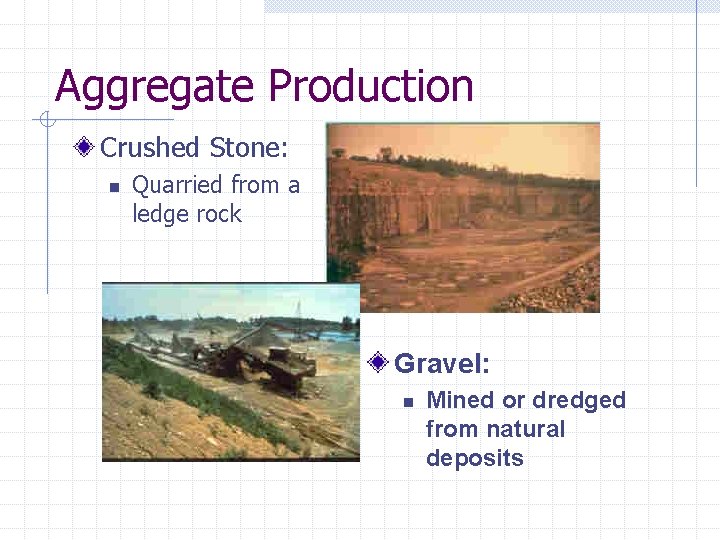
Aggregate Production Crushed Stone: n Quarried from a ledge rock Gravel: n Mined or dredged from natural deposits
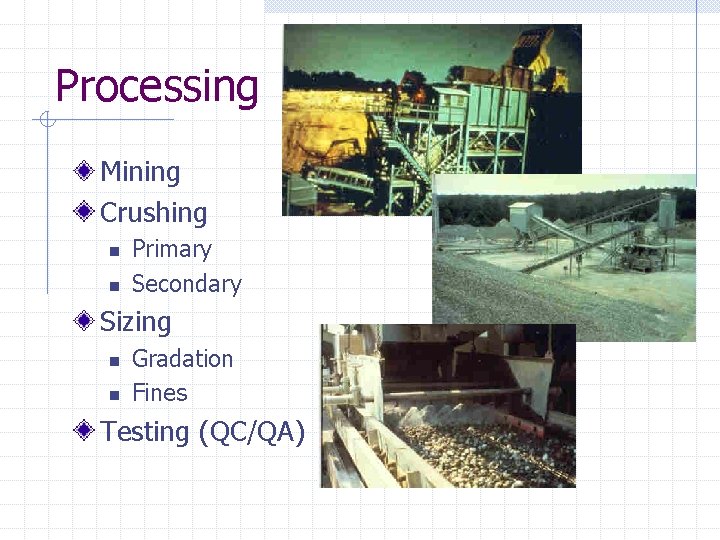
Processing Mining Crushing n n Primary Secondary Sizing n n Gradation Fines Testing (QC/QA)
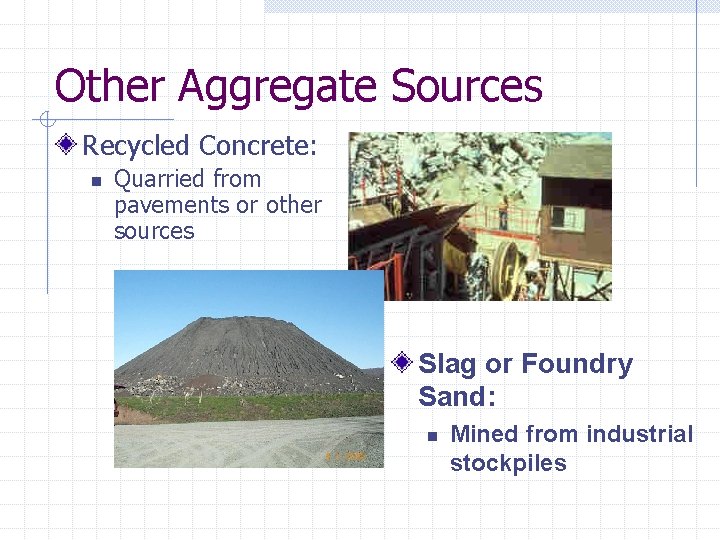
Other Aggregate Sources Recycled Concrete: n Quarried from pavements or other sources Slag or Foundry Sand: n Mined from industrial stockpiles
Natural (mineral) Aggregates U. S. Sources n n 50% Gravel 50% Crushed Gravel n n River Run Glacial Deposits Crushed Stone n n 65% Carbonates 35% Other w Sandstone w Granite w basalt. . .
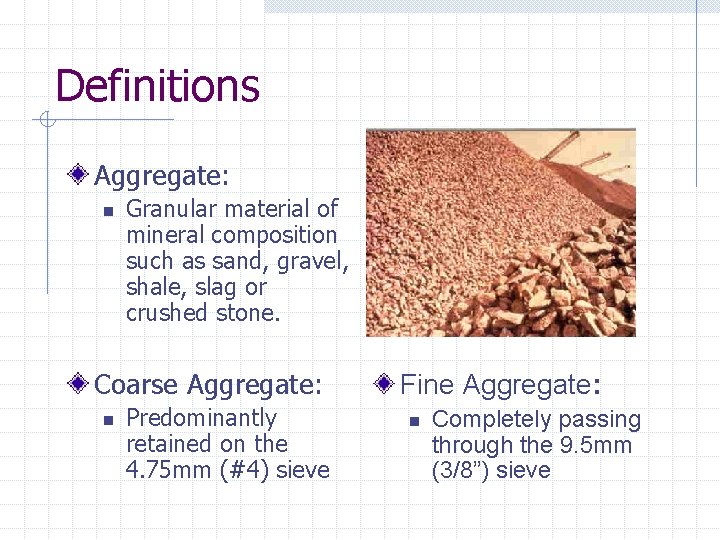
Definitions Aggregate: n Granular material of mineral composition such as sand, gravel, shale, slag or crushed stone. Coarse Aggregate: n Predominantly retained on the 4. 75 mm (#4) sieve Fine Aggregate: n Completely passing through the 9. 5 mm (3/8”) sieve
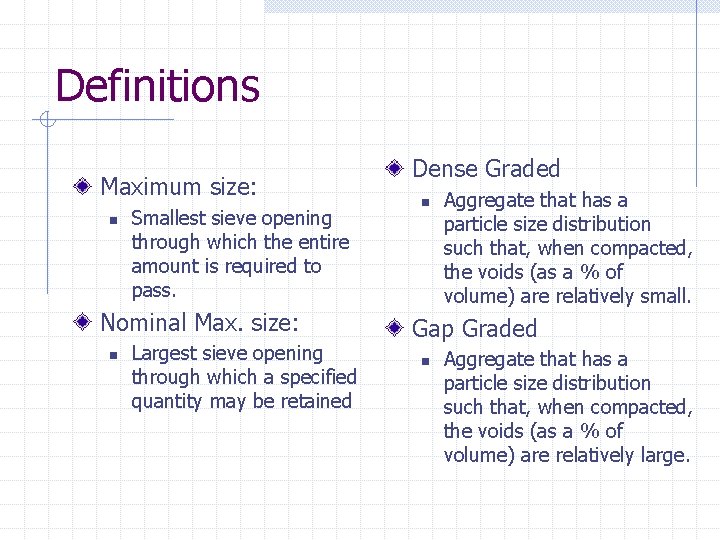
Definitions Maximum size: n Smallest sieve opening through which the entire amount is required to pass. Nominal Max. size: n Largest sieve opening through which a specified quantity may be retained Dense Graded n Aggregate that has a particle size distribution such that, when compacted, the voids (as a % of volume) are relatively small. Gap Graded n Aggregate that has a particle size distribution such that, when compacted, the voids (as a % of volume) are relatively large.
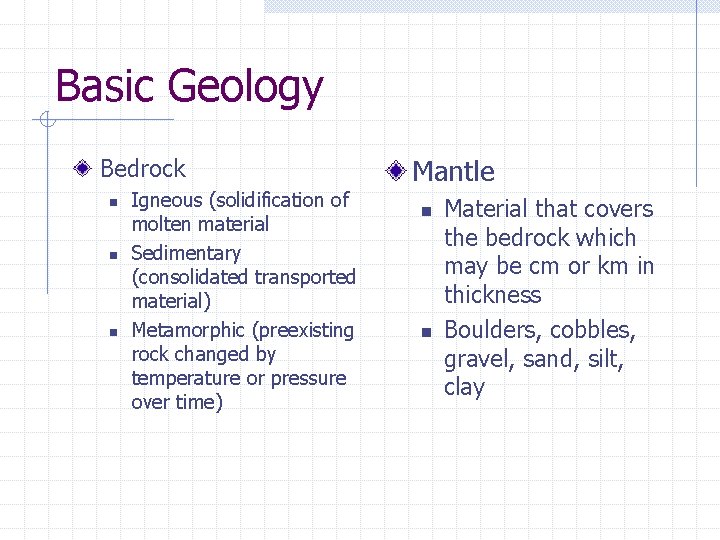
Basic Geology Bedrock n n n Igneous (solidification of molten material Sedimentary (consolidated transported material) Metamorphic (preexisting rock changed by temperature or pressure over time) Mantle n n Material that covers the bedrock which may be cm or km in thickness Boulders, cobbles, gravel, sand, silt, clay
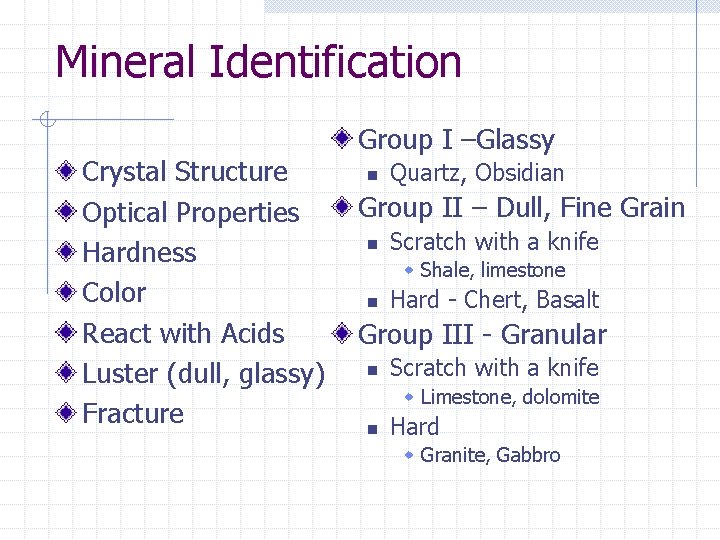
Mineral Identification Crystal Structure Optical Properties Hardness Color React with Acids Luster (dull, glassy) Fracture Group I –Glassy n Quartz, Obsidian Group II – Dull, Fine Grain n Scratch with a knife w Shale, limestone n Hard - Chert, Basalt Group III - Granular n Scratch with a knife w Limestone, dolomite n Hard w Granite, Gabbro

Mineral Identification
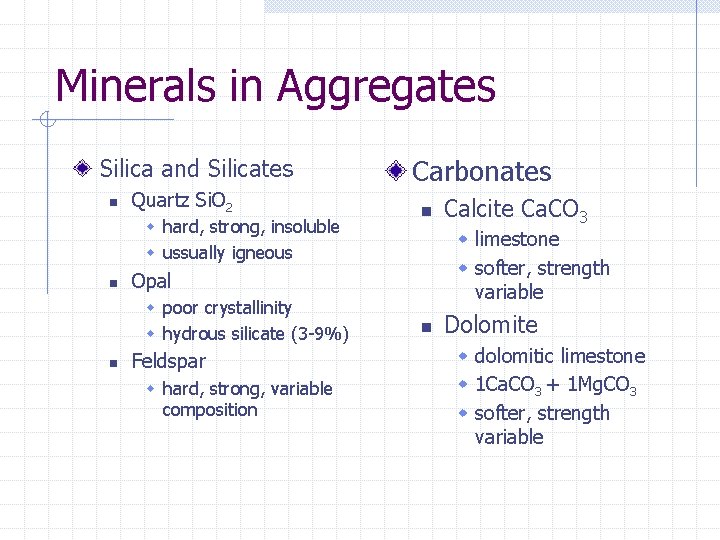
Minerals in Aggregates Silica and Silicates n Quartz Si. O 2 w hard, strong, insoluble w ussually igneous n n Feldspar w hard, strong, variable composition Calcite Ca. CO 3 w limestone w softer, strength variable Opal w poor crystallinity w hydrous silicate (3 -9%) n Carbonates n Dolomite w dolomitic limestone w 1 Ca. CO 3 + 1 Mg. CO 3 w softer, strength variable
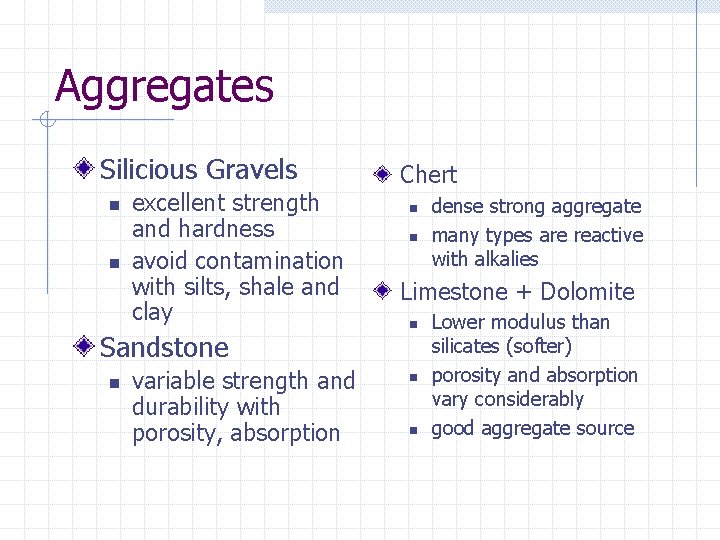
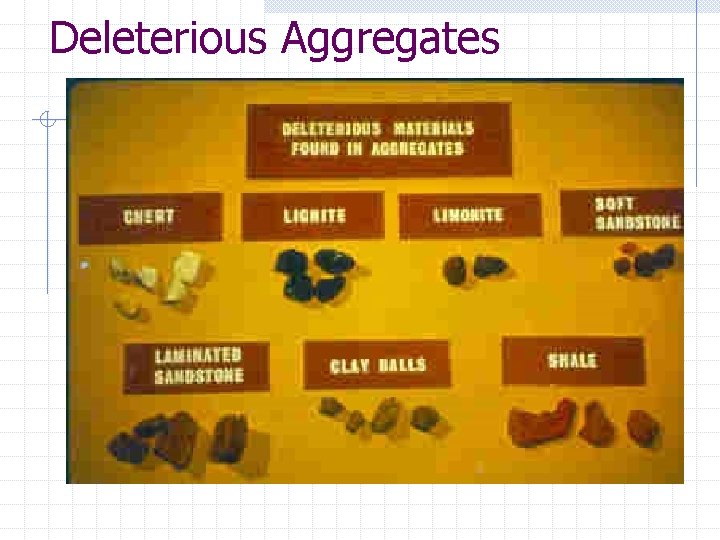
Aggregates Silicious Gravels n n excellent strength and hardness avoid contamination with silts, shale and clay Sandstone n variable strength and durability with porosity, absorption Chert n n dense strong aggregate many types are reactive with alkalies Limestone + Dolomite n n n Lower modulus than silicates (softer) porosity and absorption vary considerably good aggregate source
Aggregate Properties Density (C 29) n Dry-rodded density 1520 -1680 kg/m 3 w (95 -105 pcf ) for normal weight n “Bulk” effect of internal voids Voids (C 29) n n Space between compacted particles Difference between Dry-Rodded Density and solid density
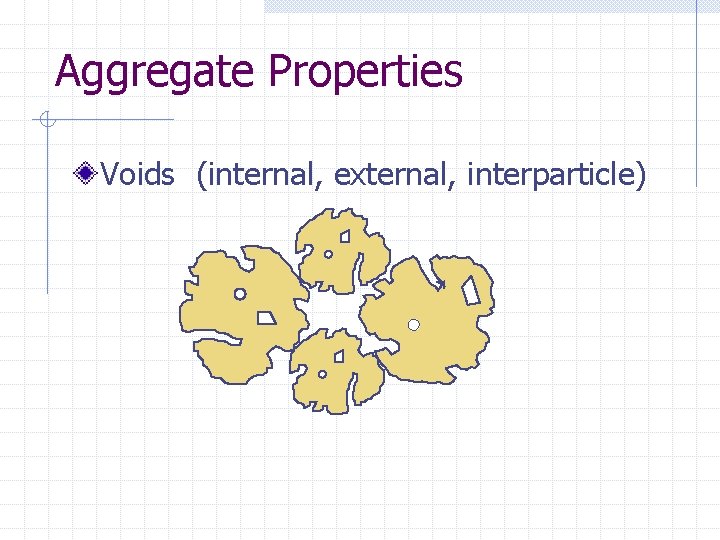
Aggregate Properties Voids (internal, external, interparticle)
Moisture Condition Oven-dried, Absorption, Moisture Content Net effect Bulking of Sand ( 5% MC is worst)
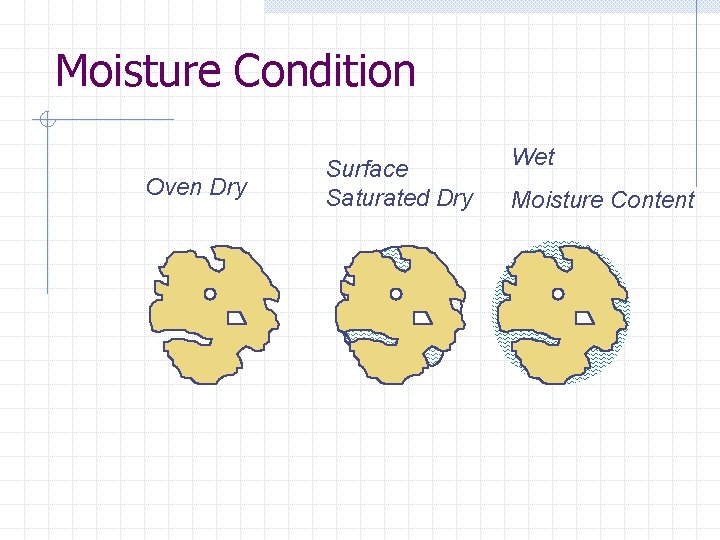
Moisture Condition Oven Dry Surface Saturated Dry Wet Moisture Content
Types of Aggregate Normal-weight (ASTM C 33) n n n Gravel, Crushed stone Natural sand Manufactured sand Bulk Specific Gravity = 2. 40 - 2. 90
Types of Aggregate Lightweight (ASTM C 330) n n Pumice, Expanded shale and Clay 3 M microspheres, cenospheres. . . Uses: filler or low modulus applications w Geo Fills, Structural Slabs
Types of Aggregate Heavyweight (ASTM C 637) n n n Steel slag Shot, Ores BSG= 3. 5 -5. 2 Uses: ballast & radiation shielding
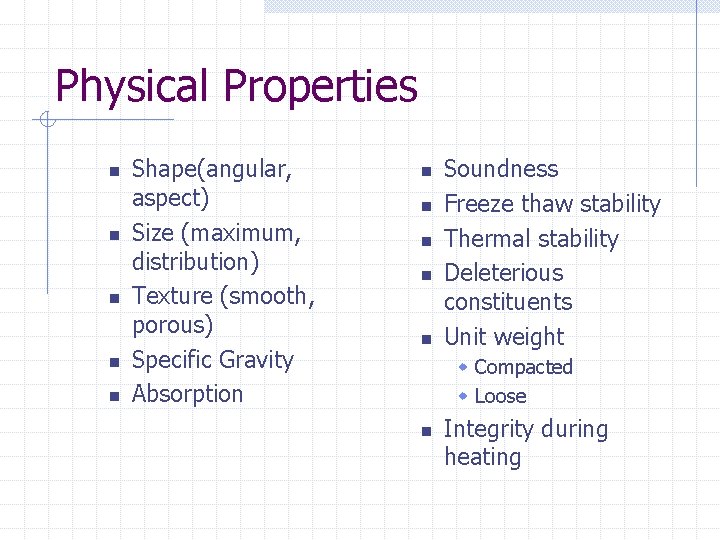
Physical Properties n n n Shape(angular, aspect) Size (maximum, distribution) Texture (smooth, porous) Specific Gravity Absorption n n Soundness Freeze thaw stability Thermal stability Deleterious constituents Unit weight w Compacted w Loose n Integrity during heating
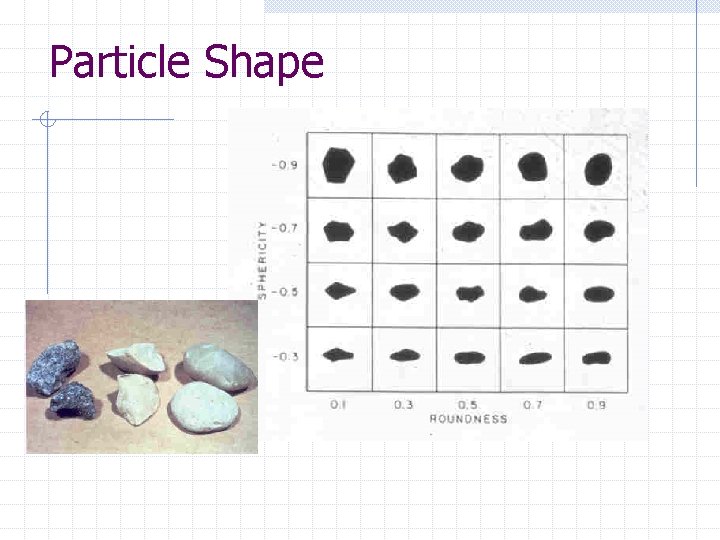
Particle Shape
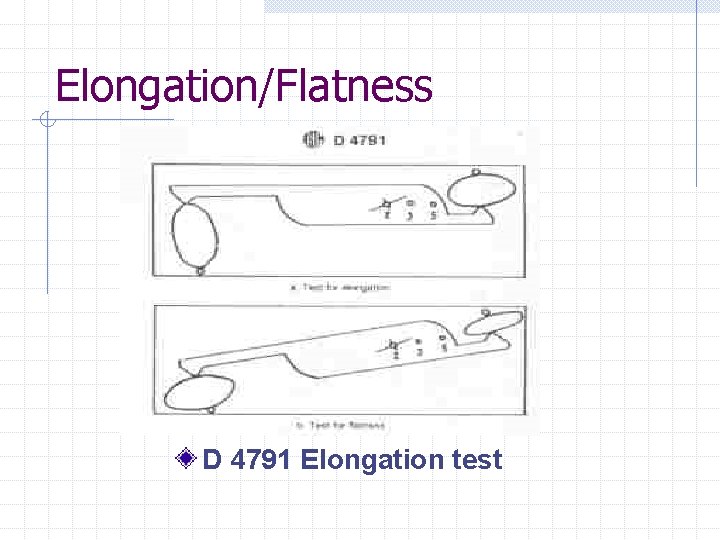
Elongation/Flatness D 4791 Elongation test
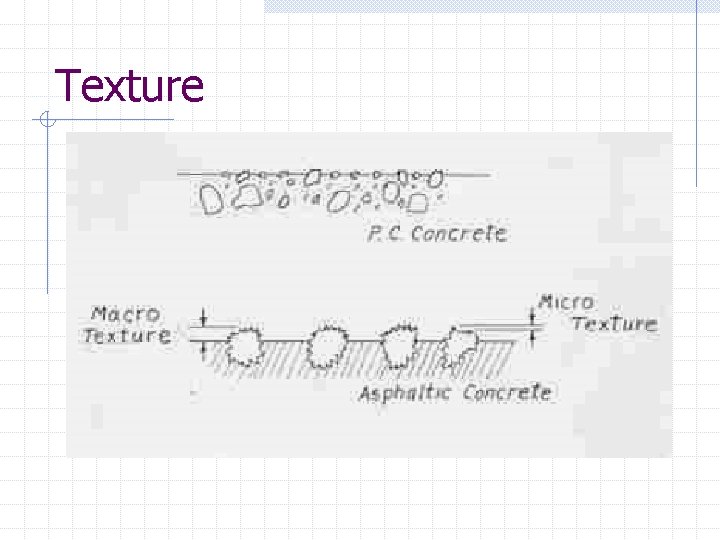
Texture
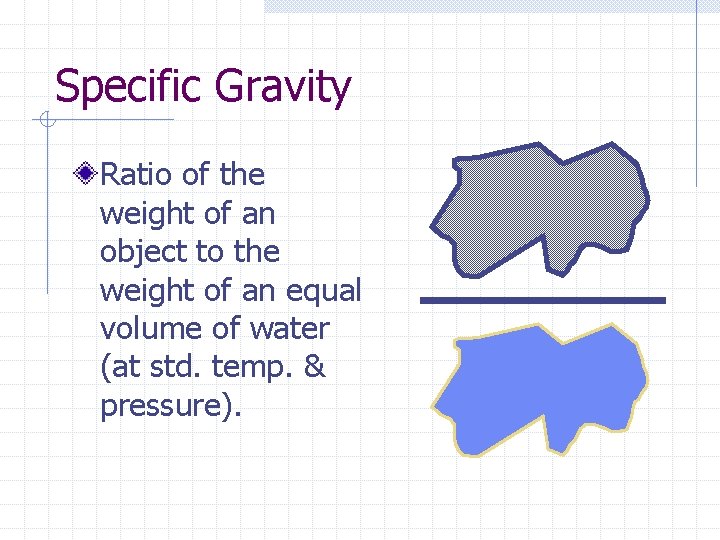
Specific Gravity Ratio of the weight of an object to the weight of an equal volume of water (at std. temp. & pressure).
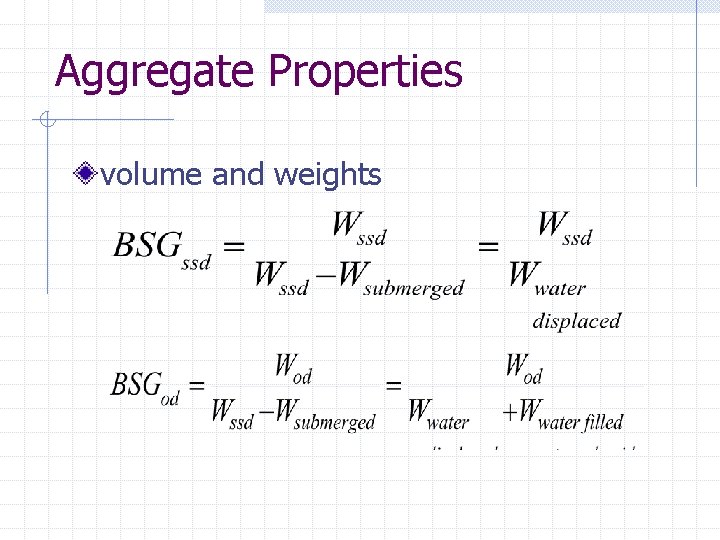
Aggregate Properties volume and weights
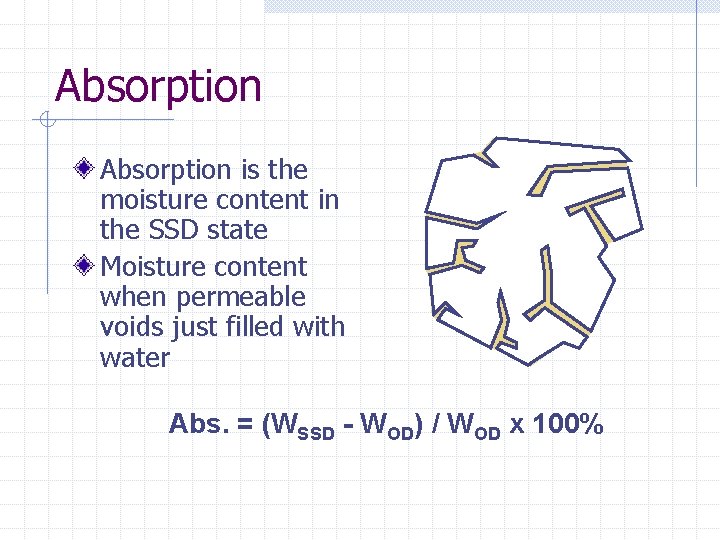
Absorption is the moisture content in the SSD state Moisture content when permeable voids just filled with water Abs. = (WSSD - WOD) / WOD x 100%
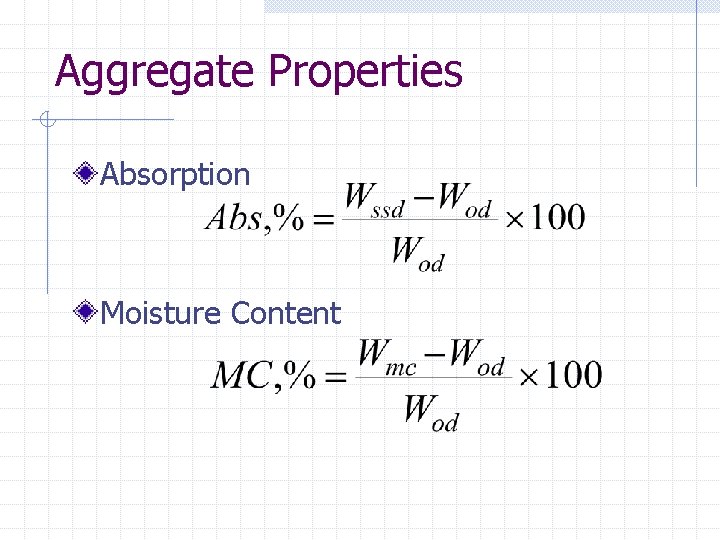
Aggregate Properties Absorption Moisture Content
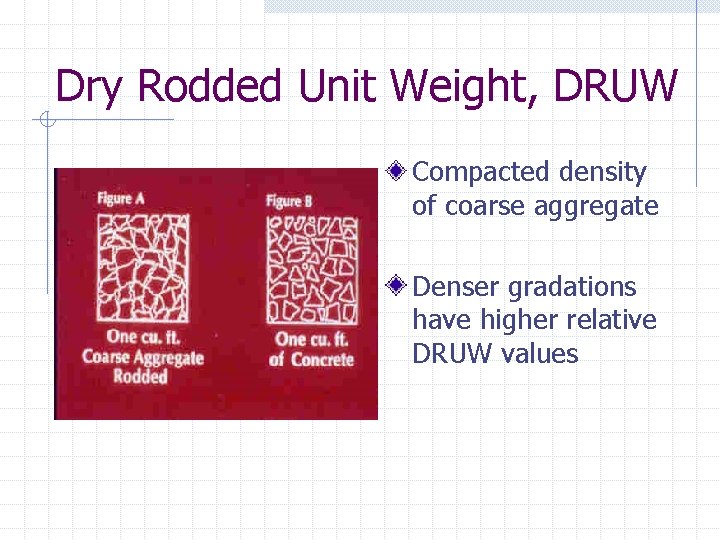
Dry Rodded Unit Weight, DRUW Compacted density of coarse aggregate Denser gradations have higher relative DRUW values
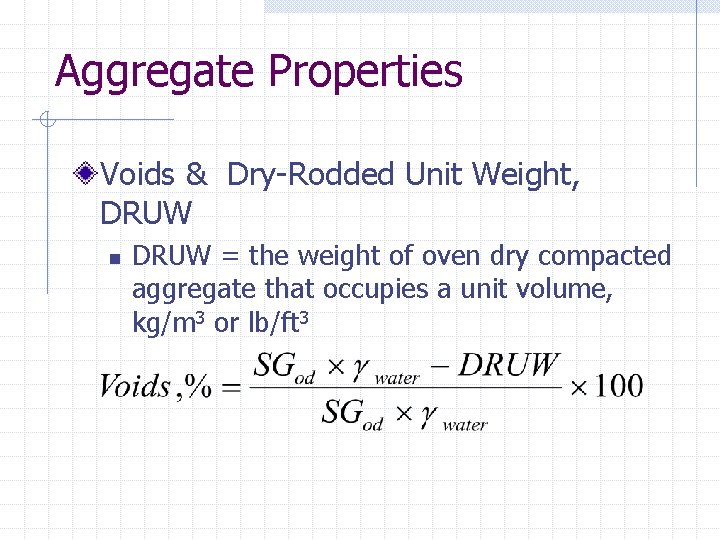
Aggregate Properties Voids & Dry-Rodded Unit Weight, DRUW n DRUW = the weight of oven dry compacted aggregate that occupies a unit volume, kg/m 3 or lb/ft 3
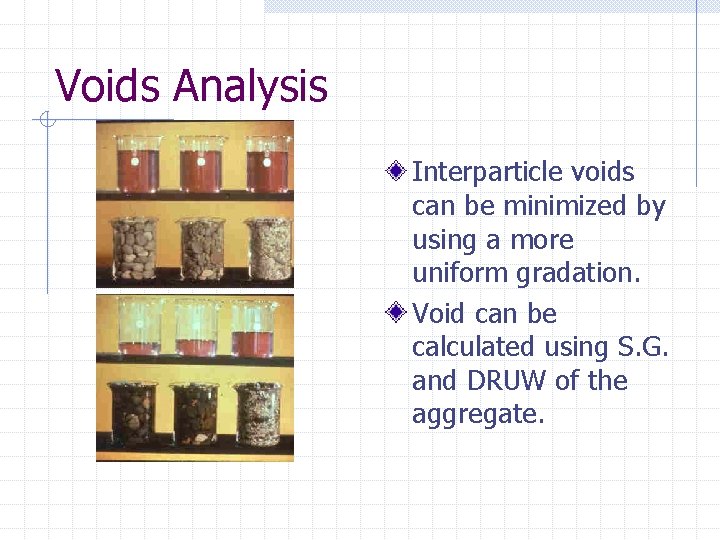
Voids Analysis Interparticle voids can be minimized by using a more uniform gradation. Void can be calculated using S. G. and DRUW of the aggregate.
Gradation (C 117, C 136) Particle size distribution n n Standard - best compaction Max size vs. Nominal max size Gap Graded (some sizes missing) Single Size
Fineness Modulus (ASTM C 136)
Gradation of Aggregates Too many fines contribute to problems Organic impurities Compaction, Water demand in concrete Shoving in asphalt Dust control
Deleterious Aggregates
Chemical Properties n n n Solubility Electrical conductivity Asphalt affinity Reactivity to alkalies Reactivity to CO 2 Chemical stability
Soundness Testing Na or Mg sulfate saturated solutions are used to test aggregate friability 5 cycles of saturation and drying Sulfates hydrate and expand to fracture weak planes ASTM C 88 n n Specific gradations Loss is determined by mass 12% max loss w/ Na 18% max loss w/ Mg Precision is very poor
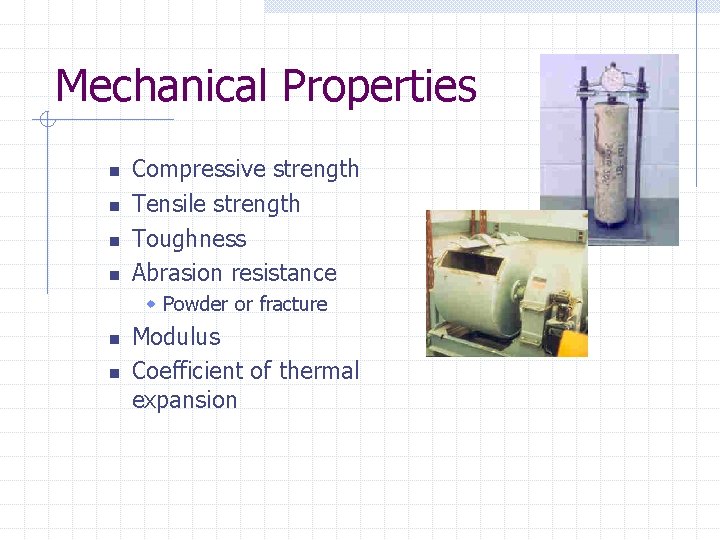
Mechanical Properties n n Compressive strength Tensile strength Toughness Abrasion resistance w Powder or fracture n n Modulus Coefficient of thermal expansion
Strength of Aggregates Shale and Sandstone: 35 -90 MPa (5 -13 ksi) Limestone: 48 -270 MPa (7 -39 ksi) Granite: 27 -275 MPa (4 -40 ksi) Pumice: 2 MPa (300 psi) Traprock: 105 -235 MPa (15 -34 ksi)
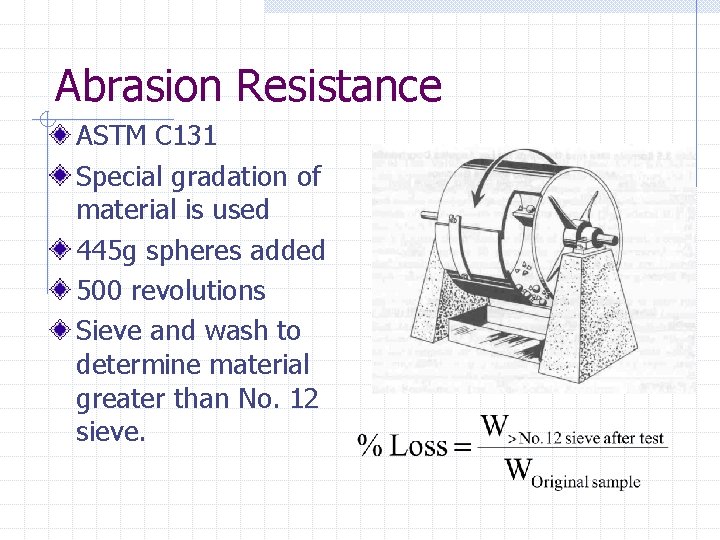
Abrasion Resistance ASTM C 131 Special gradation of material is used 445 g spheres added 500 revolutions Sieve and wash to determine material greater than No. 12 sieve.
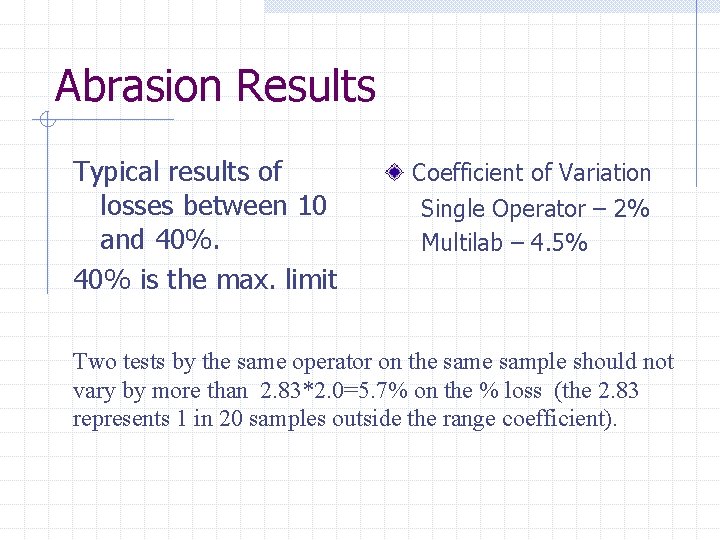
Abrasion Results Typical results of losses between 10 and 40% is the max. limit Coefficient of Variation Single Operator – 2% Multilab – 4. 5% Two tests by the same operator on the sample should not vary by more than 2. 83*2. 0=5. 7% on the % loss (the 2. 83 represents 1 in 20 samples outside the range coefficient).
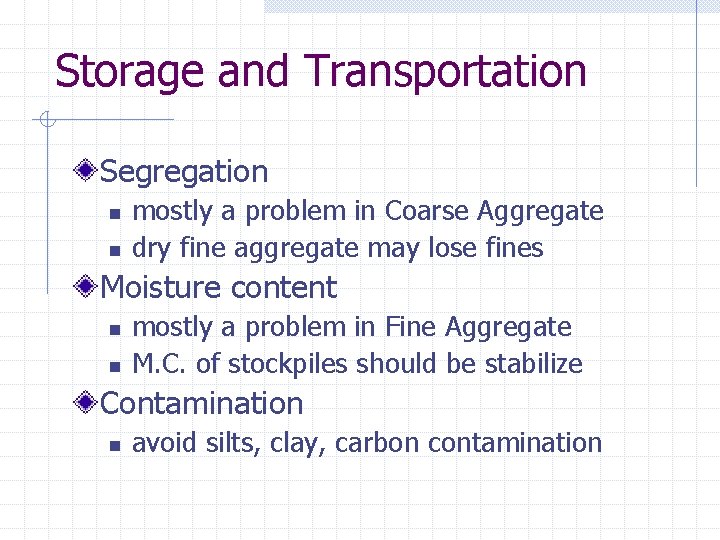
Storage and Transportation Segregation n n mostly a problem in Coarse Aggregate dry fine aggregate may lose fines Moisture content n n mostly a problem in Fine Aggregate M. C. of stockpiles should be stabilize Contamination n avoid silts, clay, carbon contamination
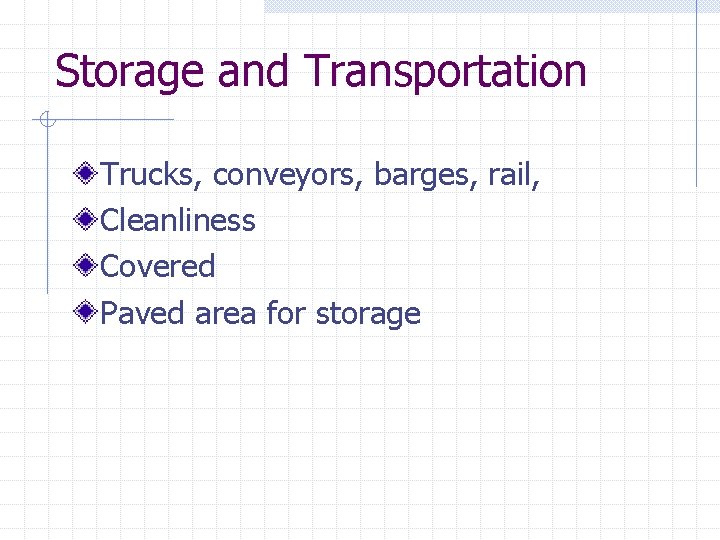
Storage and Transportation Trucks, conveyors, barges, rail, Cleanliness Covered Paved area for storage
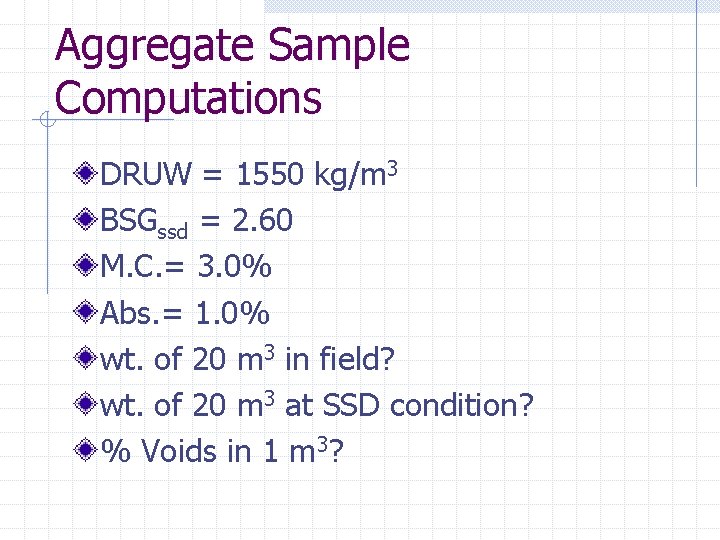
Aggregate Sample Computations DRUW = 1550 kg/m 3 BSGssd = 2. 60 M. C. = 3. 0% Abs. = 1. 0% wt. of 20 m 3 in field? wt. of 20 m 3 at SSD condition? % Voids in 1 m 3?
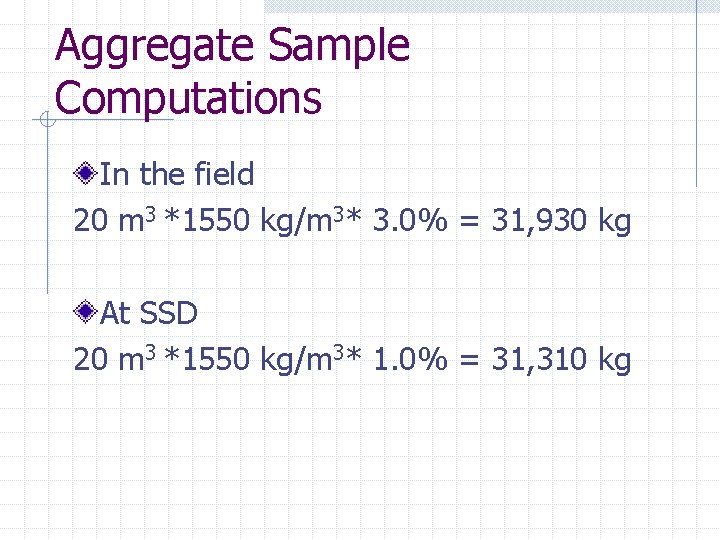
Aggregate Sample Computations In the field 20 m 3 *1550 kg/m 3* 3. 0% = 31, 930 kg At SSD 20 m 3 *1550 kg/m 3* 1. 0% = 31, 310 kg
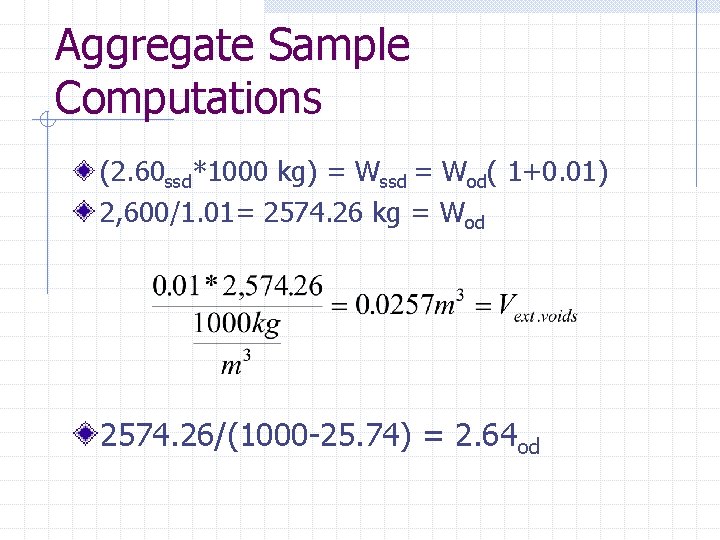
Aggregate Sample Computations (2. 60 ssd*1000 kg) = Wssd = Wod( 1+0. 01) 2, 600/1. 01= 2574. 26 kg = Wod 2574. 26/(1000 -25. 74) = 2. 64 od
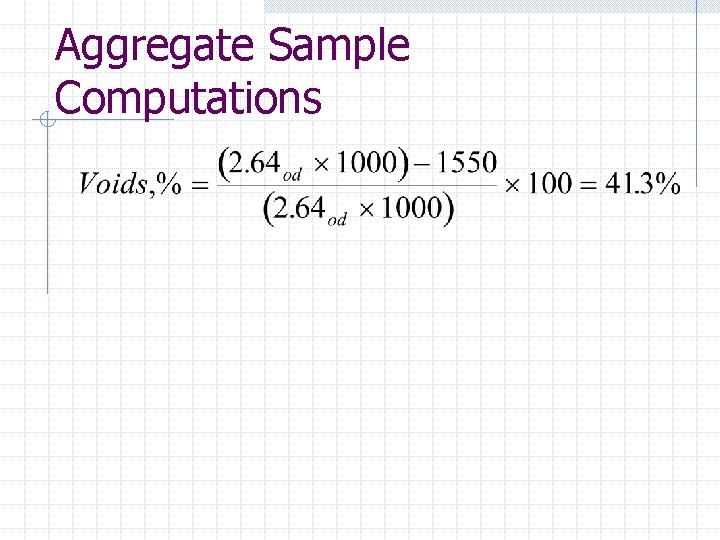
Aggregate Sample Computations
- Slides: 48