
Aggregate Supply and the Phillips Curve Chapter 6

- Slides: 32
Aggregate Supply and the Phillips Curve Chapter #6 Copyright © 2014 Mc. Graw-Hill Education. All rights reserved. No reproduction or distribution without the prior written consent of Mc. Graw-Hill Education.
Introduction • Further develop the AS side of the economy; examine the dynamic adjustment process from the short run to the long run – The price-output relationship is based upon links between wages, prices, employment, and output link between unemployment and inflation = Phillips Curve – Translate between unemployment and output, inflation and price changes • Introduce role of price and inflation expectations, and the “rational expectations revolution” • NOTE: theory of AS is the least settled area in macro – Don’t fully understand why W and P are slow to adjust, but offer several theories – All modern models differ in starting point, but reach the same conclusion: SRAS is flat, LRAS is vertical 6 -2
Inflation and Unemployment • Phillips curve (PC) shows the relationship between unemployment and inflation – Although GDP is linked to unemployment, it is easier to work with the PC than the AS when discussing unemployment 6 -3
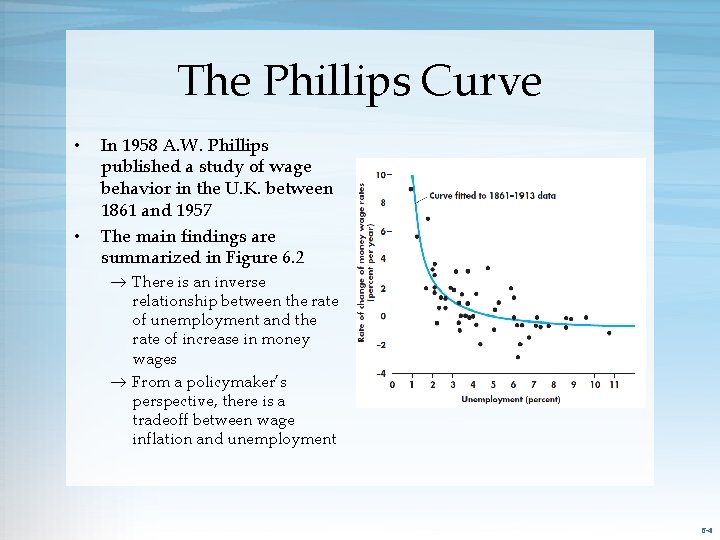
The Phillips Curve • • In 1958 A. W. Phillips published a study of wage behavior in the U. K. between 1861 and 1957 The main findings are summarized in Figure 6. 2 There is an inverse relationship between the rate of unemployment and the rate of increase in money wages From a policymaker’s perspective, there is a tradeoff between wage inflation and unemployment 6 -4
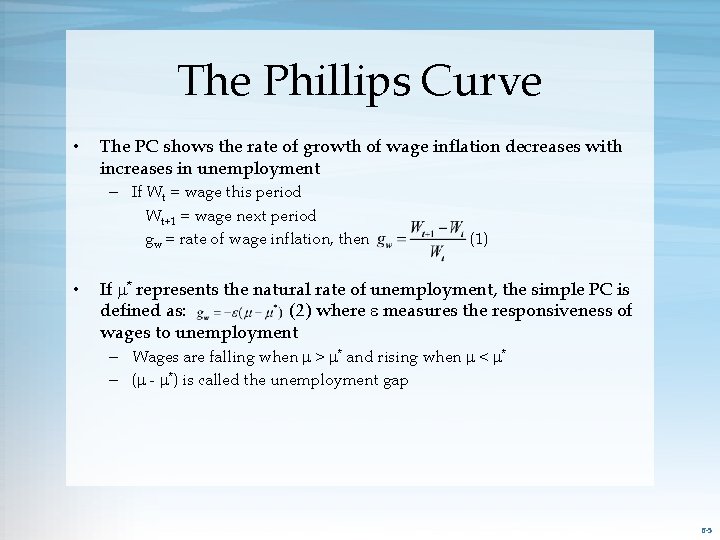
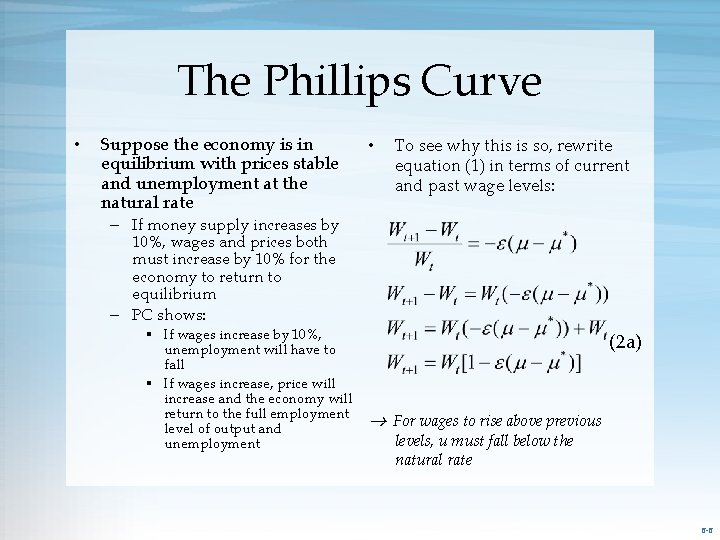
The Phillips Curve • The PC shows the rate of growth of wage inflation decreases with increases in unemployment – If Wt = wage this period Wt+1 = wage next period gw = rate of wage inflation, then • (1) If * represents the natural rate of unemployment, the simple PC is defined as: (2) where measures the responsiveness of wages to unemployment – Wages are falling when > * and rising when < * – ( - *) is called the unemployment gap 6 -5
The Phillips Curve • Suppose the economy is in equilibrium with prices stable and unemployment at the natural rate • To see why this is so, rewrite equation (1) in terms of current and past wage levels: – If money supply increases by 10%, wages and prices both must increase by 10% for the economy to return to equilibrium – PC shows: § If wages increase by 10%, unemployment will have to fall § If wages increase, price will increase and the economy will return to the full employment level of output and unemployment (2 a) For wages to rise above previous levels, u must fall below the natural rate 6 -6
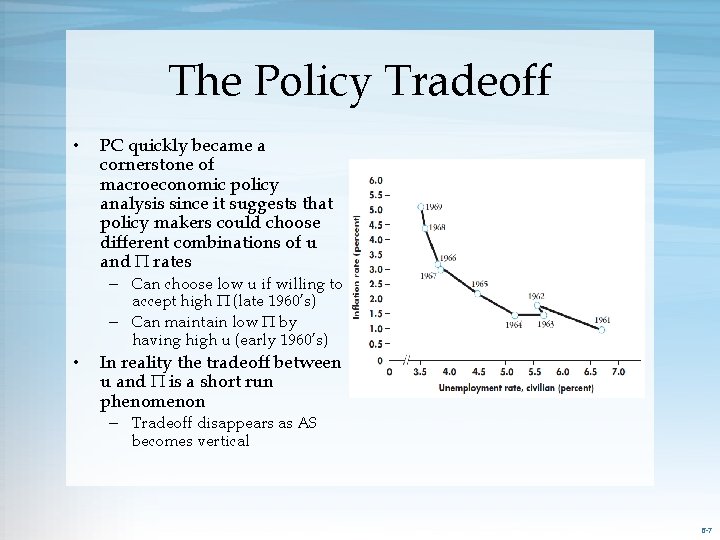
The Policy Tradeoff • PC quickly became a cornerstone of macroeconomic policy analysis since it suggests that policy makers could choose different combinations of u and rates – Can choose low u if willing to accept high (late 1960’s) – Can maintain low by having high u (early 1960’s) • In reality the tradeoff between u and is a short run phenomenon – Tradeoff disappears as AS becomes vertical 6 -7
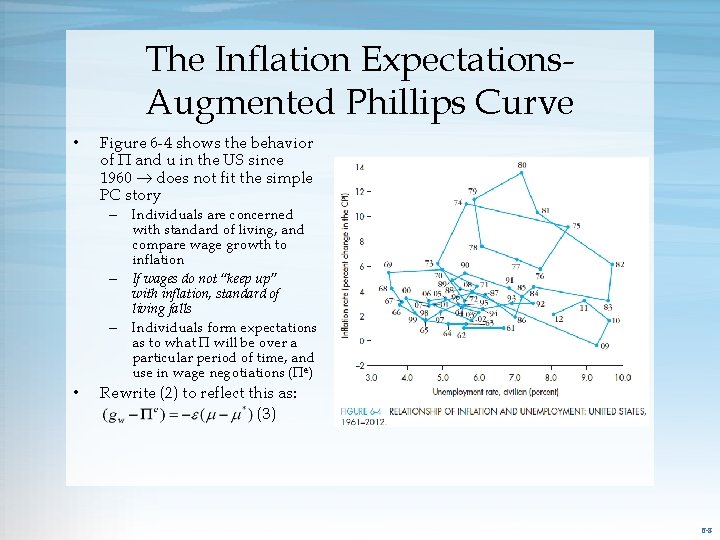
The Inflation Expectations. Augmented Phillips Curve • Figure 6 -4 shows the behavior of and u in the US since 1960 does not fit the simple PC story – Individuals are concerned with standard of living, and compare wage growth to inflation – If wages do not “keep up” with inflation, standard of living falls – Individuals form expectations as to what will be over a particular period of time, and use in wage negotiations ( e) • Rewrite (2) to reflect this as: (3) 6 -8
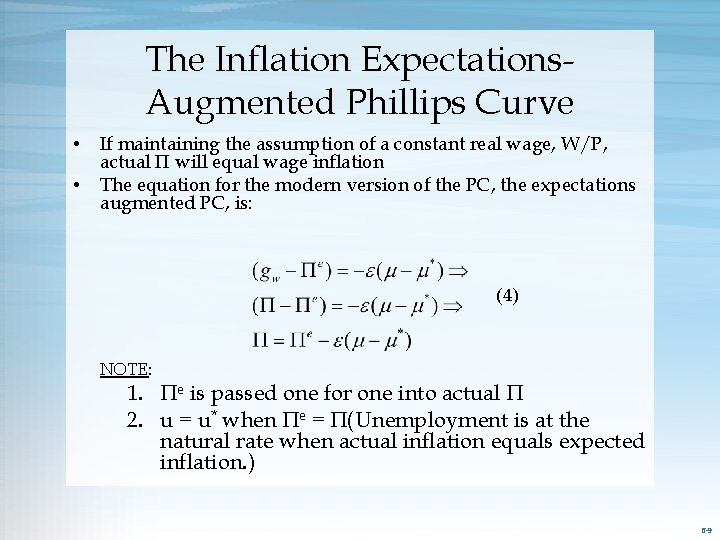
The Inflation Expectations. Augmented Phillips Curve • • If maintaining the assumption of a constant real wage, W/P, actual will equal wage inflation The equation for the modern version of the PC, the expectations augmented PC, is: (4) NOTE: 1. e is passed one for one into actual 2. u = u* when e = (Unemployment is at the natural rate when actual inflation equals expected inflation. ) 6 -9
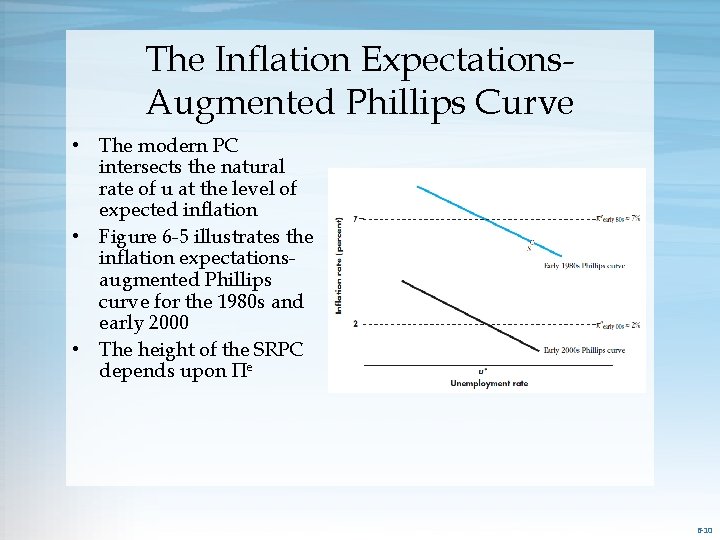
The Inflation Expectations. Augmented Phillips Curve • The modern PC intersects the natural rate of u at the level of expected inflation • Figure 6 -5 illustrates the inflation expectationsaugmented Phillips curve for the 1980 s and early 2000 • The height of the SRPC depends upon e 6 -10
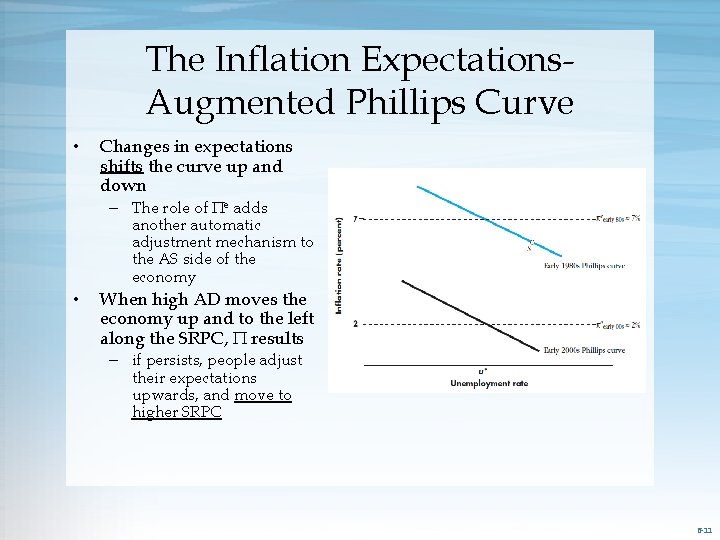
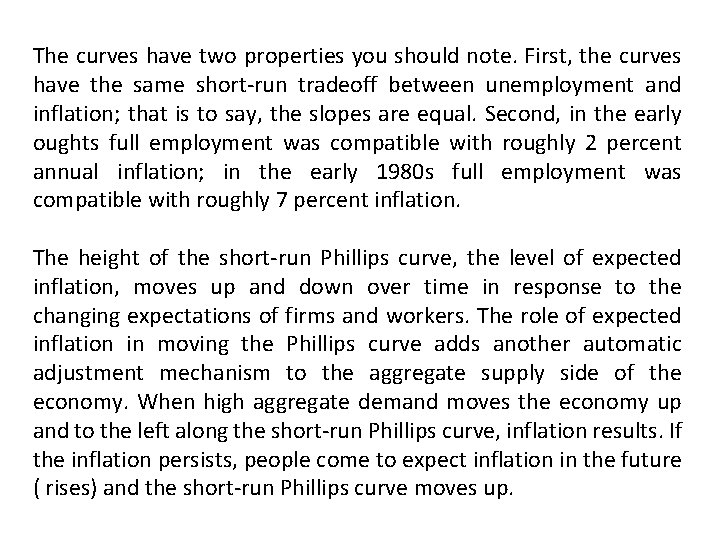
The Inflation Expectations. Augmented Phillips Curve • Changes in expectations shifts the curve up and down – The role of e adds another automatic adjustment mechanism to the AS side of the economy • When high AD moves the economy up and to the left along the SRPC, results – if persists, people adjust their expectations upwards, and move to higher SRPC 6 -11
The curves have two properties you should note. First, the curves have the same short-run tradeoff between unemployment and inflation; that is to say, the slopes are equal. Second, in the early oughts full employment was compatible with roughly 2 percent annual inflation; in the early 1980 s full employment was compatible with roughly 7 percent inflation. The height of the short-run Phillips curve, the level of expected inflation, moves up and down over time in response to the changing expectations of firms and workers. The role of expected inflation in moving the Phillips curve adds another automatic adjustment mechanism to the aggregate supply side of the economy. When high aggregate demand moves the economy up and to the left along the short-run Phillips curve, inflation results. If the inflation persists, people come to expect inflation in the future ( rises) and the short-run Phillips curve moves up.
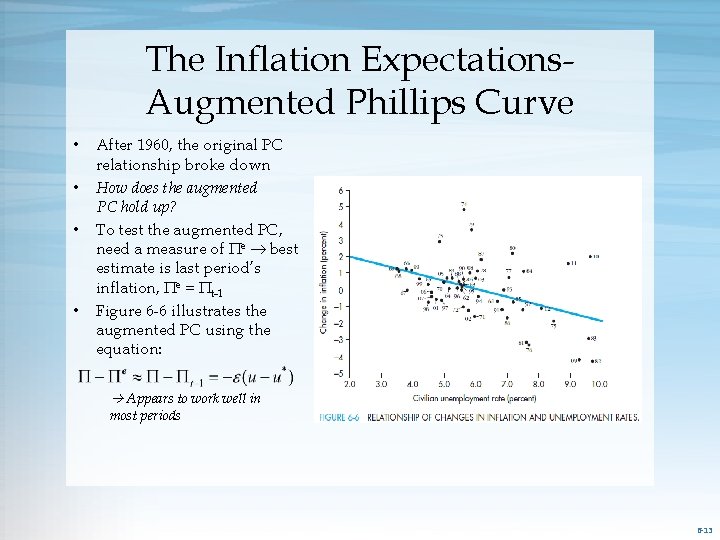
The Inflation Expectations. Augmented Phillips Curve • • After 1960, the original PC relationship broke down How does the augmented PC hold up? To test the augmented PC, need a measure of e best estimate is last period’s inflation, e = t-1 Figure 6 -6 illustrates the augmented PC using the equation: Appears to work well in most periods 6 -13
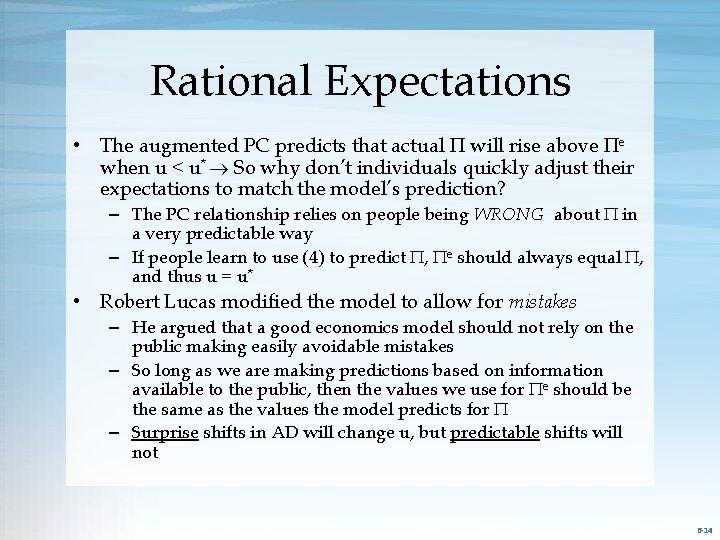
Rational Expectations • The augmented PC predicts that actual will rise above e when u < u* So why don’t individuals quickly adjust their expectations to match the model’s prediction? – The PC relationship relies on people being WRONG about in a very predictable way – If people learn to use (4) to predict , e should always equal , and thus u = u* • Robert Lucas modified the model to allow for mistakes – He argued that a good economics model should not rely on the public making easily avoidable mistakes – So long as we are making predictions based on information available to the public, then the values we use for e should be the same as the values the model predicts for – Surprise shifts in AD will change u, but predictable shifts will not 6 -14
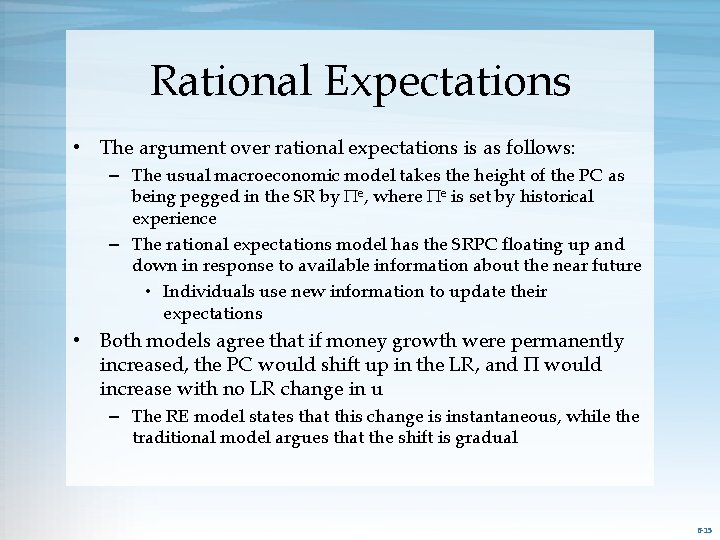
Rational Expectations • The argument over rational expectations is as follows: – The usual macroeconomic model takes the height of the PC as being pegged in the SR by e, where e is set by historical experience – The rational expectations model has the SRPC floating up and down in response to available information about the near future • Individuals use new information to update their expectations • Both models agree that if money growth were permanently increased, the PC would shift up in the LR, and would increase with no LR change in u – The RE model states that this change is instantaneous, while the traditional model argues that the shift is gradual 6 -15
The Wage-Unemployment Relationship and Sticky Wages • In neoclassical theory of supply, wages adjust instantly to ensure that output always at the full employment level, BUT output is not always at the full employment level, and the PC suggests that wages adjust slowly in response to changes in u • The key question in theory of AS is “Why does the nominal wage adjust slowly to shifts in demand? ” OR “Why are wages sticky? ” • Wages are sticky when wages move slowly over time, rather than being flexible, allowing for economy to deviate from the full employment level 6 -16
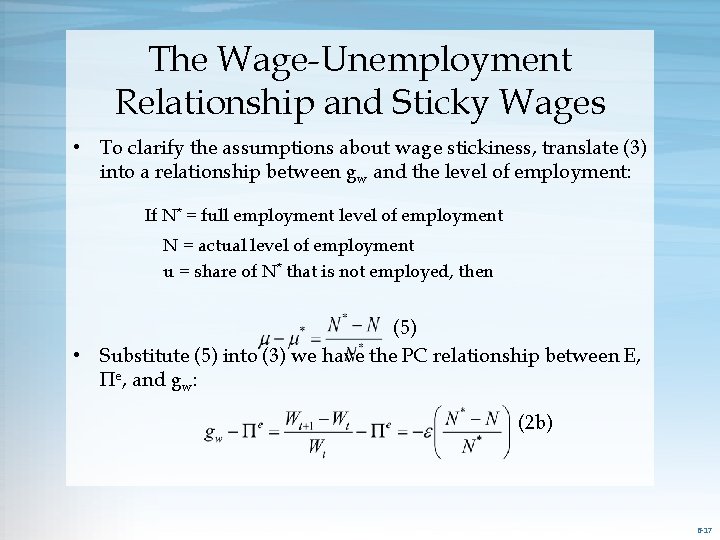
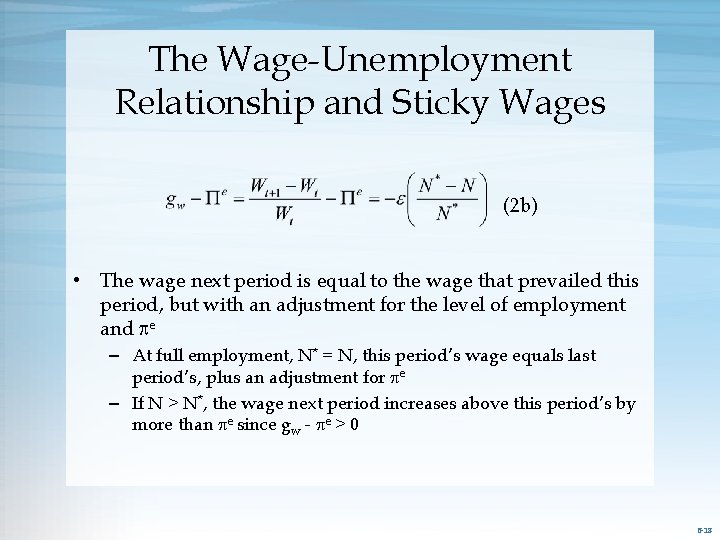
The Wage-Unemployment Relationship and Sticky Wages • To clarify the assumptions about wage stickiness, translate (3) into a relationship between gw and the level of employment: If N* = full employment level of employment N = actual level of employment u = share of N* that is not employed, then (5) • Substitute (5) into (3) we have the PC relationship between E, e, and gw: (2 b) 6 -17
The Wage-Unemployment Relationship and Sticky Wages (2 b) • The wage next period is equal to the wage that prevailed this period, but with an adjustment for the level of employment and e – At full employment, N* = N, this period’s wage equals last period’s, plus an adjustment for e – If N > N*, the wage next period increases above this period’s by more than e since gw - e > 0 6 -18
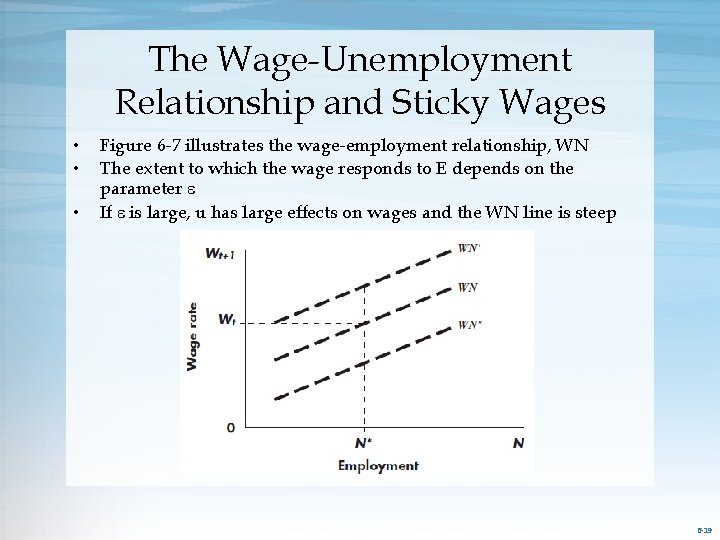
The Wage-Unemployment Relationship and Sticky Wages • • • Figure 6 -7 illustrates the wage-employment relationship, WN The extent to which the wage responds to E depends on the parameter If is large, u has large effects on wages and the WN line is steep 6 -19
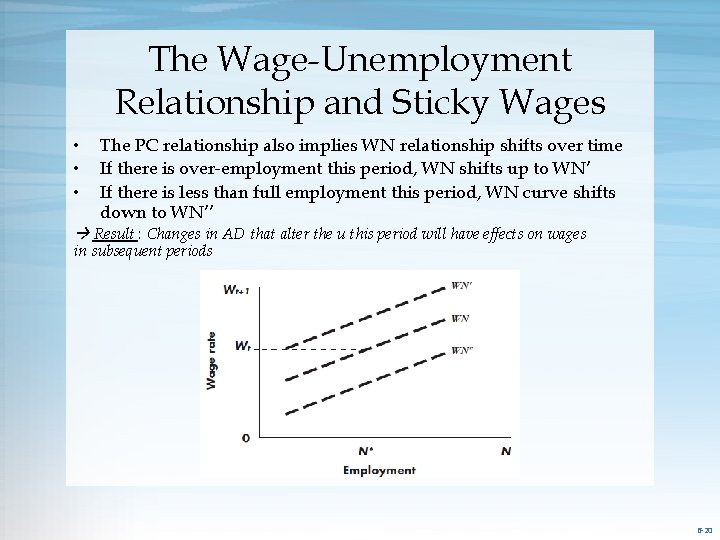
The Wage-Unemployment Relationship and Sticky Wages • • • The PC relationship also implies WN relationship shifts over time If there is over-employment this period, WN shifts up to WN’ If there is less than full employment this period, WN curve shifts down to WN’’ Result : Changes in AD that alter the u this period will have effects on wages in subsequent periods 6 -20
The Wage-Unemployment Relationship and Sticky Wages • Each school of thought has to explain why there is a PC, or the reasons for wage and price stickiness Examples of such explanations for wage and price stickiness include: 1. Imperfect information – Friedman and Phelps – In the context of clearing markets 2. Coordination problems – Focus on the process by which firms adjust their prices when demand changes 3. Efficiency wages and costs of price changes – Focus on wage as a means of motivating labor 6 -21
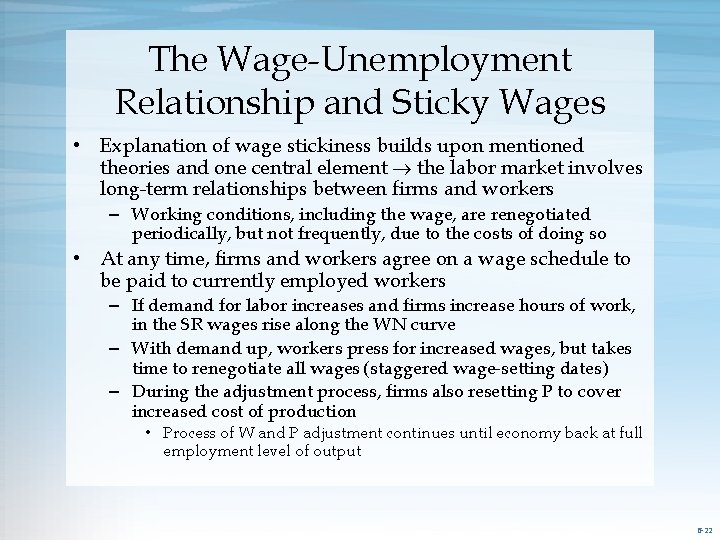
The Wage-Unemployment Relationship and Sticky Wages • Explanation of wage stickiness builds upon mentioned theories and one central element the labor market involves long-term relationships between firms and workers – Working conditions, including the wage, are renegotiated periodically, but not frequently, due to the costs of doing so • At any time, firms and workers agree on a wage schedule to be paid to currently employed workers – If demand for labor increases and firms increase hours of work, in the SR wages rise along the WN curve – With demand up, workers press for increased wages, but takes time to renegotiate all wages (staggered wage-setting dates) – During the adjustment process, firms also resetting P to cover increased cost of production • Process of W and P adjustment continues until economy back at full employment level of output 6 -22
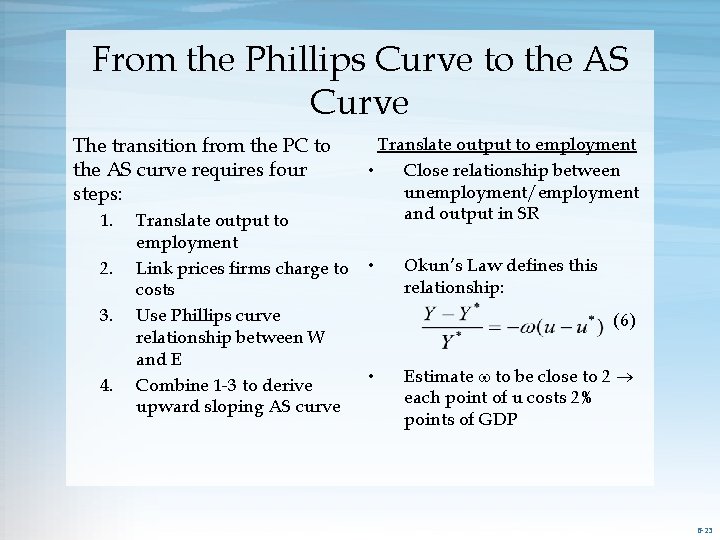
From the Phillips Curve to the AS Curve The transition from the PC to the AS curve requires four steps: 1. 2. 3. 4. Translate output to employment Link prices firms charge to costs Use Phillips curve relationship between W and E Combine 1 -3 to derive upward sloping AS curve Translate output to employment • Close relationship between unemployment/employment and output in SR • Okun’s Law defines this relationship: (6) • Estimate to be close to 2 each point of u costs 2% points of GDP 6 -23
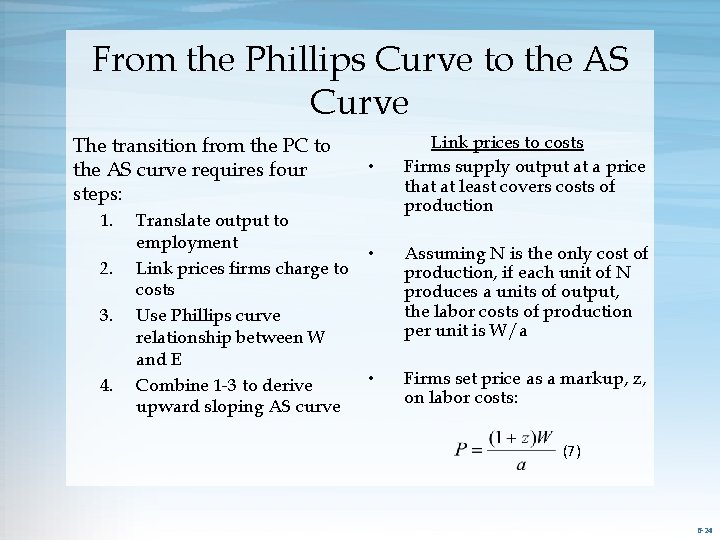
From the Phillips Curve to the AS Curve The transition from the PC to the AS curve requires four steps: 1. 2. 3. 4. Translate output to employment Link prices firms charge to costs Use Phillips curve relationship between W and E Combine 1 -3 to derive upward sloping AS curve • Link prices to costs Firms supply output at a price that at least covers costs of production • Assuming N is the only cost of production, if each unit of N produces a units of output, the labor costs of production per unit is W/a • Firms set price as a markup, z, on labor costs: (7) 6 -24
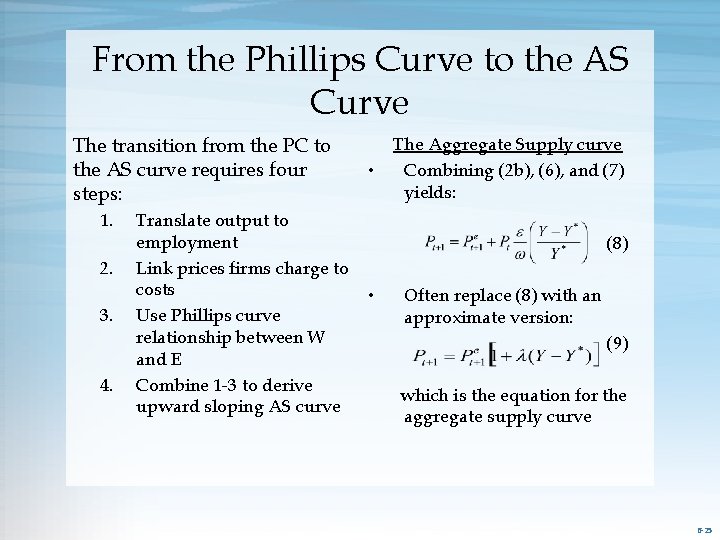
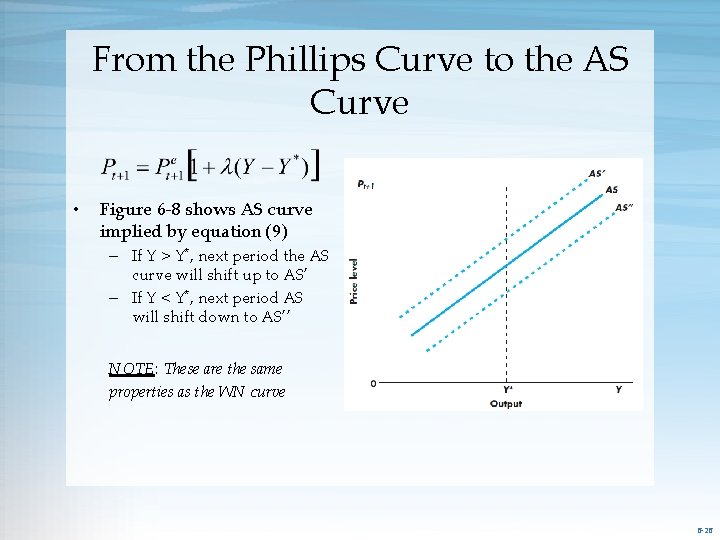
From the Phillips Curve to the AS Curve The transition from the PC to the AS curve requires four steps: 1. 2. 3. 4. Translate output to employment Link prices firms charge to costs Use Phillips curve relationship between W and E Combine 1 -3 to derive upward sloping AS curve • The Aggregate Supply curve Combining (2 b), (6), and (7) yields: (8) • Often replace (8) with an approximate version: (9) which is the equation for the aggregate supply curve 6 -25
From the Phillips Curve to the AS Curve • Figure 6 -8 shows AS curve implied by equation (9) – If Y > Y*, next period the AS curve will shift up to AS’ – If Y < Y*, next period AS will shift down to AS’’ NOTE: These are the same properties as the WN curve 6 -26
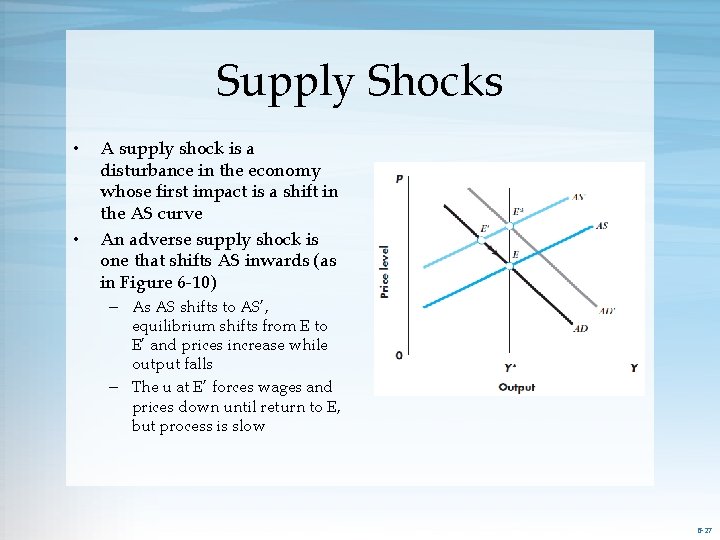
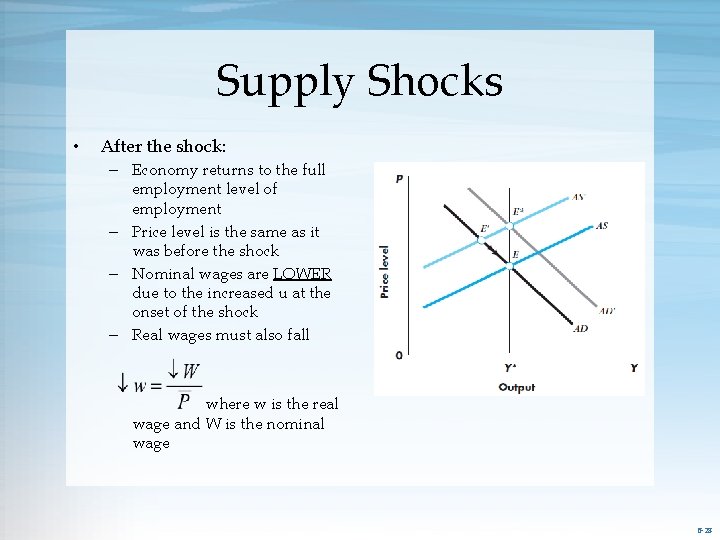
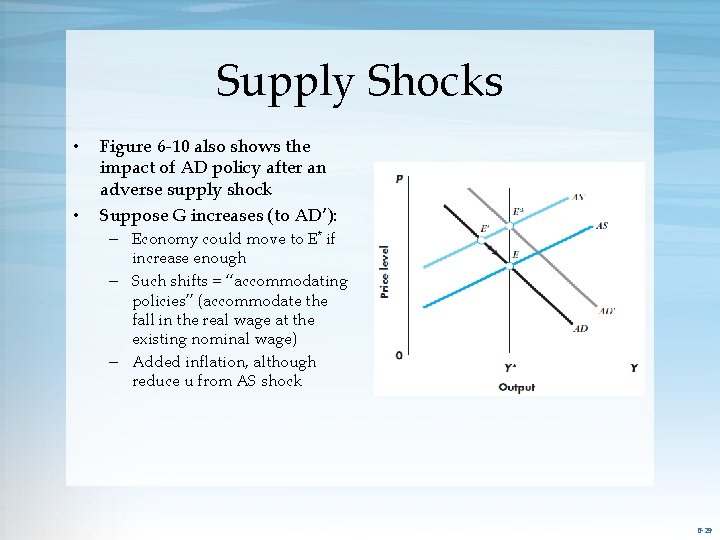
Supply Shocks • • A supply shock is a disturbance in the economy whose first impact is a shift in the AS curve An adverse supply shock is one that shifts AS inwards (as in Figure 6 -10) – As AS shifts to AS’, equilibrium shifts from E to E’ and prices increase while output falls – The u at E’ forces wages and prices down until return to E, but process is slow 6 -27
Supply Shocks • After the shock: – Economy returns to the full employment level of employment – Price level is the same as it was before the shock – Nominal wages are LOWER due to the increased u at the onset of the shock – Real wages must also fall where w is the real wage and W is the nominal wage 6 -28
Supply Shocks • • Figure 6 -10 also shows the impact of AD policy after an adverse supply shock Suppose G increases (to AD’): – Economy could move to E* if increase enough – Such shifts = “accommodating policies” (accommodate the fall in the real wage at the existing nominal wage) – Added inflation, although reduce u from AS shock 6 -29
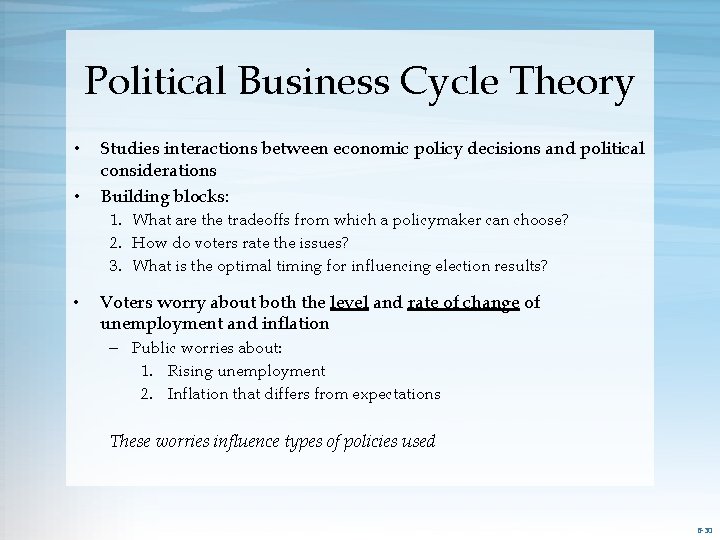
Political Business Cycle Theory • • Studies interactions between economic policy decisions and political considerations Building blocks: 1. What are the tradeoffs from which a policymaker can choose? 2. How do voters rate the issues? 3. What is the optimal timing for influencing election results? • Voters worry about both the level and rate of change of unemployment and inflation – Public worries about: 1. Rising unemployment 2. Inflation that differs from expectations These worries influence types of policies used 6 -30
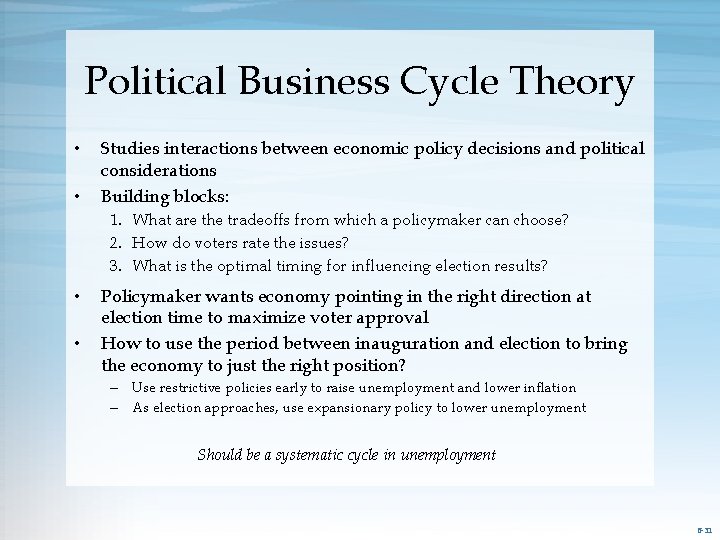
Political Business Cycle Theory • • Studies interactions between economic policy decisions and political considerations Building blocks: 1. What are the tradeoffs from which a policymaker can choose? 2. How do voters rate the issues? 3. What is the optimal timing for influencing election results? • • Policymaker wants economy pointing in the right direction at election time to maximize voter approval How to use the period between inauguration and election to bring the economy to just the right position? – Use restrictive policies early to raise unemployment and lower inflation – As election approaches, use expansionary policy to lower unemployment Should be a systematic cycle in unemployment 6 -31
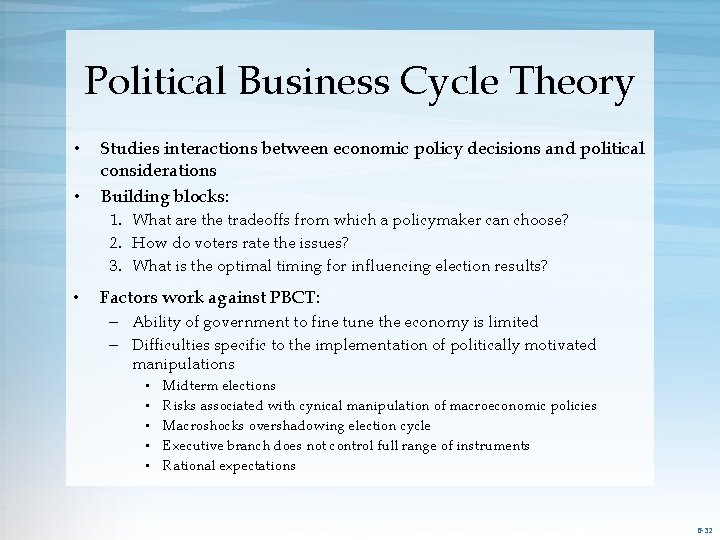
Political Business Cycle Theory • • Studies interactions between economic policy decisions and political considerations Building blocks: 1. What are the tradeoffs from which a policymaker can choose? 2. How do voters rate the issues? 3. What is the optimal timing for influencing election results? • Factors work against PBCT: – Ability of government to fine tune the economy is limited – Difficulties specific to the implementation of politically motivated manipulations • • • Midterm elections Risks associated with cynical manipulation of macroeconomic policies Macroshocks overshadowing election cycle Executive branch does not control full range of instruments Rational expectations 6 -32