
Aggregate Expenditure and Equilibrium National Output n Aggregate
Aggregate Expenditure and Equilibrium National Output n Aggregate expenditure (AE) ¨ total amount that all economic agents want or plan to spend on domestic goods and services. ¨ the planned spending of households, n firms, n government, and n foreigners. n

Aggregate Expenditure n AE = C + I + G + (X-M) ¨ consumption (C), ¨ investment (I), ¨ government spending (G), and ¨ exports less imports (X-M). n Note that AE is not the same as GDP. ¨ AE represents planned spending ¨ GDP represents actual spending or output.
Aggregate Expenditure (AE) and National Output (Y) n AE and Y are not necessarily equal: ¨ Firms formulate their production plans with an estimate of the quantities that people want to buy. ¨ A mistake on their part will cause production to exceed or fall below the amounts that people want to buy.
What if AE and Y are not equal? n If AE < Y ¨ people want to buy less than what has been produced so firms will accumulate inventories. ¨ firms will reduce production n If AE >Y ¨ What people want to buy is greater than actual production so inventories will decline. ¨ firms will increase production

Equilibrium National Income AE = Y n Can be depicted by the intersection between the AE schedule and the 45 degree line n
The 450 line The 45 -degree line is a tool that assists us in identifying the economy's equilibrium position. n Property: every point along this line depicts a situation wherein the value of the variable on the horizontal axis (in this case actual output, (Y) is equal to its counterpart on the vertical axis (AE). n
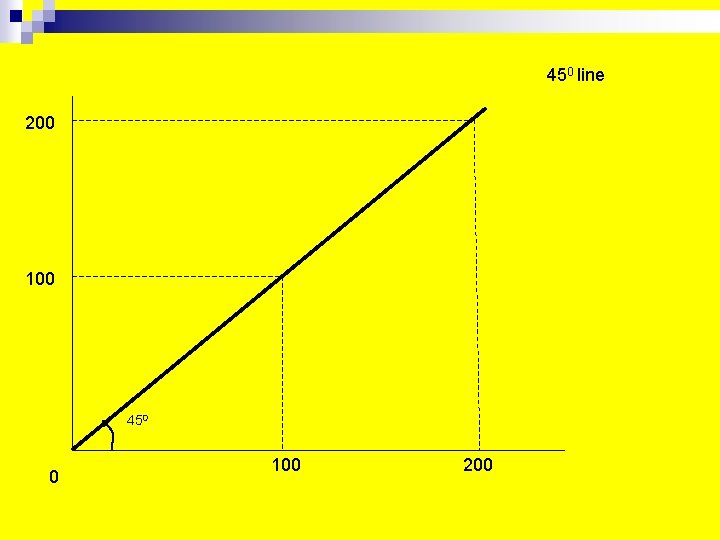
450 line 200 100 450 0 100 200
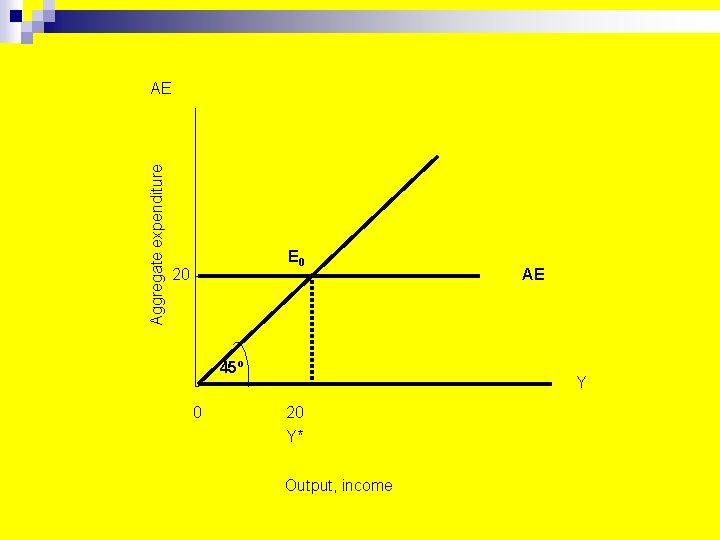
Aggregate expenditure AE E 0 20 45º 0 AE Y 20 Y* Output, income
Equilibrium Income (Y*) n When AE is equal to Y there is no reason for firms to adjust production. ¨ this suggests that the economy is in equilibrium. ¨ n Equilibrium requires the equality between income and aggregate expenditure. That is, Y = AE.
Changes in AE and Income n n n Suppose that the economy's aggregate expenditure schedule shifts upward AE 0 to AE 1, Equilibrium point will move from E 0 to E 1. As a result, the economy experiences an increase in equilibrium income from YO* to Y 1*
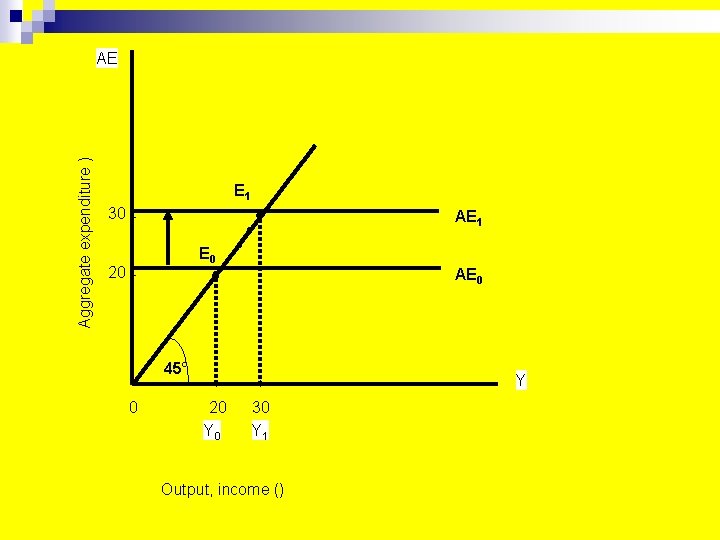
Aggregate expenditure ) AE E 1 30 AE 1 E 0 20 AE 0 45° 0 Y 20 Y 0 30 Y 1 Output, income ()
Consumption and Income n Keynes (1936) suggested that consumption spending (C) tends to increase with income. ¨ In other words, households with higher incomes tend to spend more. ¨ There is a positive relationship between consumption spending and income
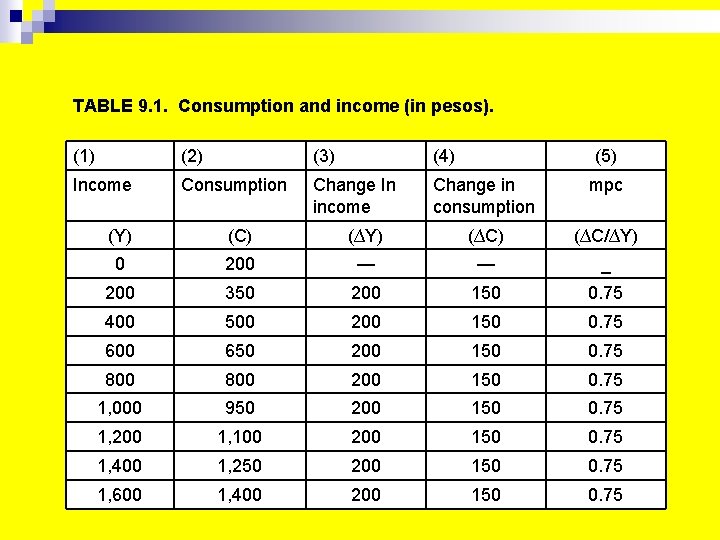
TABLE 9. 1. Consumption and income (in pesos). (1) (2) (3) (4) (5) Income Consumption Change In income Change in consumption mpc (Y) (C) (∆Y) (∆C/∆Y) 0 200 — — _ 200 350 200 150 0. 75 400 500 200 150 0. 75 600 650 200 150 0. 75 800 200 150 0. 75 1, 000 950 200 150 0. 75 1, 200 1, 100 200 150 0. 75 1, 400 1, 250 200 150 0. 75 1, 600 1, 400 200 150 0. 75
Consumption and income n n n Higher levels of income correspond to higher levels of consumption spending When income is equal to zero, consumption spending is equal to 200. Consumption spending and income are equal at each other when income = 800. When income is less than 800, consumption is higher than income. ¨ When income is greater than 800, consumption less than income ¨
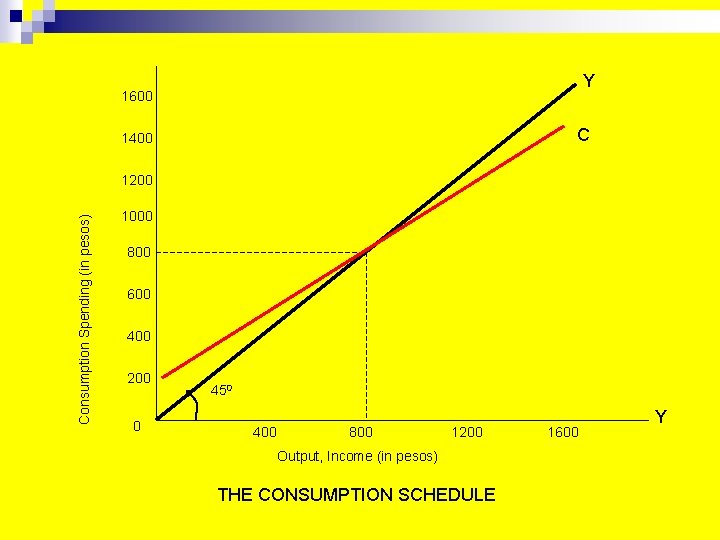
Y 1600 C 1400 Consumption Spending (in pesos) 1200 1000 800 600 400 200 0 450 400 800 1200 Output, Income (in pesos) THE CONSUMPTION SCHEDULE 1600 Y
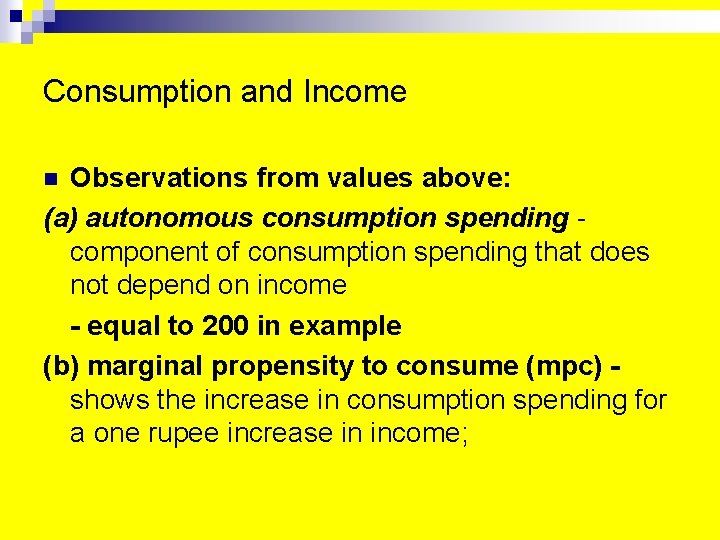
Consumption and Income Observations from values above: (a) autonomous consumption spending component of consumption spending that does not depend on income - equal to 200 in example (b) marginal propensity to consume (mpc) shows the increase in consumption spending for a one rupee increase in income; n
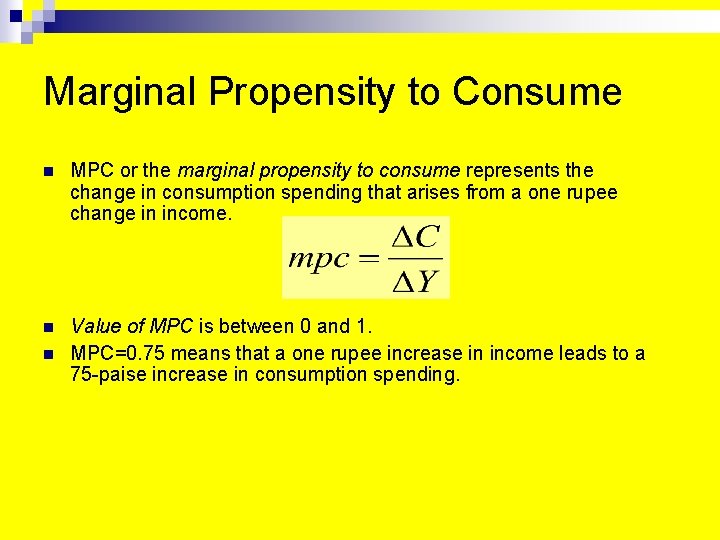
Marginal Propensity to Consume n MPC or the marginal propensity to consume represents the change in consumption spending that arises from a one rupee change in income. n Value of MPC is between 0 and 1. MPC=0. 75 means that a one rupee increase in income leads to a 75 -paise increase in consumption spending. n
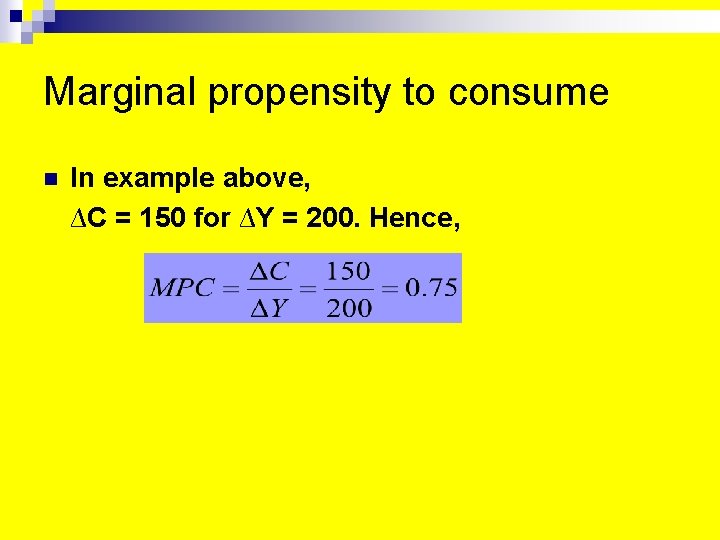
Marginal propensity to consume n In example above, ∆C = 150 for ∆Y = 200. Hence,
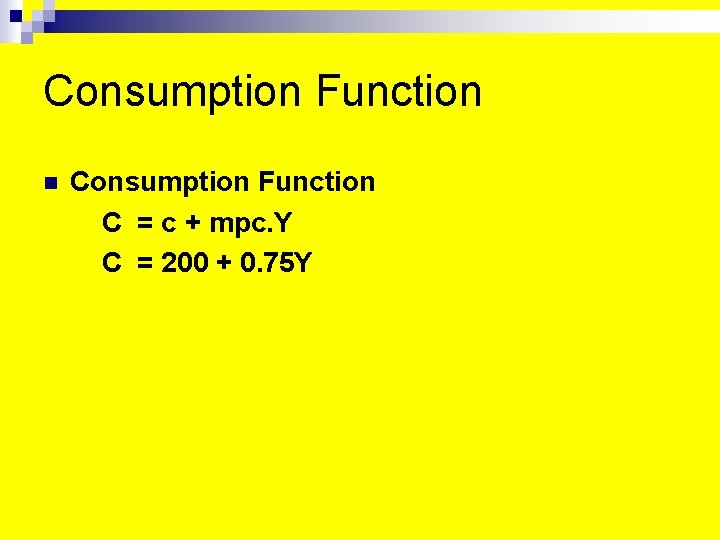
Consumption Function n Consumption Function: C = c + mpc. Y C = 200 + 0. 75 Y
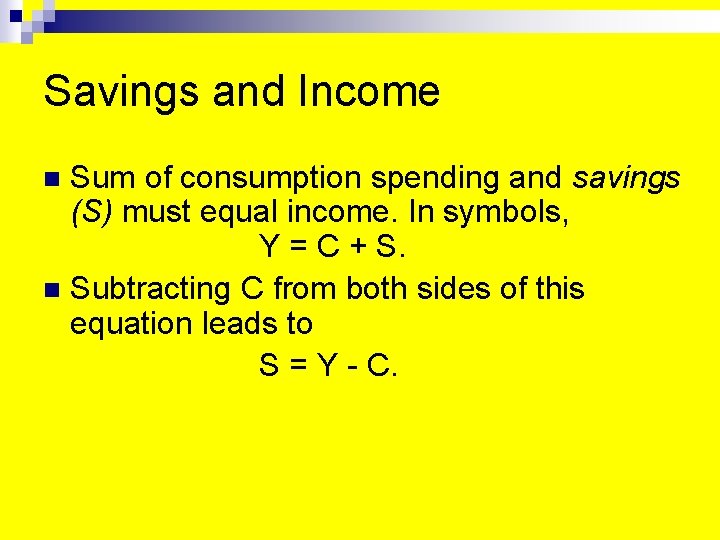
Savings and Income Sum of consumption spending and savings (S) must equal income. In symbols, Y = C + S. n Subtracting C from both sides of this equation leads to S = Y - C. n
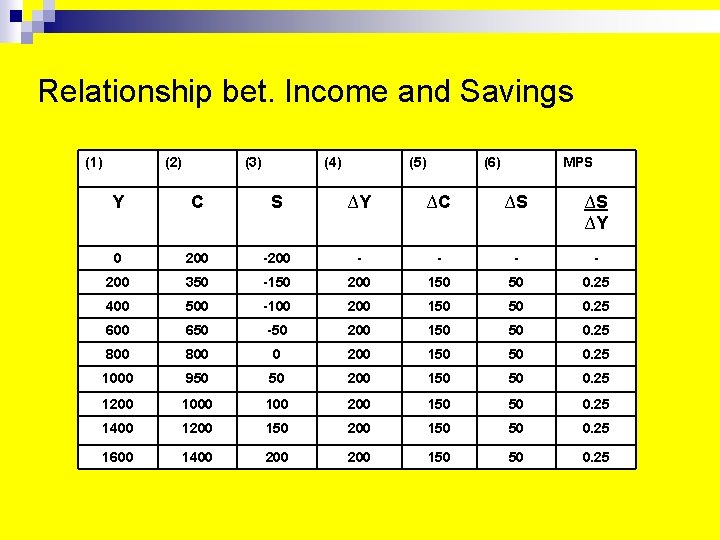
Relationship bet. Income and Savings (1) (2) (3) (4) (5) (6) MPS Y C S ∆Y ∆C ∆S ∆S ∆Y 0 200 - - - - 200 350 -150 200 150 50 0. 25 400 500 -100 200 150 50 0. 25 600 650 -50 200 150 50 0. 25 800 0 200 150 50 0. 25 1000 950 50 200 150 50 0. 25 1200 100 200 150 50 0. 25 1400 1200 150 50 0. 25 1600 1400 200 150 50 0. 25
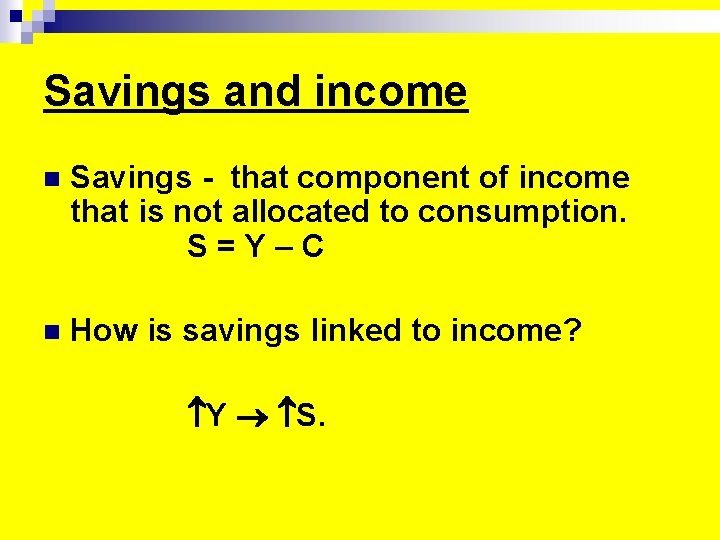
Savings and income n Savings - that component of income that is not allocated to consumption. S=Y–C n How is savings linked to income? Y S.
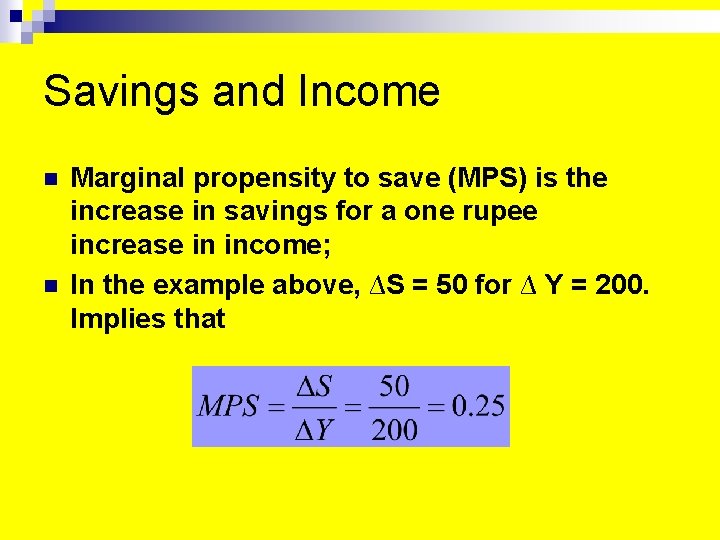
Savings and Income n n Marginal propensity to save (MPS) is the increase in savings for a one rupee increase in income; In the example above, ∆S = 50 for ∆ Y = 200. Implies that
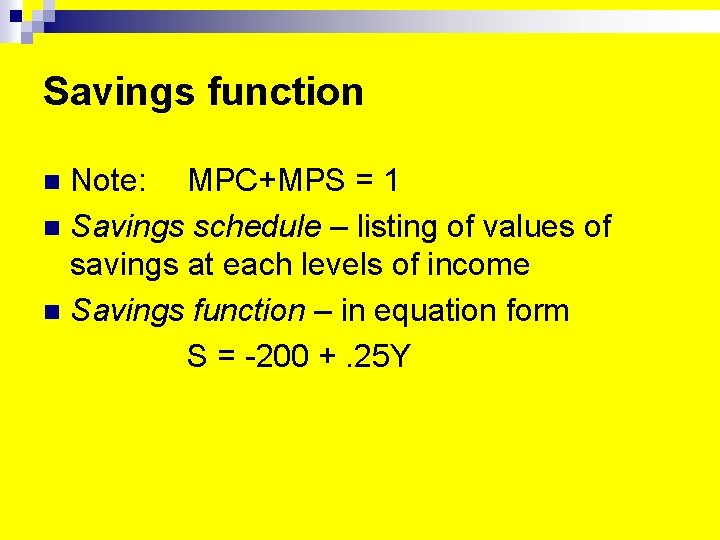
Savings function Note: MPC+MPS = 1 n Savings schedule – listing of values of savings at each levels of income n Savings function – in equation form S = -200 +. 25 Y n

Relationship between mpc and mpc
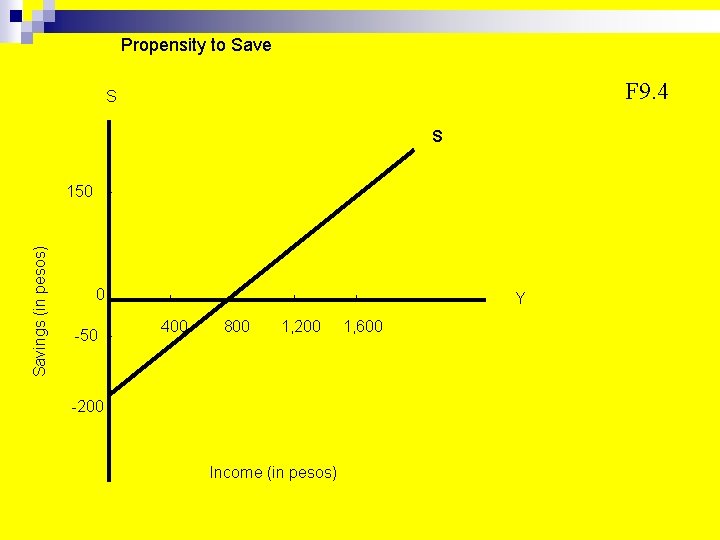
Propensity to Save F 9. 4 S S Savings (in pesos) 150 0 -50 Y 400 800 1, 200 -200 Income (in pesos) 1, 600
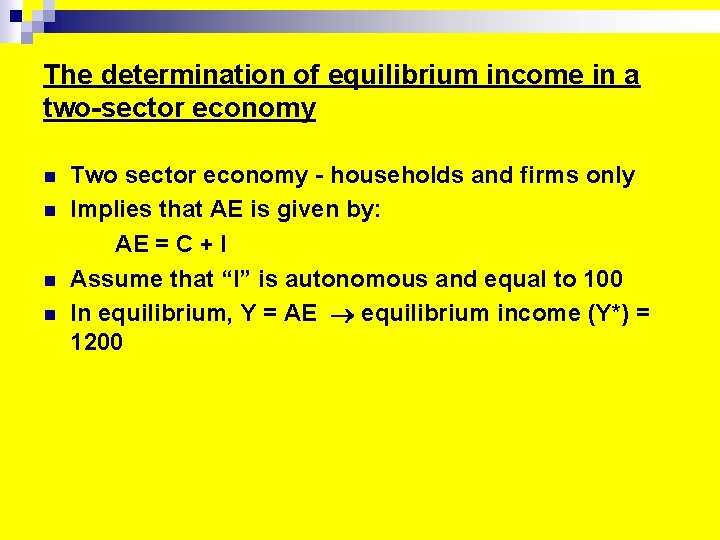
The determination of equilibrium income in a two-sector economy n n Two sector economy - households and firms only Implies that AE is given by: AE = C + I Assume that “I” is autonomous and equal to 100 In equilibrium, Y = AE equilibrium income (Y*) = 1200
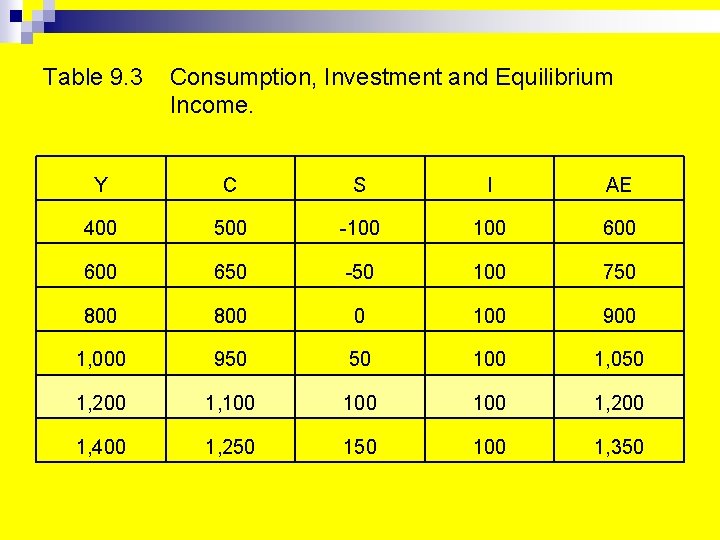
Table 9. 3 Consumption, Investment and Equilibrium Income. Y C S I AE 400 500 -100 600 650 -50 100 750 800 0 100 900 1, 000 950 50 100 1, 050 1, 200 1, 100 100 1, 200 1, 400 1, 250 100 1, 350
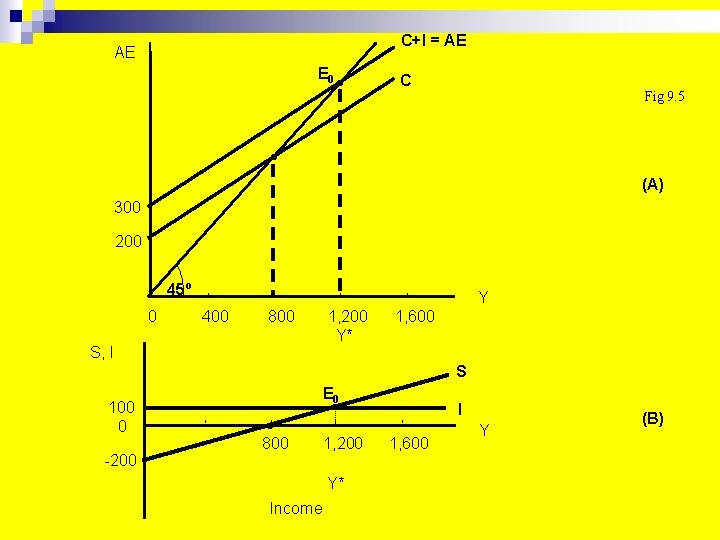
C+I = AE AE E 0 C Fig 9. 5 (A) 300 200 45º 0 Y 400 800 S, I 1, 200 Y* 1, 600 S 100 0 -200 800 E 0 1, 200 Y* Income I 1, 600 Y (B)
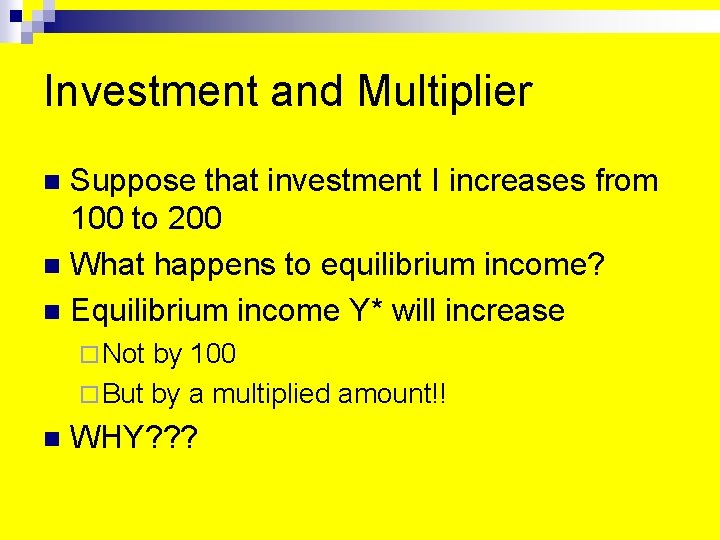
Investment and Multiplier Suppose that investment I increases from 100 to 200 n What happens to equilibrium income? n Equilibrium income Y* will increase n ¨ Not by 100 ¨ But by a multiplied amount!! n WHY? ? ?
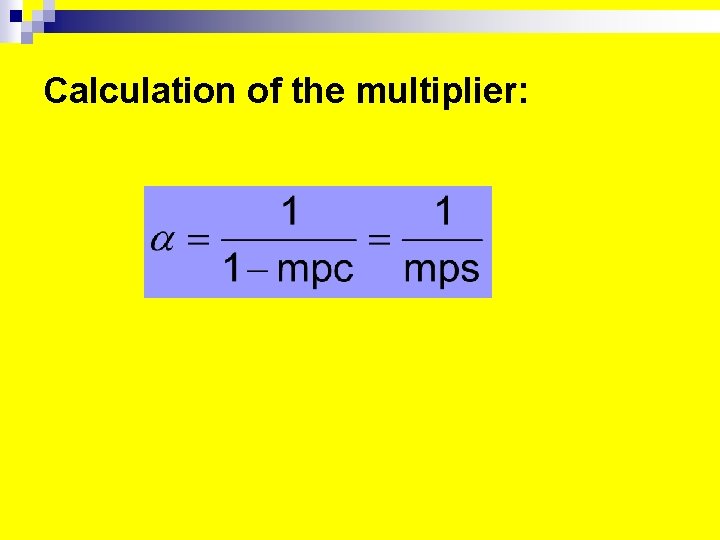
Calculation of the multiplier:
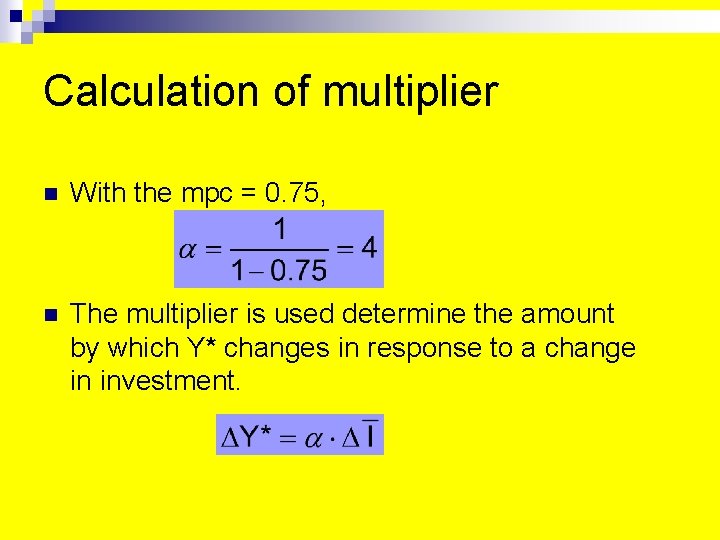
Calculation of multiplier n With the mpc = 0. 75, n The multiplier is used determine the amount by which Y* changes in response to a change in investment.
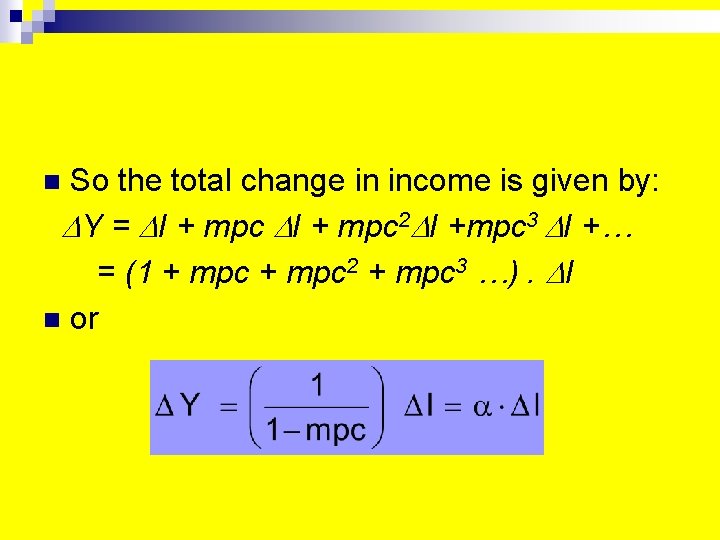
So the total change in income is given by: Y = I + mpc 2 I +mpc 3 I +… = (1 + mpc 2 + mpc 3 …). I n or n

The Multiplier
- Slides: 34