
Aggregate Demand Supply AD What is AD Determinants



- Slides: 28
Aggregate Demand Supply
AD • What is AD?
Determinants of AD • Change in Consumer Spending – – Consumer Wealth Consumer Expectatitons Household Borrowing Taxes • Change in Investment Spending – Interest Rates – Expected Returns • • Expected future business conditions Technology Degree of excess capacity Business taxes • Change in government spending • Change in net export spending – National Income Abroad – Exchange Rates
Aggregate Supply • What is AS? • 1 st : Immediate Short run: • 2 nd : Short Run: • 3 rd : Long Run:
AS-Immediate Short Run
AS- Short Run
AS- Long Run
Changes in Aggregate Supply • Change in Input Prices – Domestic Resource prices – Prices of imported resources • Change in productivity • Change in Legal-Institutional Enviroment – Business Taxes and subsidies – Government Regulations
• Factors that change LRAS: n n An increase (decrease) in the supply of resources. An improvement (deterioration) in technology and productivity. Institutional changes that increase (reduce) the efficiency of resource use. Factors that change SRAS: n n n A decrease (increase) in resource prices — that is, production costs. A reduction (increase) in the expected rate of inflation. Favorable (unfavorable) supply shocks, such as good (bad) weather or a reduction (increase) in the world price of a key imported resource.
Questions for Thought: 1. Indicate how each of the following would influence U. S. aggregate supply in the short run: (a) An increase in real wage rates. (b) A severe freeze that destroys half the orange crop in Florida. (c) An increase in the expected rate of inflation in the future. (d) An increase in the world price of oil, a key import. (e) Abundant rainfall during the growing season of agricultural states.
Equilibrium • Changes in equilibrium? – Demand pull and Cost Push
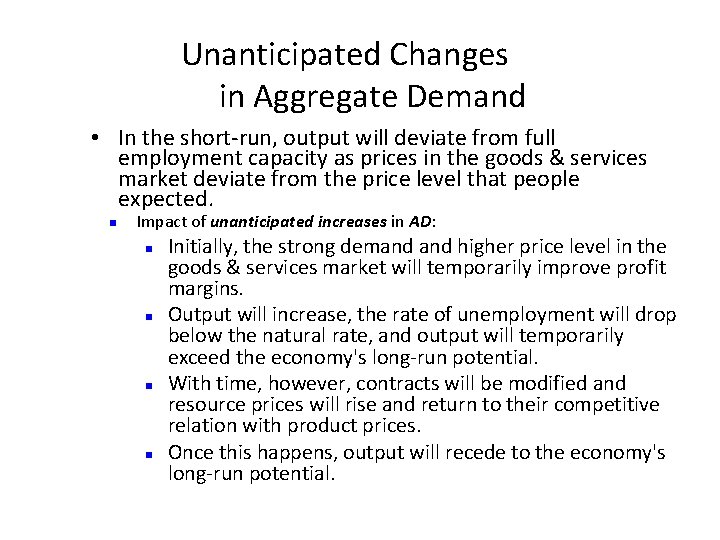
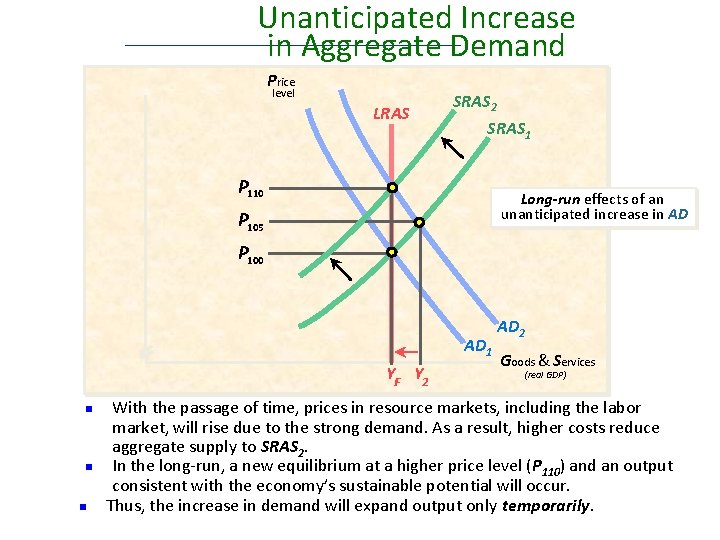
Unanticipated Changes in Aggregate Demand • In the short-run, output will deviate from full employment capacity as prices in the goods & services market deviate from the price level that people expected. n Impact of unanticipated increases in AD: n n Initially, the strong demand higher price level in the goods & services market will temporarily improve profit margins. Output will increase, the rate of unemployment will drop below the natural rate, and output will temporarily exceed the economy's long-run potential. With time, however, contracts will be modified and resource prices will rise and return to their competitive relation with product prices. Once this happens, output will recede to the economy's long-run potential.
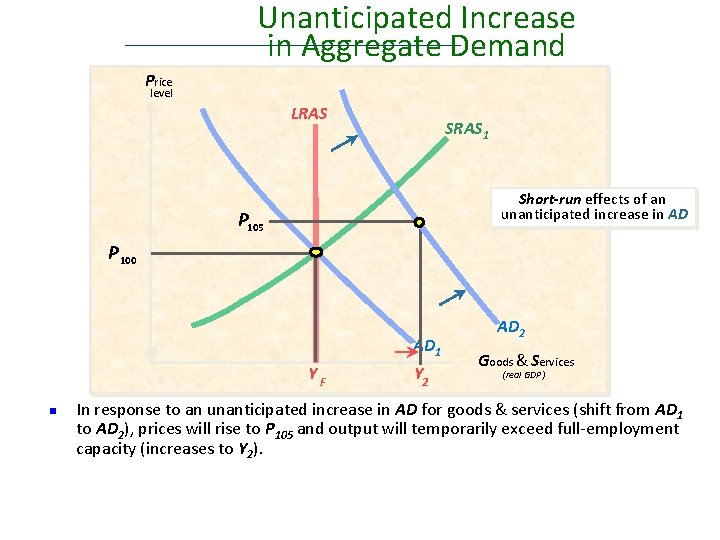
Unanticipated Increase in Aggregate Demand Price level LRAS SRAS 1 Short-run effects of an unanticipated increase in AD P 105 P 100 AD 1 YF n Y 2 AD 2 Goods & Services (real GDP) In response to an unanticipated increase in AD for goods & services (shift from AD 1 to AD 2), prices will rise to P 105 and output will temporarily exceed full-employment capacity (increases to Y 2).
Unanticipated Increase in Aggregate Demand Price level LRAS SRAS 2 SRAS 1 P 110 Long-run effects of an unanticipated increase in AD P 105 P 100 AD 1 YF Y 2 n n n AD 2 Goods & Services (real GDP) With the passage of time, prices in resource markets, including the labor market, will rise due to the strong demand. As a result, higher costs reduce aggregate supply to SRAS 2. In the long-run, a new equilibrium at a higher price level (P 110) and an output consistent with the economy’s sustainable potential will occur. Thus, the increase in demand will expand output only temporarily.
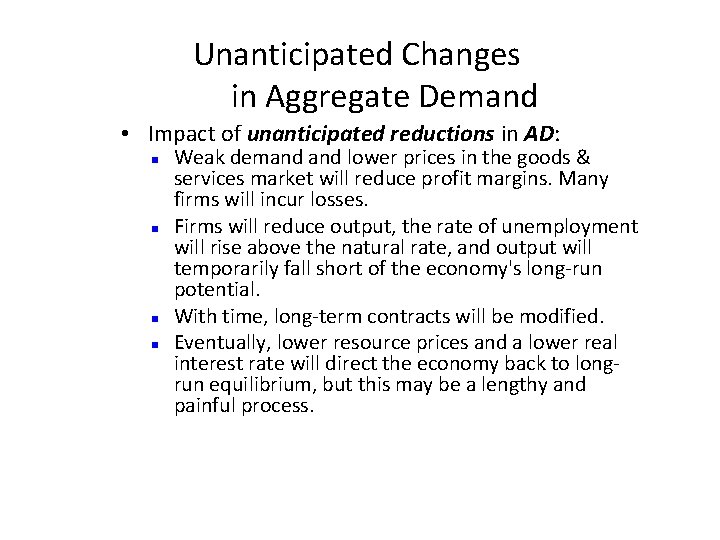
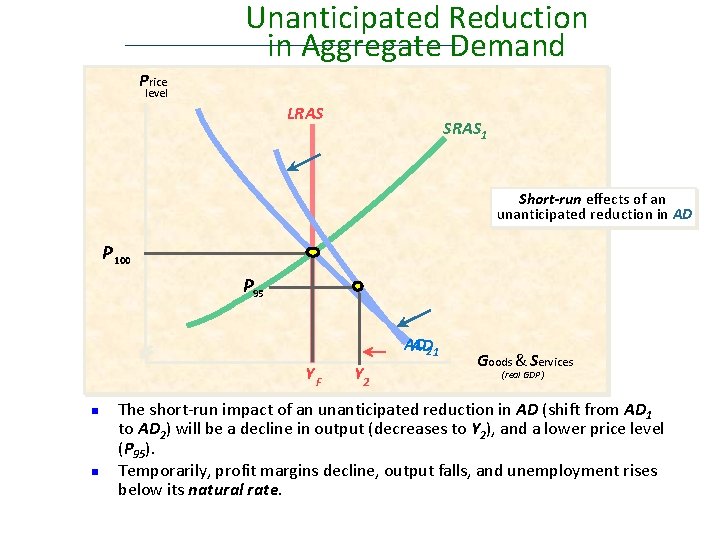
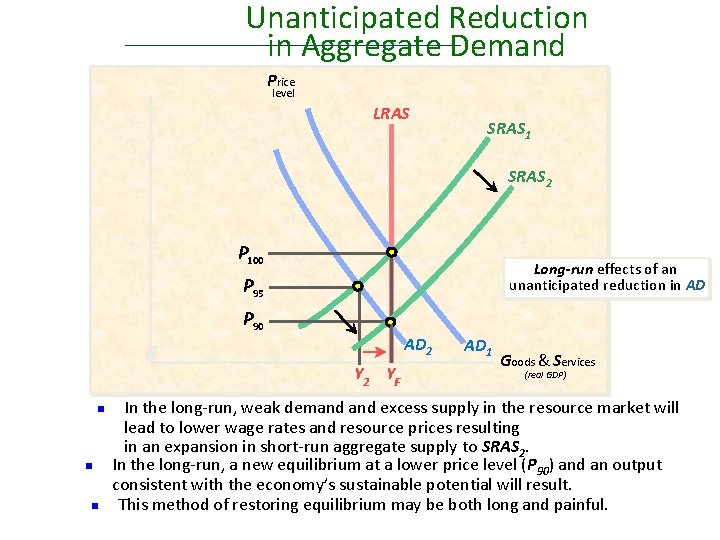
Unanticipated Changes in Aggregate Demand • Impact of unanticipated reductions in AD: n n Weak demand lower prices in the goods & services market will reduce profit margins. Many firms will incur losses. Firms will reduce output, the rate of unemployment will rise above the natural rate, and output will temporarily fall short of the economy's long-run potential. With time, long-term contracts will be modified. Eventually, lower resource prices and a lower real interest rate will direct the economy back to longrun equilibrium, but this may be a lengthy and painful process.
Unanticipated Reduction in Aggregate Demand Price level LRAS SRAS 1 Short-run effects of an unanticipated reduction in AD P 100 P 95 AD AD 2 1 YF n n Y 2 Goods & Services (real GDP) The short-run impact of an unanticipated reduction in AD (shift from AD 1 to AD 2) will be a decline in output (decreases to Y 2), and a lower price level (P 95). Temporarily, profit margins decline, output falls, and unemployment rises below its natural rate.
Unanticipated Reduction in Aggregate Demand Price level LRAS SRAS 1 SRAS 2 P 100 Long-run effects of an unanticipated reduction in AD P 95 P 90 AD 2 YF n n n AD 1 Goods & Services (real GDP) In the long-run, weak demand excess supply in the resource market will lead to lower wage rates and resource prices resulting in an expansion in short-run aggregate supply to SRAS 2. In the long-run, a new equilibrium at a lower price level (P 90) and an output consistent with the economy’s sustainable potential will result. This method of restoring equilibrium may be both long and painful.
Impact of Changes in Aggregate Supply • Economic growth and anticipated shifts in longrun aggregate supply. n n n Increases in LRAS will make it possible to produce and sustain a larger rate of output. Both LRAS and SRAS will shift to the right and output will increase. These changes generally take place slowly and therefore they need not disrupt long-run equilibrium.
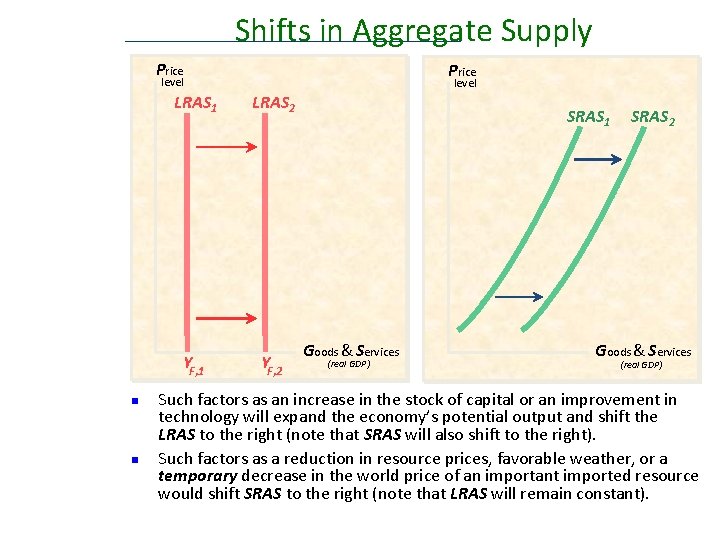
Shifts in Aggregate Supply Price level LRAS 1 YF, 1 n n level LRAS 2 YF, 2 SRAS 1 Goods & Services (real GDP) SRAS 2 Goods & Services (real GDP) Such factors as an increase in the stock of capital or an improvement in technology will expand the economy’s potential output and shift the LRAS to the right (note that SRAS will also shift to the right). Such factors as a reduction in resource prices, favorable weather, or a temporary decrease in the world price of an important imported resource would shift SRAS to the right (note that LRAS will remain constant).
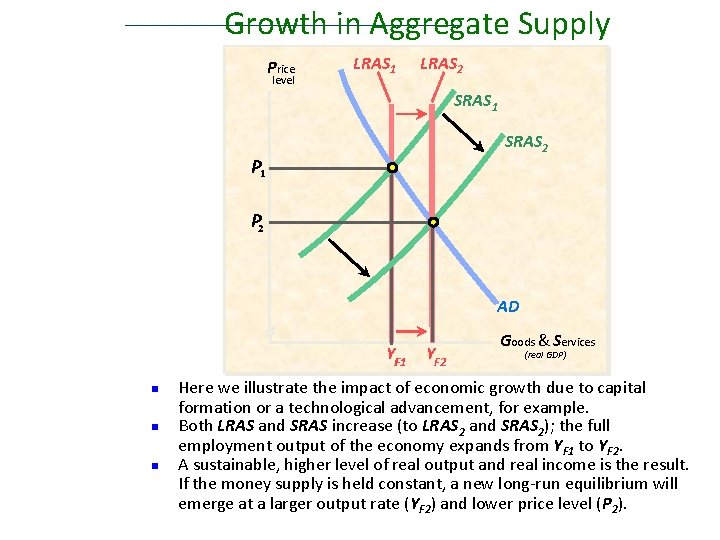
Growth in Aggregate Supply Price level LRAS 1 LRAS 2 SRAS 1 SRAS 2 P 1 P 2 AD YFF 1 n n n YF 2 Goods & Services (real GDP) Here we illustrate the impact of economic growth due to capital formation or a technological advancement, for example. Both LRAS and SRAS increase (to LRAS 2 and SRAS 2); the full employment output of the economy expands from YF 1 to YF 2. A sustainable, higher level of real output and real income is the result. If the money supply is held constant, a new long-run equilibrium will emerge at a larger output rate (YF 2) and lower price level (P 2).
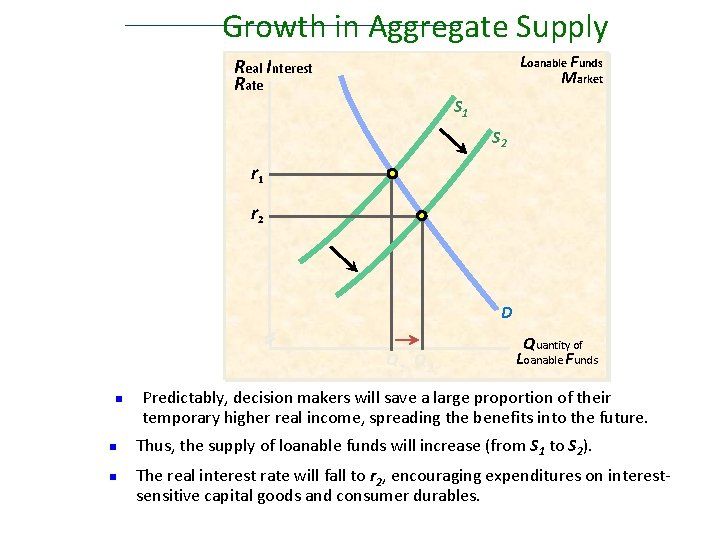
Impact of Changes in Aggregate Supply • The impact of changes in short-run aggregate supply (SRAS): n n SRAS shifts to the right – output will temporarily exceed the economy's long-run potential. Since the temporarily favorable supply conditions cannot be counted on in the future, the economy’s long-term production capacity will not be altered. Recognizing that they will be unable to maintain their current high level of income, individuals will generally save a substantial portion of it for use at a future time that is not nearly so prosperous. The increased saving will reduce interest rates, which encourages investment (capital formation).
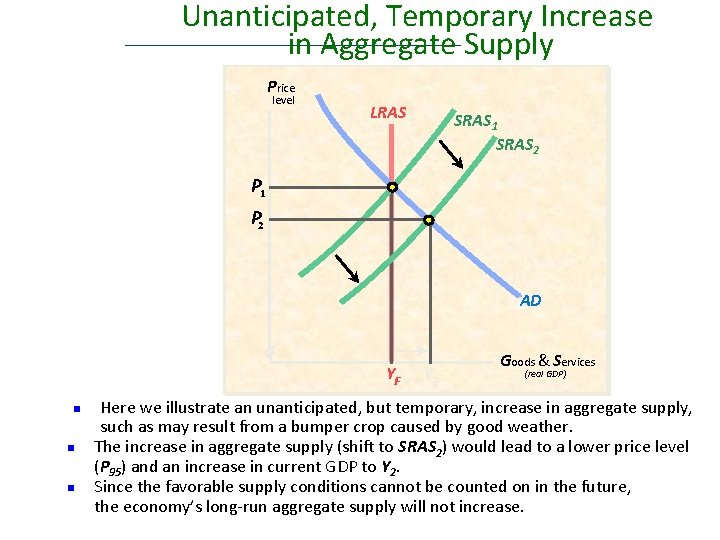
Unanticipated, Temporary Increase in Aggregate Supply Price level LRAS SRAS 1 SRAS 2 P 1 P 2 AD YF n n n Y 2 Goods & Services (real GDP) Here we illustrate an unanticipated, but temporary, increase in aggregate supply, such as may result from a bumper crop caused by good weather. The increase in aggregate supply (shift to SRAS 2) would lead to a lower price level (P 95) and an increase in current GDP to Y 2. Since the favorable supply conditions cannot be counted on in the future, the economy’s long-run aggregate supply will not increase.
Growth in Aggregate Supply Loanable Funds Market Real Interest Rate S 1 S 2 r 1 r 2 D Q 1 Q 2 n n n Quantity of Loanable Funds Predictably, decision makers will save a large proportion of their temporary higher real income, spreading the benefits into the future. Thus, the supply of loanable funds will increase (from S 1 to S 2). The real interest rate will fall to r 2, encouraging expenditures on interestsensitive capital goods and consumer durables.
Impact of Changes in Aggregate Supply • The impact of unanticipated reductions in short-run aggregate supply (SRAS): n n n If an unfavorable supply shock is expected to be temporary, long-run aggregate supply will be unaffected. Households will reduce their current saving level (and dip into past savings) to maintain a current consumption level more consistent with their longerterm perceived opportunities. The reduction in saving will lead to higher real interest rates and retard current investment.
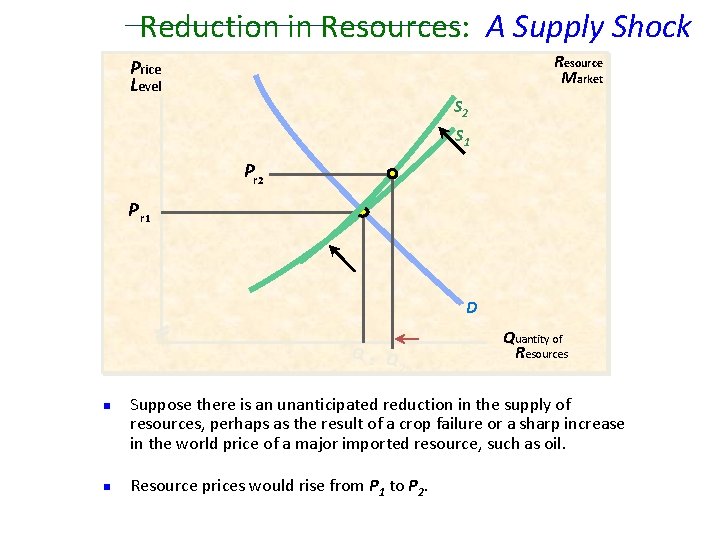
Reduction in Resources: A Supply Shock Resource Market Price Level S 2 S 1 Pr 2 P r 1 D Q 1 Q 2 n n Quantity of Resources Suppose there is an unanticipated reduction in the supply of resources, perhaps as the result of a crop failure or a sharp increase in the world price of a major imported resource, such as oil. Resource prices would rise from P 1 to P 2.
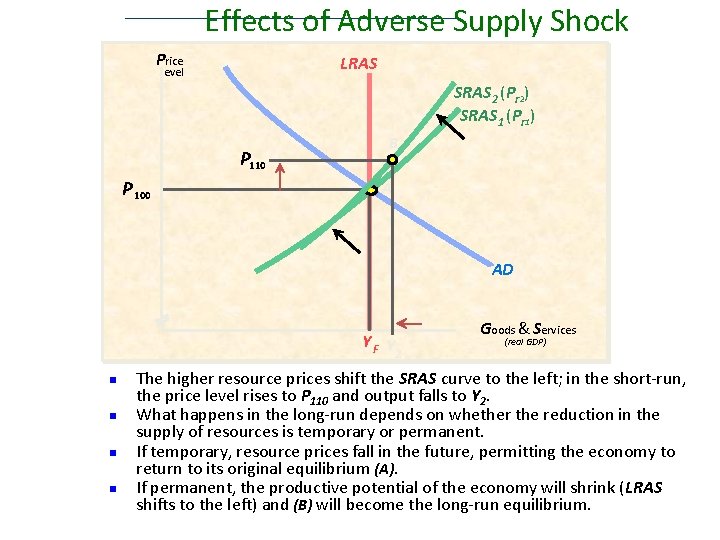
Effects of Adverse Supply Shock Price LRAS level SRAS 2 (Pr 2) SRAS 1 (Pr 1) P 110 P 100 B A AD YF Y 2 n n Goods & Services (real GDP) The higher resource prices shift the SRAS curve to the left; in the short-run, the price level rises to P 110 and output falls to Y 2. What happens in the long-run depends on whether the reduction in the supply of resources is temporary or permanent. If temporary, resource prices fall in the future, permitting the economy to return to its original equilibrium (A). If permanent, the productive potential of the economy will shrink (LRAS shifts to the left) and (B) will become the long-run equilibrium.