
Aggregate Demand Learning outcomes To be able to
Aggregate Demand
Learning outcomes • To be able to distinguish between demand aggregate demand • To become familiar with the components of aggregate demand • To be able to distinguish between inward and outward shifts of the aggregate demand curve
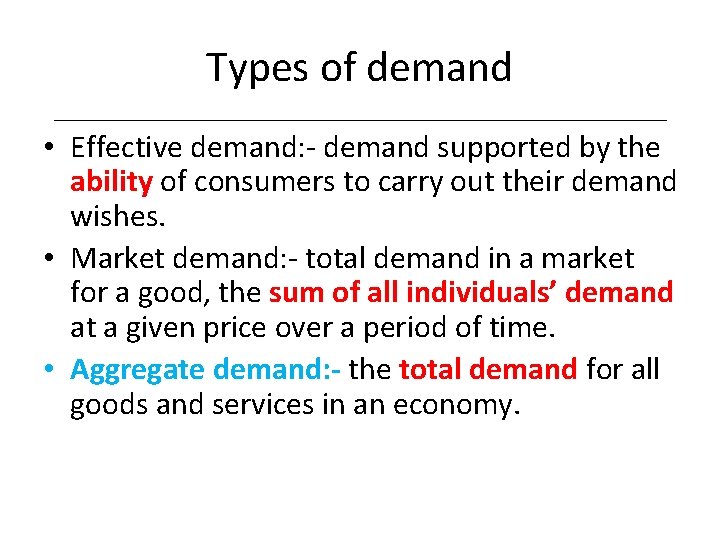
Types of demand • Effective demand: - demand supported by the ability of consumers to carry out their demand wishes. • Market demand: - total demand in a market for a good, the sum of all individuals’ demand at a given price over a period of time. • Aggregate demand: - the total demand for all goods and services in an economy.
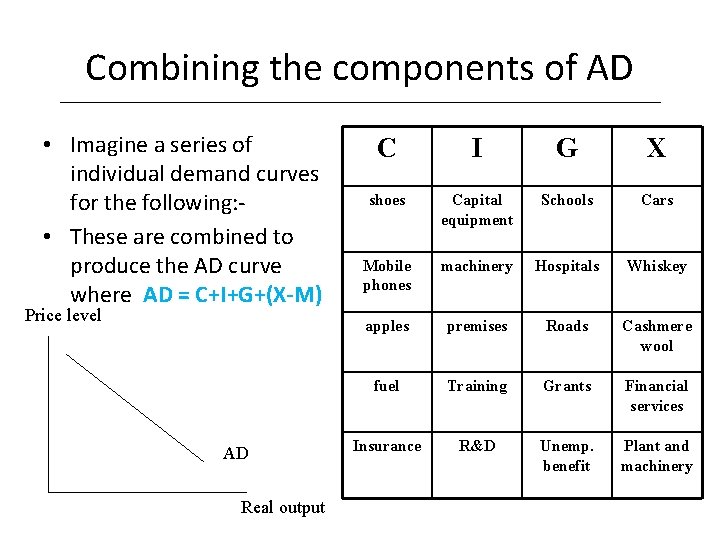
Combining the components of AD • Imagine a series of individual demand curves for the following: • These are combined to produce the AD curve where AD = C+I+G+(X-M) Price level AD Real output C I G X shoes Capital equipment Schools Cars Mobile phones machinery Hospitals Whiskey apples premises Roads Cashmere wool fuel Training Grants Financial services Insurance R&D Unemp. benefit Plant and machinery
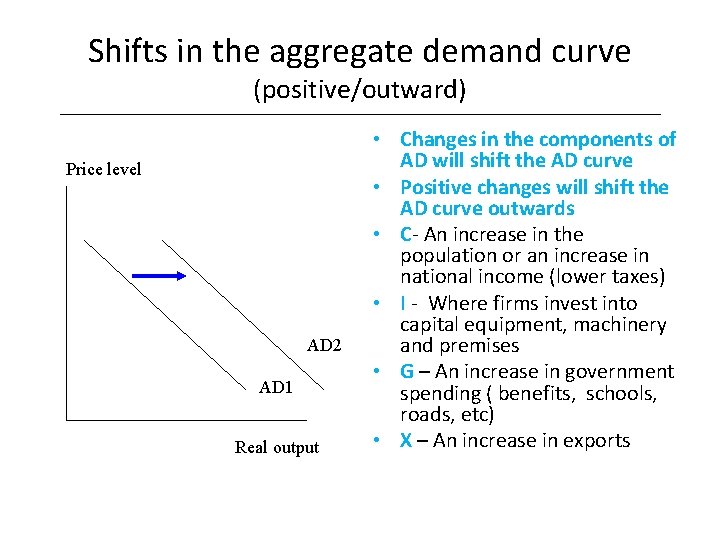
Shifts in the aggregate demand curve (positive/outward) Price level AD 2 AD 1 Real output • Changes in the components of AD will shift the AD curve • Positive changes will shift the AD curve outwards • C- An increase in the population or an increase in national income (lower taxes) • I - Where firms invest into capital equipment, machinery and premises • G – An increase in government spending ( benefits, schools, roads, etc) • X – An increase in exports
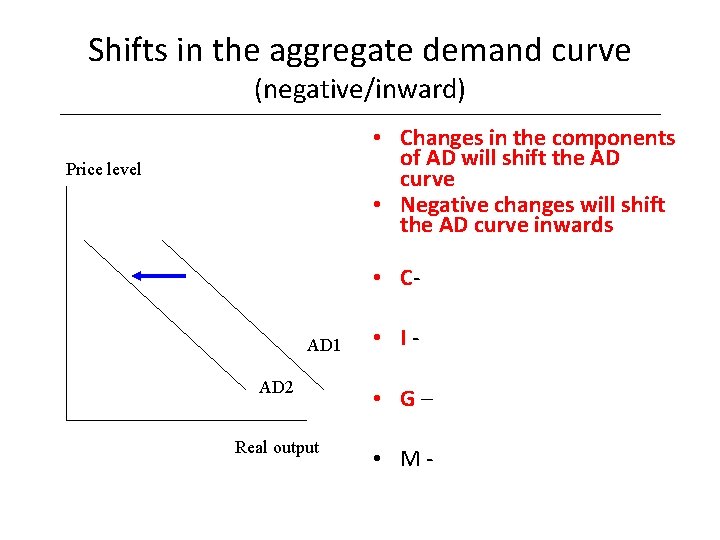
Shifts in the aggregate demand curve (negative/inward) • Changes in the components of AD will shift the AD curve • Negative changes will shift the AD curve inwards Price level • CAD 1 • I- AD 2 • G– Real output • M-
The multiplier & accelerator principle • Accelerator • Multiplier • Current investment plans based on previous changes to GDP. • As GDP rises future plans incorporate this change. • Last year GDP rose by 2%, businesses intend on increasing investment by 2. 1% expecting the economy to grow in the forthcoming year. • How a change in injections (I, G, X) can have a disproportionate effect on GDP. That is a £ 1 m injection can increase GDP by more than £ 1 m. • This is increase impacts upon future business plans accelerating investment. • This injection has a multiplier effect on GDP.
- Slides: 7