
Aggregate Demand I Building the ISLM Model Chapter
Aggregate Demand I: Building the IS-LM Model Chapter 11 of Macroeconomics, 9 th edition, by N. Gregory Mankiw ECO 62 Udayan Roy
THE GOODS MARKET IN THE SHORT RUN

Recap: Equations of Chapter 3 • Chapter 3 was about the long run. Now we are discussing the short run. In the short run, the available capital and labor may go underutilized. Therefore, the first equation is not applicable in the short run. The other equations continue to apply.
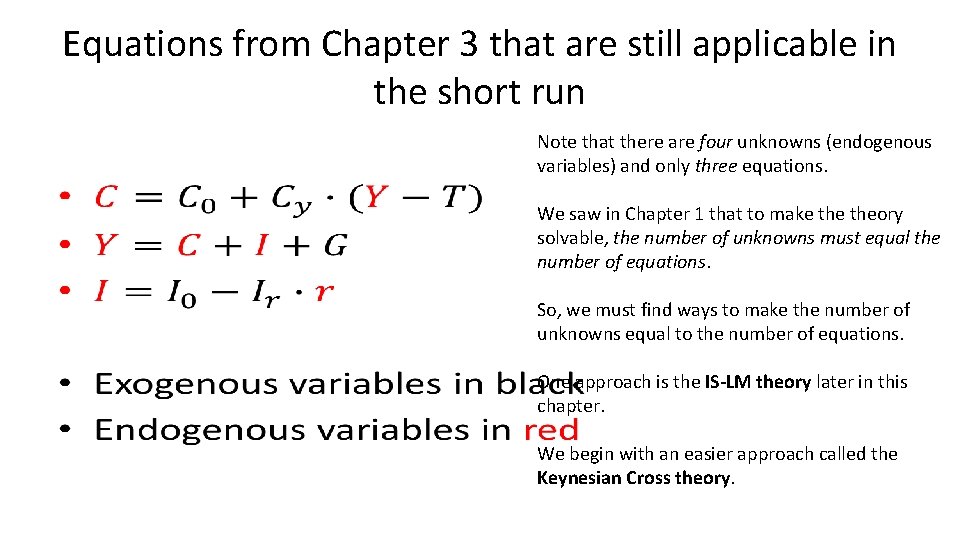
Equations from Chapter 3 that are still applicable in the short run • Note that there are four unknowns (endogenous variables) and only three equations. We saw in Chapter 1 that to make theory solvable, the number of unknowns must equal the number of equations. So, we must find ways to make the number of unknowns equal to the number of equations. One approach is the IS-LM theory later in this chapter. We begin with an easier approach called the Keynesian Cross theory.
The simplest theory of short-run equilibrium in the goods market THE KEYNESIAN CROSS

Keynesian Cross Theory •

Keynesian Cross Theory Our first equation makes the supply of goods and services (Y) equal to the demand for goods and services (C + I + G). The textbook refers to the demand for goods and services as planned expenditure: PE = C + I + G. So, the goods market equilibrium equation can also be written as Y = PE. Note that every variable on the right hand-side of the last equation is exogenous. So, this equation tells us everything we can say about Y in the Keynesian Cross model.

Short-Run GDP: predictions Predictions Grid Y Recall from Ch. 3 that: • The first row of the predictions grid lists the endogenous variables (unknowns) • In this case, Y is the only endogenous variable • The first column lists the exogenous variables (knowns) • In this case, C 0, T, I and G are the exogenous variables • Each cell shows the kind of effect that the corresponding exogenous variable has on the corresponding endogenous variable Co + T − I + G + Q: Can you look at the equation above for long-run output and see why it algebraically implies the predictions in the predictions grid?
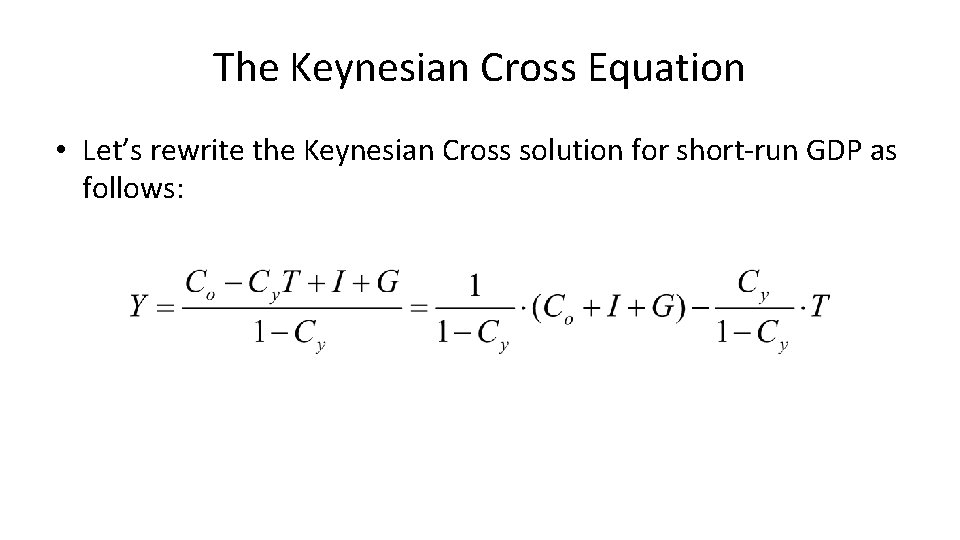
The Keynesian Cross Equation • Let’s rewrite the Keynesian Cross solution for short-run GDP as follows:

The Spending Multiplier • Note that if C 0 + I + G increases by $1. 00, then Y increases by $1/(1 – Cy). • As Cy is the marginal propensity to consume, 1/(1 – Cy) may be written as 1/(1 – MPC). • This is called the spending multiplier.
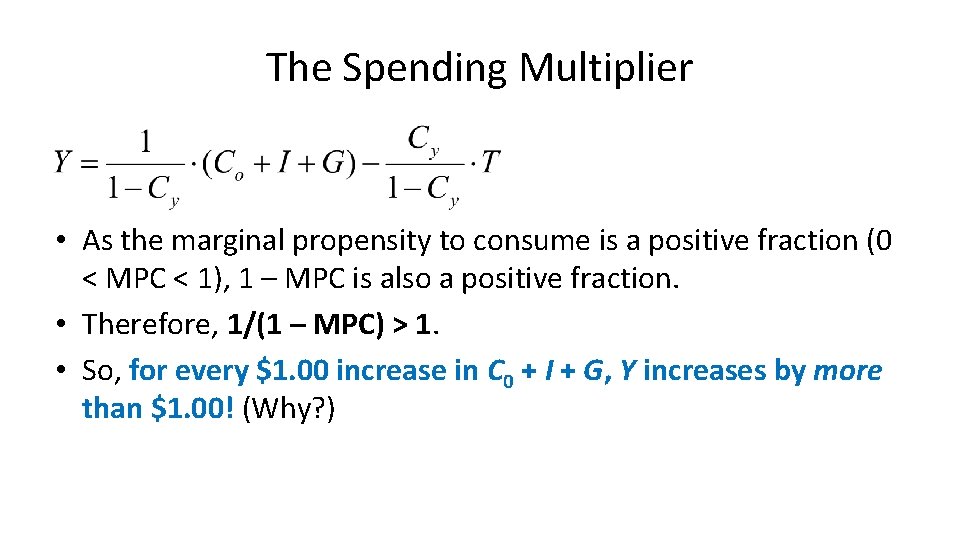
The Spending Multiplier • As the marginal propensity to consume is a positive fraction (0 < MPC < 1), 1 – MPC is also a positive fraction. • Therefore, 1/(1 – MPC) > 1. • So, for every $1. 00 increase in C 0 + I + G, Y increases by more than $1. 00! (Why? )
The Spending Multiplier • Suppose the government spends an additional $1 billion to build a new highway • This immediately increases national income by $1 billion, because the money spent by the government can’t disappear into thin air; it must end up in people’s pockets • Those who earn this additional income will spend a fraction of it on additional consumption spending (on, say, food) – If the MPC is 0. 8, this additional spending will be 0. 8 × $1 billion or $800 million
The Spending Multiplier • So you see that although the government got the ball rolling by spending $1 billion, in a mere two steps national income has already increased by $1. 8 billion • This explains why the spending multiplier is greater than one • … and the process will continue! • Those who produced the additional food bought by those who made the highway will earn $800 million • They will spend 0. 8 × $800 million or $640 million on additional consumption (of, say, clothes), and so on and on …
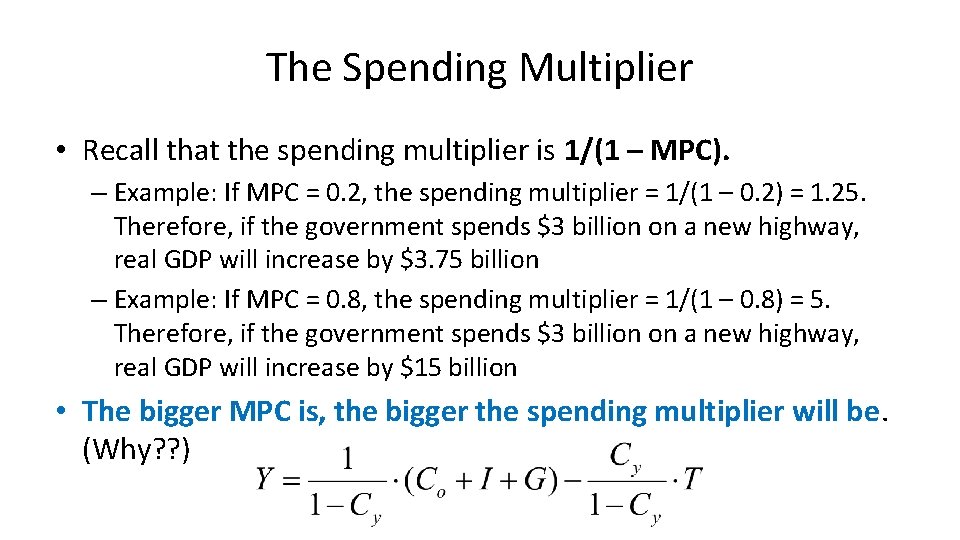
The Spending Multiplier • Recall that the spending multiplier is 1/(1 – MPC). – Example: If MPC = 0. 2, the spending multiplier = 1/(1 – 0. 2) = 1. 25. Therefore, if the government spends $3 billion on a new highway, real GDP will increase by $3. 75 billion – Example: If MPC = 0. 8, the spending multiplier = 1/(1 – 0. 8) = 5. Therefore, if the government spends $3 billion on a new highway, real GDP will increase by $15 billion • The bigger MPC is, the bigger the spending multiplier will be. (Why? ? )

The Tax-Cut Multiplier • Note that if T decreases by $1. 00, then Y increases by $Cy/(1 – Cy). • As Cy is the marginal propensity to consume, Cy /(1 – Cy) may be written as MPC/(1 – MPC). • This is the tax-cut multiplier.
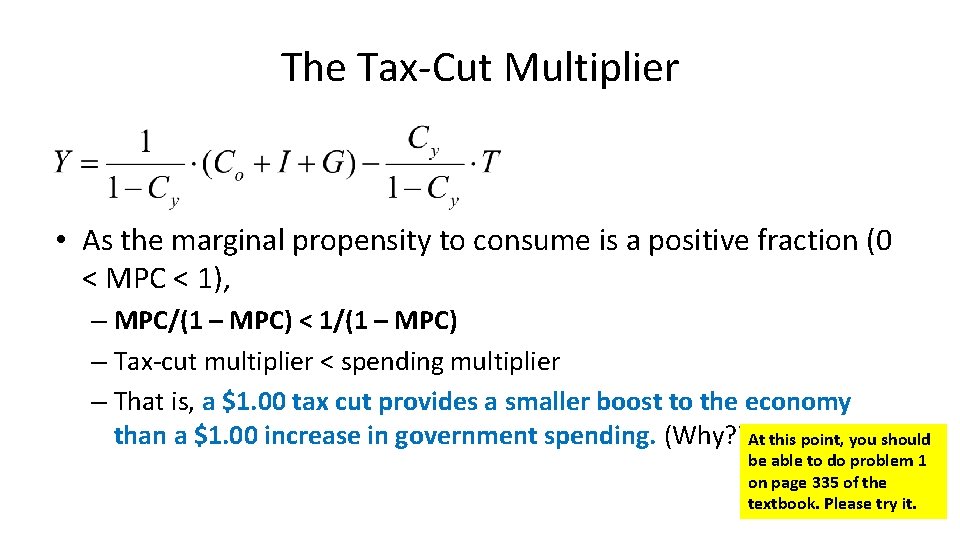
The Tax-Cut Multiplier • As the marginal propensity to consume is a positive fraction (0 < MPC < 1), – MPC/(1 – MPC) < 1/(1 – MPC) – Tax-cut multiplier < spending multiplier – That is, a $1. 00 tax cut provides a smaller boost to the economy than a $1. 00 increase in government spending. (Why? ? )At this point, you should be able to do problem 1 on page 335 of the textbook. Please try it.
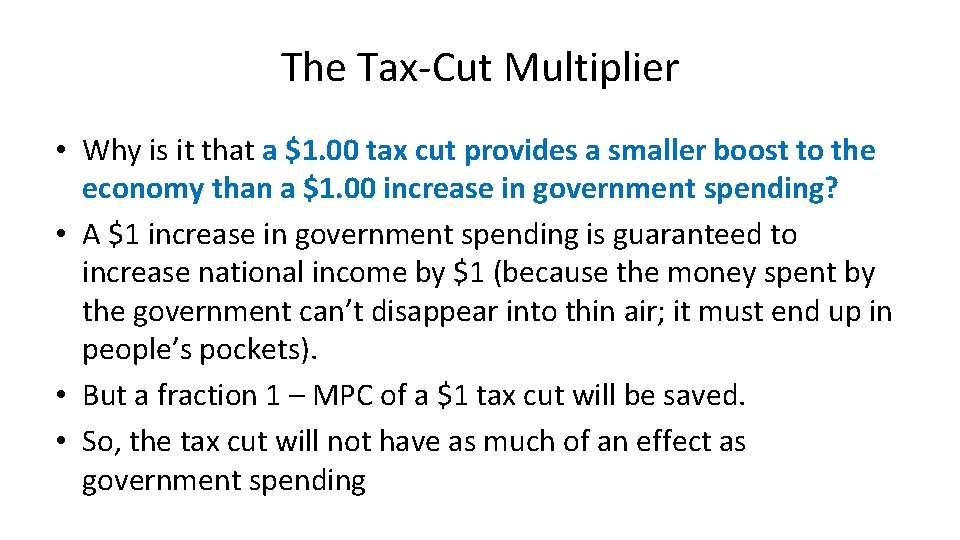
The Tax-Cut Multiplier • Why is it that a $1. 00 tax cut provides a smaller boost to the economy than a $1. 00 increase in government spending? • A $1 increase in government spending is guaranteed to increase national income by $1 (because the money spent by the government can’t disappear into thin air; it must end up in people’s pockets). • But a fraction 1 – MPC of a $1 tax cut will be saved. • So, the tax cut will not have as much of an effect as government spending
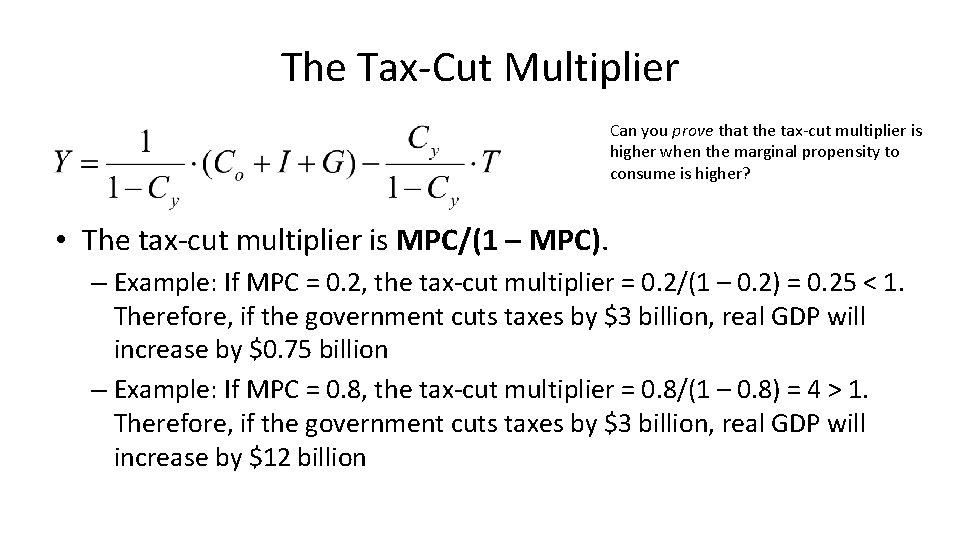
The Tax-Cut Multiplier Can you prove that the tax-cut multiplier is higher when the marginal propensity to consume is higher? • The tax-cut multiplier is MPC/(1 – MPC). – Example: If MPC = 0. 2, the tax-cut multiplier = 0. 2/(1 – 0. 2) = 0. 25 < 1. Therefore, if the government cuts taxes by $3 billion, real GDP will increase by $0. 75 billion – Example: If MPC = 0. 8, the tax-cut multiplier = 0. 8/(1 – 0. 8) = 4 > 1. Therefore, if the government cuts taxes by $3 billion, real GDP will increase by $12 billion
Fiscal Policy • The practice of changing the levels of government spending (G) and/or taxes (T) in order to affect the macroeconomic outcome is called fiscal policy – Spending more (G↑) and/or cutting taxes (T↓) is called expansionary fiscal policy – Spending less (G↓) and/or raising taxes (T↑) is called contractionary fiscal policy
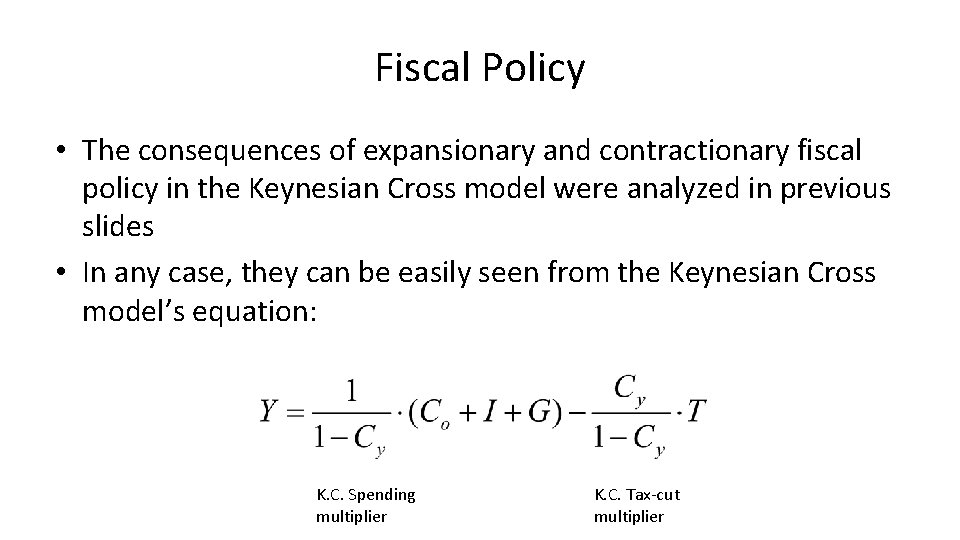
Fiscal Policy • The consequences of expansionary and contractionary fiscal policy in the Keynesian Cross model were analyzed in previous slides • In any case, they can be easily seen from the Keynesian Cross model’s equation: K. C. Spending multiplier K. C. Tax-cut multiplier
Fiscal Policy: balanced budget multiplier • Note that expansionary fiscal policy (G↑ and/or T↓) leads to lower public saving (T – G↓) – This could mean a rise in the budget deficit or a fall in the budget surplus • Is there no way to stimulate an economy in a recession while keeping the budget balanced? • There is!
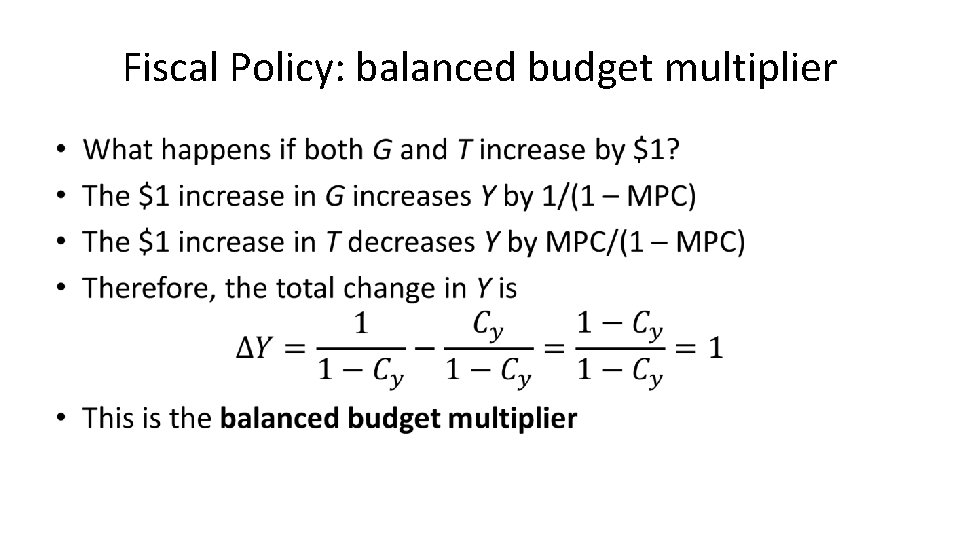
Fiscal Policy: balanced budget multiplier •
Fiscal Policy: balanced budget multiplier • The balanced budget multiplier shows that if both government spending and taxes are increased by some amount—thereby keeping the budget balanced—then output will increase by that same amount. – Example: If both government spending and taxes are increased by $50 billion—thereby keeping the budget balanced—then output will increase by $50 billion. – Important: The Keynesian Cross theory assumes that the economy is in a recession and, therefore, has unemployed resources.
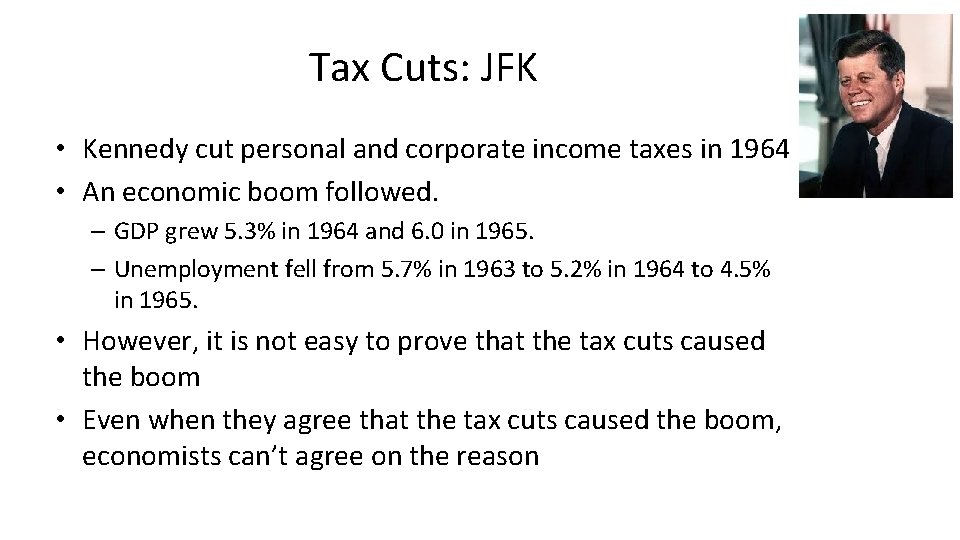
Tax Cuts: JFK • Kennedy cut personal and corporate income taxes in 1964 • An economic boom followed. – GDP grew 5. 3% in 1964 and 6. 0 in 1965. – Unemployment fell from 5. 7% in 1963 to 5. 2% in 1964 to 4. 5% in 1965. • However, it is not easy to prove that the tax cuts caused the boom • Even when they agree that the tax cuts caused the boom, economists can’t agree on the reason
Tax Cuts: JFK • Keynesians argued that the tax cuts boosted demand, which led to higher production and falling unemployment • Supply-siders argued that demand had nothing to do with it. The tax cuts gave people the incentive to work harder. So, L increased. Therefore, Y = F(K, L) also increased. – Personally, I feel this argument doesn’t explain why the unemployment rate fell
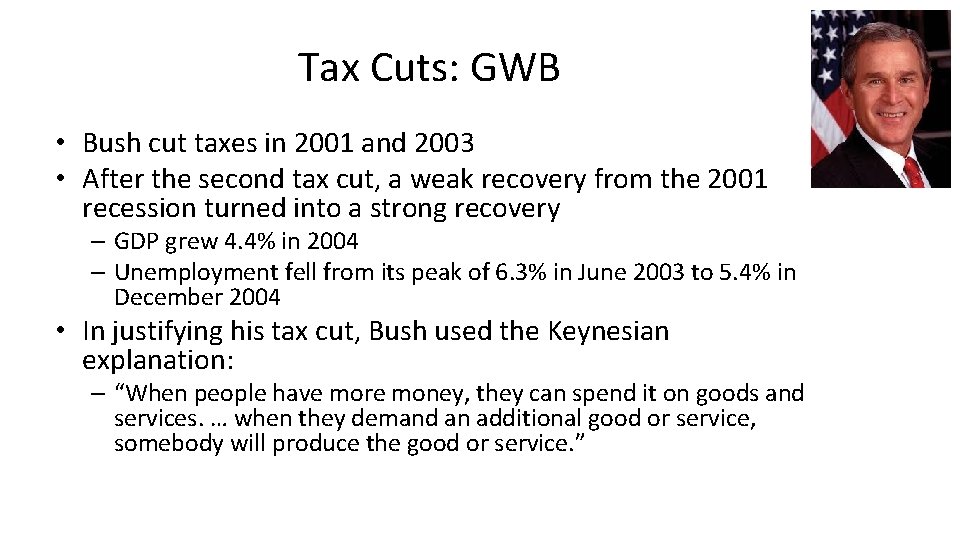
Tax Cuts: GWB • Bush cut taxes in 2001 and 2003 • After the second tax cut, a weak recovery from the 2001 recession turned into a strong recovery – GDP grew 4. 4% in 2004 – Unemployment fell from its peak of 6. 3% in June 2003 to 5. 4% in December 2004 • In justifying his tax cut, Bush used the Keynesian explanation: – “When people have more money, they can spend it on goods and services. … when they demand an additional good or service, somebody will produce the good or service. ”
Spending Stimulus: Barack Obama • When President Obama took office in January 2009, the economy had suffered the worst collapse since the Great Depression • Obama helped enact an $800 billion (5% of annual GDP) stimulus to be spent over a two-year period • About 40% was tax cuts, and 60% was additional government spending – White House economists had estimated the spending multiplier to be 1. 57 and the tax-cut multiplier to be 0. 99
Spending Stimulus: Barack Obama • Much of the new spending was on infrastructure projects • These projects were fine for the long run, but took a long time to be implemented, and were therefore not ideal as a shortrun boost • Obama publicly justified his stimulus bill using Keynesian demand-side reasoning

Big-Picture Comparison Long-Run Macroeconomics (Chs. 3, 5) Short-Run Macroeconomics (Keynesian Cross) • • Variables in red font are endogenous. Variables in black font are exogenous.
A slightly more complex theory of short-run equilibrium in the goods market THE IS CURVE
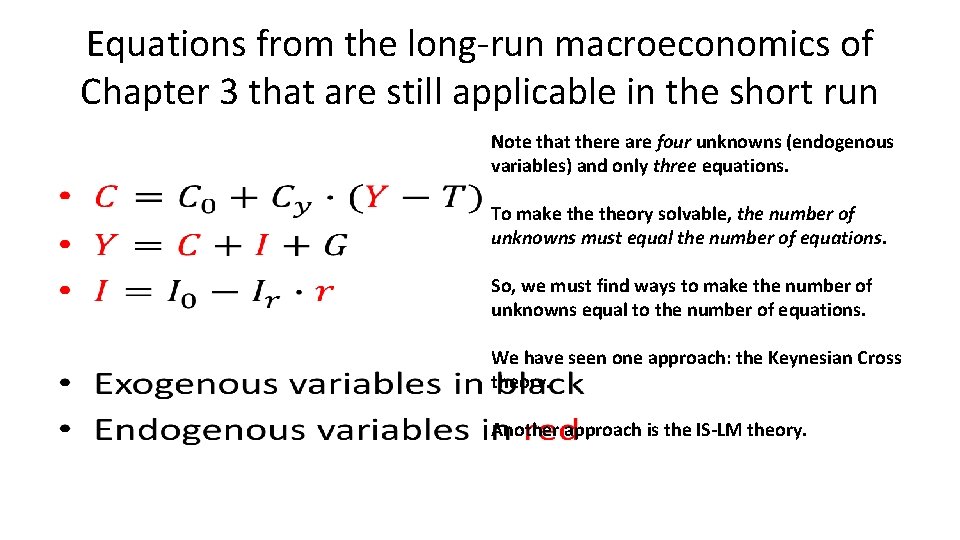
Equations from the long-run macroeconomics of Chapter 3 that are still applicable in the short run • Note that there are four unknowns (endogenous variables) and only three equations. To make theory solvable, the number of unknowns must equal the number of equations. So, we must find ways to make the number of unknowns equal to the number of equations. We have seen one approach: the Keynesian Cross theory. Another approach is the IS-LM theory.
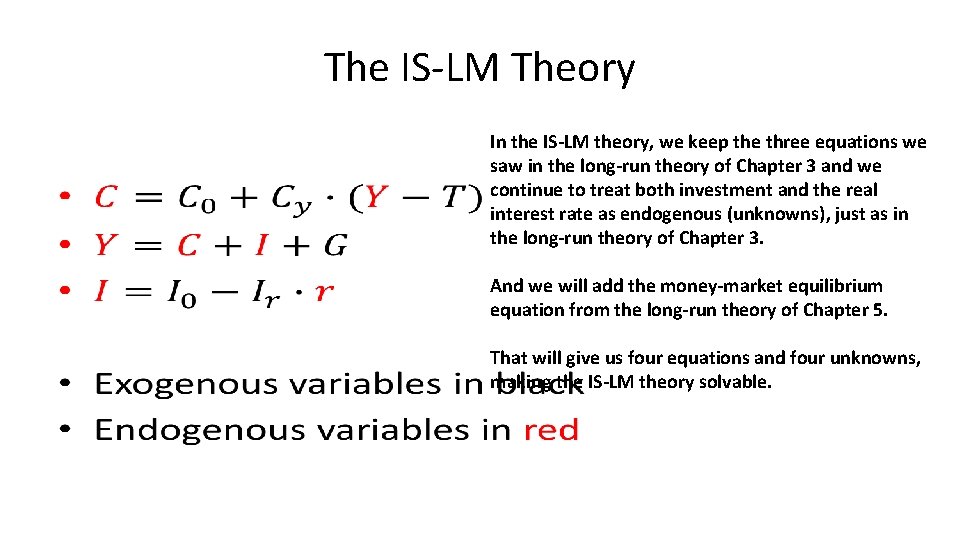
The IS-LM Theory • In the IS-LM theory, we keep the three equations we saw in the long-run theory of Chapter 3 and we continue to treat both investment and the real interest rate as endogenous (unknowns), just as in the long-run theory of Chapter 3. And we will add the money-market equilibrium equation from the long-run theory of Chapter 5. That will give us four equations and four unknowns, making the IS-LM theory solvable.

The IS-LM Theory: The IS Curve • Before we add an equation from the long-run theory of Chapter 5, let’s see what we can do with the three equations on this slide.

Deriving the IS Curve: algebra K. C. Spending multiplier K. C. Tax-cut multiplier IS Interest rate effect

Deriving the IS Curve: algebra So, although the basic equation underlying the IS curve is … … for my specific consumption and investment functions, the equation underlying the IS curve can also be expressed as: The two equations are equivalent forms of the IS curve.

Comparing the Equations of the Keynesian Cross and the IS Curve Keynesian Cross K. C. Spending multiplier K. C. Tax-cut multiplier This is the only difference IS Curve IS Interest rate effect

The IS Curve K. C. Spending multiplier K. C. Tax-cut multiplier r IS Interest rate effect Any change in the real interest rate will cause an opposite change in real total GDP by a multiple determined by the size of the interest rate effect. r 1 Δr r 2 This is why the IS curve is negatively sloped. IS Y 1 Y 2 ΔY Y
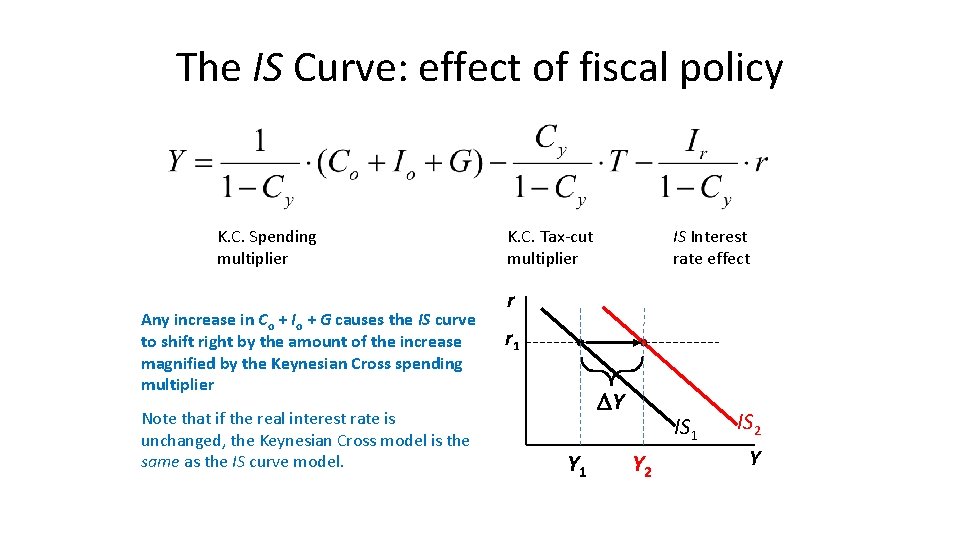
The IS Curve: effect of fiscal policy K. C. Spending multiplier Any increase in Co + Io + G causes the IS curve to shift right by the amount of the increase magnified by the Keynesian Cross spending multiplier Note that if the real interest rate is unchanged, the Keynesian Cross model is the same as the IS curve model. K. C. Tax-cut multiplier IS Interest rate effect r r 1 Y Y 1 IS 1 Y 2 IS 2 Y

The IS Curve: effect of fiscal policy K. C. Spending multiplier Any decrease in taxes (T) causes the IS curve to shift right by the amount of the tax cut magnified by the Keynesian Cross tax-cut multiplier K. C. Tax-cut multiplier IS Interest rate effect r r 1 Y Y 1 IS 1 Y 2 IS 2 Y
The IS Curve: shifts • To sum up the previous two slides: • The IS curve shifts right if there is: – an increase in Co + Io + G, or – a decrease in T.
The theory of short-run equilibrium in the money market THE MONEY MARKET IN THE SHORT RUN: THE LM CURVE
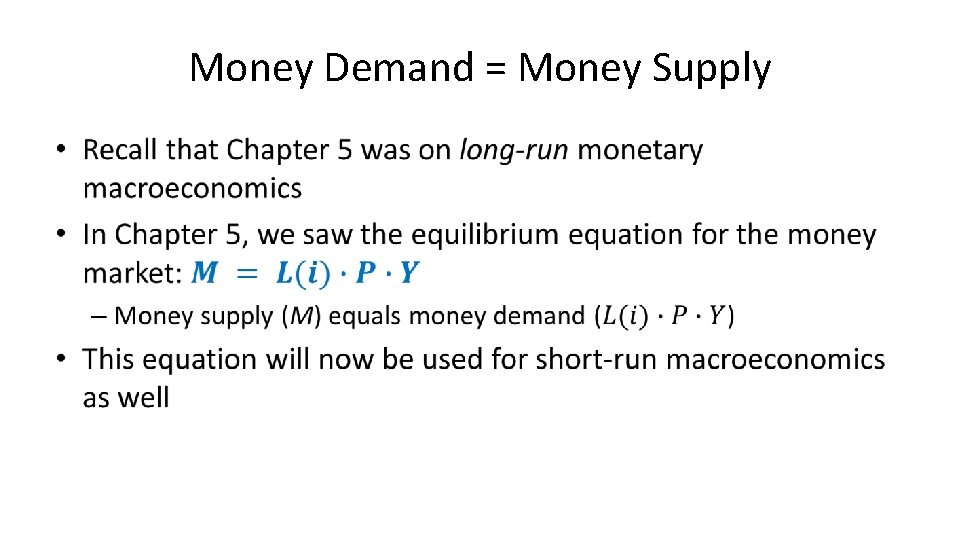
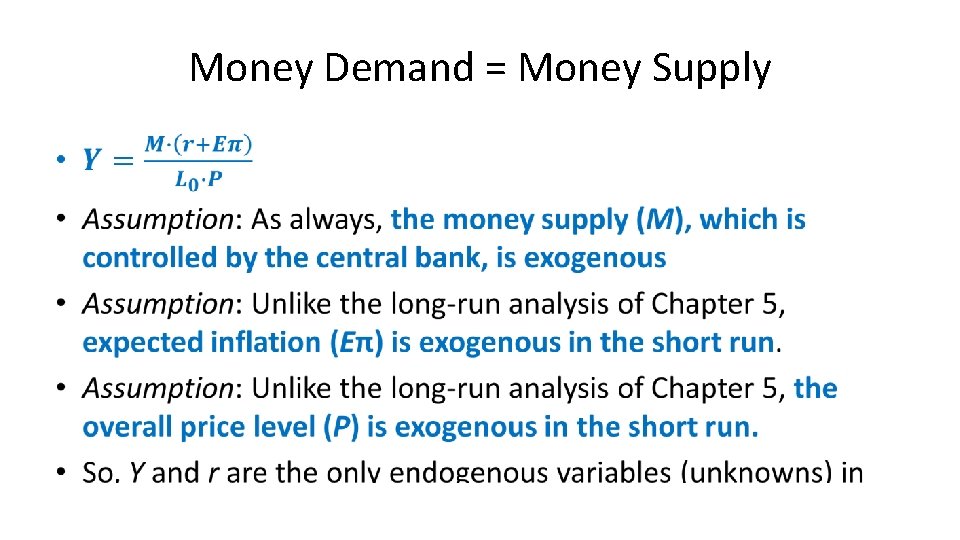
Money Demand = Money Supply •
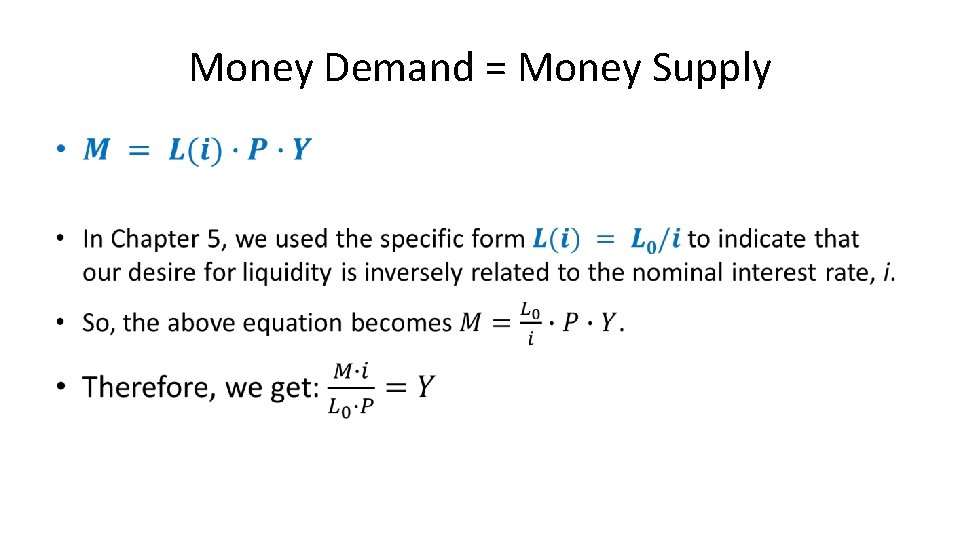
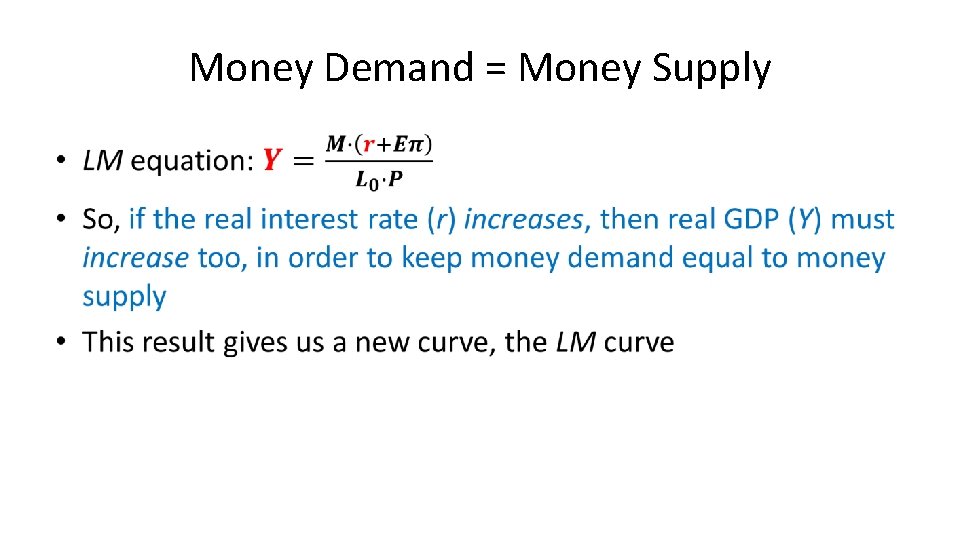
Money Demand = Money Supply •
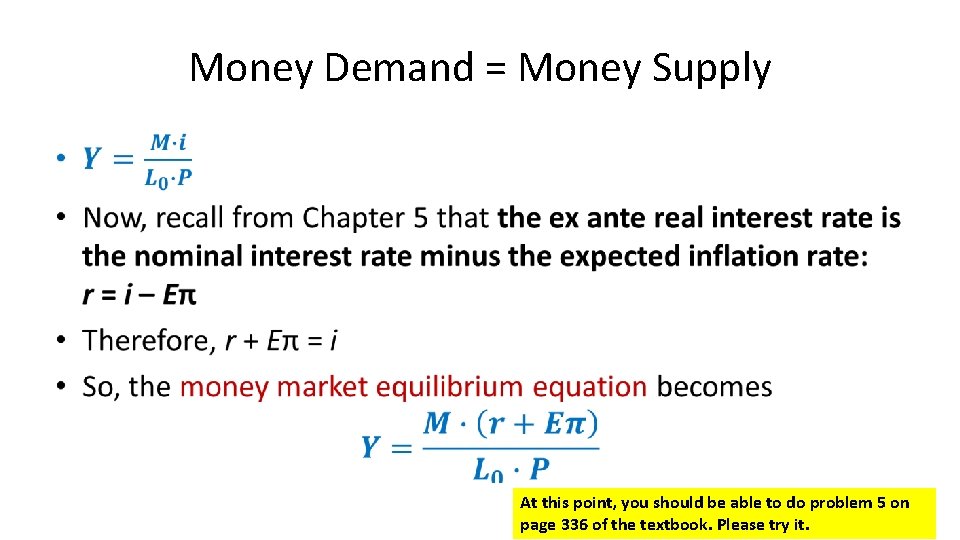
Money Demand = Money Supply • At this point, you should be able to do problem 5 on page 336 of the textbook. Please try it.
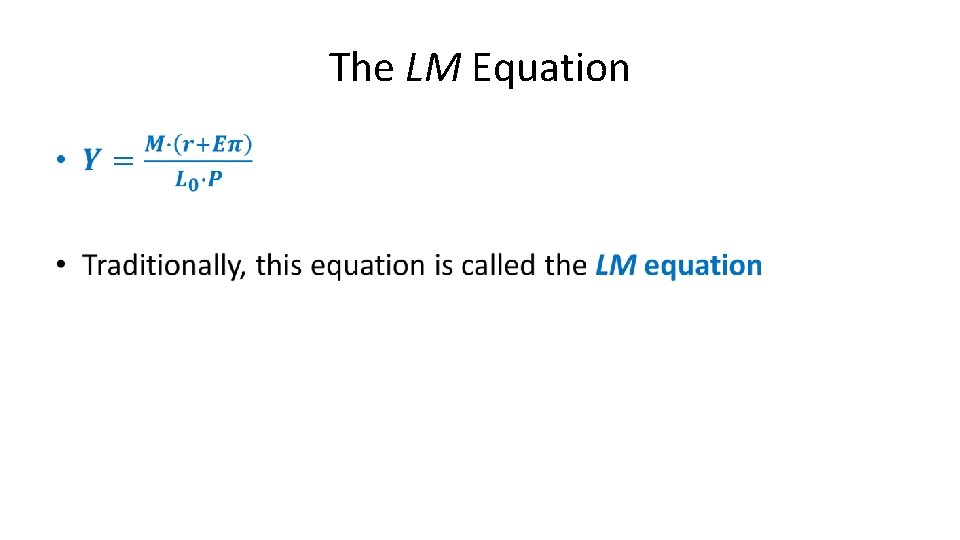
The LM Equation •
Money Demand = Money Supply •
Money Demand = Money Supply •

The LM Curve: algebra to graph • The LM curve shows all combinations of r and Y for which the money market is in equilibrium • Note that the LM curve is upward rising r LM r 2 r 1 Y 2 Y
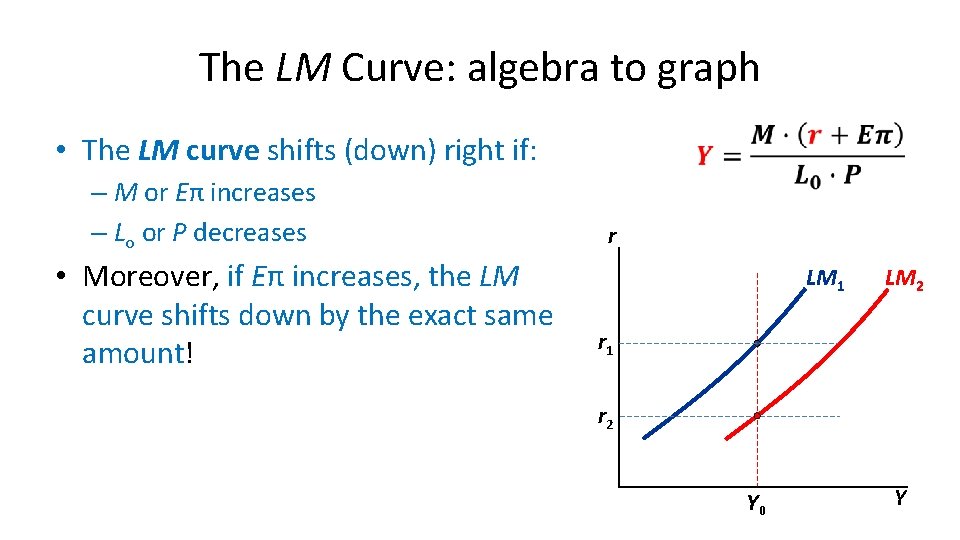
The LM Curve: algebra to graph • The LM curve shifts (down) right if: – M or Eπ increases – Lo or P decreases • Moreover, if Eπ increases, the LM curve shifts down by the exact same amount! r LM 1 LM 2 r 1 r 2 Y 0 Y
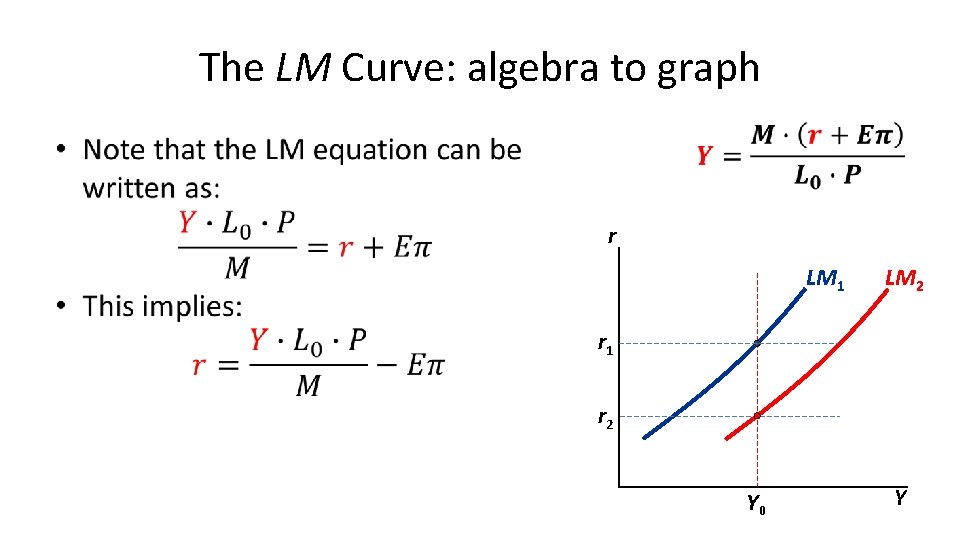
The LM Curve: algebra to graph • r LM 1 LM 2 r 1 r 2 Y 0 Y
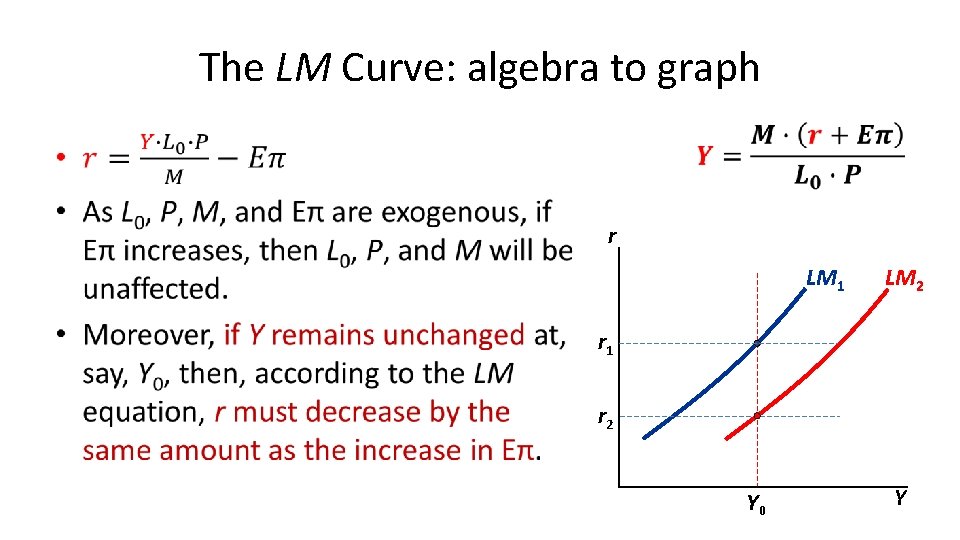
The LM Curve: algebra to graph • r LM 1 LM 2 r 1 r 2 Y 0 Y
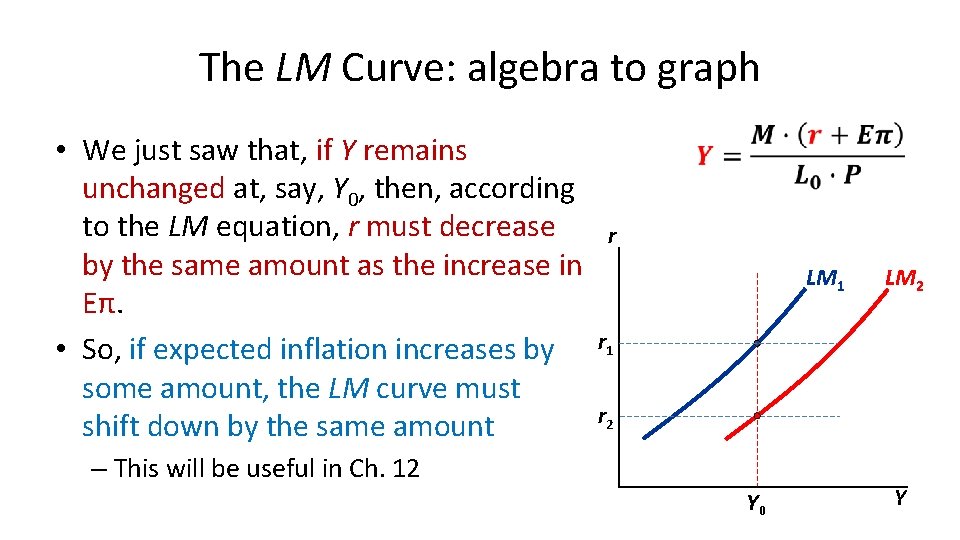
The LM Curve: algebra to graph • We just saw that, if Y remains unchanged at, say, Y 0, then, according to the LM equation, r must decrease r by the same amount as the increase in Eπ. • So, if expected inflation increases by r 1 some amount, the LM curve must r 2 shift down by the same amount LM 1 – This will be useful in Ch. 12 Y 0 LM 2 Y
Both the goods market and the money market need to be in equilibrium SHORT-RUN EQUILIBRIUM IN THE IS-LM MODEL
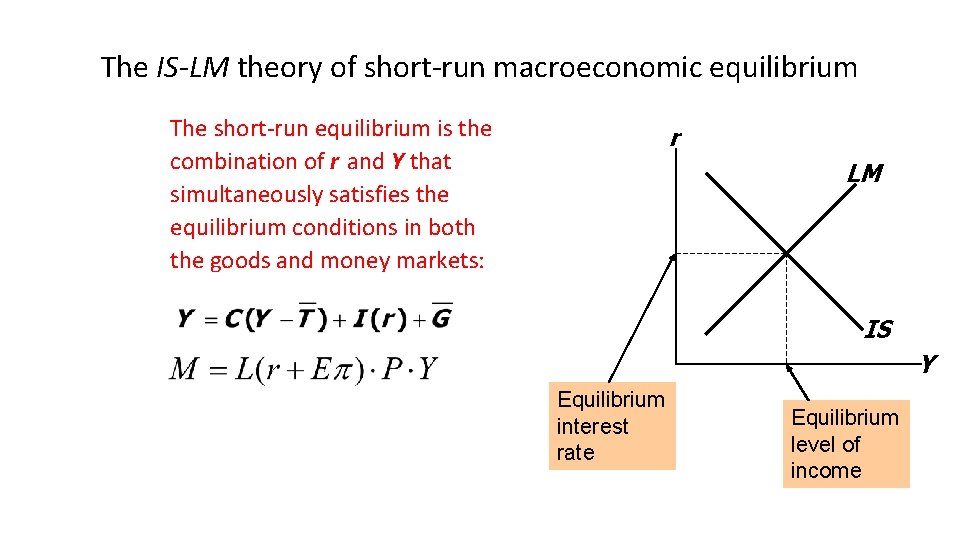
The IS-LM theory of short-run macroeconomic equilibrium The short-run equilibrium is the combination of r and Y that simultaneously satisfies the equilibrium conditions in both the goods and money markets: r LM IS Y Equilibrium interest rate Equilibrium level of income
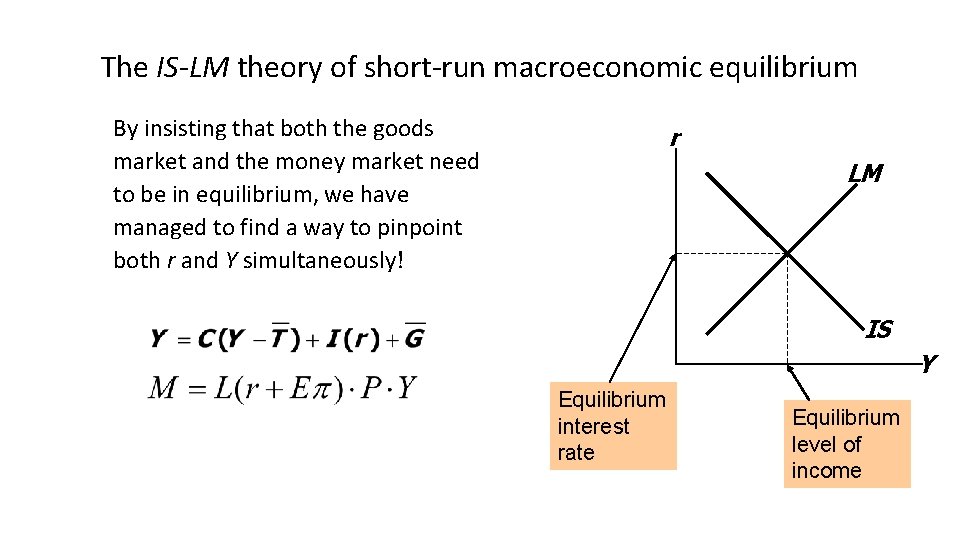
The IS-LM theory of short-run macroeconomic equilibrium By insisting that both the goods market and the money market need to be in equilibrium, we have managed to find a way to pinpoint both r and Y simultaneously! r LM IS Y Equilibrium interest rate Equilibrium level of income
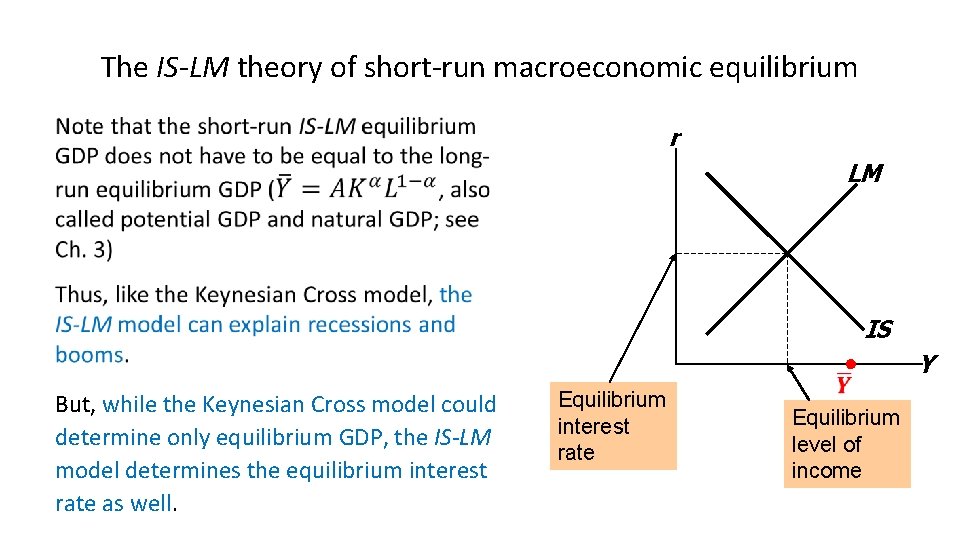
The IS-LM theory of short-run macroeconomic equilibrium • r LM IS But, while the Keynesian Cross model could determine only equilibrium GDP, the IS-LM model determines the equilibrium interest rate as well. Equilibrium interest rate Equilibrium level of income Y
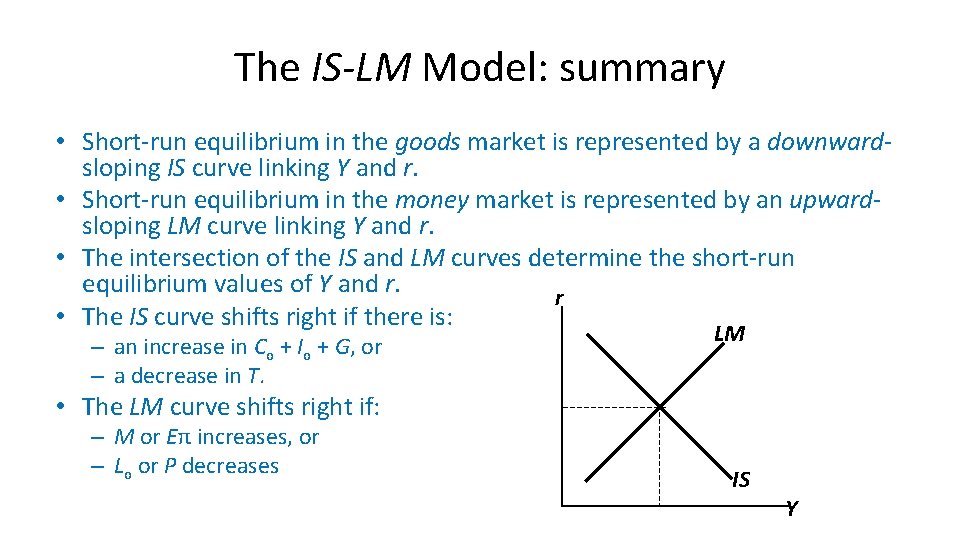
The IS-LM Model: summary • Short-run equilibrium in the goods market is represented by a downwardsloping IS curve linking Y and r. • Short-run equilibrium in the money market is represented by an upwardsloping LM curve linking Y and r. • The intersection of the IS and LM curves determine the short-run equilibrium values of Y and r. r • The IS curve shifts right if there is: – an increase in Co + Io + G, or – a decrease in T. LM • The LM curve shifts right if: – M or Eπ increases, or – Lo or P decreases IS Y
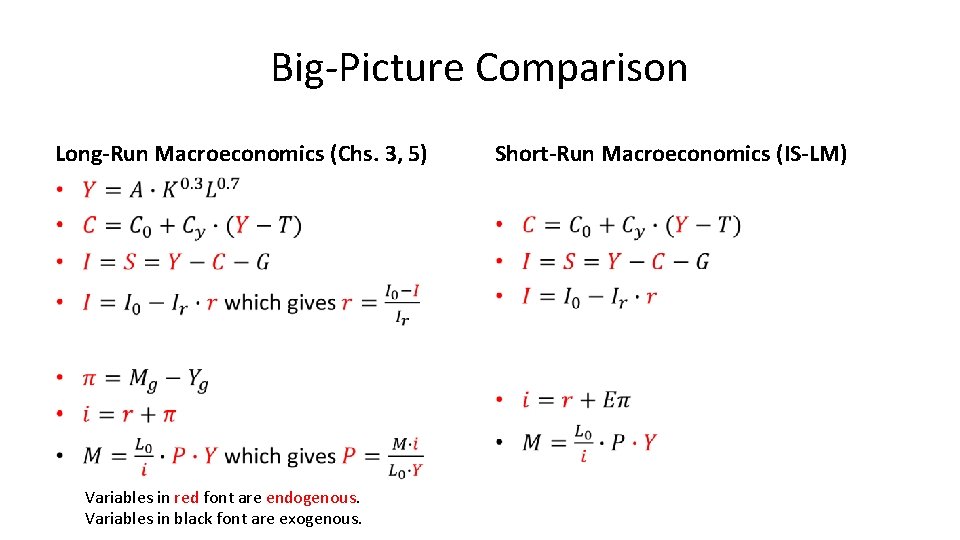
Big-Picture Comparison Long-Run Macroeconomics (Chs. 3, 5) Short-Run Macroeconomics (IS-LM) • • Variables in red font are endogenous. Variables in black font are exogenous.
Preview of Chapter 12 In Chapter 12, we will – use the IS-LM model to analyze the impact of policies and shocks. – use the IS-LM model to explain the Great Depression.
- Slides: 59