
Aggregate Demand Aggregate Supply Aggregate Demand Aggregate demand

- Slides: 27
Aggregate Demand Aggregate Supply
Aggregate Demand Aggregate demand (AD) refers to the total amount that different sectors in the economy spend in a given period.
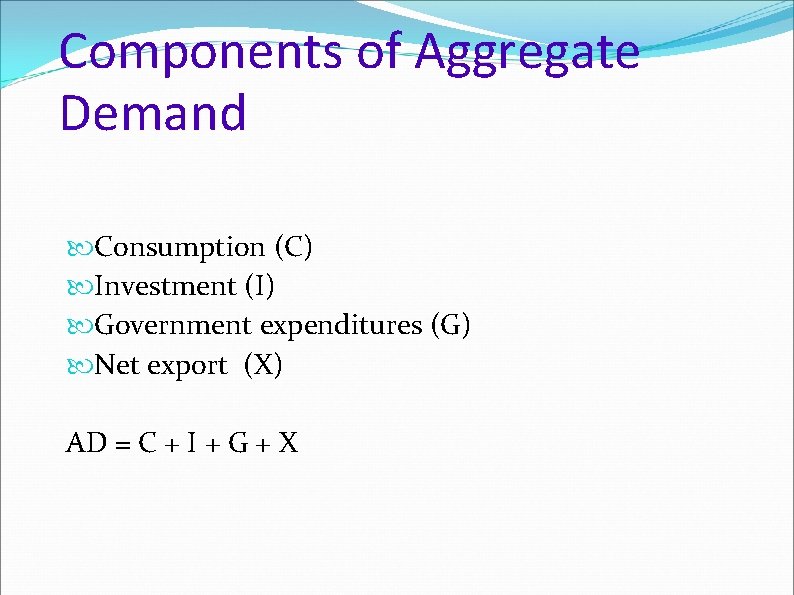
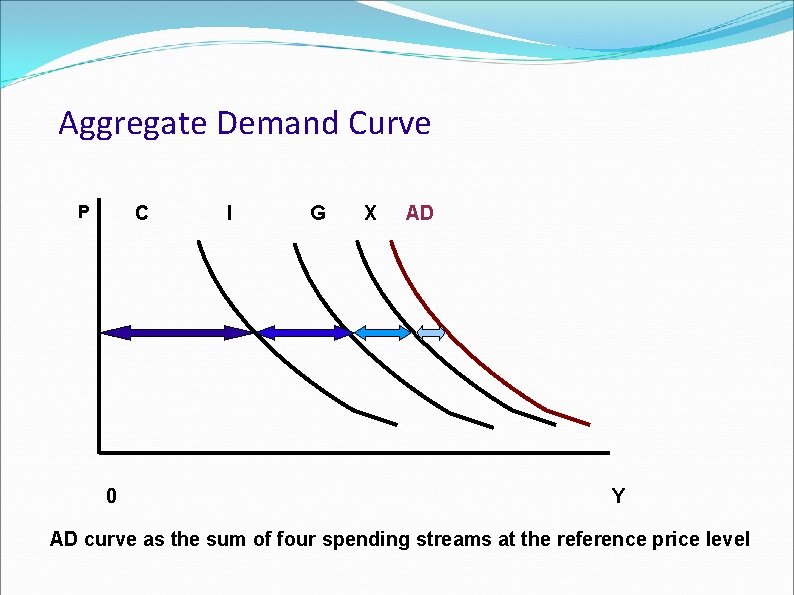
Components of Aggregate Demand Consumption (C) Investment (I) Government expenditures (G) Net export (X) AD = C + I + G + X
Consumption spending involves the purchases of consumers goods and services. It includes only those purchases that consumers make for their own personal use. Consumption is the largest component of AD.
Investment Gross private domestic investment consists of investment in capital, such as buildings and machinery. It also includes the value of any decrease or increase in inventories.
Government Expenditures Government spending represents the sums the government (this includes all levels of government) spends on goods and services.
Net exports are defined as difference between the value of exports and the value of imports.
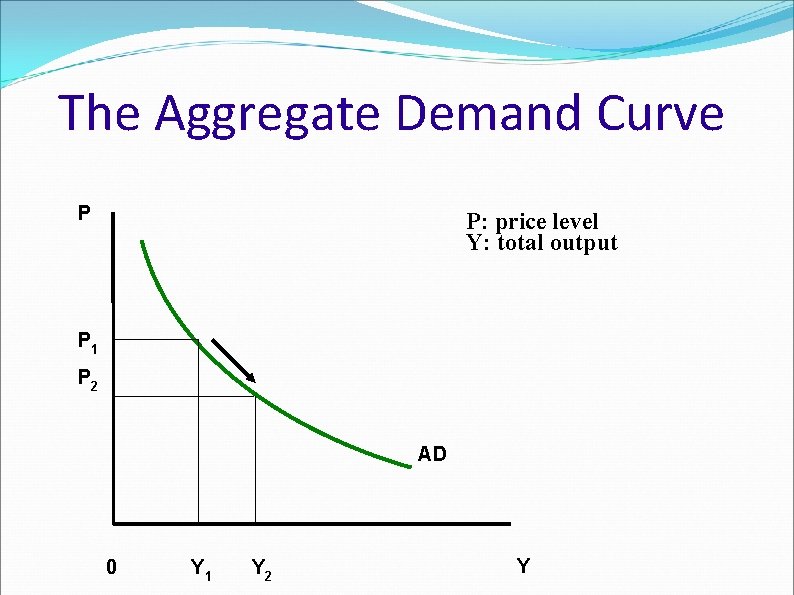
The Aggregate Demand Curve Aggregate demand curve is showing the relationship between the quantity of total spending and the aggregate price level, other things equal.
Aggregate Demand Curve C P 0 I G X AD Y AD curve as the sum of four spending streams at the reference price level
The Aggregate Demand Curve P P: price level Y: total output P 1 P 2 AD 0 Y 1 Y 2 Y
Aggregate Supply Aggregate supply (AS) refers to the total quantity of goods and services that the nation's businesses are willing to produce and sell in a given period of time at each level of price.
Determinants of Aggregate Supply The aggregate supply depends on: The price level that businesses can charge The productive capacity of the economy The level of costs
Aggregate Supply Curve Aggregate supply curve represents the quantity of goods and services that businesses are willing to produce and sell at each price level (with other determinants of aggregate supply held constant).
Aggregate Supply Curve Models The Classical Model The Keynesian Model The Neokeynesian Model
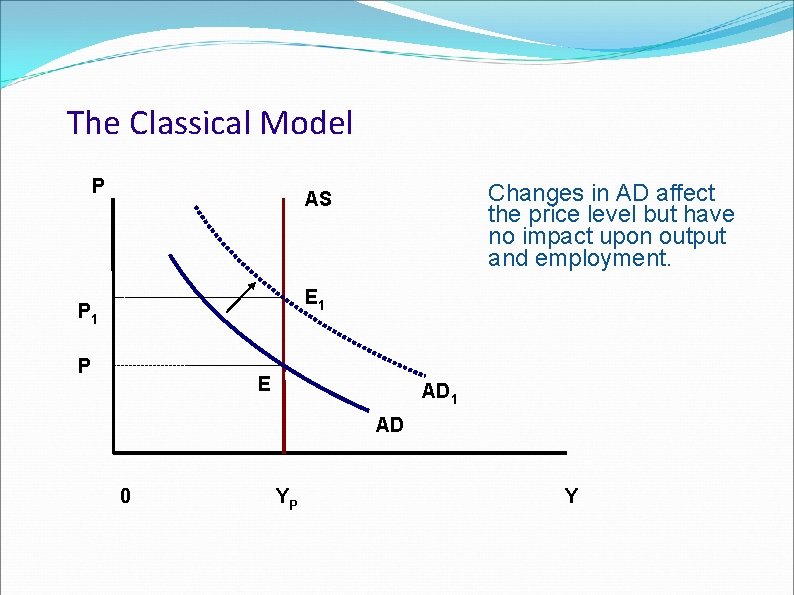
The Classical Model In the classical view, in the long-run, price and wage flexibility ensures that the real level of spending is sufficient to maintain full employment. The classical macroeconomists conclude that the economy always operates at full employment (natural rate of unemployment) or at its potential output.
The Classical Model P Changes in AD affect the price level but have no impact upon output and employment. AS E 1 P E AD 1 AD 0 YP Y
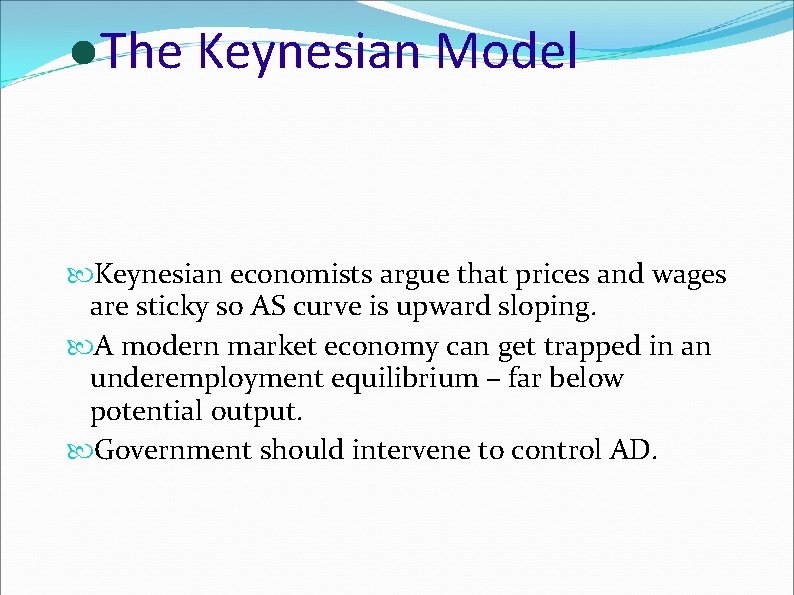
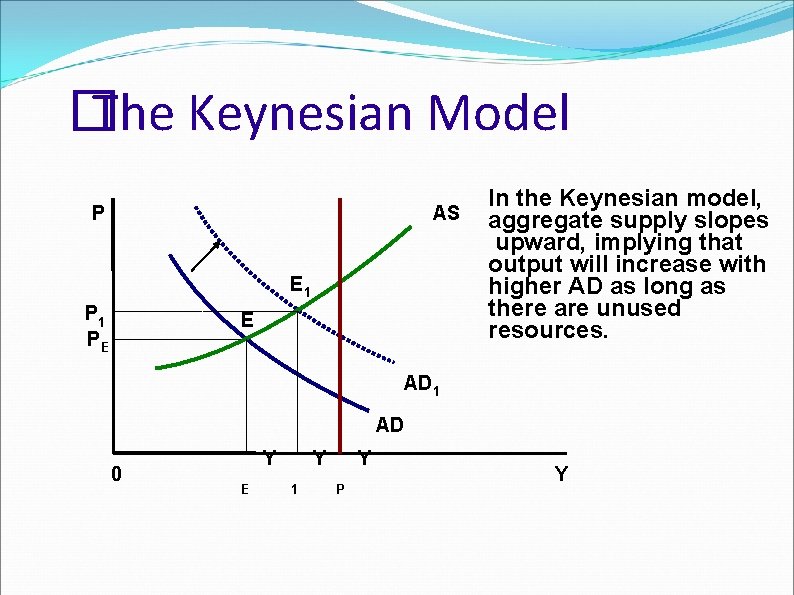
●The Keynesian Model Keynesian economists argue that prices and wages are sticky so AS curve is upward sloping. A modern market economy can get trapped in an underemployment equilibrium – far below potential output. Government should intervene to control AD.
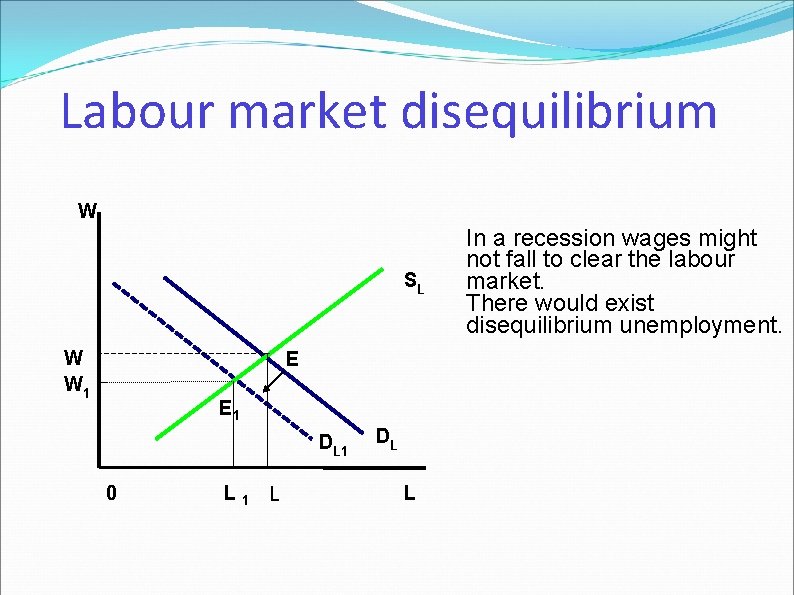
Labour market disequilibrium W SL W W 1 E E 1 DL 1 0 L 1 L DL L In a recession wages might not fall to clear the labour market. There would exist disequilibrium unemployment.
� The Keynesian Model P AS E 1 PE E In the Keynesian model, aggregate supply slopes upward, implying that output will increase with higher AD as long as there are unused resources. AD 1 AD 0 Y E Y 1 Y P Y
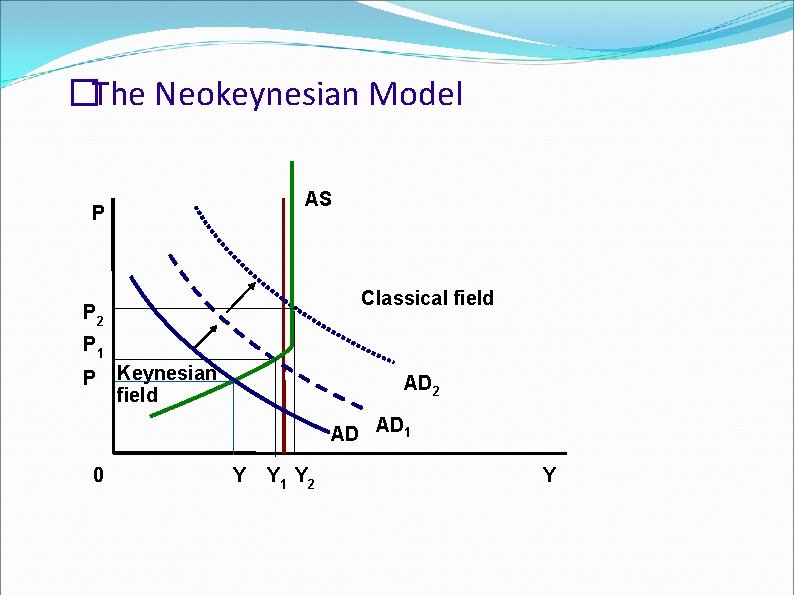
● The Neokeynesian Model In the short-run as long as there are unused resources AS curve is slightly upward sloping (Keynesian field). Many costs are inflexible in the short-run. In the long-run, prices and wages are flexible so AS curve is steep (vertical) line with output equal to potential output (Classical field).
�The Neokeynesian Model AS P Classical field P 2 P 1 P Keynesian field AD 2 AD AD 1 0 Y Y 1 Y 2 Y
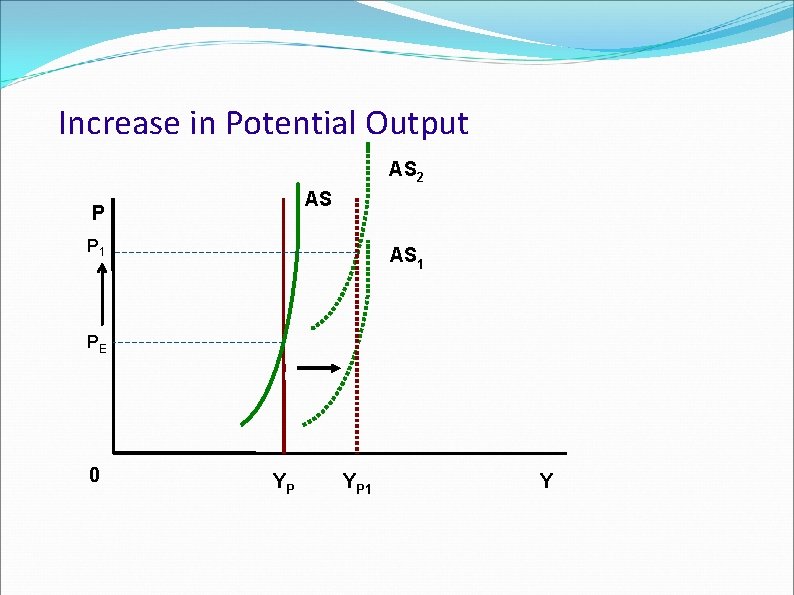
Increase in Potential Output Potential output is affected by level of efficiency and technologies used by businesses. Innovation and technological improvement increase level of potential output. An increase in potential output with no change in production costs would shift AS curve to AS 1. When production costs increase AS curve shifts upward to AS 2.
Increase in Potential Output AS 2 AS P P 1 AS 1 PE 0 YP YP 1 Y
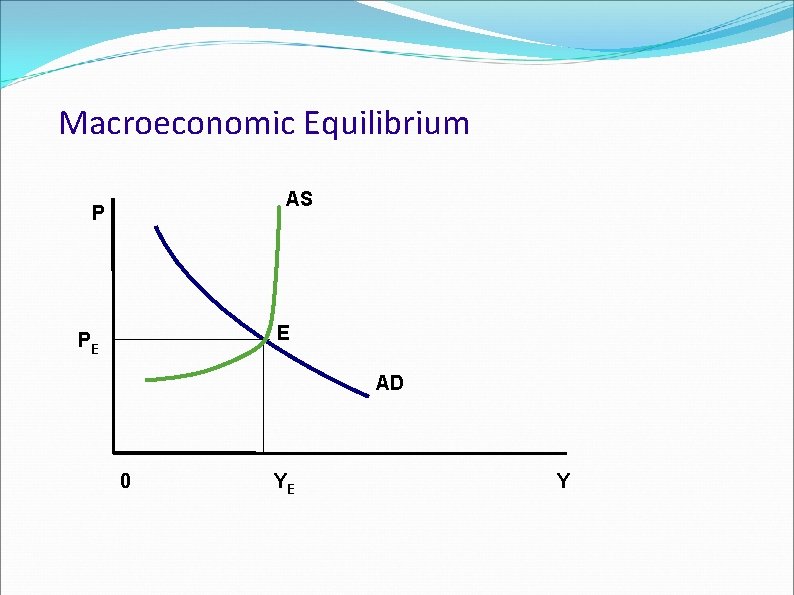
Macroeconomic Equilibrium Macroeconomic equilibrium occurs when the quantity of total output demanded equals the quantity of total output supplied. Macroeconomic equilibrium does not necessarily occur at full employment (potential output).
Macroeconomic Equilibrium AS P E PE AD 0 YE Y
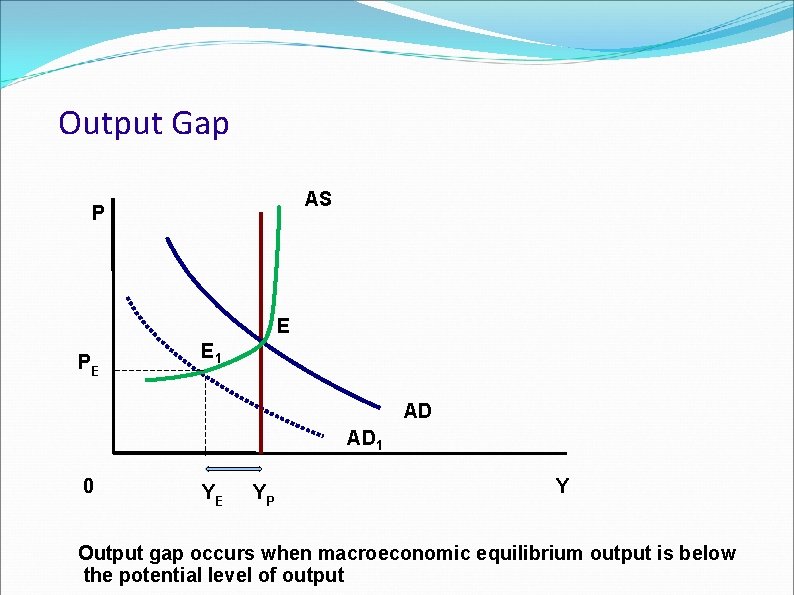
Output Gap AS P E PE E 1 AD AD 1 0 YE YP Y Output gap occurs when macroeconomic equilibrium output is below the potential level of output
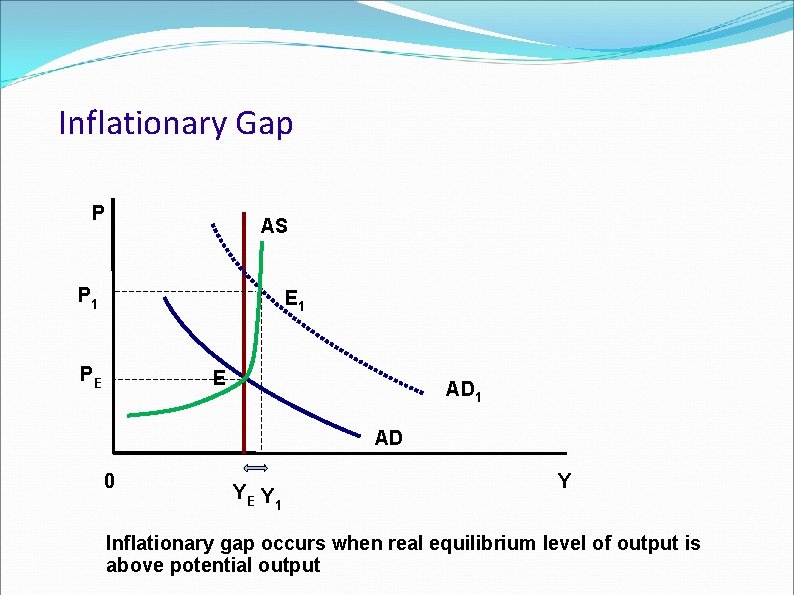
Inflationary Gap P AS P 1 E 1 PE E AD 1 AD 0 YE Y Y 1 Inflationary gap occurs when real equilibrium level of output is above potential output