
AGGREGATE Definition aggregate is a broad category of
AGGREGATE
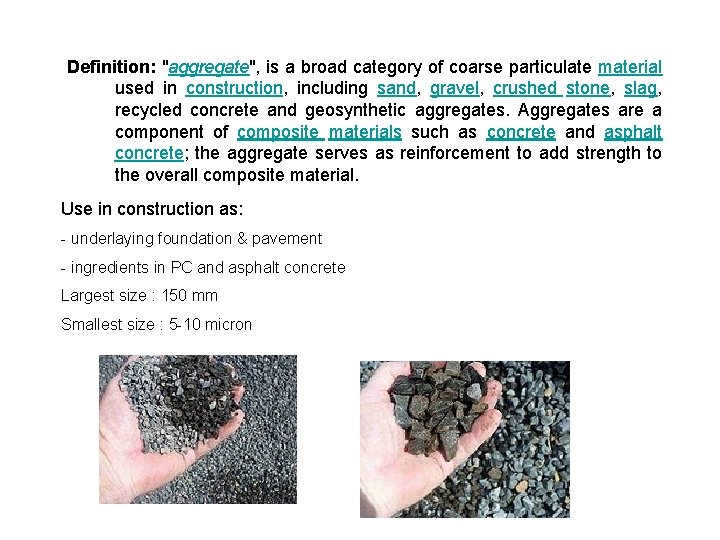
Definition: "aggregate", is a broad category of coarse particulate material used in construction, including sand, gravel, crushed stone, slag, recycled concrete and geosynthetic aggregates. Aggregates are a component of composite materials such as concrete and asphalt concrete; the aggregate serves as reinforcement to add strength to the overall composite material. Use in construction as: - underlaying foundation & pavement - ingredients in PC and asphalt concrete Largest size : 150 mm Smallest size : 5 -10 micron
Geological Classification Classify into 3 basic types: 1. Igneous: produced by volcanoc action, e. g. , hardening of molten material, magma 2. Sedimentary rocks, from deposit of disintegrated existing rock or inorganic remains of marine animal. 3. Metamorphic, from igneous and sedimentary rock that exposed to heat and pressure reforming the grain structure.
Evaluation of aggregate source Civil Engineers select the aggregate for their ability to meet specific project requirement rather than geological history The properties of the aggregate determine the acceptability of an aggregate used for construction. Cost/availability : how to use the locally available material in the most cost effective manner
Aggregate Properties 1. 2. 3. 4. 5. 6. 7. 8. 9. 10. Particle shape and surface texture Soundness and Durability Toughness, Hardness and Abrasion Resistance Absorption Specific Grafity Bulk Unit Weight and Voids in Aggregate Strength and Modulus Gradation and Maximum Size Deleterious Substance in Aggregate Alkali-Aggregate Reactivity
Particle shape and surface texture Particle Shape The shape of individual aggregate particle determines: how the material will pack into dense configuration The mobility of the stones within a mix Two consederations in the shape of the material: angularity and flakiness. Flakiness describe relationship between the smallest and largest dimensions of the aggregate.

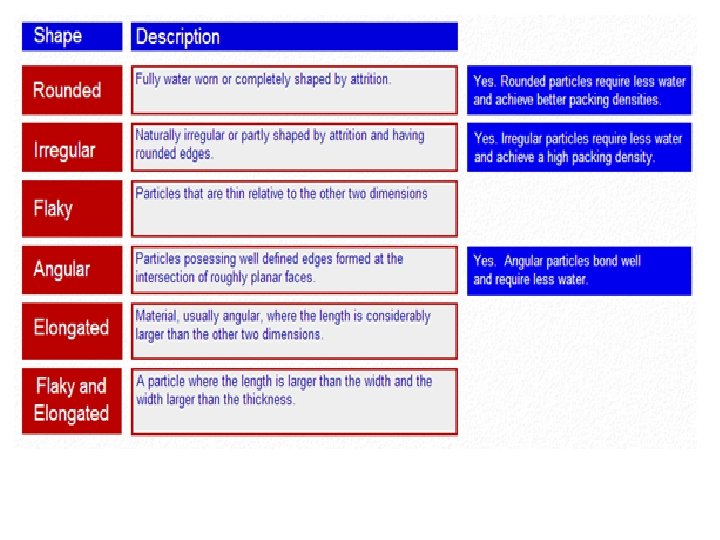
Crushing rock produces angular particle with sharp corner (a) Due to weathering, the corners break down subangular particle When the aggregate tumble while being transported in water the corner completly rounded (b) Angular aggregate produce the material with higher stability than rounded aggregate. However, the angular aggregate will be difficult to work, because their shape make it difficult for them to slide across each other Figure. . Particle shape: (a) angular; (b) rounded, (c) flaky, (d) elongated, (e) flaky and elongated
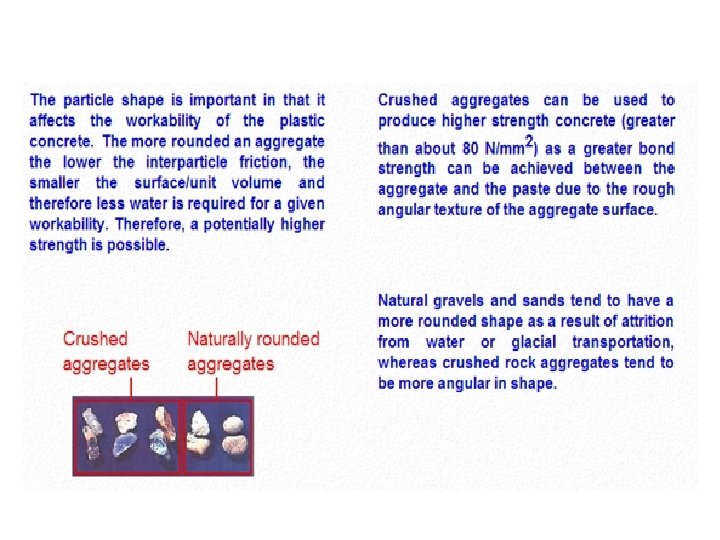
Surface texture • Rougness is important role in the way the aggregate compact and bond with the binder material. – Rough texture improves bonding and increase interparticle friction. – But, aggregate with rough texture are more difficult to compact into dense configuration than smooth aggregate – Smooth texture: natural gravel, sand – Rough texture: crushed aggregate
Surface texture (con’t) • Round and smooth aggregate are desirable to improve the workability of fresh concrete during mixing PC concrete. • Angular and rough particles are desirable for asphalt and base courses (pavement) in order to increase the stability. • Flaky and elongated aggregate are undesirable, since they are difficult to compact during construction and are easy to break
SOUNDNESS (DURABILITY) • Soundness (durability) is defined as the ability of aggregate to withstand weathering
Toughness/abrasion resistance is defined as the ability of aggregate to resist the damaged effect of load. • It is related to the hardeness of the aggregate particle. • To evaluate the aggregate’s toughness and abrasion resistance • Los Angeles abrasion Test:
Absorption Aggregate can capture water in surface voids. The amount of water the aggregate absorb is important in the design of PC concrete. Moisture captured in the aggregate voids is not available to improve the workability of the plastic concrete and to react with the cement. Aggregate absorption must be evaluated to determine the appropriate amount of water to mix into the concrete.
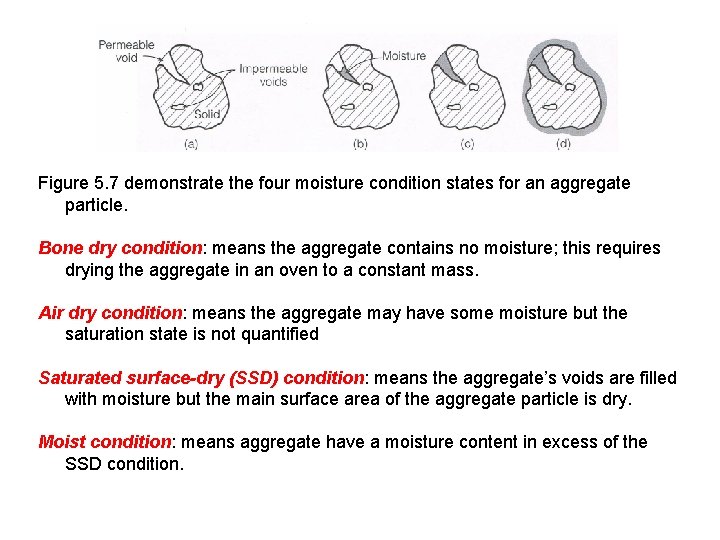
Figure 5. 7 demonstrate the four moisture condition states for an aggregate particle. Bone dry condition: means the aggregate contains no moisture; this requires drying the aggregate in an oven to a constant mass. Air dry condition: means the aggregate may have some moisture but the saturation state is not quantified Saturated surface-dry (SSD) condition: means the aggregate’s voids are filled with moisture but the main surface area of the aggregate particle is dry. Moist condition: means aggregate have a moisture content in excess of the SSD condition.
Absorption is defined as the moisture content in the SSD condition Free moisture is the difference between the actual moisture content of the aggregate and the moisture content in the SSD condition (absorption) Example: A sample of sand has the following properties: Wet mass = 625. 2 g Dry mass = 589. 9 g Absorption = 1. 6% Determine: (a) total moisture content, (b) free moisture content Solution a. Mass of water = 625. 2 – 589. 9 = 35. 3 g Total moisture content = 35. 3/589. 0 x 100 = 6. 0% b. Free moisture = 6. 0% – 1. 6% = 4. 4%
5. 5. 5 Specific Gravity Specific gravity (Sp. Gr. ), the mass of a material divided by the mass of an equal volume of distilled water. Specific grafity is the ratio of the density (mass of a unit volume) of a substance to the density of a given reference material (usually relative density with respect to water). Four types of specific gravity are defined based on how voids in the aggregate particles are considered, there are: 1. Bulk-dry Sp. Gr. 2. Bulk-saturated surface-dry Sp. Gr. 3. Apparent Sp. Gr.
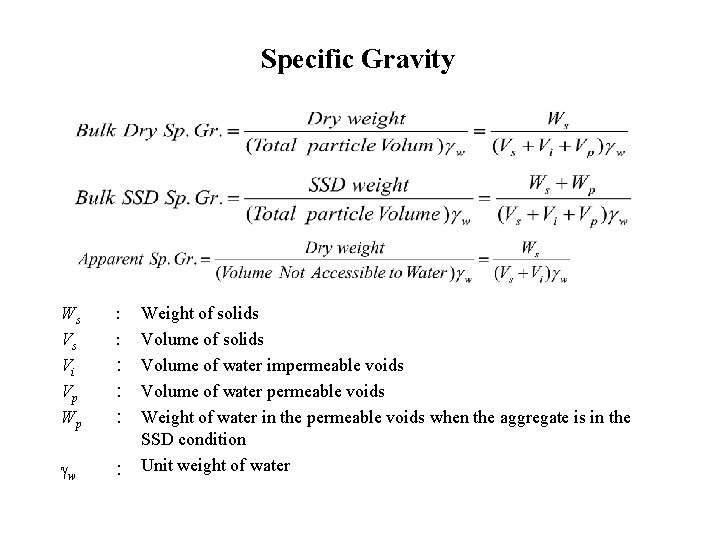
Specific Gravity Ws Vs Vi Vp Wp : : : gw : Weight of solids Volume of water impermeable voids Volume of water permeable voids Weight of water in the permeable voids when the aggregate is in the SSD condition Unit weight of water
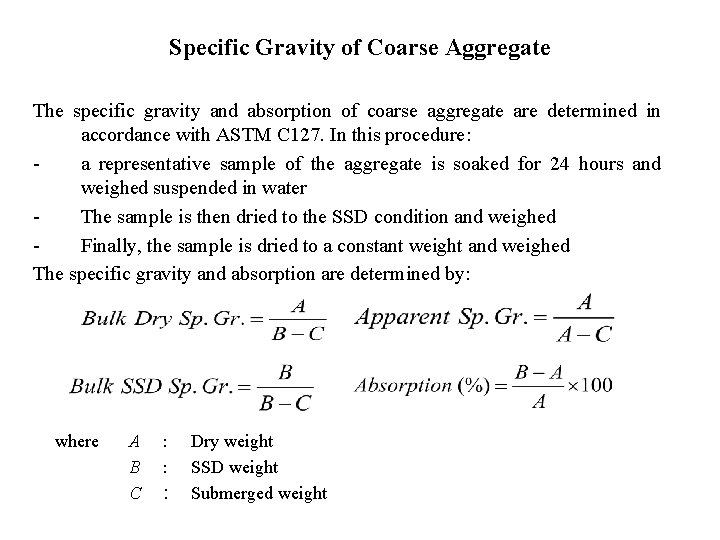
Specific Gravity of Coarse Aggregate The specific gravity and absorption of coarse aggregate are determined in accordance with ASTM C 127. In this procedure: a representative sample of the aggregate is soaked for 24 hours and weighed suspended in water The sample is then dried to the SSD condition and weighed Finally, the sample is dried to a constant weight and weighed The specific gravity and absorption are determined by: where A B C : : : Dry weight SSD weight Submerged weight
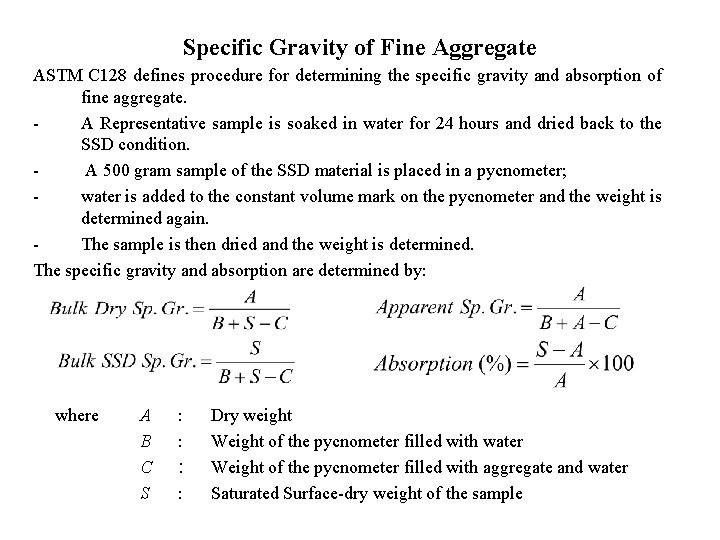
Specific Gravity of Fine Aggregate ASTM C 128 defines procedure for determining the specific gravity and absorption of fine aggregate. A Representative sample is soaked in water for 24 hours and dried back to the SSD condition. A 500 gram sample of the SSD material is placed in a pycnometer; water is added to the constant volume mark on the pycnometer and the weight is determined again. The sample is then dried and the weight is determined. The specific gravity and absorption are determined by: where A B C S : : Dry weight Weight of the pycnometer filled with water Weight of the pycnometer filled with aggregate and water Saturated Surface-dry weight of the sample
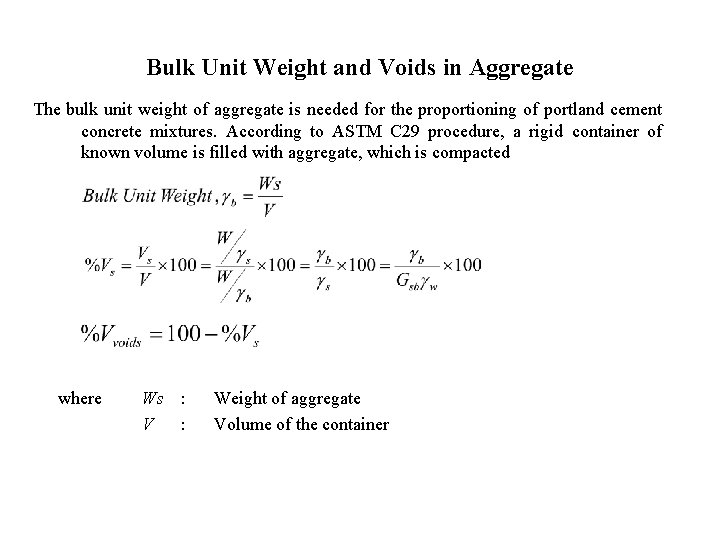
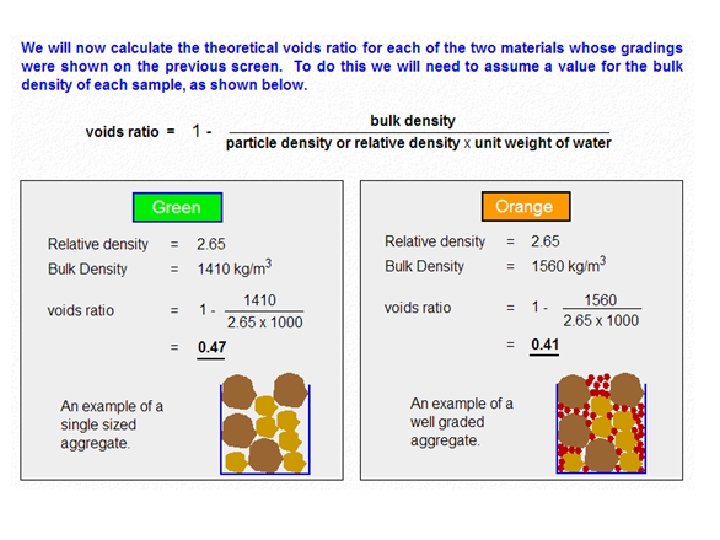
Bulk Unit Weight and Voids in Aggregate The bulk unit weight of aggregate is needed for the proportioning of portland cement concrete mixtures. According to ASTM C 29 procedure, a rigid container of known volume is filled with aggregate, which is compacted where Ws : V : Weight of aggregate Volume of the container
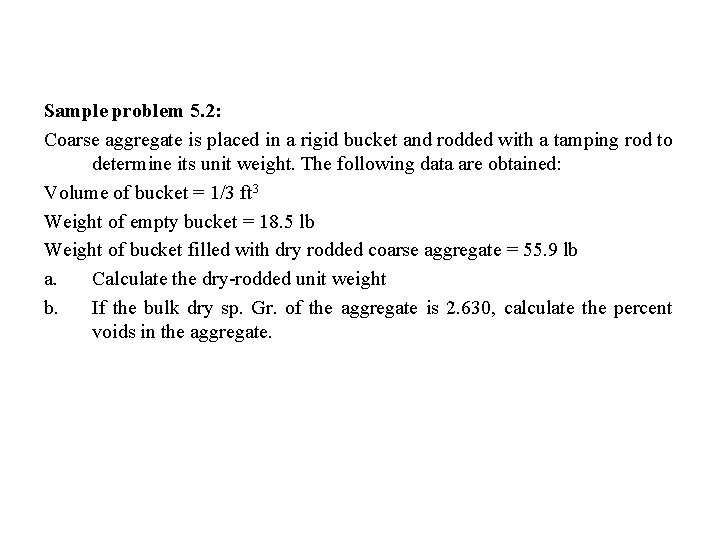
Sample problem 5. 2: Coarse aggregate is placed in a rigid bucket and rodded with a tamping rod to determine its unit weight. The following data are obtained: Volume of bucket = 1/3 ft 3 Weight of empty bucket = 18. 5 lb Weight of bucket filled with dry rodded coarse aggregate = 55. 9 lb a. Calculate the dry-rodded unit weight b. If the bulk dry sp. Gr. of the aggregate is 2. 630, calculate the percent voids in the aggregate.
- Slides: 23