
Ages of History The history of technology n



- Slides: 11
Ages of History The history of technology
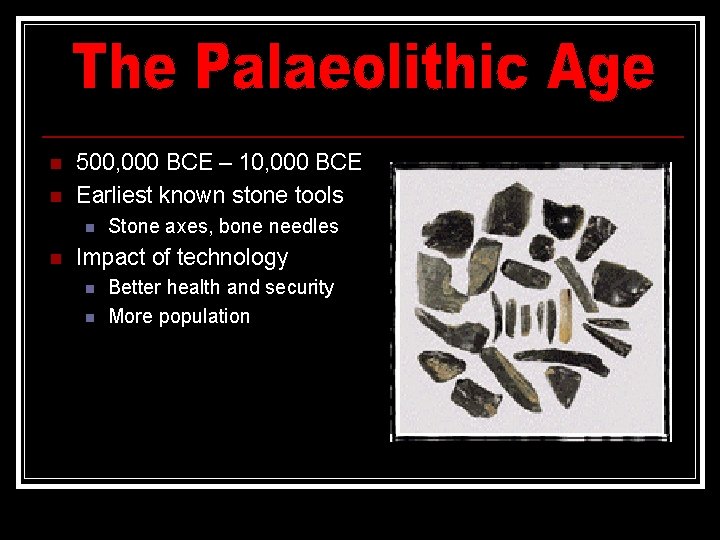
n n 500, 000 BCE – 10, 000 BCE Earliest known stone tools n n Stone axes, bone needles Impact of technology n n Better health and security More population
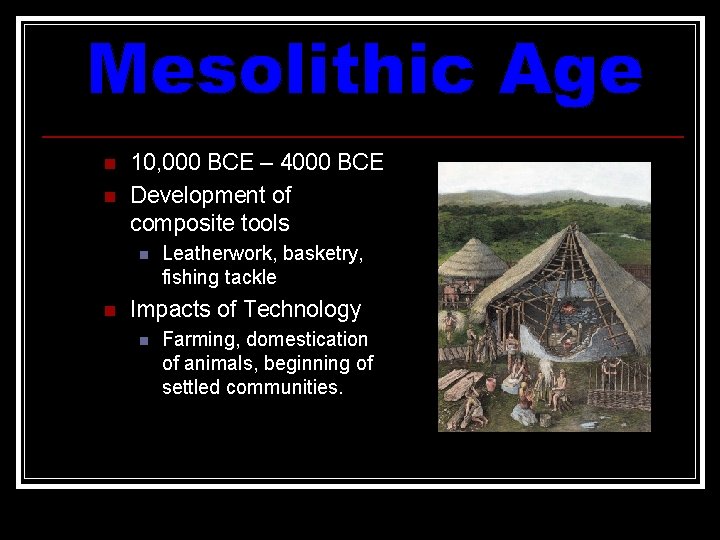
n n 10, 000 BCE – 4000 BCE Development of composite tools n n Leatherwork, basketry, fishing tackle Impacts of Technology n Farming, domestication of animals, beginning of settled communities.
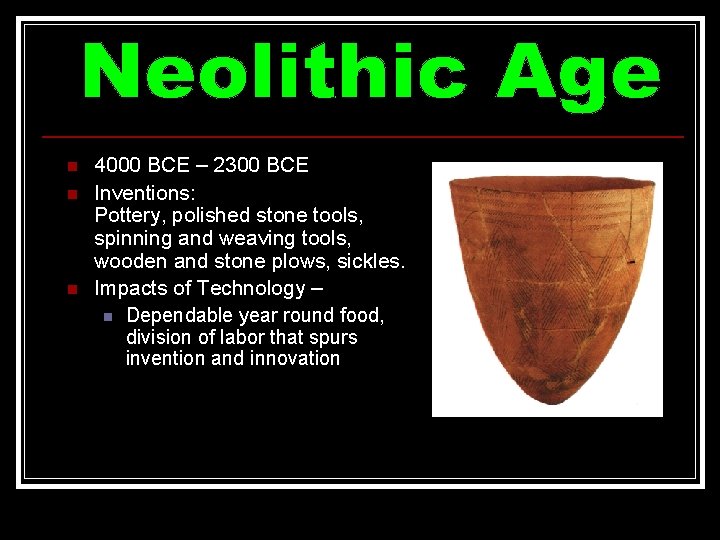
n n n 4000 BCE – 2300 BCE Inventions: Pottery, polished stone tools, spinning and weaving tools, wooden and stone plows, sickles. Impacts of Technology – n Dependable year round food, division of labor that spurs invention and innovation
n n n 2300 BCE – 700 BCE Earliest civilizations - the development of metallurgy, mainly the combining of copper and tin to make bronze. Creating bronze jewelry, tools, and weapons. Impact of Technology - Stone tools were gradually replaced by metal ones. Enabled humans to alter their environment at a great rate
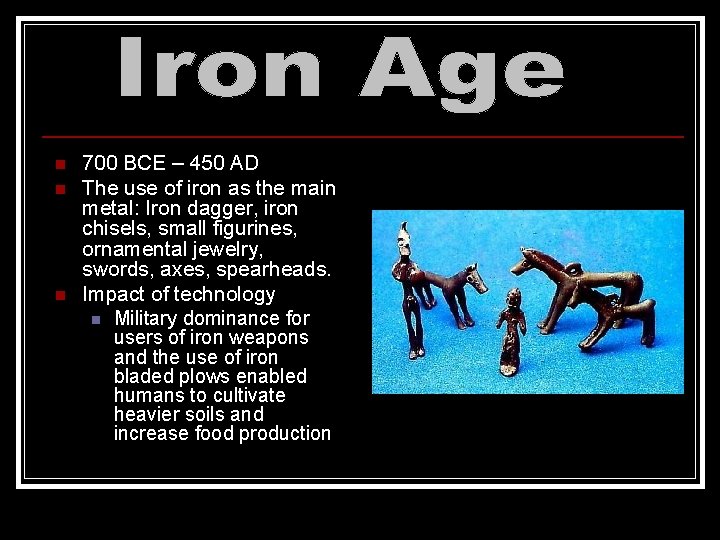
n n n 700 BCE – 450 AD The use of iron as the main metal: Iron dagger, iron chisels, small figurines, ornamental jewelry, swords, axes, spearheads. Impact of technology n Military dominance for users of iron weapons and the use of iron bladed plows enabled humans to cultivate heavier soils and increase food production
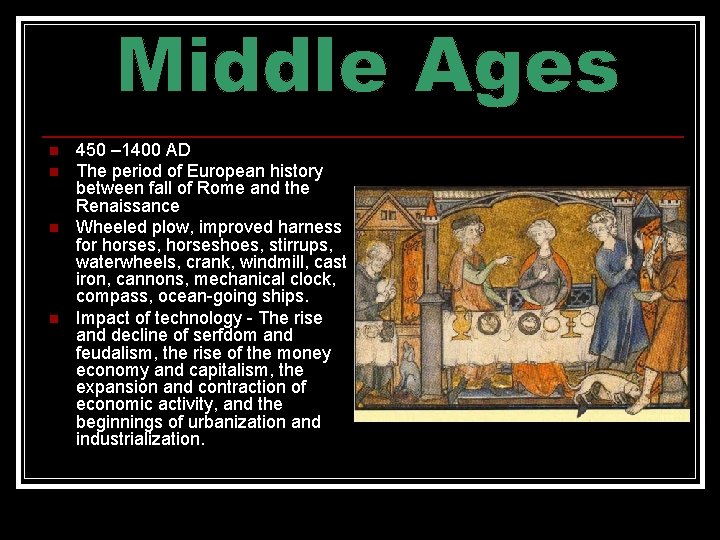
n n 450 – 1400 AD The period of European history between fall of Rome and the Renaissance Wheeled plow, improved harness for horses, horseshoes, stirrups, waterwheels, crank, windmill, cast iron, cannons, mechanical clock, compass, ocean-going ships. Impact of technology - The rise and decline of serfdom and feudalism, the rise of the money economy and capitalism, the expansion and contraction of economic activity, and the beginnings of urbanization and industrialization.
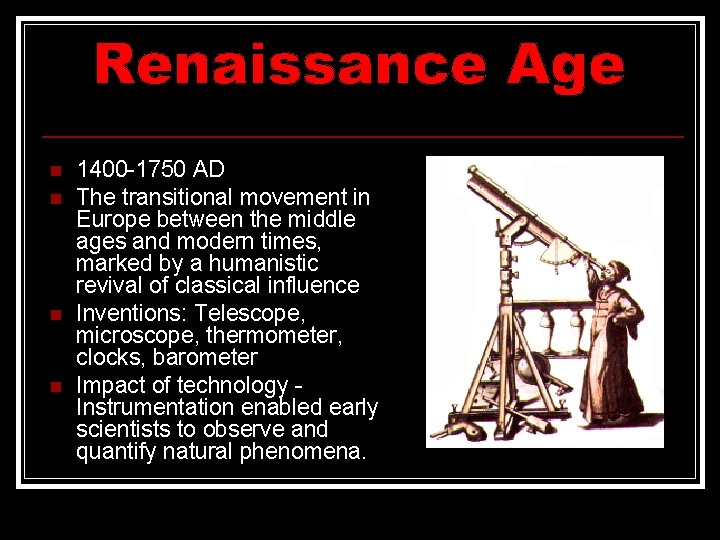
n n 1400 -1750 AD The transitional movement in Europe between the middle ages and modern times, marked by a humanistic revival of classical influence Inventions: Telescope, microscope, thermometer, clocks, barometer Impact of technology Instrumentation enabled early scientists to observe and quantify natural phenomena.
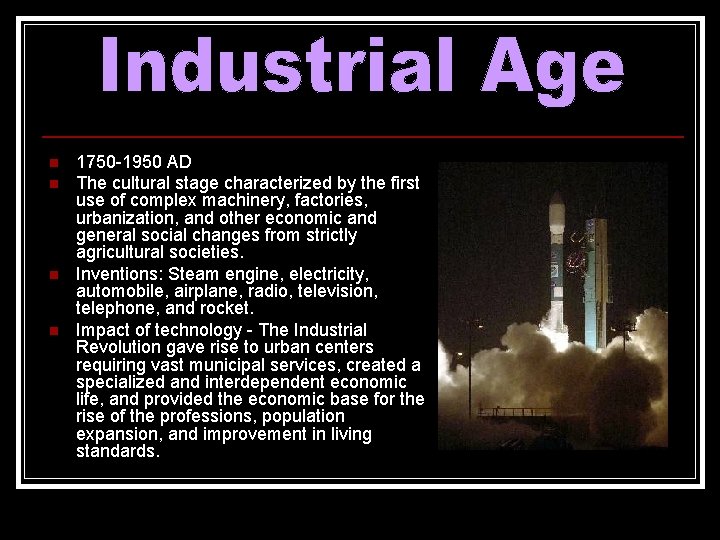
n n 1750 -1950 AD The cultural stage characterized by the first use of complex machinery, factories, urbanization, and other economic and general social changes from strictly agricultural societies. Inventions: Steam engine, electricity, automobile, airplane, radio, television, telephone, and rocket. Impact of technology - The Industrial Revolution gave rise to urban centers requiring vast municipal services, created a specialized and interdependent economic life, and provided the economic base for the rise of the professions, population expansion, and improvement in living standards.
n n 1950 AD–Present Starting in the 1950 s and continuing today in which the gathering, manipulation, classification, storage, and retrieval of information is central to the workings of society. Inventions: Transistor, integrated circuit, computer, communication satellite, digital photography, artificial heart, nuclear power plant, space shuttle. Impact of technology - As information becomes more widely available, increasing numbers of individuals and organizations will be in a better position to make decisions that “experts” now make, decentralizing decision making and empowering more people.
Examine the following graph. How has the nature of work changed over time?