
Agents with Beliefs Desires Intentions Andre Vellino Cognitive
Agents with Beliefs Desires & Intentions Andre Vellino Cognitive Sciences Carleton University
Overview • Motivation for BDI • Logical models for BDI • BDI Agent Implementations 6/19/2021 2
Folk Psychology of BDI • Actions, choices and decisions in human beings can be “explained” in folk psychology with BDI – i. e. They are made based on a mental representation of the world (beliefs) and goals to be achieved (desires) and rational deliberations and commitments for achieving them (intentions) 6/19/2021 3
Desiderata for Communicating Distributed Agents • Make autonomous decisions; • React to a changing environment; • Collaborate with other agents towards a common goal; • Reason about (problem solve) attaining its own and other Agents’ objectives; • Act rationally; • Account for choices and actions. 6/19/2021 4
BDI Model for Agents: Assumptions • There exists a “mental representation language” which can express BDIs and the way the world is; • The means for achieving goals (actions, behaviours) can be deduced from a logic and an ATP; • BDI agent architectures can best meet desiderata of distributed, collaborative multiagents; 6/19/2021 5
The Planning Problem Given Initial conditions (I) – Goal (G) – Find – Sequences of intermediate states (S) to achieve (G) i. e. design a theorem prover for deducing (G) from (I). The proof is (S) In this model Computation is Deduction Knowledge + Question = Answer 6/19/2021 6
Some Properties of BDI Model • Intentions (Plans of Action) must be believed to be achievable, given what the agent knows • Intentions and Beliefs must be compatible with actions (more later …. ) 6/19/2021 7
Expressing & Reasoning w/ BDIs • Logic for changing beliefs and plans (Temporal and Modal Logic) – Agents need to reason about its own and other agents BDIs (Modal Logic) and do so over time (Temporal Logic). • Decision procedure – 6/19/2021 Needs to be effective and resourcebounded 8
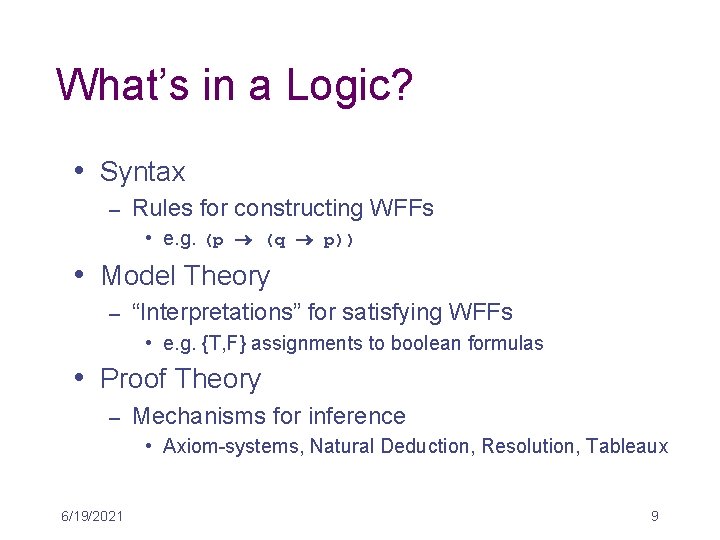
What’s in a Logic? • Syntax – Rules for constructing WFFs • e. g. (p ® (q ® p)) • Model Theory – “Interpretations” for satisfying WFFs • e. g. {T, F} assignments to boolean formulas • Proof Theory – Mechanisms for inference • Axiom-systems, Natural Deduction, Resolution, Tableaux 6/19/2021 9
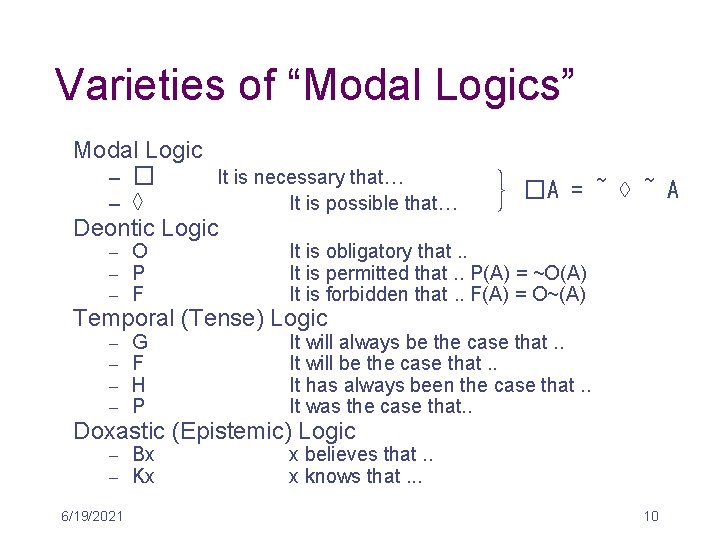
Varieties of “Modal Logics” Modal Logic – � It is necessary that… – ◊ It is possible that… Deontic Logic – – – �A = ~ ◊ ~ A O P F It is obligatory that. . It is permitted that. . P(A) = ~O(A) It is forbidden that. . F(A) = O~(A) G F H P It will always be the case that. . It will be the case that. . It has always been the case that. . It was the case that. . Bx Kx x believes that. . x knows that. . . Temporal (Tense) Logic – – Doxastic (Epistemic) Logic – – 6/19/2021 10
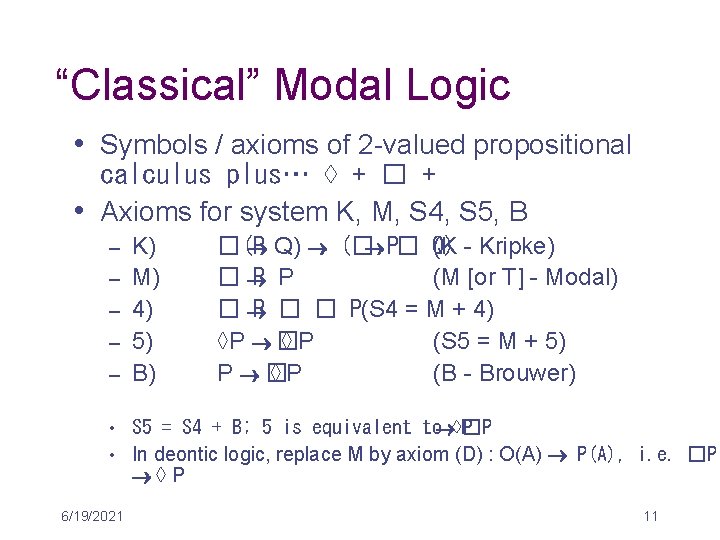
“Classical” Modal Logic • Symbols / axioms of 2 -valued propositional calculus plus… ◊ + � + • Axioms for system K, M, S 4, S 5, B – – – K) M) 4) 5) B) �(P ® Q) ® (� ® P� Q) (K - Kripke) �® P P (M [or T] - Modal) �® P � � P(S 4 = M + 4) ◊P ® � ◊ P (S 5 = M + 5) P ® � ◊ P (B - Brouwer) S 5 = S 4 + B; 5 is equivalent to® P ◊�P • In deontic logic, replace M by axiom (D) : O(A) ® P(A), i. e. �P ® ◊ P • 6/19/2021 11
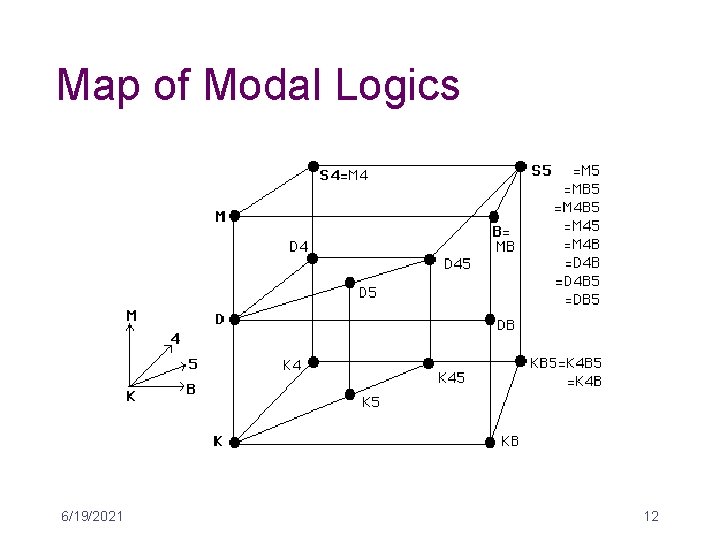
Map of Modal Logics 6/19/2021 12
Questions • Can you interpret � as “it ought to be”? • If you interpret � as “knows” do you think true that �P P ® Q �P or even �®P � � P? • Exercise: devise a logic for modal operator: Y 6/19/2021 13
George Dubya Bush - Modal Logician 4) �®P � � P “I know what I believe. I will continue to articulate what I believe and what I believe - I believe what I believe is right” G. W. Bush, Rome, July 22, 2001 6/19/2021 14
“Possible World” Semantics for Modal Logic A sentence A is true in a possible world in a model M = <W, P> M |= A Where P = {P 1, P 2, …Pn} is a sequence of subsets of possible worlds in W such that the P 1 is the set of worlds at which the atomic formula P 1 is true, P 2 is the set of worlds at which the atomic formula P 2 is true, etc… 6/19/2021 15
Some Of The Truth Conditions M |= Pn iff Pn M M M |= A & B iff |= A and |= B …. . |= �iff. Afor every M |= A M M M ◊ A iff for some M |= M A |= 6/19/2021 16
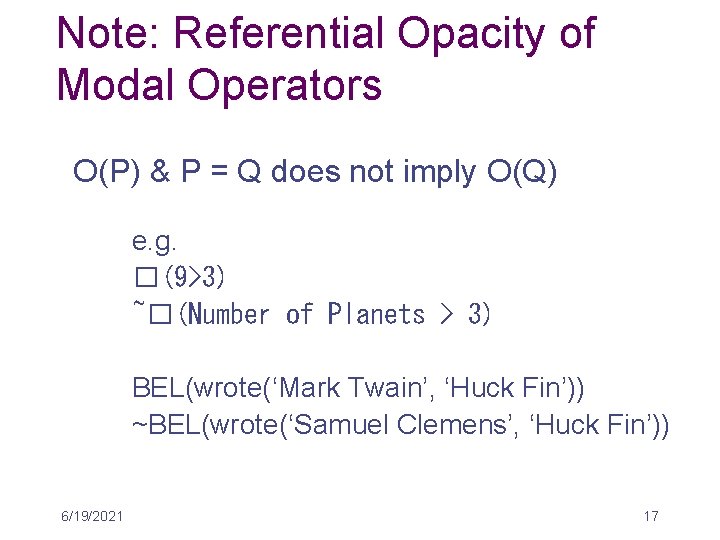
Note: Referential Opacity of Modal Operators O(P) & P = Q does not imply O(Q) e. g. �(9>3) ~�(Number of Planets > 3) BEL(wrote(‘Mark Twain’, ‘Huck Fin’)) ~BEL(wrote(‘Samuel Clemens’, ‘Huck Fin’)) 6/19/2021 17
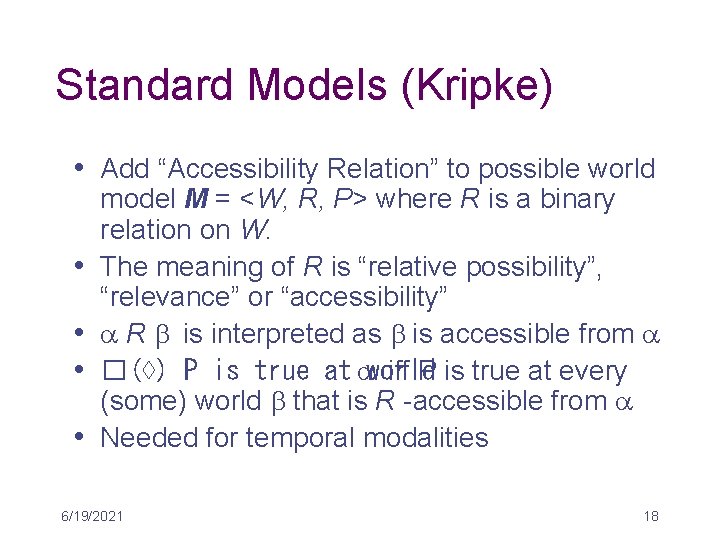
Standard Models (Kripke) • Add “Accessibility Relation” to possible world • • model M = <W, R, P> where R is a binary relation on W. The meaning of R is “relative possibility”, “relevance” or “accessibility” R b is interpreted as b is accessible from �(◊) P is true at iff world P is true at every (some) world b that is R -accessible from Needed for temporal modalities 6/19/2021 18
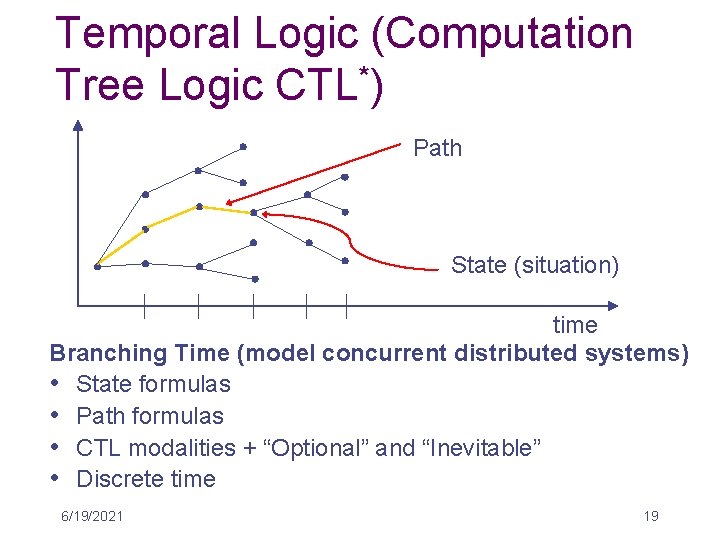
Temporal Logic (Computation * Tree Logic CTL ) Path State (situation) time Branching Time (model concurrent distributed systems) • State formulas • Path formulas • CTL modalities + “Optional” and “Inevitable” • Discrete time 6/19/2021 19
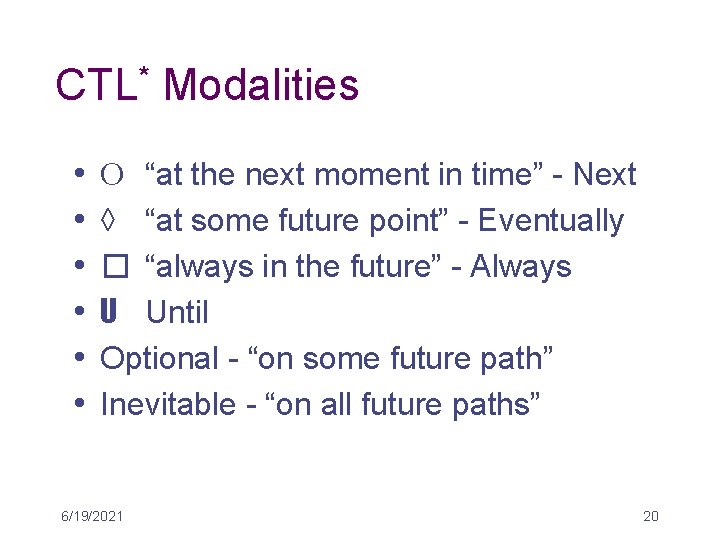
* CTL • • • Modalities O “at the next moment in time” - Next ◊ “at some future point” - Eventually � “always in the future” - Always U Until Optional - “on some future path” Inevitable - “on all future paths” 6/19/2021 20
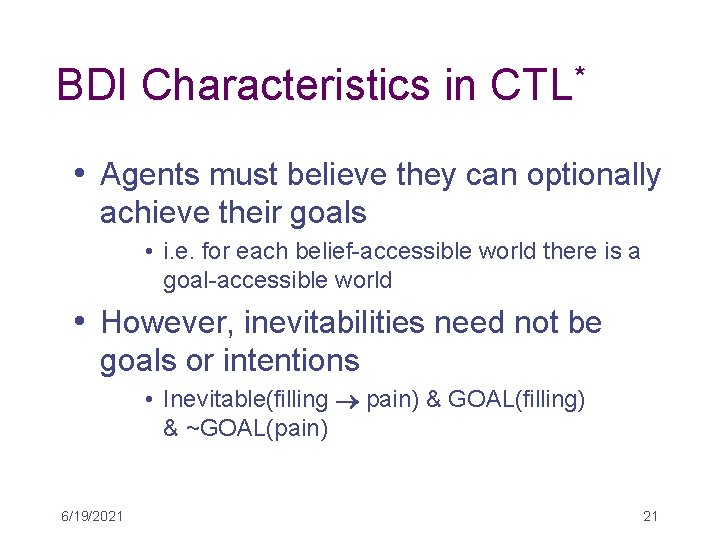
BDI Characteristics in * CTL • Agents must believe they can optionally achieve their goals • i. e. for each belief-accessible world there is a goal-accessible world • However, inevitabilities need not be goals or intentions • Inevitable(filling ® pain) & GOAL(filling) & ~GOAL(pain) 6/19/2021 21
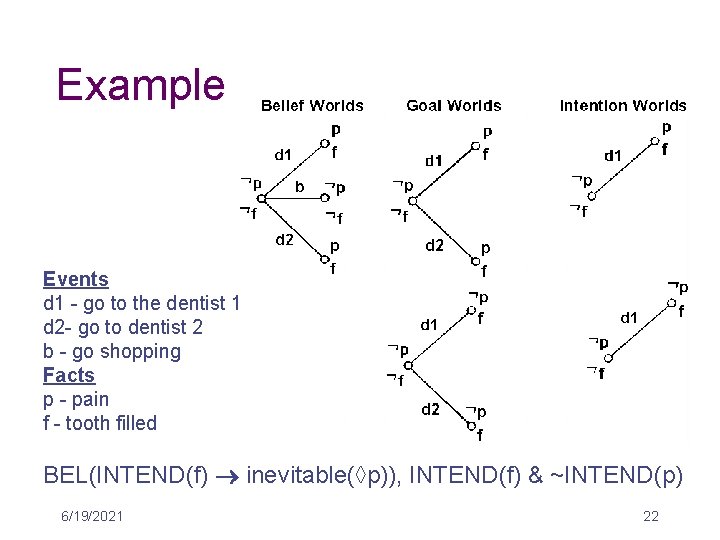
Example Events d 1 - go to the dentist 1 d 2 - go to dentist 2 b - go shopping Facts p - pain f - tooth filled BEL(INTEND(f) ® inevitable(◊p)), INTEND(f) & ~INTEND(p) 6/19/2021 22
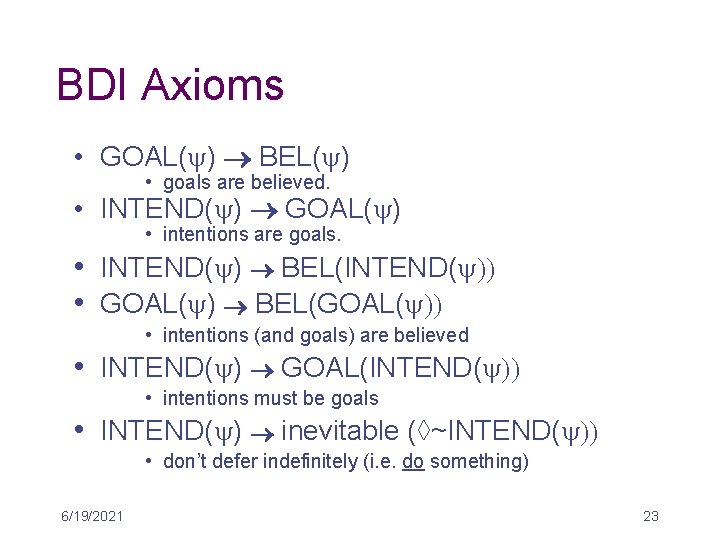
BDI Axioms • GOAL(y) ® BEL(y) • goals are believed. • INTEND(y) ® GOAL(y) • intentions are goals. • INTEND(y) ® BEL(INTEND(y • GOAL(y) ® BEL(GOAL(y • intentions (and goals) are believed • INTEND(y) ® GOAL(INTEND(y • intentions must be goals • INTEND(y) ® inevitable (◊~INTEND(y • don’t defer indefinitely (i. e. do something) 6/19/2021 23
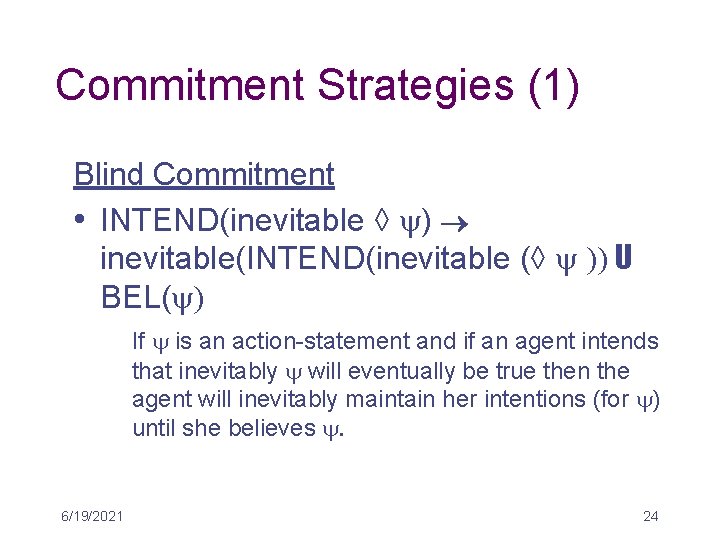
Commitment Strategies (1) Blind Commitment • INTEND(inevitable ◊ y) ® inevitable(INTEND(inevitable (◊ y U BEL(y If y is an action-statement and if an agent intends that inevitably y will eventually be true then the agent will inevitably maintain her intentions (for y) until she believes y. 6/19/2021 24
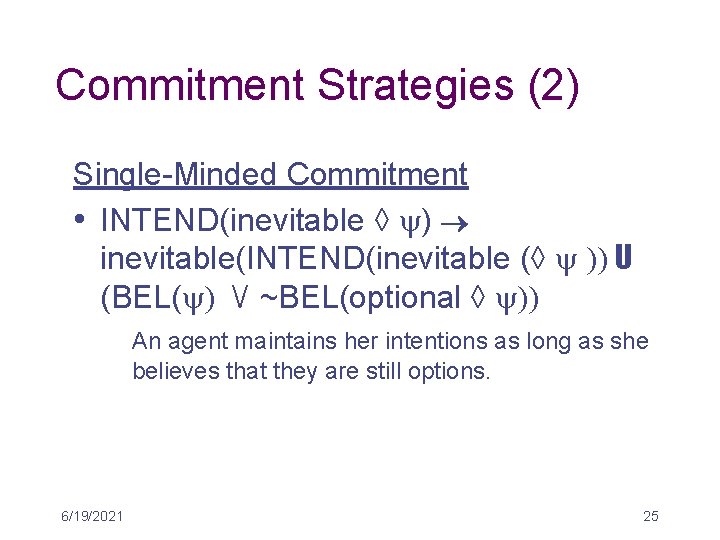
Commitment Strategies (2) Single-Minded Commitment • INTEND(inevitable ◊ y) ® inevitable(INTEND(inevitable (◊ y U (BEL(y / ~BEL(optional ◊ y An agent maintains her intentions as long as she believes that they are still options. 6/19/2021 25
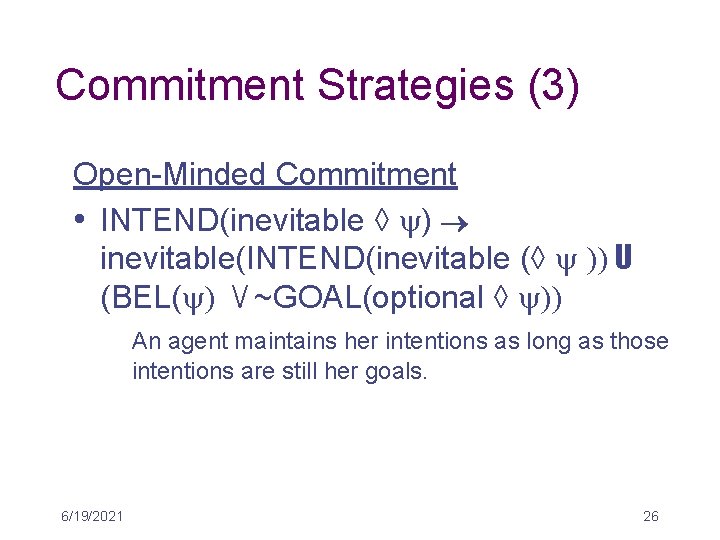
Commitment Strategies (3) Open-Minded Commitment • INTEND(inevitable ◊ y) ® inevitable(INTEND(inevitable (◊ y U (BEL(y / ~GOAL(optional ◊ y An agent maintains her intentions as long as those intentions are still her goals. 6/19/2021 26
Y Exercise: Express wedding vows as a commitment strategy in a BDI logic! 6/19/2021 27
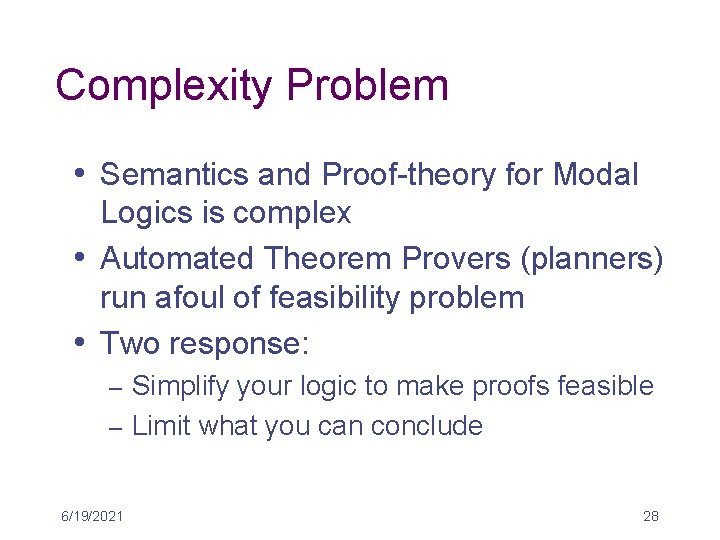
Complexity Problem • Semantics and Proof-theory for Modal Logics is complex • Automated Theorem Provers (planners) run afoul of feasibility problem • Two response: Simplify your logic to make proofs feasible – Limit what you can conclude – 6/19/2021 28
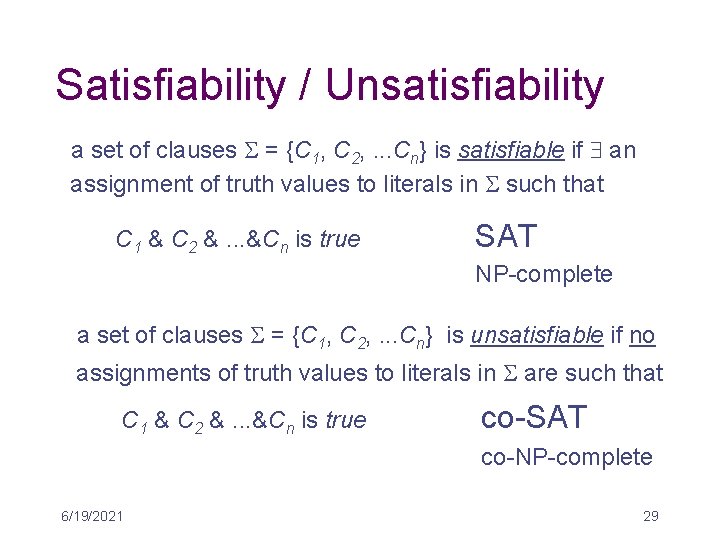
Satisfiability / Unsatisfiability a set of clauses S = {C 1, C 2, . . . Cn} is satisfiable if $ an assignment of truth values to literals in S such that C 1 & C 2 &. . . &Cn is true SAT NP-complete a set of clauses S = {C 1, C 2, . . . Cn} is unsatisfiable if no assignments of truth values to literals in S are such that C 1 & C 2 &. . . &Cn is true co-SAT co-NP-complete 6/19/2021 29
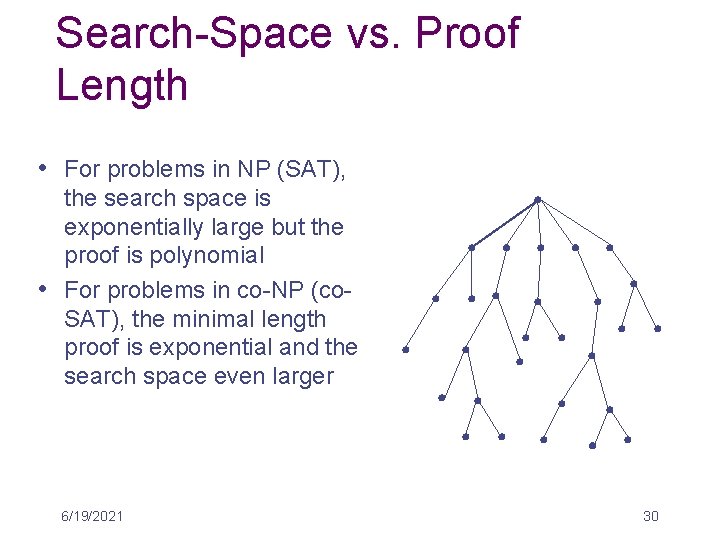
Search-Space vs. Proof Length • For problems in NP (SAT), the search space is exponentially large but the proof is polynomial • For problems in co-NP (co. SAT), the minimal length proof is exponential and the search space even larger 6/19/2021 30
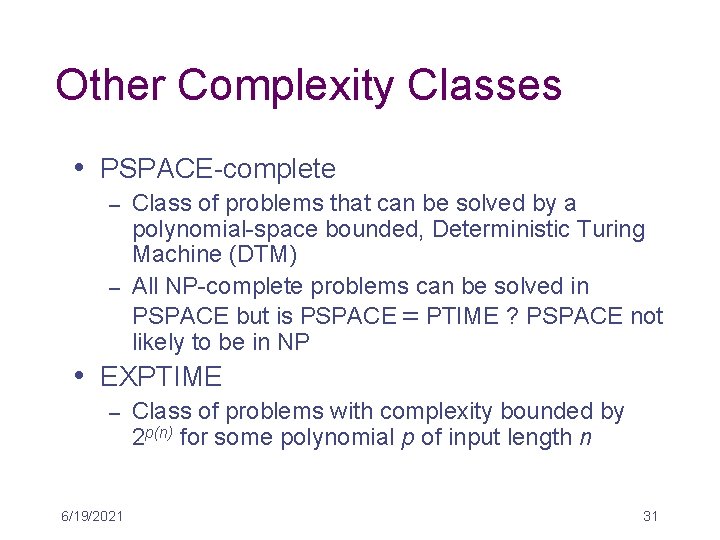
Other Complexity Classes • PSPACE-complete Class of problems that can be solved by a polynomial-space bounded, Deterministic Turing Machine (DTM) – All NP-complete problems can be solved in PSPACE but is PSPACE PTIME ? PSPACE not likely to be in NP – • EXPTIME – 6/19/2021 Class of problems with complexity bounded by 2 p(n) for some polynomial p of input length n 31
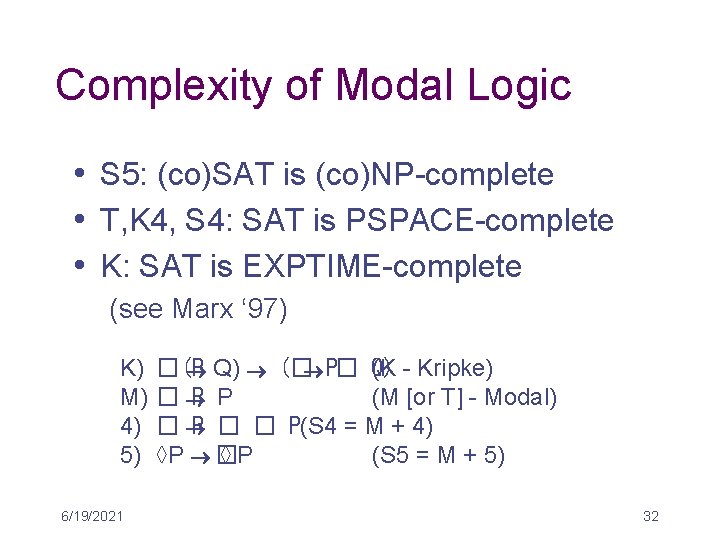
Complexity of Modal Logic • S 5: (co)SAT is (co)NP-complete • T, K 4, S 4: SAT is PSPACE-complete • K: SAT is EXPTIME-complete (see Marx ‘ 97) K) M) 4) 5) 6/19/2021 �(P ® Q) ® (� ® P� Q) (K - Kripke) �® P P (M [or T] - Modal) �® P � � P(S 4 = M + 4) ◊P ® � ◊ P (S 5 = M + 5) 32
Dealing with Complexity • Simplify your logic to make proofs feasible • Limit what you can conclude – In PRS: • • Only represent beliefs about current state of the world Consider only ground terms (no variables) No disjunctions or implications Plans are obtained from plan-libraries that represent accessible future states • Plans are treated implicitly on the “goal stack” 6/19/2021 33
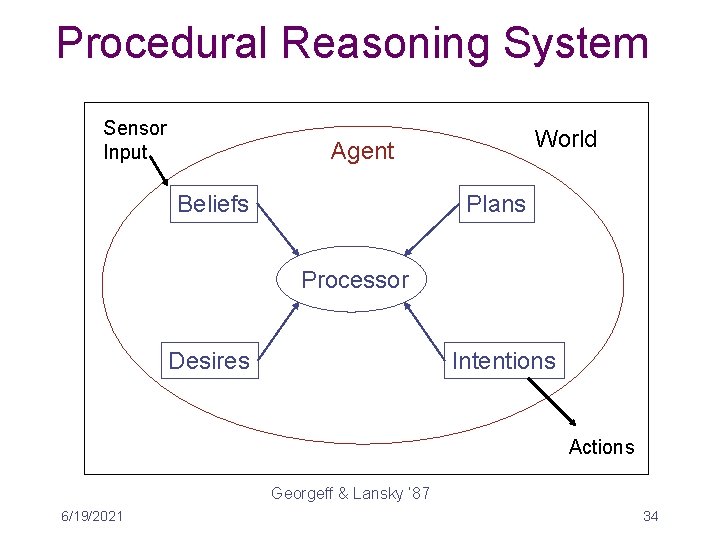
Procedural Reasoning System Sensor Input World Agent Beliefs Plans Processor Desires Intentions Actions Georgeff & Lansky ‘ 87 6/19/2021 34
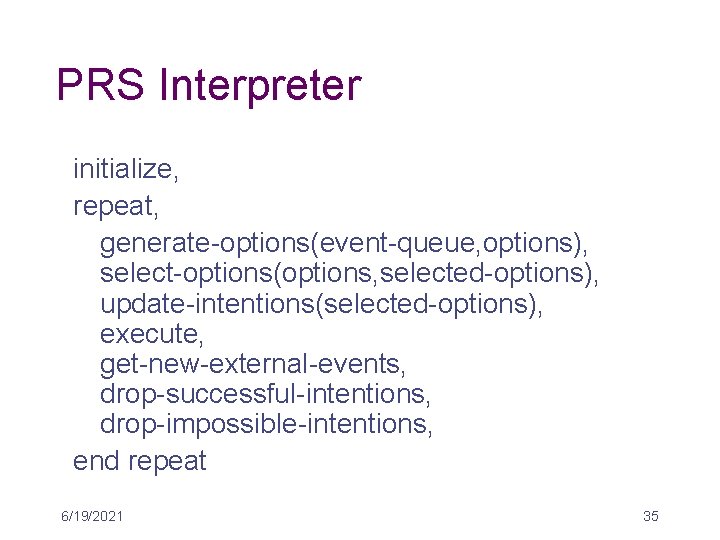
PRS Interpreter initialize, repeat, generate-options(event-queue, options), select-options(options, selected-options), update-intentions(selected-options), execute, get-new-external-events, drop-successful-intentions, drop-impossible-intentions, end repeat 6/19/2021 35
d. MARS (Distributed Multi. Agent Reasoning System) • Based on PRS • Paired-down version (PRS-lite) used in space shuttle Reaction Control System (diagnosis of malfunction and automatic system reconfiguration) • No first-principles planning • Only ground formulae and negations 6/19/2021 36
BDIM & TOMAS • BDI + Messages Toolkit • Adds concurrency control in BDI • Addresses problems of multiple agents attempting to collaboratively achieve the same goal • Potentially useful for mobile BDI agents • Transaction Oriented Multi-Agent System – 6/19/2021 Concurrent BDIMs for teams of BDI agents 37
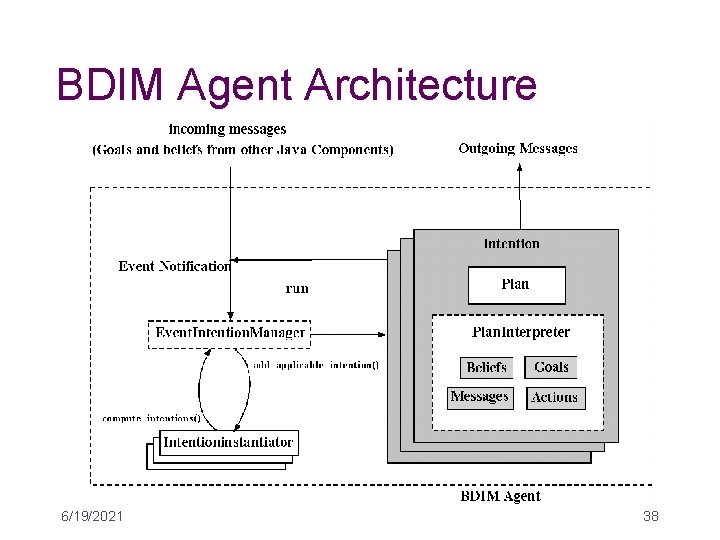
BDIM Agent Architecture 6/19/2021 38
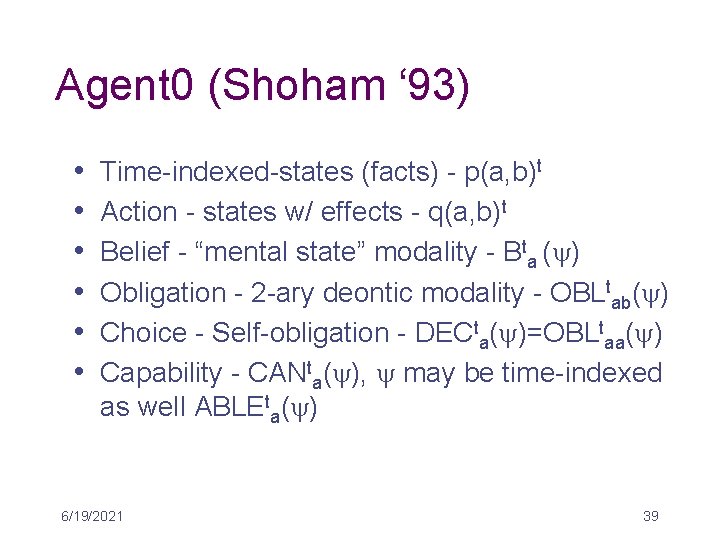
Agent 0 (Shoham ‘ 93) • • • Time-indexed-states (facts) - p(a, b)t Action - states w/ effects - q(a, b)t Belief - “mental state” modality - Bta (y) Obligation - 2 -ary deontic modality - OBLtab(y) Choice - Self-obligation - DECta(y)=OBLtaa(y) Capability - CANta(y), y may be time-indexed as well ABLEta(y) 6/19/2021 39
Agent 0 Properties • Consistency (between intentions, between intentions and beliefs, between beliefs. . . ) • Good faith: only commit to what you believe you are capable of • Introspection • Persistence • beliefs (obligations, capabilities) persist by default, and their absence as well, until the belief is learned • Complexity is dealt with by disallowing connectives other than ~ and disallowing nested modal operators. 6/19/2021 40
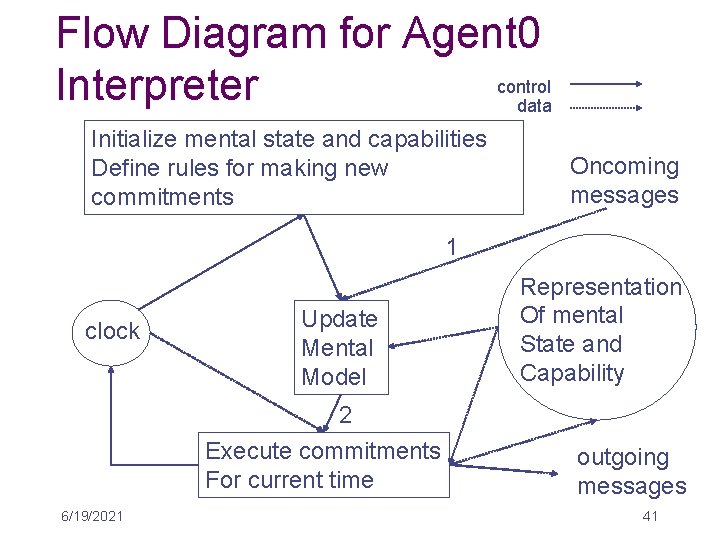
Flow Diagram for Agent 0 control Interpreter data Initialize mental state and capabilities Define rules for making new commitments Oncoming messages 1 clock Update Mental Model 2 Execute commitments For current time 6/19/2021 Representation Of mental State and Capability outgoing messages 41
Conclusions • Theory of BDI is conceptually rich, welldeveloped and provides fertile ground for AI research • Successful BDI implementations in reactive systems don’t take full advantage of theory (for practical reasons) • Jury is still out on whether BDI model is better than “representation-free” rational agents 6/19/2021 42
References • P. R. Cohen and H. J. Levesque. Intention is choice with commitment. Artificial Intelligence, 42: 213– 261, 1990. • A. S. Rao and M. Georgeff. BDI Agents: from theory to practice. In Proceedings of the First International Conference on Multi-Agent Systems (ICMAS-95), pages 312– 319, San Francisco, CA, June 1995. • A. S. Rao and M. P. Georgeff. Modeling rational agents within a BDIarchitecture. In R. Fikes and E. Sandewall, editors, Proceedings of Knowledge Representation and Reasoning(KR&R-91), pages 473– 484. Morgan Kaufmann Publishers: San Mateo, CA, April 1991. • Busetta, P. and Ramamohanarao, K. , 1998, "An architecture for mobile BDI agents. ", In Proc. of the 1998 ACM Symposium on Applied Computing (SAC'98)'', pp. 445 -452. 6/19/2021 43
References (cont. ) • d'Inverno, M. , Kinny, D. , Luck, M. , Wooldridge, M. “A Formal Specification of d. MARS” pages 155 -176 of: Intelligent Agents IV: Proceedings of the Fourth International Workshop on Agent Theories, Architectures and Languages Springer-Verlag. 1365, 1998. • Shoham, Y. , 1993. "Agent oriented programming", Artificial Intelligence, 60(1), pp. 51 -92. • Hughes and Cresswell A New Introduction to Modal Logic Routledge 1996 • M. Marx. “Complexity of modal logics of relations: . Technical Report ML-97 -02, Institute for Logic, Language and Computation, University of Amsterdam, May 1997. 6/19/2021 44
- Slides: 44