
Agents of Metamorphism Three metamorphic agents cause rocks
- Slides: 7
Agents of Metamorphism Ø Three metamorphic agents cause rocks to change, which include: 1) increased heat (i. e. temperature) 2) increased pressure 3) chemically active fluids (e. g. water) Ø During the process of metamorphism, rocks are often subjected to all three agents at the same time. Reference: Tarbuck and Lutgens - Pages 193 - 198
Agents of Metamorphism Heat (i. e. Temperature): Ø The most important agent of metamorphism. It provides the energy to drive the chemical reactions that lead to the recrystallization of minerals. Ø Rocks are heated by (1) burial beneath the surface (30 ºC/km) and by (2) intrusions of molten material that rises upwards from deep inside Earth. Ø Certain minerals (e. g. clay minerals) recrystallize to become stable when buried only a few kilometers. To the contrary, other minerals (e. g. igneous minerals) are stable when buried only a few kilometers and/or at higher temperatures and pressures and must therefore be buried very deep (20 kilometers or more) before metamorphism will occur. Ø Heat is involved in both regional and contact metamorphism.
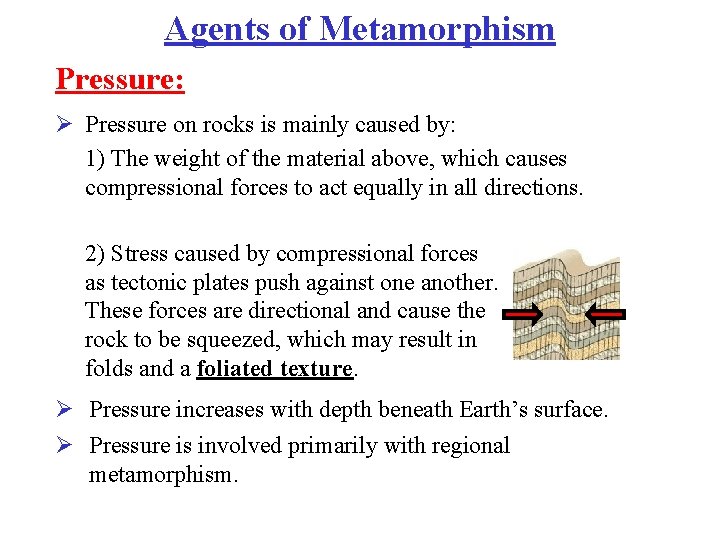
Agents of Metamorphism Pressure: Ø Pressure on rocks is mainly caused by: 1) The weight of the material above, which causes compressional forces to act equally in all directions. 2) Stress caused by compressional forces as tectonic plates push against one another. These forces are directional and cause the rock to be squeezed, which may result in folds and a foliated texture. Ø Pressure increases with depth beneath Earth’s surface. Ø Pressure is involved primarily with regional metamorphism.
Agents of Metamorphism Chemically Active Fluids: Ø These fluids have a strong influence on the metamorphism of rocks. Ø Water located in pore spaces of rocks (i. e. porosity) is perhaps the most common fluid involved in metamorphism. Ø Water helps move the ions through the solid rock allowing the rock to recrystalize into a more stable structure. It also helps in ion exchange between minerals, which is responsible for the decomposition of some minerals and the formation of completely different/new minerals. For example, garnet.
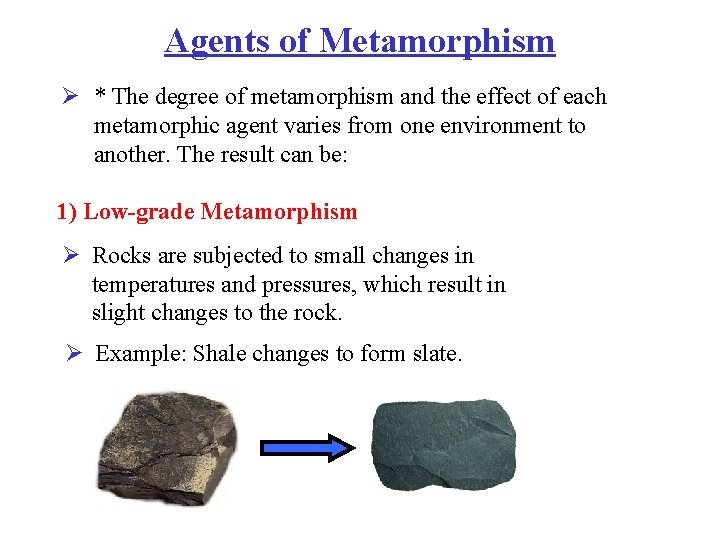
Agents of Metamorphism Ø * The degree of metamorphism and the effect of each metamorphic agent varies from one environment to another. The result can be: 1) Low-grade Metamorphism Ø Rocks are subjected to small changes in temperatures and pressures, which result in slight changes to the rock. Ø Example: Shale changes to form slate.
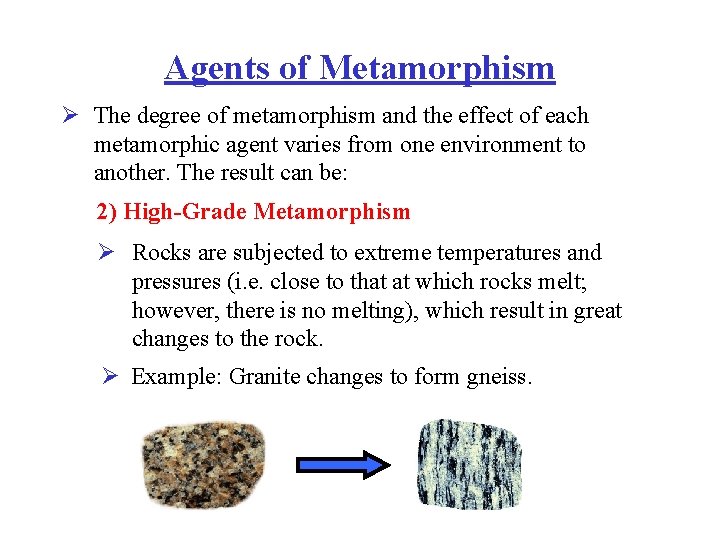
Agents of Metamorphism Ø The degree of metamorphism and the effect of each metamorphic agent varies from one environment to another. The result can be: 2) High-Grade Metamorphism Ø Rocks are subjected to extreme temperatures and pressures (i. e. close to that at which rocks melt; however, there is no melting), which result in great changes to the rock. Ø Example: Granite changes to form gneiss.
Sample Problem List the agents which cause metamorphism to occur and explain how it can change quartz sandstone to form quartzite. Answer: Agents of metamorphism include: heat, pressure, and chemically active fluids. Quartz sandstone is composed of sand grains (made of the mineral quartz) that are cemented together and may contain water in its pore spaces. Heat and pressure causes the quartz grains to recrystallize. The chemical recrystallization of the grains is accelerated because of the activity of fluids (water) in the rock, which move the ions around. This causes larger, more dense interlocking crystals to form. This is an example of a non -foliated texture.