
Agenda Wednesday February 11 th Classical Conditioning Notes
Agenda – Wednesday, February 11 th �Classical Conditioning • Notes • Examples �Homework: Reading Quiz FRIDAY
Learning Unit �Acquiring new information �Modifying or reinforcing existing knowledge, behaviors, skills, values, or preferences �Learning does not happen all at once • Ideas build upon one another
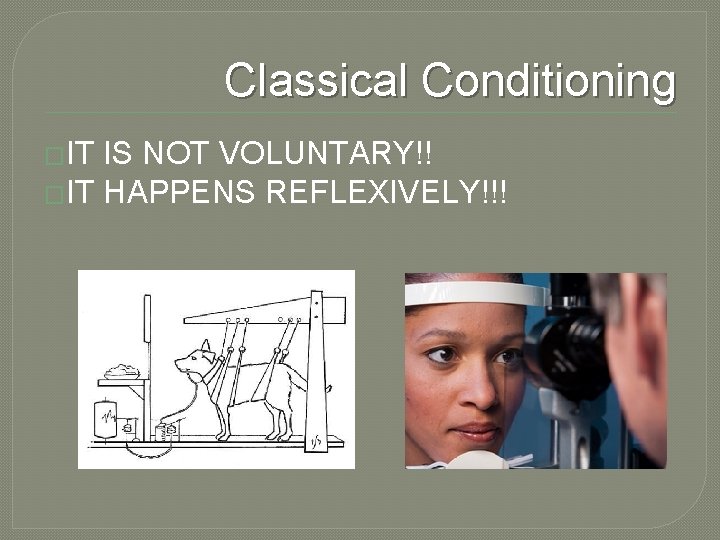
Classical Conditioning �IT IS NOT VOLUNTARY!! �IT HAPPENS REFLEXIVELY!!!
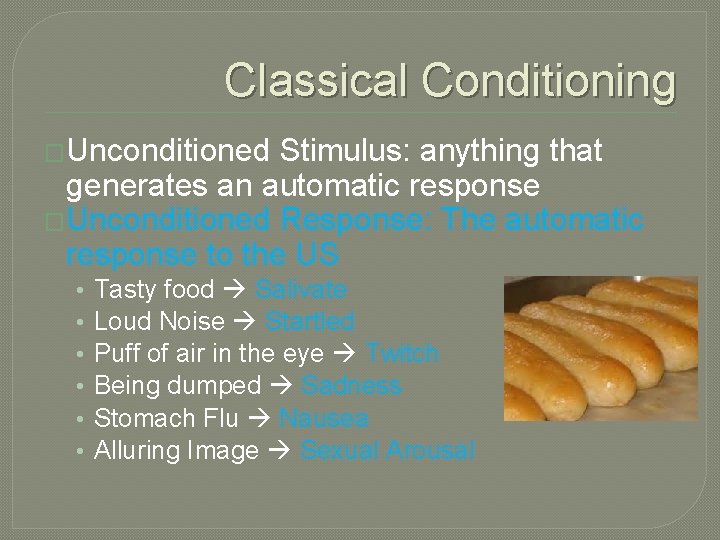
Classical Conditioning �Unconditioned Stimulus: anything that generates an automatic response �Unconditioned Response: The automatic response to the US • • • Tasty food Salivate Loud Noise Startled Puff of air in the eye Twitch Being dumped Sadness Stomach Flu Nausea Alluring Image Sexual Arousal
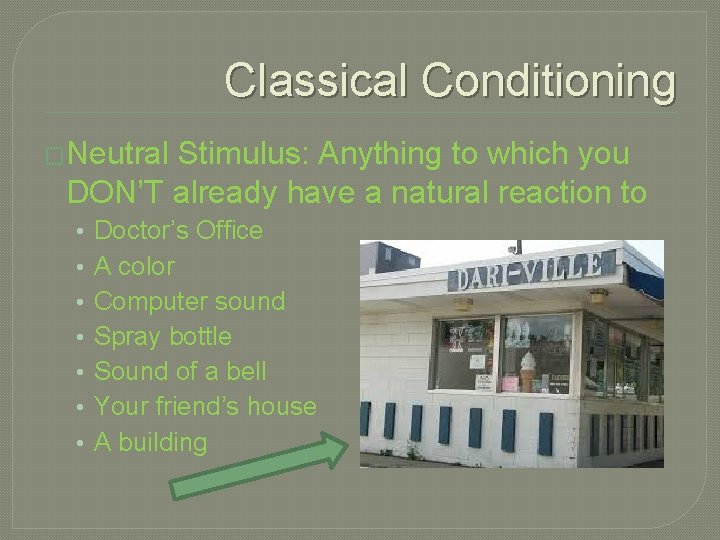
Classical Conditioning �Neutral Stimulus: Anything to which you DON’T already have a natural reaction to • • Doctor’s Office A color Computer sound Spray bottle Sound of a bell Your friend’s house A building
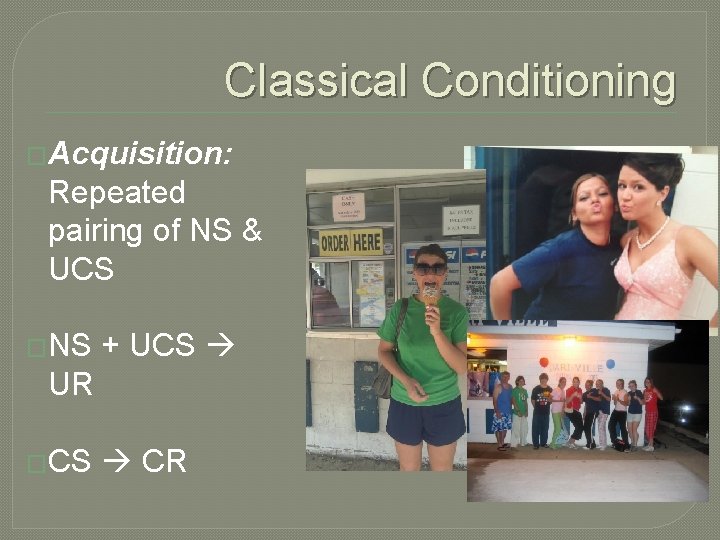
Classical Conditioning �Acquisition: Repeated pairing of NS & UCS �NS + UCS UR �CS CR
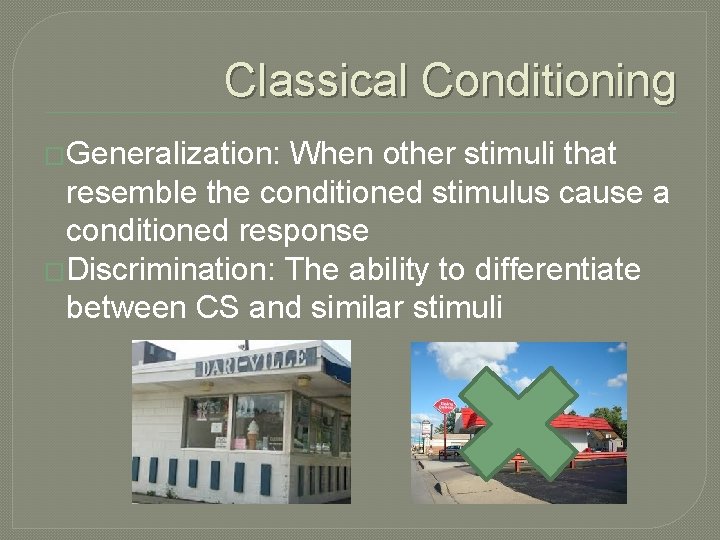
Classical Conditioning �Generalization: When other stimuli that resemble the conditioned stimulus cause a conditioned response �Discrimination: The ability to differentiate between CS and similar stimuli
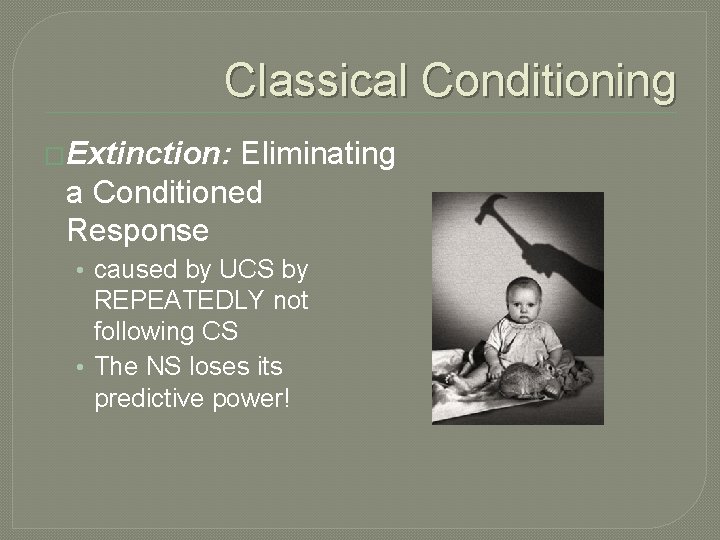
Classical Conditioning �Extinction: Eliminating a Conditioned Response • caused by UCS by REPEATEDLY not following CS • The NS loses its predictive power!
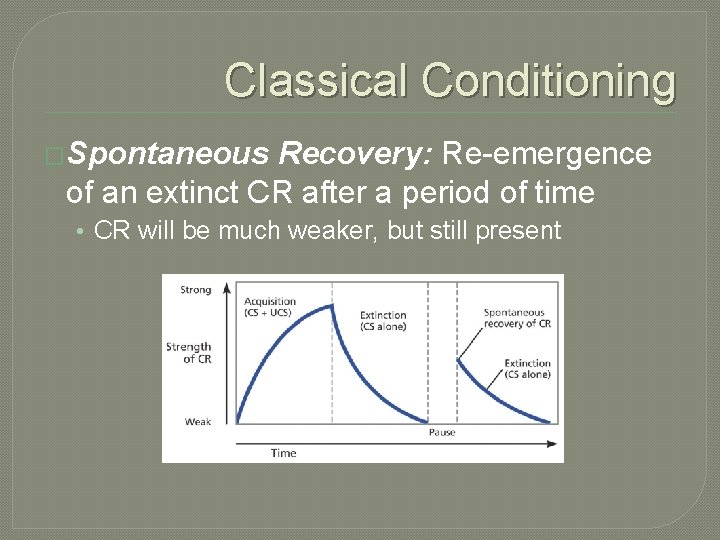
Classical Conditioning �Spontaneous Recovery: Re-emergence of an extinct CR after a period of time • CR will be much weaker, but still present
Agenda – Thursday, February 12 th �Classical conditioning examples �Operant conditioning terms �Homework: Reading Quiz TOMORROW
Example: Invisible Fences Some dog owners prefer to get an invisible fence (a fence that provides a shock when dogs with shock collars cross a wire in the ground) because their neighborhood does not allow certain fences. When the dog is about 6 inches away from the wire, it hears a loud tone. If the dog continues walking after hearing the tone, it will be shocked.
Before the fence… �Unconditioned Stimulus: ________ �Unconditioned Response: _______ �Neutral Stimulus: ___________
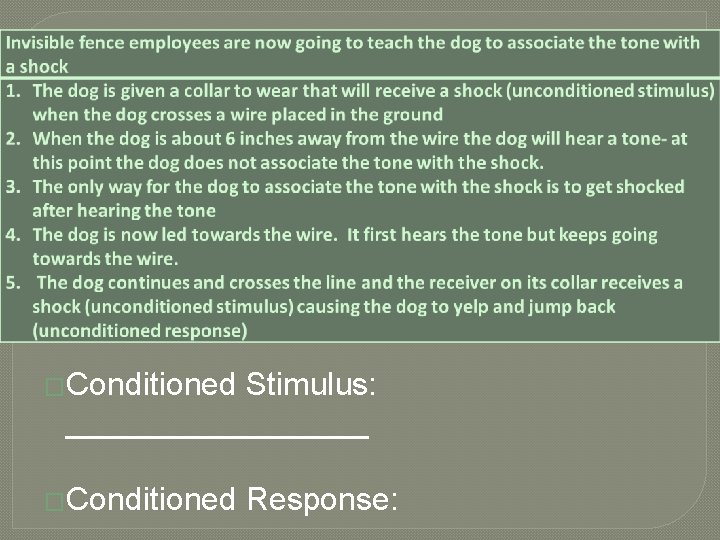
�Conditioned Stimulus: _________ �Conditioned Response:
�Extinction: �Spontaneous Recovery: �Generalization: �Discrimination:
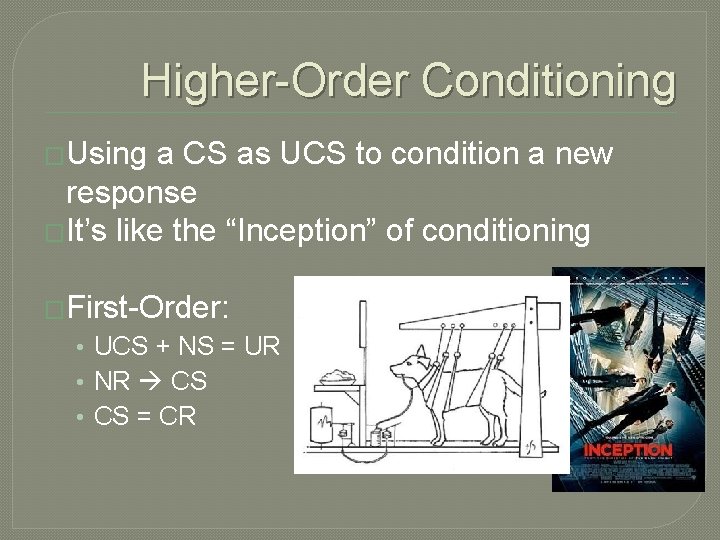
Higher-Order Conditioning �Using a CS as UCS to condition a new response �It’s like the “Inception” of conditioning �First-Order: • UCS + NS = UR • NR CS • CS = CR
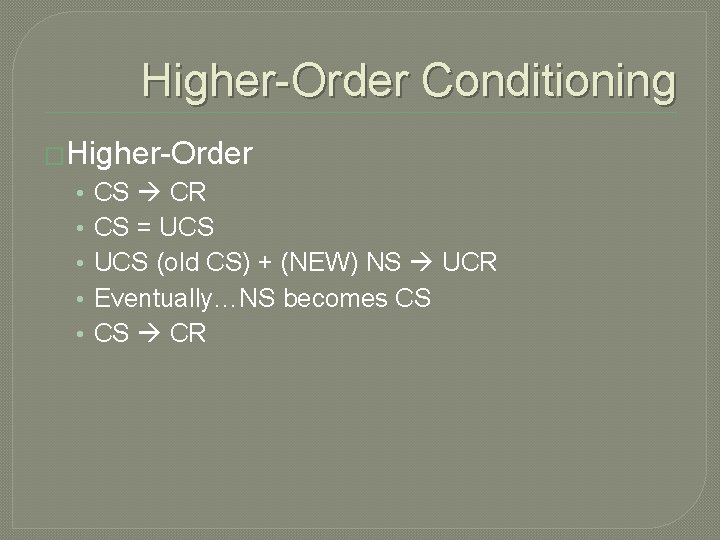
Higher-Order Conditioning �Higher-Order • • • CS CR CS = UCS (old CS) + (NEW) NS UCR Eventually…NS becomes CS CS CR
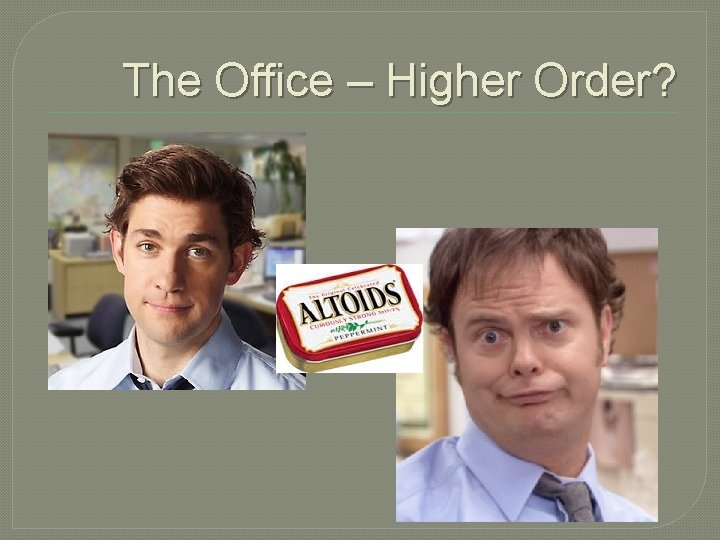
The Office – Higher Order?
Operant Conditioning �IT IS VOLUNTARY!! �You learn consequences that follow your behavior (GOOD OR BAD) �How do CRUSH CARDS function as operant conditioning?
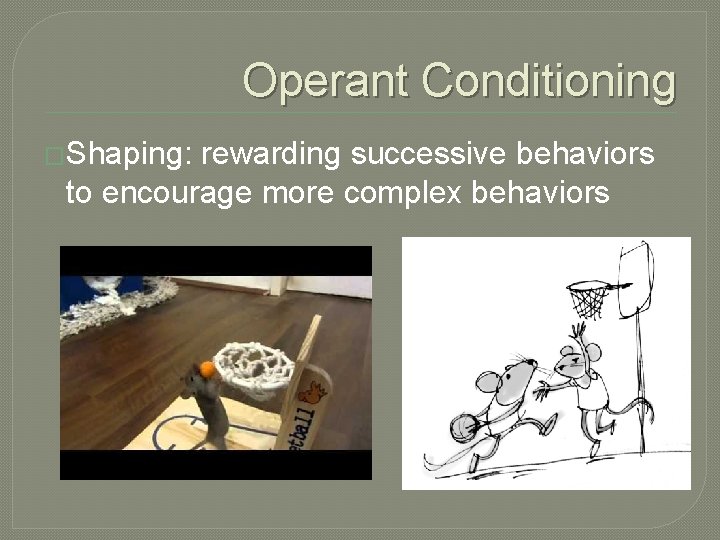
Operant Conditioning �Shaping: rewarding successive behaviors to encourage more complex behaviors
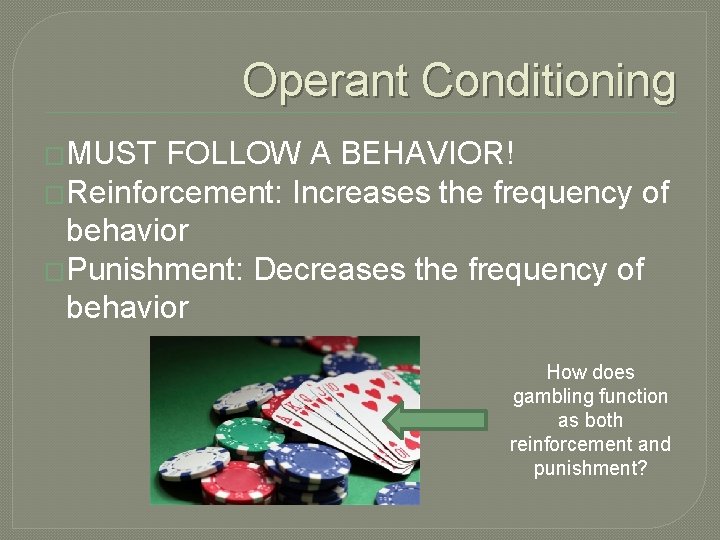
Operant Conditioning �MUST FOLLOW A BEHAVIOR! �Reinforcement: Increases the frequency of behavior �Punishment: Decreases the frequency of behavior How does gambling function as both reinforcement and punishment?
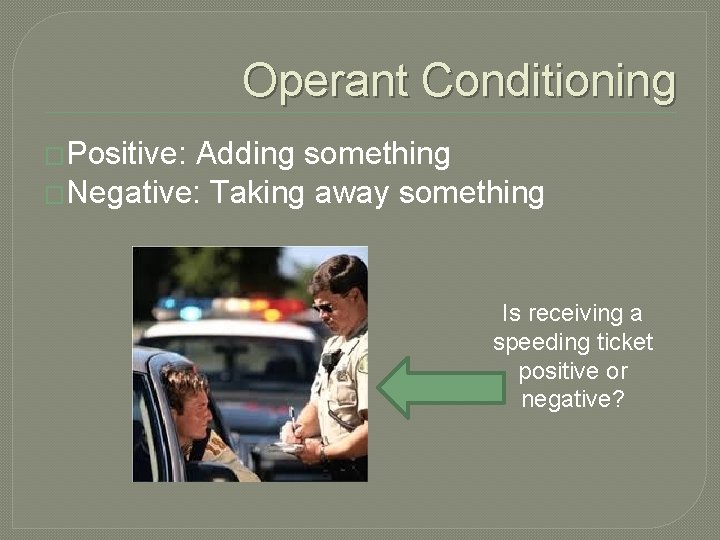
Operant Conditioning �Positive: Adding something �Negative: Taking away something Is receiving a speeding ticket positive or negative?
Agenda – Monday, February 24 th �Important people (yellow sheet) �Classical vs. Operant conditioning examples worksheet �Reinforcement Schedules �Practice FRQ (if time) �Homework: • Reading Guide #6 due tomorrow • Reading Quiz #6 tomorrow
Important People �Ivan Pavlov �B. F. Skinner �John B. Watson �Edward Thorndike �Albert Bandura
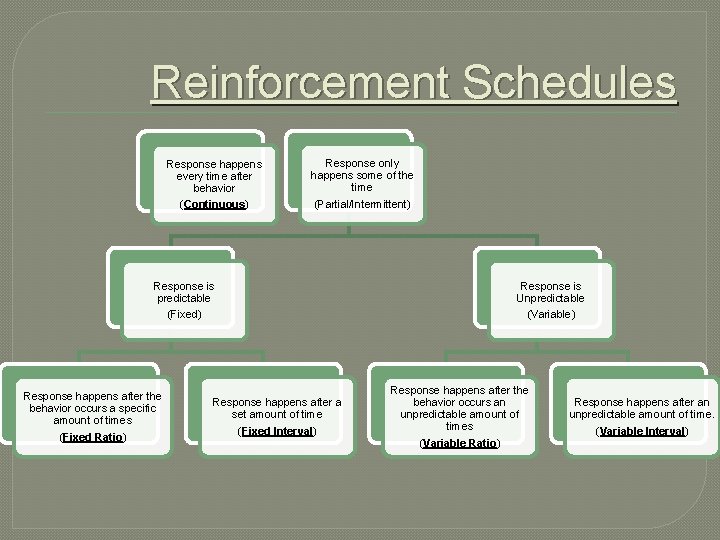
Reinforcement Schedules Response happens every time after behavior (Continuous) Response only happens some of the time (Partial/Intermittent) Response is predictable (Fixed) Response happens after the behavior occurs a specific amount of times (Fixed Ratio) Response happens after a set amount of time (Fixed Interval) Response is Unpredictable (Variable) Response happens after the behavior occurs an unpredictable amount of times (Variable Ratio) Response happens after an unpredictable amount of time. (Variable Interval)
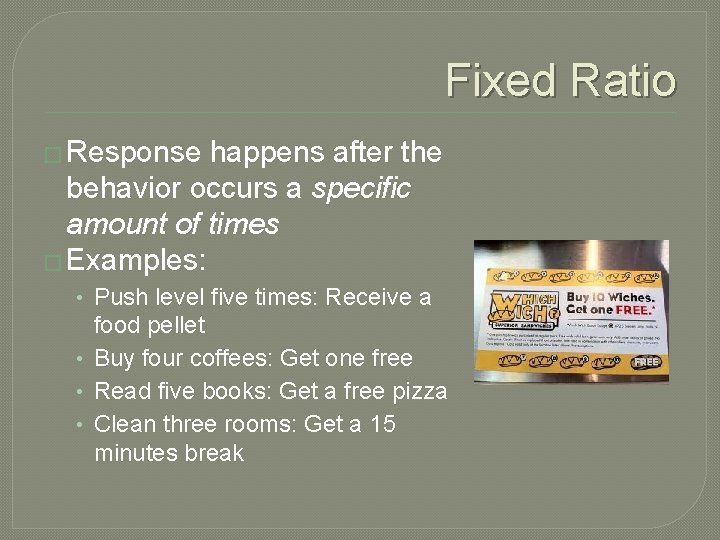
Fixed Ratio � Response happens after the behavior occurs a specific amount of times � Examples: • Push level five times: Receive a food pellet • Buy four coffees: Get one free • Read five books: Get a free pizza • Clean three rooms: Get a 15 minutes break
Fixed Interval �Response time �Examples: happens after a set amount of • Pressing a lever: Food pellet released every 10 minutes • Studying: Final exam given every end of semester • Being paid every two weeks for working a job • Reading a textbook: ” Teacher gives quiz every Tuesday
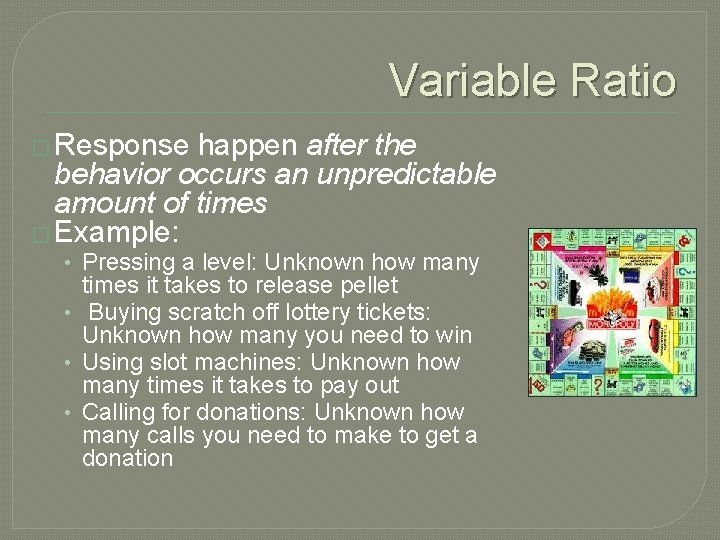
Variable Ratio � Response happen after the behavior occurs an unpredictable amount of times � Example: • Pressing a level: Unknown how many times it takes to release pellet • Buying scratch off lottery tickets: Unknown how many you need to win • Using slot machines: Unknown how many times it takes to pay out • Calling for donations: Unknown how many calls you need to make to get a donation
Variable Interval �Response happens after an unpredictable amount of time �Examples: • Pressing a lever: You don’t know when the pellet will be released • Studying: You don’t know when a pop quiz will happen • Fishing: You can go very long or short periods of time without catching fish • Drug Use: Random drug tests by an employer
Cognition �Latent Learning: Even without reinforcement and punishment schedules, you are still learning (create a cognitive map) �Example �Other examples?
Cognition �Intrinsic Motivation: The inner desire to perform a behavior effectively for the sake of it �Extrinsic Motivation: The desire to behave a certain way to receive external rewards or avoid threatened punishment
Intrinsic or Extrinsic? �“I remember a daily ritual that we had: I would call Pop at work to ask if I could practice with him. He would always pause a second or two, keeping me in suspense, but he’d always say yes…In his own way, he was teaching me initiative. You see, he never pushed me to play. ” • -Tiger Woods

�http: //www. youtube. com/watch? v=74 x 0 Ha cr 1 -w �http: //www. youtube. com/watch? v=8 nu. I 2 Rr JTf. A �http: //www. youtube. com/watch? v=H 6 LEc. M 0 E 0 io �(TED Talk)
- Slides: 32