
AGENDA SEPT 6 n Objective Examine the contributions
AGENDA SEPT 6 n Objective: Examine the contributions of individuals to develop the field of forensic science. n 1. DO NOW n 2. Welcome to Forensics n 3. Review – History of Forensics CONCEPT CHECK DATE TBA
Forensics in the Field Sept 6 n An officer responds to a disturbance in a parking lot where he finds a young man has suffered a gunshot wound to the mid lower torso. It is a cold evening and has been raining all day. The officer checks that the victim is breathing and begins to seal off the crime scene. He then checks the scene for evidence and collects what he finds. After collecting all the visible evidence, he calls in for an ambulance and officer assistance. n Evaluate the actions of the officer.
Forensics in the Field Debate n Do you agree with the officer’s course of actions? – Share your thoughts with your classmates. – Be prepared to discuss and debate.
Forensics in the Field Evaluation The officer does not follow the proper protocol in this situation. n Assess the environment. n – Is it safe? – Is the perpetrator still in the area. The officer’s actions may have been dictated by the fact that it was raining outside and that any possible evidence may have been washed away or destroyed. n However, any injured person takes priority over the collection of evidence. n – Depends on individual circumstances. – A wound sustained to the mid lower torso (specifically the abdomen for you A&P fans out there) can be especially dangerous.
AGENDA SEPT 7 n Objective: Examine the contributions of individuals to develop the field of forensic science. n 1. Collection of Forms – Do I really need to call parents on the second day of the year? n 2. Real World Forensics – GOOGLE Classroom n 3. Review - History of Forensics CONCEPT CHECK DATE TBA
The Value of Forensic Science n Let’s take a more realistic look at the use of forensics.
The Value of Forensics n 1. DNA can be easily destroyed by those who commit crimes.
The Value of Forensics n 1. This is a FALSE statement. n What methods are commonly used in efforts to remove all traces of a suspect’s or victim’s DNA?
The Value of Forensics n 2. Crime Scene Investigators facilitate all aspects of an investigation.
The Value of Forensics n 2. Another FALSE statement. n Most CSI personnel specialize in a singular aspect of forensic science. n They often have NO contact with people involved in a crime (suspects, victims, witnesses).
The Value of Forensics n 3. Crime Lab Testing is generally completed in a matter of hours.
The Value of Forensics n 3. Yes. You guessed it. FALSE. n Many tests involving biological materials can take weeks to complete. n What is a common test that can produce results in a day or two?
The Value of Forensics n 4. Criminal Investigations remain active for relatively short periods of time.
The Value of Forensics n 4. This one is actually TRUE. n. A number of factors affect the time frame in which an investigation is conducted. n Which time? factors play a role in this window of
The Value of Forensics n 5. It is possible to commit the perfect crime.
The Value of Forensics n 5. FALSE n Some small piece of trace evidence is always left behind no matter how much work is done to attempt to cover it up. n So why do some crimes remain unsolved?
“Elementary, my dear Watson” – Popular media has marginalized and sensationalized the importance of the scientific process behind forensic science.
AGENDA n Objective: SEPT 8 Examine the contributions of individuals to develop the field of forensic science. n 1. Collection of Forms n 2. History of Forensics n 3. Review - History of Forensics CONCEPT CHECK DATE TBA
FORENSICS Chapter 1: Introduction to Forensic Science
The Development of Forensics n Forensics, like any science, is always based upon ____? _____. n What is the ultimate purpose of Forensic Science?
Why do we need laws in our society? n What – – – do laws regulate in our society?
Introduction n Laws are a necessity to regulate… n The quality of our food n The potency of drugs n The quality of water n The preservation of nature n The honesty and integrity of man. n Ensure the safety and security of lawabiding citizens against criminal acts.
What is Forensics? n The application of science to criminal and civil laws enforced by police agencies in a criminal justice system. n Forensic science owes its origins to individuals who developed the principles and techniques needed to identify and compare physical evidence.
History n Mathieu Orfila – the father of forensic toxicology. n Alphonse Bertillion - devised the first scientific system of personal identification in 1879. n Francis Galton – conducted the first definitive study of fingerprints and their classification. n Leone Lattes – developed a procedure to determine blood type from dried blood stains.
CONCEPT CHECK n. A blood sample taken from a crime scene is type A. Police arrest a suspect, Ivan, with type A blood but claims he did not commit the crime. He tells police that his half brother, Apollo, is guilty of the crime. Both men have the same mother whose blood type is B. n If Apollo’s father has type O blood, is Ivan a suspect in the crime?
CONCEPT CHECK ANSWER n No, Apollo can only have blood type B or O. n Apollo scene. n Ivan did not leave his blood at the crime is still a suspect.
History n Walter Mc. Crone – utilized microscopy and other analytical methodologies to examine evidence. n Hans Gross – wrote the first treatise describing the application of scientific principles to the field of criminal investigation. n Edmond Locard – incorporated Gross’ principles within a workable crime laboratory. n Locard’s Exchange Principle – states that a crosstransfer of evidence occurs when a criminal comes in contact with an object or person.
AGENDA n Objective: SEPT 11 Examine the contributions of individuals to develop the field of forensic science. n 1. History of Forensics CONCEPT CHECK n 2. SYSTEM OF IDENTIFICATION n 3. Review and Homework Tomorrow - LAB INVESTIGATION
Team Activity ID System n Design your own system of personal identification. n It must be testable!
Team Activity ID System n How valuable is your system of ID?
AGENDA SEPT 12 n Objective: Examine the contributions of individuals to develop the field of forensic science. n 1. History of Forensics CONCEPT CHECK n 2. Anthropometry LAB Investigation n 3. Review and Homework
Bertillion’s SYSTEM of ID n Complete the Anthropometry Lab Investigation.
AGENDA SEPT 13 n Objective: Examine the contributions of individuals to develop the field of forensic science. n 1. History of Forensics QUIZ – RESULTS n 2. See REALTIME Anthropometry LAB Investigation – DAY 2 All team data must be collected! n 3. Review and Homework – FIND YOUR SUSPECT!

AGENDA Sept 14 n Learning Objective: Describe the technical services available to analyze evidence. n 1. The Crime Lab and its Role in Investigation n 2. Forensic Career Project n 3. Homework and Review – Anthropometry LAB DUE SEPT 20
The Crime Lab n Rapid growth n Lack of national and regional planning and coordination. n Paul Leland Kirk (1902 -1970) was head of first criminalistics department at the University of California Berkeley. n 350 public crime labs operating at four levels of government – federal, state, county, and municipal.
Why did Crime Labs begin to expand in size and number? n Factors – – – that affected Crime Labs
The Crime Lab n Increasing numbers of crime labs partly on the rise due to… – Supreme Court decisions in the 1960 s § police to build cases on scientifically evaluated evidence. – High levels of drug abuse § crime labs unable to keep up with demands. – DNA profiling technology
Let’s Consider your Systems of Personal ID n Team Grades in Realtime. n How accurate are these systems? n This brings us to the role of the Crime Lab.
AGENDA SEPT 15 n Objective: Examine the contributions of individuals to develop the field of forensic science. n 1. History of Forensics CONCEPT CHECK n 2. Anthropometry LAB Investigation n 3. Review and Homework
Is Forensic Science Infallible? n http: //www. nytimes. com/2014/05/19/us/d na-analysis-exposes-an-inexact-forensicscience. html
Forensics Career Project n See Project Requirements and Rubric on GOOGLE Classroom n Teams of 2

AGENDA n SEPT 18 Objective: Explore the role of the forensic scientist and the special service units that process and analyze evidence. 1. Anthropometry LAB Investigation – DUE WEDNESDAY SEPT 20 n 2. Skills and Services n 3. Review and Homework – Career Project and Presentations DUE – Sept 25 I will volunteer teams! n
CONCEPT CHECK Blood Typing n Which blood type is the universal donor? n Which blood type is the universal recipient? n Justify your answers… WHY? (Here is a little bit of Biology!)
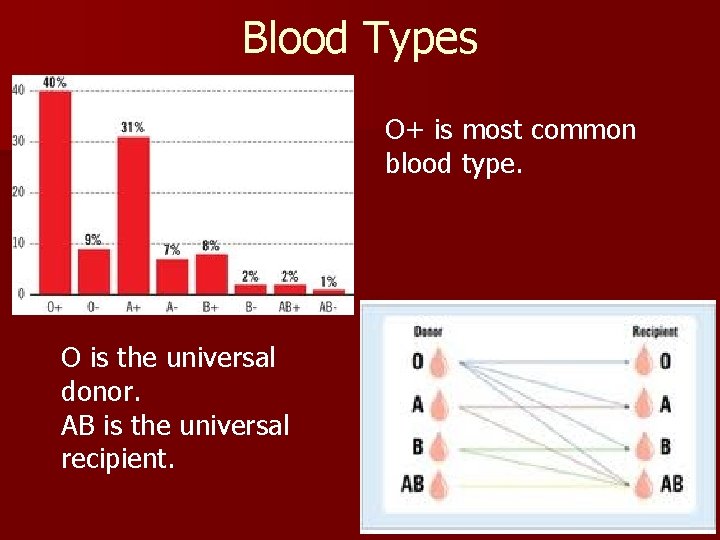
Blood Types O+ is most common blood type. O is the universal donor. AB is the universal recipient.
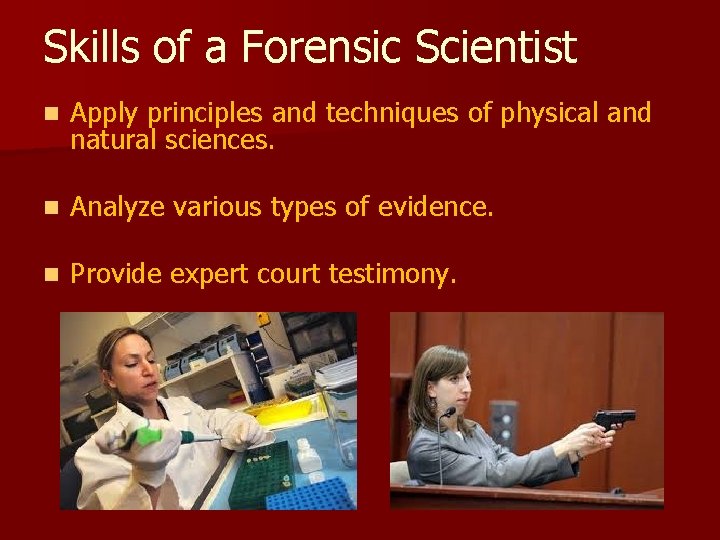
Skills of a Forensic Scientist n Apply principles and techniques of physical and natural sciences. n Analyze various types of evidence. n Provide expert court testimony.
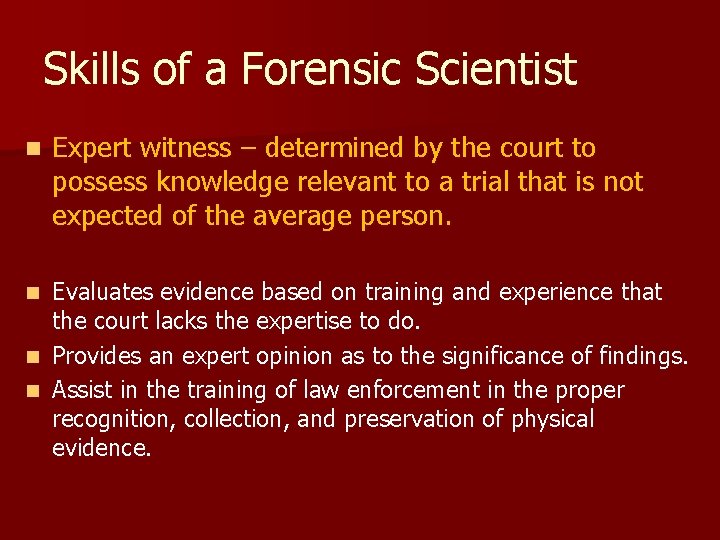
Skills of a Forensic Scientist n Expert witness – determined by the court to possess knowledge relevant to a trial that is not expected of the average person. Evaluates evidence based on training and experience that the court lacks the expertise to do. n Provides an expert opinion as to the significance of findings. n Assist in the training of law enforcement in the proper recognition, collection, and preservation of physical evidence. n
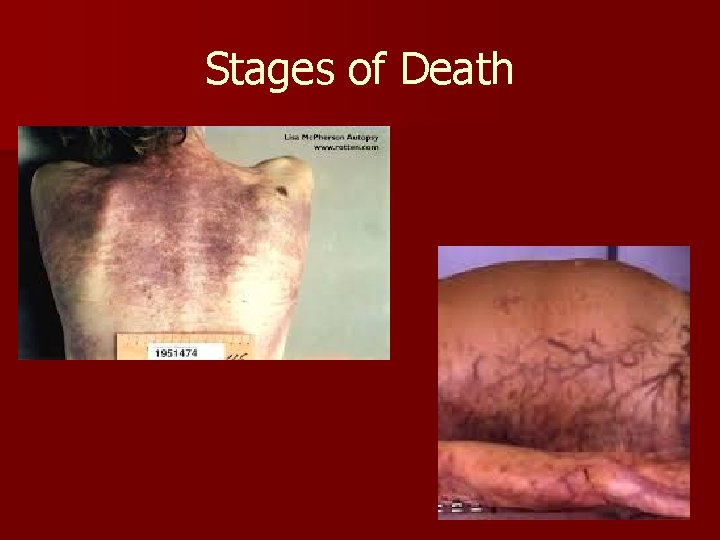
Stages of Death RIGOR mortis results in the shortening of muscle tissue and stiffening of body parts in the position at death. Occurs within first 24 hours and disappears within 36 hours. LIVOR mortis results in the settling of blood in areas of body closest to the ground. Begins immediately on death up to 12 hours after death.
Stages of Death ALGOR mortis results in loss of body heat. General rule – begins an hour after death. Body loses heat at a rate of 1 to 1. 5 degrees F per hour until body reaches environmental temperature.
Forensics at Work n http: //www. abc. net. au/btn/story/s 352774 4. htm
Forensics at Work n http: //www. abc. net. au/news/2012 -06 - 12/coroner-rules-dingo-killed-azariachamberlain/4065802

CONCEPT CHECK n 1. This stage of death dissipates within 36 hours following death and is characterized by the shortening of muscle tissues. n 2. Approximate the time of death (in real time) if a body has been discovered at a temperature of 84. 9 degrees F. (Enviro Temp = 81 F) 3. View the following images. n Which stage of death is represented? n Why? n
Stages of Death

AGENDA Sept 25 n Learning Objective: Assess the value of evidence through the special forensic service units responsible for processing and analysis. n 1. Complete Evidence Inquiry – GOOGLE Classroom 2. PRESENTATIONS 3. Looking Ahead – CASE STUDY 1 4. Review n n n – More Presentations – UNIT TEST
Technical Support n Five basic services. n Physical Science Unit – use of chemistry, physics, and geology to identify and compare physical evidence. n Biology Unit – use of biology to investigate blood samples, body fluids, hair, and fiber samples. n Firearms Unit investigates discharged bullets, cartridge cases, shotgun shells, and ammunition as well as all types of firearms.
Technical Support n Document Unit analyzes handwriting and questioned-document issues. n Photographic Unit applies specialized photographic techniques for examining and recording physical evidence.
Optional Tech Services n Toxicology Unit examines body fluids and organs for the presence of drugs and poisons. n Latent Fingerprint Unit n Polygraph Unit n Voiceprint Analysis Unit analyze voice patterns. n Evidence Collection Unit specially trained individuals collect and preserve physical evidence.
Special Forensic Services n Forensic Entomology is the study of insects and their relation to a criminal investigation often to estimate time of death. n Forensic Psychiatry involves the relationship between human behavior and legal proceedings. n Forensic Odontology involves the use of teeth and bite marks to assist in identifying a victim in an unrecognizable state.
Special Forensic Services n Forensic Engineering involves failure analysis, accident reconstruction, and the causes and origins of fires and explosions. n Forensic Computer Science involves the examination of digital evidence.
Special Forensic Services n Forensic Pathology involves the investigation of unnatural, unexplained, or violent deaths. n Medical examiners or coroners determine the cause of death. n Autopsy or medical dissection and examination of a body.

AGENDA Sept 27 n Learning Objective: Examine landmark cases that have shaped forensic science laws. n 1. Complete Project Presentations n 2. Case Study No. 1 n 3. Review Chapter 1 Test NEXT WEEK Frye and Daubert Rulings
FRYE vs. the United States 1923 n Defendant was convicted of Second Degree Murder. n An early form of a Polygraph test was used by prosecution as key evidence in the case. n Systolic Blood Pressure Deception Test
n Scientific experiments have demonstrated that fear, rage, and pain always produce a rise of systolic blood pressure. Conscious deception n Guilt of crime n n Indicates the struggle going on in the subject's mind between fear and attempted control of that fear under examination.
THE RULING n Expert testimony deduced from a wellrecognized scientific principle or discovery. n Deduction made must be sufficiently established to have gained general acceptance in the particular field in which it belongs.
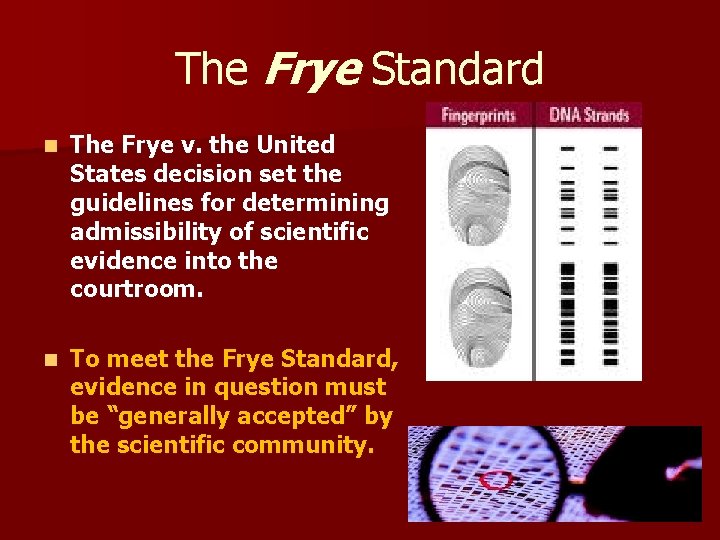
The Frye Standard n The Frye v. the United States decision set the guidelines for determining admissibility of scientific evidence into the courtroom. n To meet the Frye Standard, evidence in question must be “generally accepted” by the scientific community.
Daubert Ruling 1993 case of Daubert v. Merrell Dow Pharmaceutical, Inc. U. S. Supreme Court asserted that Frye Standard is not an absolute prerequisite to the admissibility of scientific evidence. Trial judges are ultimately responsible as “gatekeepers” for the admissibility and validity of scientific evidence presented in their courts as well as expert testimony.
AGENDA Sept 23 n Learning Objective: Discuss the contributions of forensics to criminal and civil investigations. n 1. Chapter 1 TEST n 2. Career Presentations DUE TOMORROW – Rehearse with your partner.
The Daubert Criteria n n n In Daubert, Supreme Court offered guidelines as to how a judge can gauge scientific evidence. 1. Whether the scientific technique or theory can be (and has been) tested. 2. Whether the technique or theory has been subject to peer review and publication. 3. The technique’s potential rate of error. 4. Existence and maintenance of standards controlling the technique’s operation. 5. Widespread acceptance of scientific theory or method within a relevant scientific community.
Unsolved Crimes n http: //www. youtube. com/watch? v=s 27 fx. R k 9 dp. E
Unsolved Crimes n Based upon what you have seen, what steps may have been taken to further investigate these murders? n Do you believe both crimes were committed by the same individual/individuals? WHY? n Write your answers on a piece of paper.
UNSOLVED CRIMES n n n n Physical evidence on the victims. ID the type of instrument that caused the injuries to the victims. Cross reference the DNA found on the cigarettes. Good old fashioned police work – walk the beat and ask questions. Retrace the path of the victims. Search surrounding area/waters for a weapon. Attempt to ID a possible means/route of escape for the attackers (search the local parking lots, etc)
Investigation n What n Pay Sept 23 the following video clip? close attention to the piece of evidence in question. n http: //www. youtube. com/watch? v=z. Vr. Ubk HJu. HY
- Slides: 76