
Agenda Overview of meeting topics 9 30 AM
- Slides: 19
Agenda Overview of meeting topics 9: 30 AM Introduction and Agenda Review 9: 45 AM Select Regional Allocation Option and Process Steps for 2006 SRFB Funding Cycle 11: 00 AM Review Goals & Objectives & 3 -year Plans 12: 00 PM Working Lunch Review the Road to July – Process & Decisions 12: 30 PM Discuss Investment Scenarios 2: 15 PM Identify sub-group members to develop proposal re: funding level to pursue 2: 30 PM Wrap-Up and Adjourn
SRFB Round 7 Steps & Distribution Options • The goal for this year is to use as efficient a process as possible. • This is a transition year. • Ultimately the 3 -year investment scenario selected will guide future decisions. Today: 1. Clarify steps—see handout 2. Select distribution option—see handout
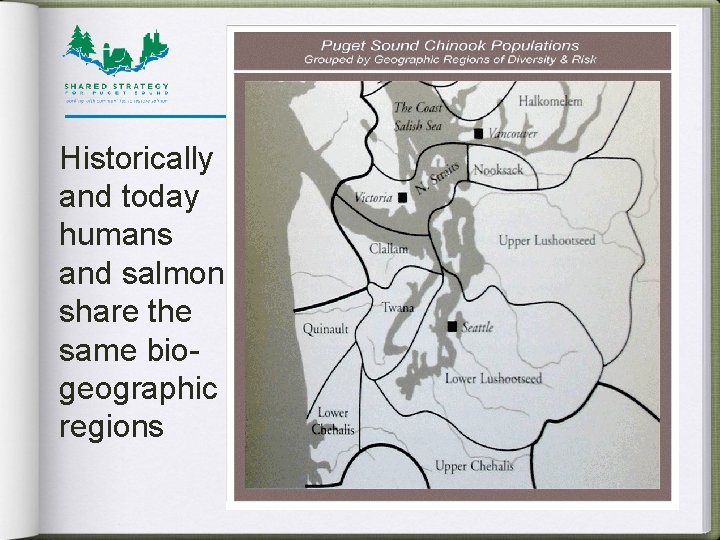
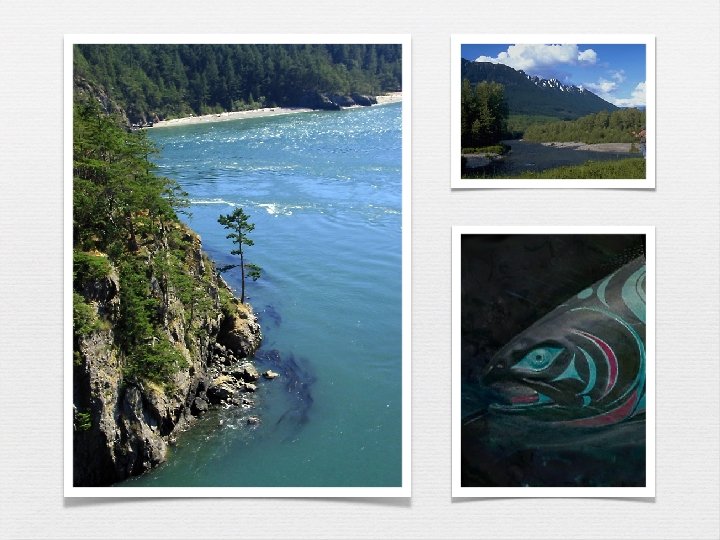
Historically and today humans and salmon share the same biogeographic regions
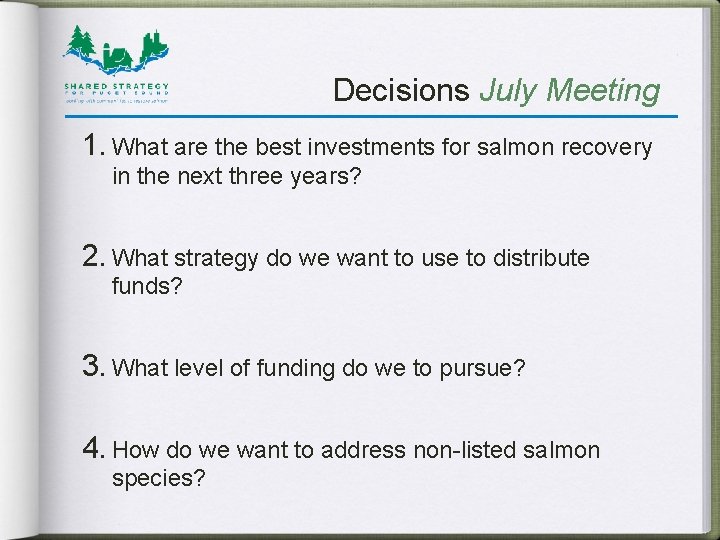
Decisions July Meeting 1. What are the best investments for salmon recovery in the next three years? 2. What strategy do we want to use to distribute funds? 3. What level of funding do we to pursue? 4. How do we want to address non-listed salmon species?
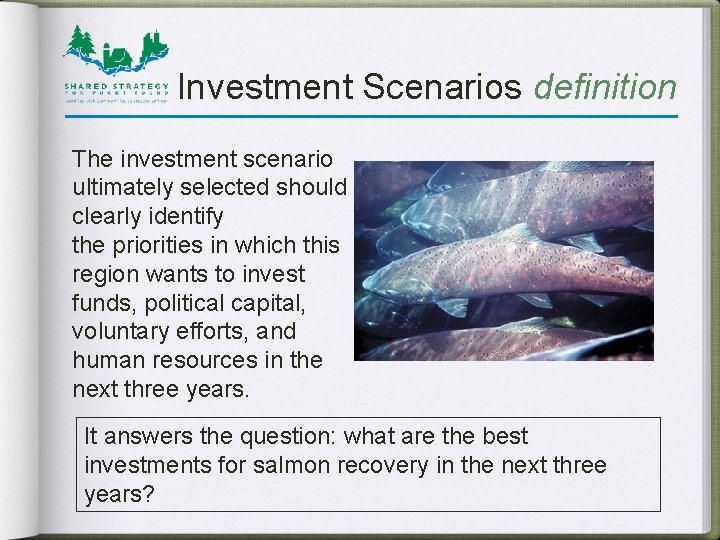
Investment Scenarios definition The investment scenario ultimately selected should clearly identify the priorities in which this region wants to invest funds, political capital, voluntary efforts, and human resources in the next three years. It answers the question: what are the best investments for salmon recovery in the next three years?
Technical Analyses for Prioritizing Recovery Strategies Across the Puget Sound Chinook Salmon ESU Puget Sound Technical Recovery Team
Two Key Criteria for Making Choices 1. Protect options for the future role of existing natural populations “Where are the populations whose future role is most threatened? ” 2. Protect existing salmon habitat and the opportunities for habitat restoration “Where is the best existing salmon habitat and the best opportunities for habitat restoration? ”
Data Used to Evaluate Near-term Threat of Extinction 1. Current abundance of natural-origin Chinook salmon (NOR) 2. Average number of adults produced by each Chinook salmon spawning in the wild (Recruits/spawner) 3. Proportion and origin of hatchery fish on the spawning grounds
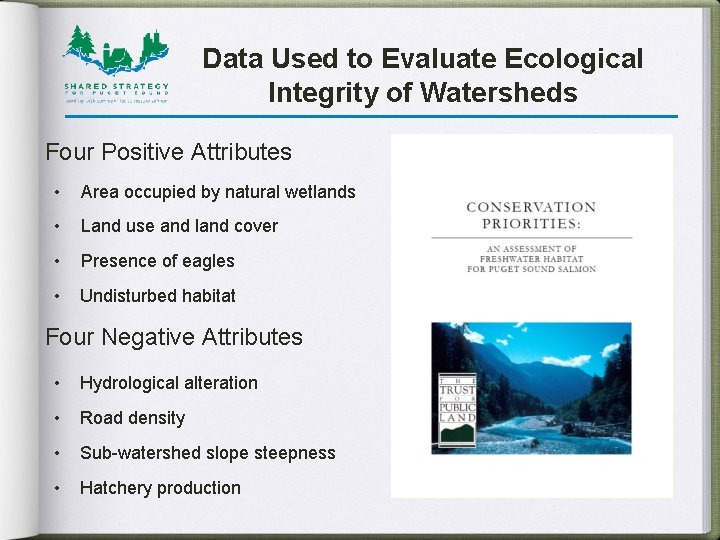
Data Used to Evaluate Ecological Integrity of Watersheds Four Positive Attributes • Area occupied by natural wetlands • Land use and land cover • Presence of eagles • Undisturbed habitat Four Negative Attributes • Hydrological alteration • Road density • Sub-watershed slope steepness • Hatchery production
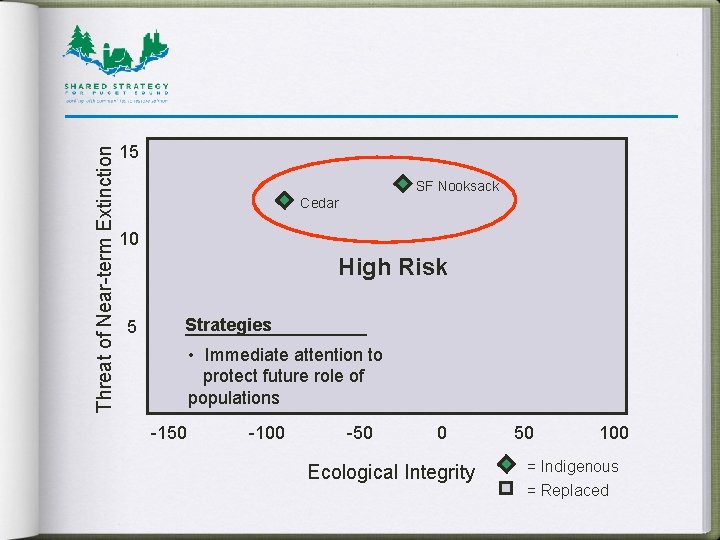
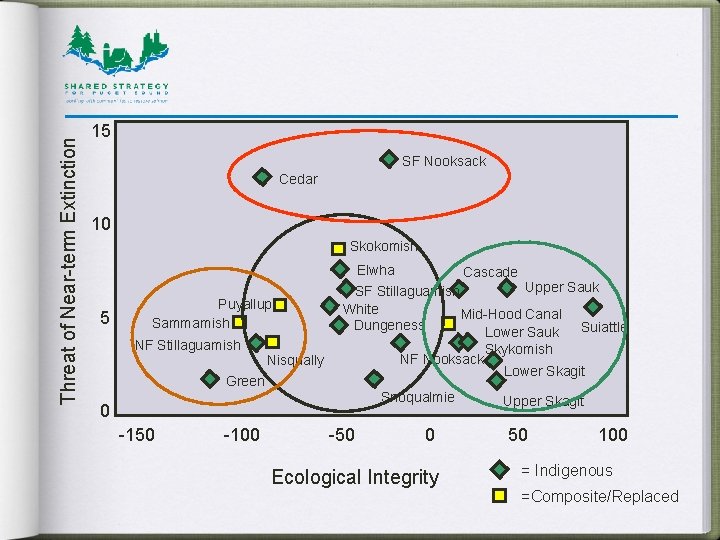
Threat of Near-term Extinction 15 SF Nooksack Cedar 10 High Risk 5 Strategies • Immediate attention to protect future role of populations -150 -100 -50 0 Ecological Integrity 50 100 = Indigenous = Replaced
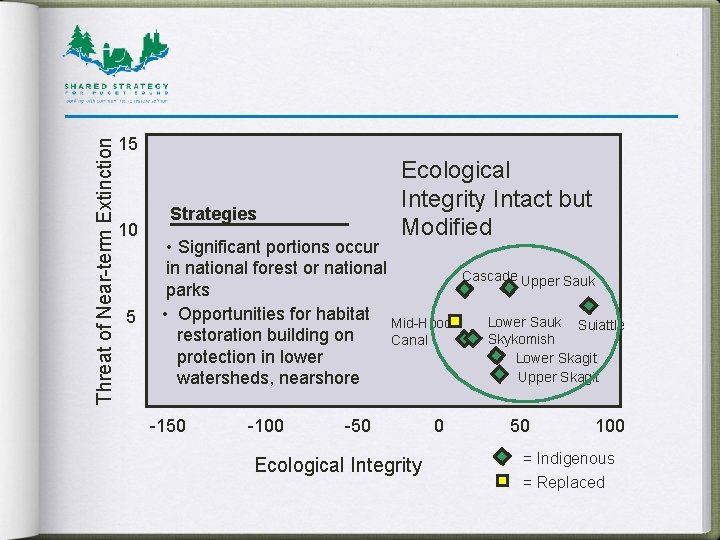
Threat of Near-term Extinction 15 10 5 Ecological Integrity Intact but Modified Strategies • Significant portions occur in national forest or national parks • Opportunities for habitat Mid-Hood restoration building on Canal protection in lower watersheds, nearshore -150 -100 -50 Ecological Integrity 0 Cascade Upper Sauk Lower Sauk Suiattle Skykomish Lower Skagit Upper Skagit 50 100 = Indigenous = Replaced
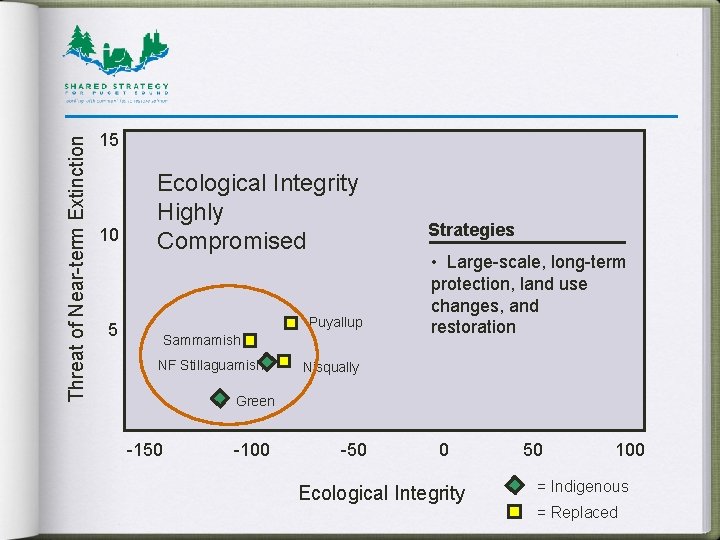
Threat of Near-term Extinction 15 10 5 Ecological Integrity Highly Compromised Puyallup Sammamish NF Stillaguamish Strategies • Large-scale, long-term protection, land use changes, and restoration Nisqually Green -150 -100 -50 0 Ecological Integrity 50 100 = Indigenous = Replaced
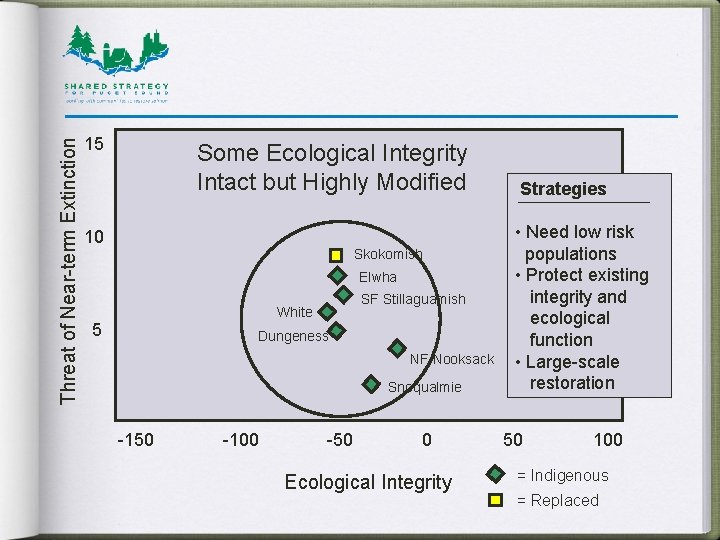
Threat of Near-term Extinction 15 Some Ecological Integrity Intact but Highly Modified 10 Skokomish Elwha SF Stillaguamish White 5 Dungeness NF Nooksack Snoqualmie -150 -100 -50 0 Ecological Integrity Strategies • Need low risk populations • Protect existing integrity and ecological function • Large-scale restoration 50 100 = Indigenous = Replaced
Threat of Near-term Extinction 15 SF Nooksack Cedar 10 Skokomish Elwha 5 Puyallup Sammamish NF Stillaguamish Green Nisqually Cascade Upper Sauk SF Stillaguamish White Mid-Hood Canal Dungeness Suiattle Lower Sauk Skykomish NF Nooksack Lower Skagit Snoqualmie 0 -150 -100 -50 0 Ecological Integrity Upper Skagit 50 100 = Indigenous =Composite/Replaced
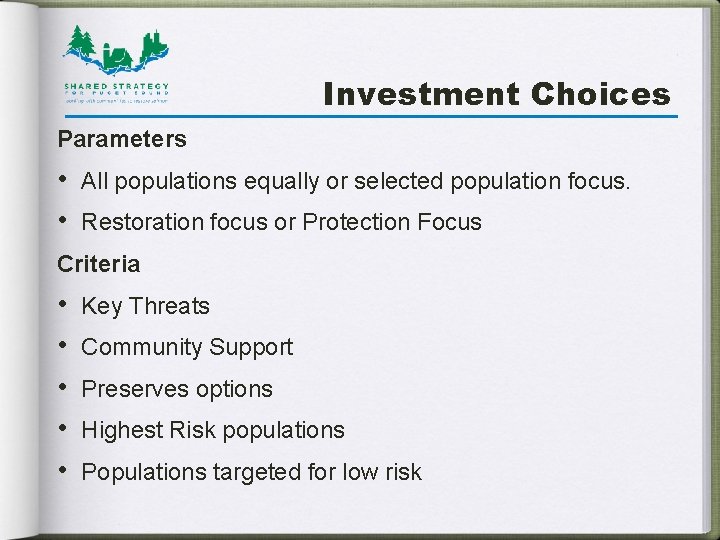
Investment Choices Parameters • • All populations equally or selected population focus. Restoration focus or Protection Focus Criteria • • • Key Threats Community Support Preserves options Highest Risk populations Populations targeted for low risk