
Agenda Lec 06 Notepad Latin Translator Debugger Exceptions
Agenda Lec 06 Notepad Latin. Translator Debugger Exceptions Go over QT exam OCP JP 7 -I & 7 -2 Mortal. Kombat
Exceptions: Checked versus Unchecked Exceptions http: //www. ibm. com/developerw orks/java/library/j-jtp 05254/
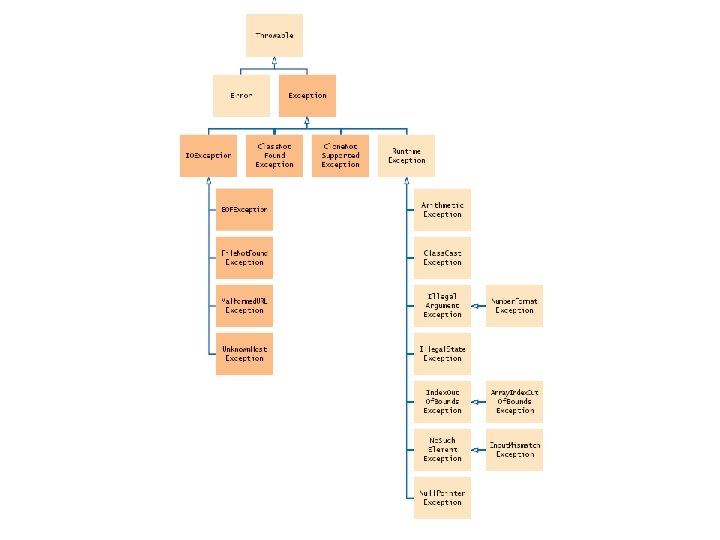
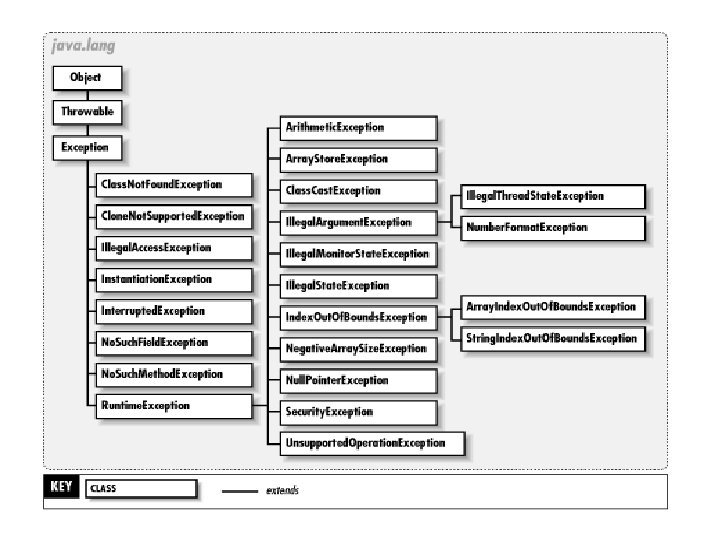
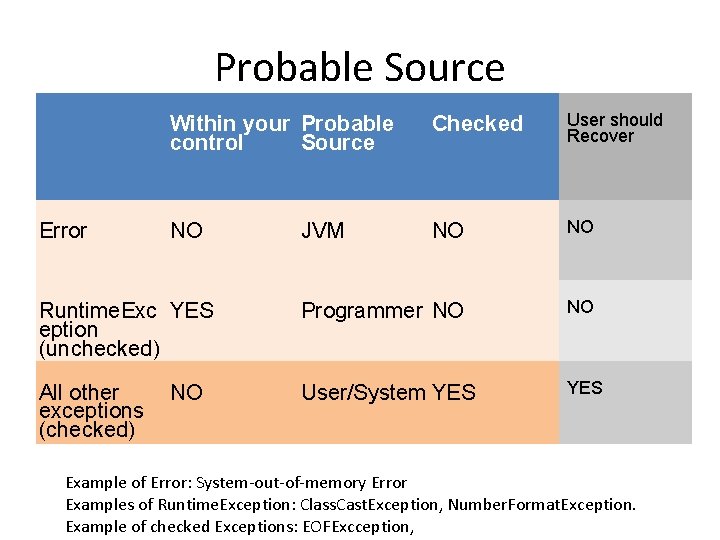
Probable Source Within your Probable control Source Checked User should Recover NO NO NO Runtime. Exc YES eption (unchecked) Programmer NO NO All other exceptions (checked) User/System YES Error NO JVM Example of Error: System-out-of-memory Error Examples of Runtime. Exception: Class. Cast. Exception, Number. Format. Exception. Example of checked Exceptions: EOFExcception,
Situations which cause Exceptions (or Errors) to be thrown • An internal Error occurs in the VM (Out. Of. Memory. Error) • An unchecked Exception is generated and thrown (Array. Index. Out. Of. Bounds) • A checked Exception is thrown (EOFException) • You purposefully throw an Exception.
Exception sequence • Once an exception is generated, the execution sequence immediately terminates until the exception is caught (or propagates up the call stack to the VM). In practice that means that any code following your statement which threatens to throw an exception will NOT be executed if an exception occurs. No return value! • An exception is thrown up the call stack
Some Java naming wierdness in the Exception Handling API • Despite having the 'able' suffix, Throwable is a class, not an interface. • Errors are considered part of the "Exception Handling" API • All Exceptions and Errors occur at Runtime, so Runtime. Exception is a useless name.
Some things to remember about Exceptions • Anything that inherets from Runtime. Exception is unchecked.
The debate over checked and unchecked See: http: //www. ibm. com/developerworks/java/libr ary/j-jtp 05254/ 1/ are you dealing with user or remote data? 2/ should your user recover? If yes, use a checked exception
Debugger
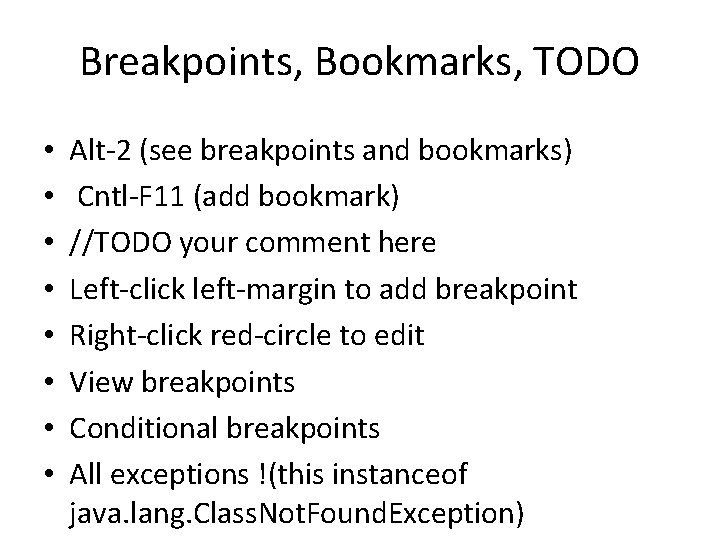
Breakpoints, Bookmarks, TODO • • Alt-2 (see breakpoints and bookmarks) Cntl-F 11 (add bookmark) //TODO your comment here Left-click left-margin to add breakpoint Right-click red-circle to edit View breakpoints Conditional breakpoints All exceptions !(this instanceof java. lang. Class. Not. Found. Exception)
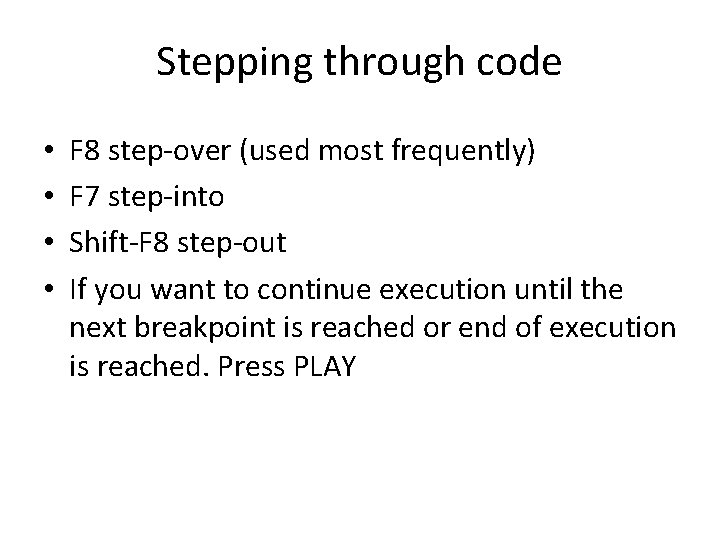
Stepping through code • • F 8 step-over (used most frequently) F 7 step-into Shift-F 8 step-out If you want to continue execution until the next breakpoint is reached or end of execution is reached. Press PLAY
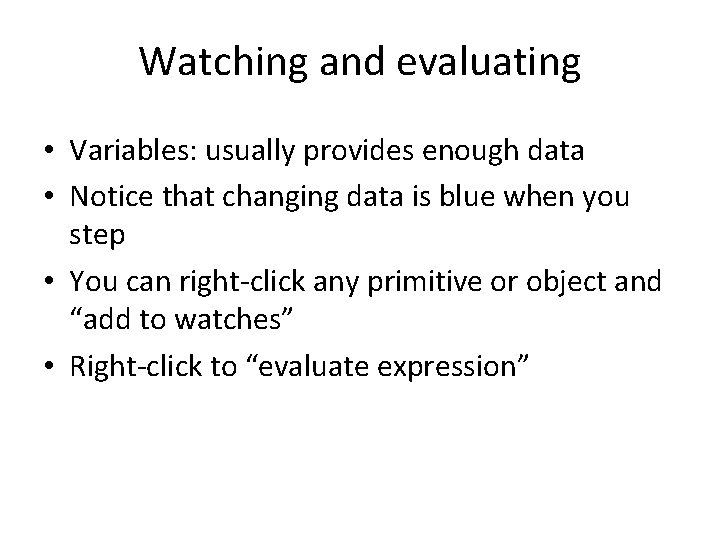
Watching and evaluating • Variables: usually provides enough data • Notice that changing data is blue when you step • You can right-click any primitive or object and “add to watches” • Right-click to “evaluate expression”
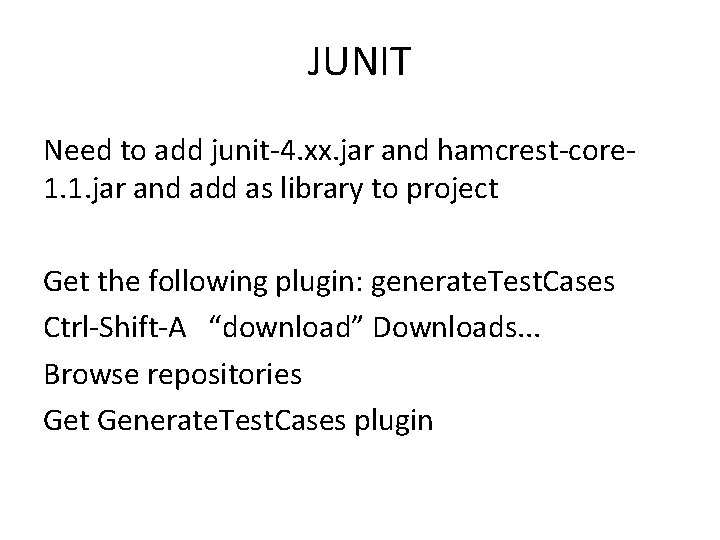
JUNIT Need to add junit-4. xx. jar and hamcrest-core 1. 1. jar and add as library to project Get the following plugin: generate. Test. Cases Ctrl-Shift-A “download” Downloads. . . Browse repositories Get Generate. Test. Cases plugin
Reflection • If your program is written well and adheres to the principals of polymorphism, then you don't really need reflection. • However, it's nice to know you have it when testing/debugging though. • Very useful when first learning an OO language.
Reflection • Reflection allows you to inspect the type (class) of the implicit parameter at runtime. • We will use reflection to gain a deeper understanding of polymorphism and the java event model. Every class has a class object which you can access like so: java. util. Date. class, or like so: Class. for. Name(str. Fully. Qualified. Class); See reflection example
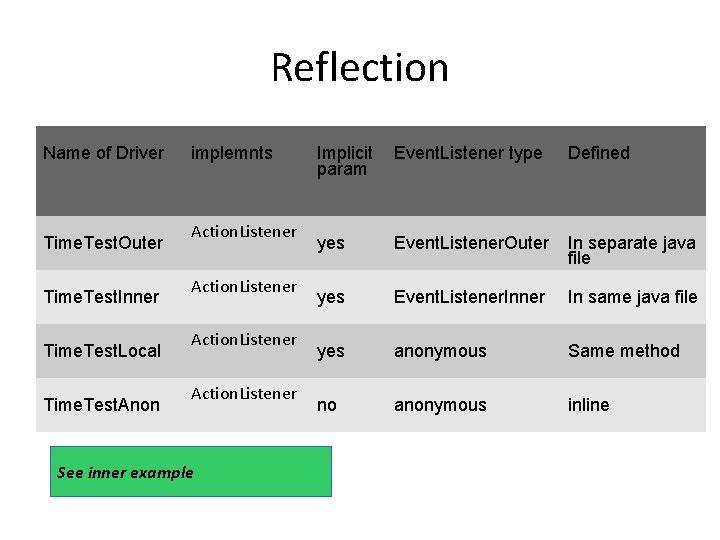
Reflection Name of Driver Time. Test. Outer Time. Test. Inner Time. Test. Local Time. Test. Anon implemnts Action. Listener See inner example Implicit param Event. Listener type Defined yes Event. Listener. Outer In separate java file yes Event. Listener. Inner In same java file yes anonymous Same method no anonymous inline

Source Code Online
Source Code Online • Please avail yourselves of the many excellent sources for source code, both full applications and snippets. • http: //stackoverflow. com/ (best for snippets) • Git. Hub. com • Bit. Bucket. org • http: //www. planet-source-code. com/ (best for full apps) • http: //www. freewarejava. com/ • http: //www. javagalaxy. com/
Guidelines for using found source code • If you know the URL where you got it, cite like so: – //http: //stackoverflow. com/questions/26305/how -can-i-play-sound-in-java • Don't copy an entire application; that is plagiarism. • Use found source code within reason.
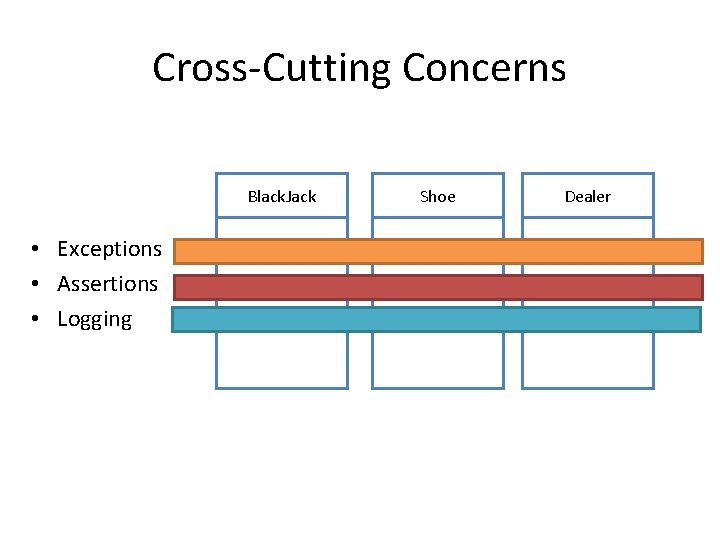
Cross-Cutting Concerns Black. Jack • Exceptions • Assertions • Logging Shoe Dealer
Inner and Anonymous Classes • Though you are captive in the OO paradigm, you can use inner classes and anonymous classes to get around this constraint and write procedural-like code. • Often times, no one but the enclosing class cares about an object. In this case, you may consider using anonymous inner classes. • Often times, these anon inner classes are both reference- and type-anonymous.
Model a system • Object-oriented programming is about modeling a system. • Write the problem out as requirements -- this will essentially be a math world problem (your favorite kind to solve!) • Your computer objects map directly to realworld objects (nouns). • Your methods map directly to real-world actions (verbs).
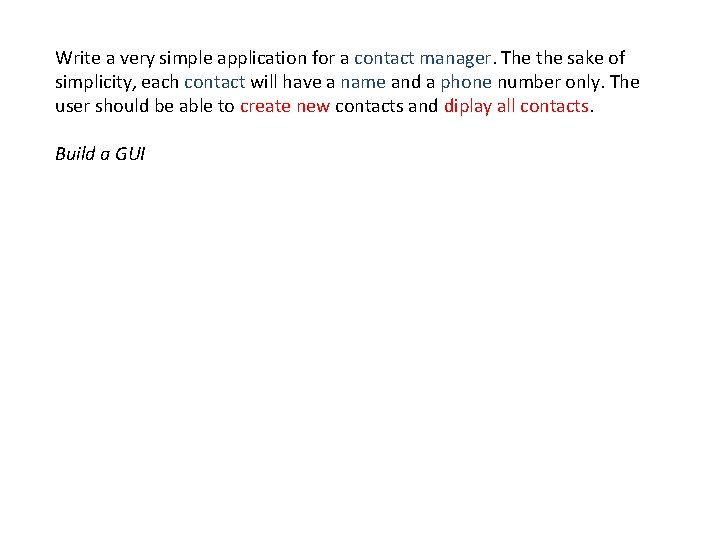
Write a very simple application for a contact manager. The the sake of simplicity, each contact will have a name and a phone number only. The user should be able to create new contacts and diplay all contacts. Build a GUI
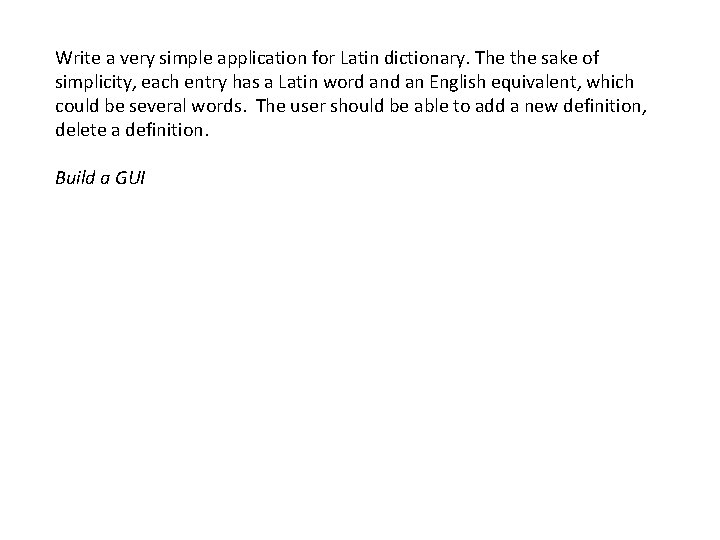
Write a very simple application for Latin dictionary. The the sake of simplicity, each entry has a Latin word an English equivalent, which could be several words. The user should be able to add a new definition, delete a definition. Build a GUI
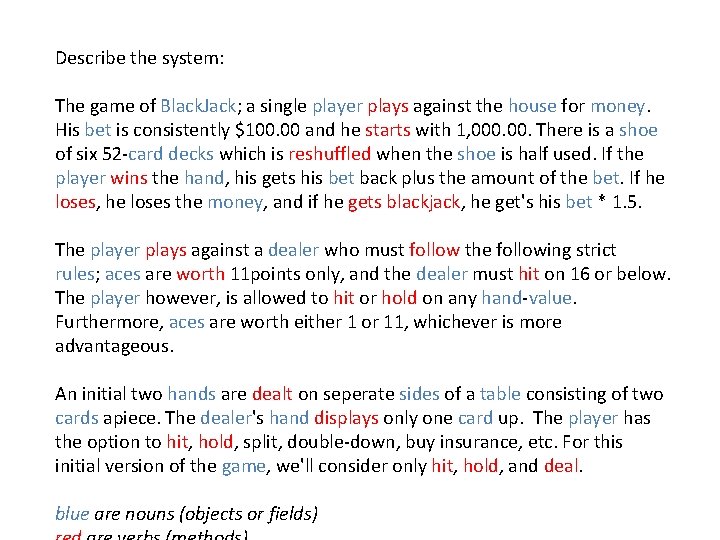
Describe the system: The game of Black. Jack; a single player plays against the house for money. His bet is consistently $100. 00 and he starts with 1, 000. There is a shoe of six 52 -card decks which is reshuffled when the shoe is half used. If the player wins the hand, his gets his bet back plus the amount of the bet. If he loses, he loses the money, and if he gets blackjack, he get's his bet * 1. 5. The player plays against a dealer who must follow the following strict rules; aces are worth 11 points only, and the dealer must hit on 16 or below. The player however, is allowed to hit or hold on any hand-value. Furthermore, aces are worth either 1 or 11, whichever is more advantageous. An initial two hands are dealt on seperate sides of a table consisting of two cards apiece. The dealer's hand displays only one card up. The player has the option to hit, hold, split, double-down, buy insurance, etc. For this initial version of the game, we'll consider only hit, hold, and deal. blue are nouns (objects or fields)
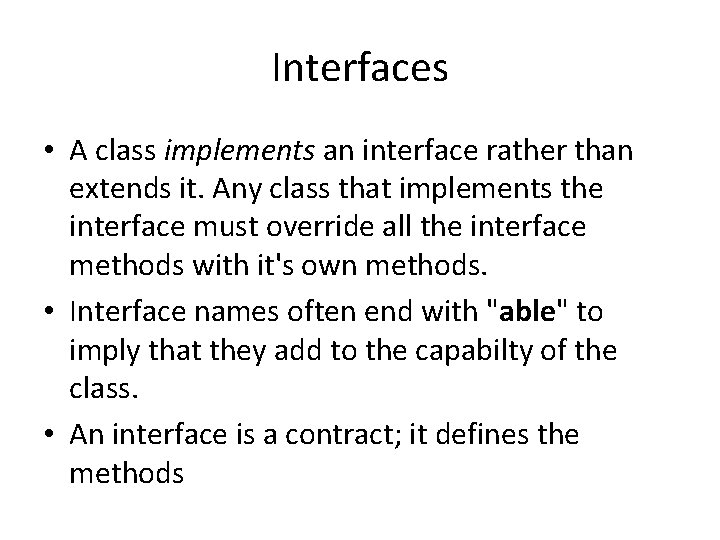
Interfaces • A class implements an interface rather than extends it. Any class that implements the interface must override all the interface methods with it's own methods. • Interface names often end with "able" to imply that they add to the capabilty of the class. • An interface is a contract; it defines the methods
- Slides: 29