
Agenda Environmental health and safety regulatory overview Waste
- Slides: 70
Agenda • Environmental, health, and safety regulatory overview • Waste determination • Container management • Other wastes • Manifests • Employee training • Emergency preparedness and response
Agenda Q&A session (RCRA) Wastewater pretreatment Pollution prevention Overview of the small quantity generator self-certification program • Q&A (all presenters) • Wrap up • •
Context • RCRA and other environmental and safety laws • ODEQ and EPA • ODEQ and other state agencies In Oklahoma • RCRA and other programs at ODEQ
Major Environmental and Safety Laws • Resource Conservation and Recovery Act (RCRA) • Occupational Safety and Health Act (OSHA) • Toxic Substances Control Act (TSCA) • Comprehensive Environmental Response, Compensation Liability Act (CERCLA/Superfund) • Safe Drinking Water Act (SDWA)
Major Environmental and Safety Laws • Federal Insecticide, Fungicide, and Rodenticide Act (FIFRA) • Clean Air Act (CAA) • Clean Water Act (CWA) • Atomic Energy Act (AEA) • Hazardous Materials Transportation Act (HMTA)
ODEQ and EPA • ODEQ is authorized by EPA to manage the hazardous waste regulatory program in the state of Oklahoma
ODEQ and Other State Agencies • • Oklahoma Corporation Commission Oklahoma Department of Transportation Oklahoma Department of Health Oklahoma Department of Mines Oklahoma Water Resources Board Oklahoma Conservation Commission Oklahoma Department of Wildlife
RCRA and Other Programs at DEQ • ODEQ Divisions – Land Protection Division – Water Quality Division – Air Quality Division – Environmental Complaints and Local Services Division – State Environmental Laboratory Services – Administrative Services Division
Programs in the Land Protection Division at ODEQ • Inspection/Permitting – Hazardous Waste Compliance and Inspection Section • SQG Self-Certification Program – Hazardous Waste Permitting and Corrective Action Section – Radiation Management Section – Solid Waste Compliance and Inspection Section – Tire Recycling Program – Underground Injection Control Unit
Programs in the Land Protection Division at ODEQ • Cleanup/Remediation – Brownfields Program – Land Restoration Section – Site Cleanup Assistance (SCAP) & Armory Cleanup Program – Superfund Site Remediation Section – Tar Creek Section – Voluntary Cleanup Program
Programs in the Land Protection Division at ODEQ • Assistance – Risk Management Section – Solid Waste Planning and Sustainability Unit – (SQG Self-Certification Program)
Waste Determination • Waste determination: Determining if a material meets the definition of a hazardous waste
Two Types of Hazardous Waste • Characteristic waste • Listed waste
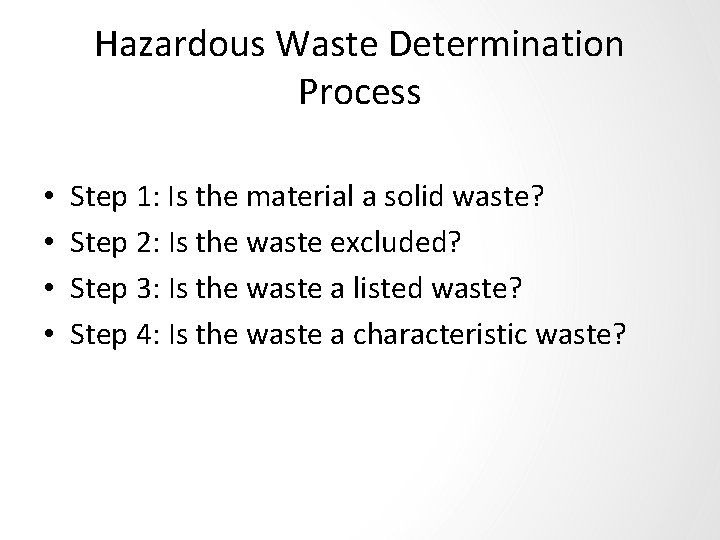
Hazardous Waste Determination Process • • Step 1: Is the material a solid waste? Step 2: Is the waste excluded? Step 3: Is the waste a listed waste? Step 4: Is the waste a characteristic waste?
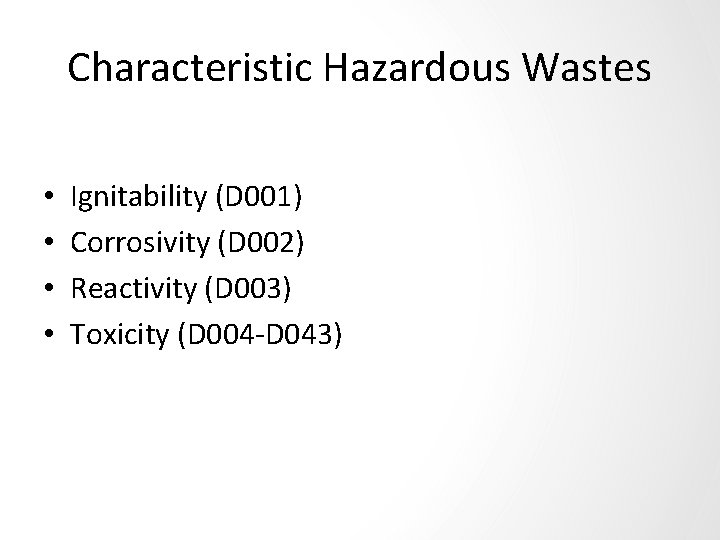
Characteristic Hazardous Wastes • • Ignitability (D 001) Corrosivity (D 002) Reactivity (D 003) Toxicity (D 004 -D 043)
Characteristic of Ignitability Applies to: • • Liquids Solids Ignitable compressed gases Oxidizers
Ignitable Liquid • A liquid that has a flash point <140° F (60° C)
How Do You Know If the Material Is a Liquid? • Knowledge • Paint Filter Liquids Test • Pressure Filtration Technique
How Is the Flash Point Determined? • A test flame is applied to fumes/vapors given off by the sample – Pensky-Martens Closed-Cup – Setaflash Closed-Cup
Alcohol-Content Exclusion • Aqueous solution • Contains <24% alcohol (by volume)
How Do You Know if a Liquid Waste Is Aqueous? • It contains at least 50% water (by weight)*
Ignitable Solid • Material is capable of ignition through: – Friction – Moisture absorption – Spontaneous ignition • Material must burn so vigorously and persistently that it creates a hazard
Ignitable Compressed Gas • Flammable when in a mixture of 13% or less with air • Has a flammable range with air of more than 12%
Oxidizer • Material that yields oxygen readily to stimulate the combustion of organic matter – Nitrates, permanganates, chlorates, and peroxide (organic and inorganic) are examples
Characteristic of Corrosivity • aqueous waste with a p. H <2. 0 or > 12. 5, acids or bases • liquid waste that corrodes carbon steel at a rate of >0. 25 inch (6. 35 mm) per year
How do you know if the Waste Is aqueous? • The material must contain at least 20% free water by volume* *The definition of aqueous is different when determining the p. H of a waste versus evaluating the applicability of the alcohol-content exclusion (where the alcohol must contain at least 50% water by weight).
How do you know if the Waste is a liquid? • Exactly the same process used for ignitable wastes: – Knowledge – Paint Filter Liquids Test – Pressure Filtration Technique
How Do You Know If You Have a Corrosive Solid • TRICK QUESTION: – There are no corrosive solids at the federal Level
Characteristic of Reactivity • Normally unstable and readily undergoes violent change without detonating • Reacts violently with water, i. e. elemental sodium or potassium • Forms potentially explosive mixtures with water
Characteristic of Reactivity • Generates toxic gases, vapors, or fumes in quantities sufficient to present a danger to human health or the environment when mixed with water • Cyanide or sulfide-bearing waste that generates toxic gases, vapors, or fumes in a quantity sufficient to present a danger to human health or the environment when exposed to conditions in which the p. H is between 2. 0 and 12. 5
Characteristic of Reactivity • Capable of detonation or explosive reaction if subjected to a strong initiating source or if heated under confinement • Is readily capable of detonation or explosive decomposition or reaction at standard temperature and pressure • Forbidden explosive (as defined by DOT)
Examples of Reactive Wastes • • • Cyanides Lithium-containing materials Sodium containing materials Sulfides Aluminum alkyls Acetyl chloride Chromic acid Hypochlorites perchlorates
Characteristic of Toxicity • Developed to protect groundwater • Includes: – 8 heavy metals • arsenic, barium, cadmium, chromium, lead, mercury, selenium, silver – 6 pesticides – 26 solvents or other organic chemicals
Toxicity Characteristic Leaching Procedure (TCLP) • Designed to simulate acidic conditions found in a municipal landfill • Extraction Procedure (EP) Toxicity Test was used prior to 1990
TCLP – Things to Keep in Mind • Reproducibility • Cost • Oily wastes and organic liquids
Alternatives to Using the TCLP • Process knowledge • Total waste analysis – “ 20 times rule” • Directly analyze liquid wastes for total concentration of toxic constituents – Wastes that contain less than 0. 5% filterable solids – The waste is already in liquid form - no extraction is necessary
Listed Wastes • F-List: Process wastes – not industry specific • K-List: Process wastes – industry specific • P and U-Lists: Discarded unused chemicals
Hazard Codes • Indicate the basis on which EPA listed a particular waste – Ignitable waste – (I) – Corrosive waste – (C) – Reactive waste – (R) – Toxicity characteristic waste – (E) – Acute hazardous waste – (H) – Toxic waste – (T)
ICR-Listed Wastes • Wastes That Are listed ONLY because they exhibit the characteristic of ignitability, corrosivity, and/or reactivity • 29 wastes meet this description • The ICR listing does not apply if the waste does not exhibit the associated characteristic at the point of generation
F-Listed Wastes • Spent solvents (F 001 -F 005) • Electroplating and other metal finishing wastes (F 006 -F 019) • Dioxin-containing wastes (F 020 -F 023 and F 026 -F 028) • Chlorinated aliphatic hydrocarbon production wastes (F 024 and F 025)
F-Listed Wastes • Wood preserving wastes (F 032, F 034, and F 035) • Petroleum refinery wastewater treatment sludges (F 037 and F 038) • Multisource leachate (F 039)
Spent Solvents • Used for its solvent properties • Too contaminated for further use (i. e. spent) • Meets a specific before-use concentration
F 001 • Halogenated solvents • Used in large-scale industrial degreasing operations • Includes five specific chemicals and one class of compounds
F 001 Solvents • • • Carbon tetrachloride Methylene chloride Tetrachloroethylene (perchloroethylene) 1, 1, 1 -trichloroethane Trichloroethylene Chlorinated fluorocarbons
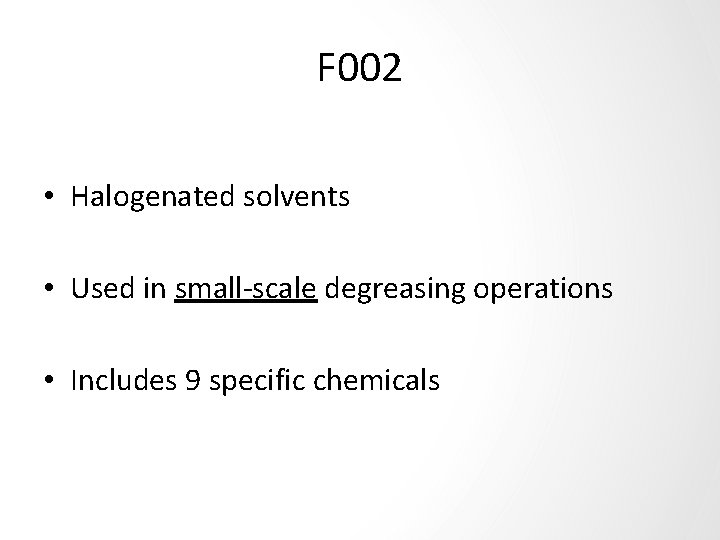
F 002 • Halogenated solvents • Used in small-scale degreasing operations • Includes 9 specific chemicals
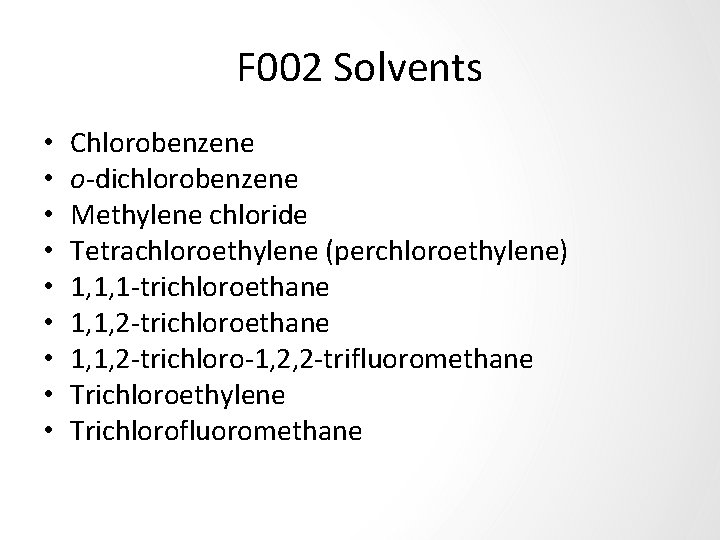
F 002 Solvents • • • Chlorobenzene o-dichlorobenzene Methylene chloride Tetrachloroethylene (perchloroethylene) 1, 1, 1 -trichloroethane 1, 1, 2 -trichloro-1, 2, 2 -trifluoromethane Trichloroethylene Trichlorofluoromethane
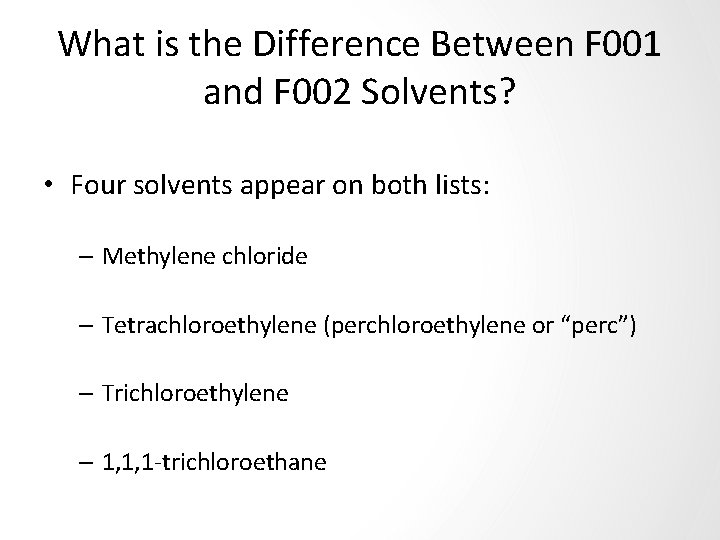
What is the Difference Between F 001 and F 002 Solvents? • Four solvents appear on both lists: – Methylene chloride – Tetrachloroethylene (perchloroethylene or “perc”) – Trichloroethylene – 1, 1, 1 -trichloroethane
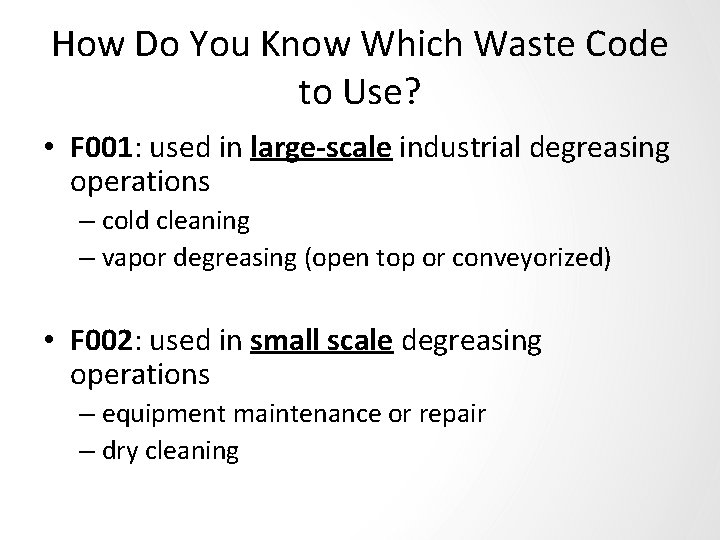
How Do You Know Which Waste Code to Use? • F 001: used in large-scale industrial degreasing operations – cold cleaning – vapor degreasing (open top or conveyorized) • F 002: used in small scale degreasing operations – equipment maintenance or repair – dry cleaning
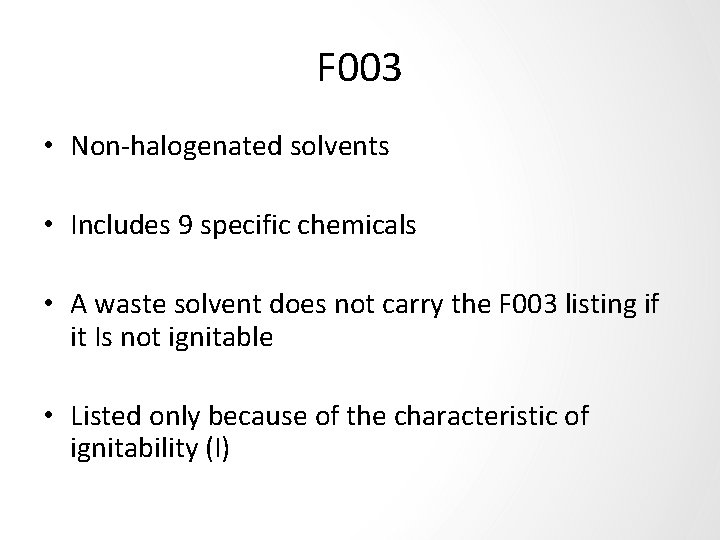
F 003 • Non-halogenated solvents • Includes 9 specific chemicals • A waste solvent does not carry the F 003 listing if it Is not ignitable • Listed only because of the characteristic of ignitability (I)
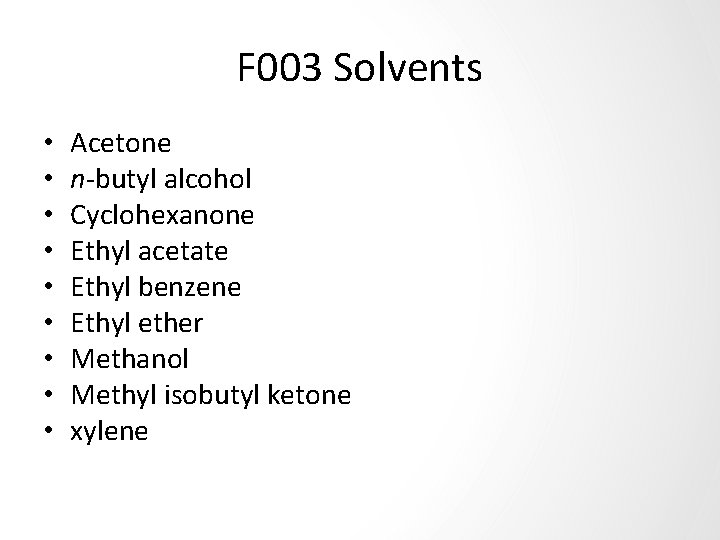
F 003 Solvents • • • Acetone n-butyl alcohol Cyclohexanone Ethyl acetate Ethyl benzene Ethyl ether Methanol Methyl isobutyl ketone xylene
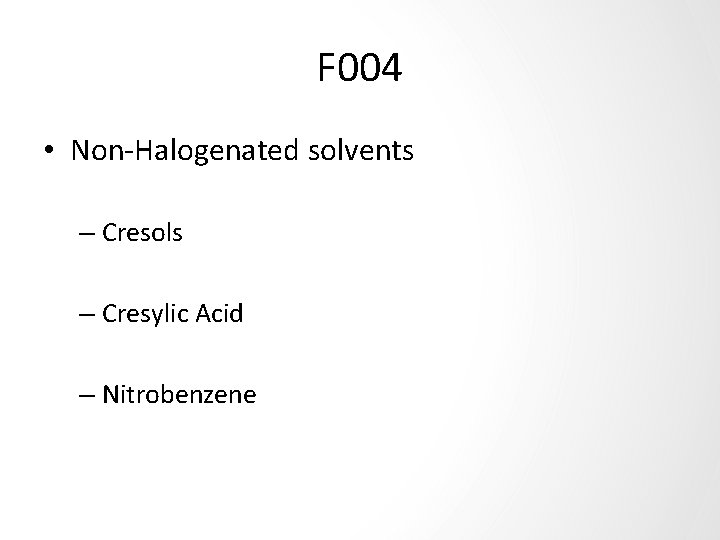
F 004 • Non-Halogenated solvents – Cresols – Cresylic Acid – Nitrobenzene
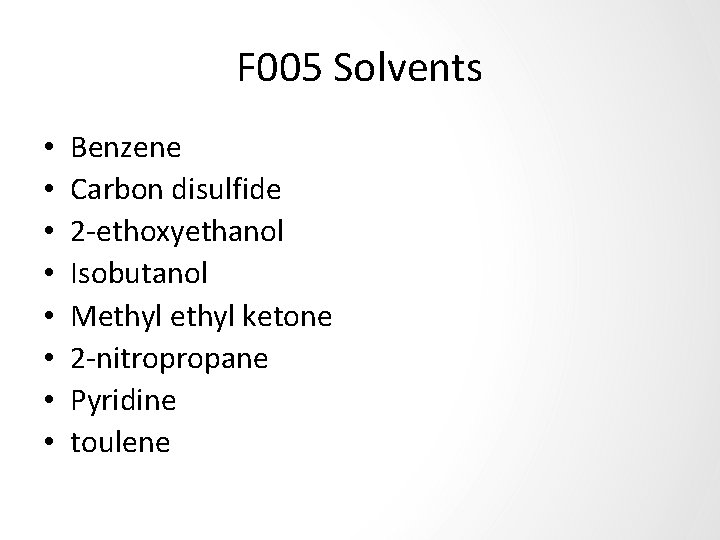
F 005 • Non-Halogenated Solvents • Includes 8 Specific Chemicals
F 005 Solvents • • Benzene Carbon disulfide 2 -ethoxyethanol Isobutanol Methyl ketone 2 -nitropropane Pyridine toulene
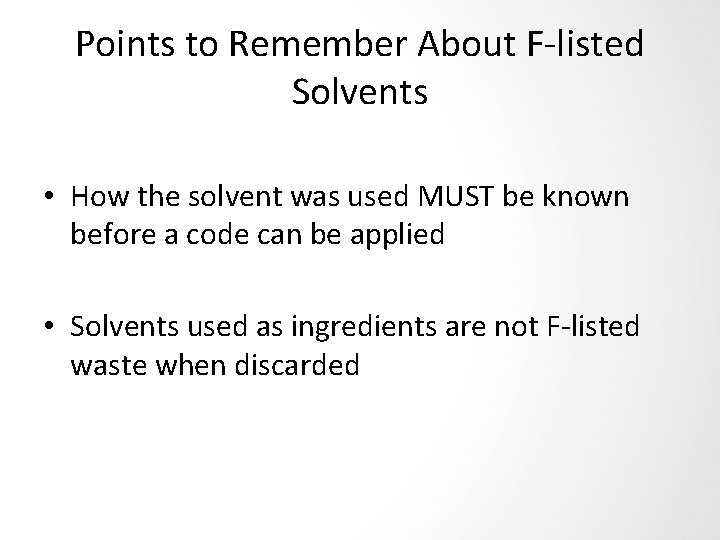
Points to Remember About F-listed Solvents • How the solvent was used MUST be known before a code can be applied • Solvents used as ingredients are not F-listed waste when discarded
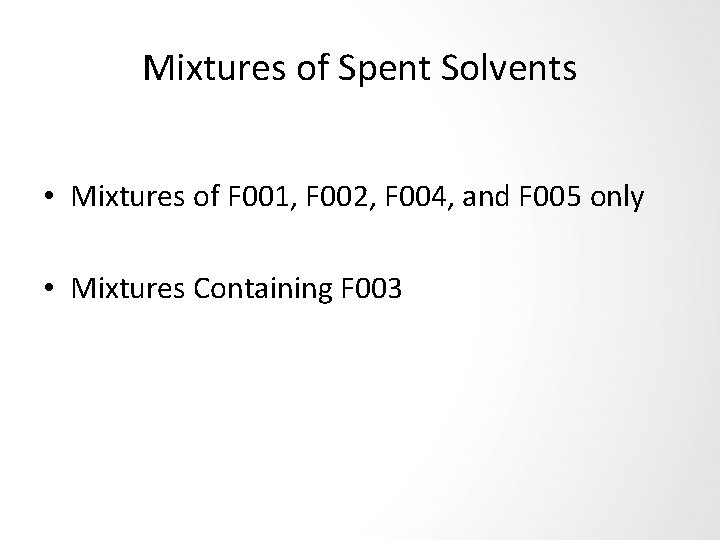
Mixtures of Spent Solvents • Mixtures of F 001, F 002, F 004, and F 005 only • Mixtures Containing F 003
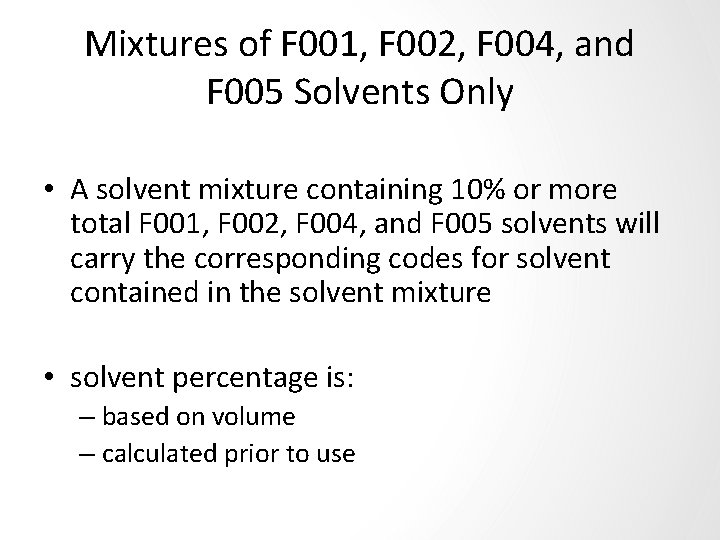
Mixtures of F 001, F 002, F 004, and F 005 Solvents Only • A solvent mixture containing 10% or more total F 001, F 002, F 004, and F 005 solvents will carry the corresponding codes for solvent contained in the solvent mixture • solvent percentage is: – based on volume – calculated prior to use
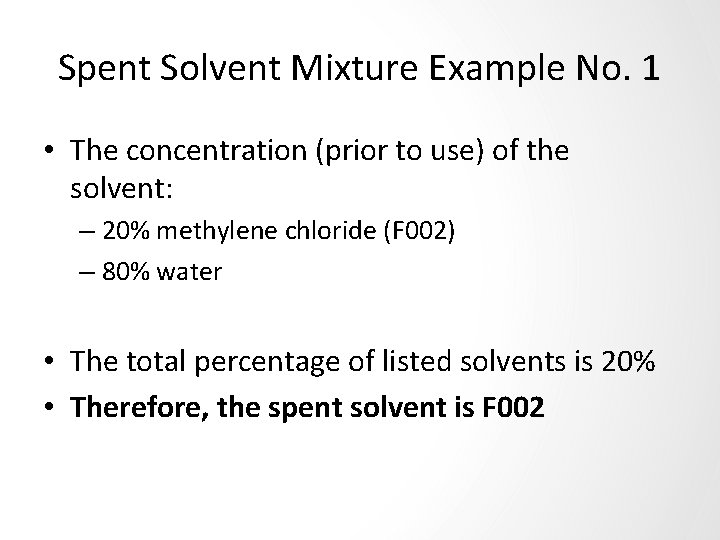
Spent Solvent Mixture Example No. 1 • The concentration (prior to use) of the solvent: – 20% methylene chloride (F 002) – 80% water • The total percentage of listed solvents is 20% • Therefore, the spent solvent is F 002
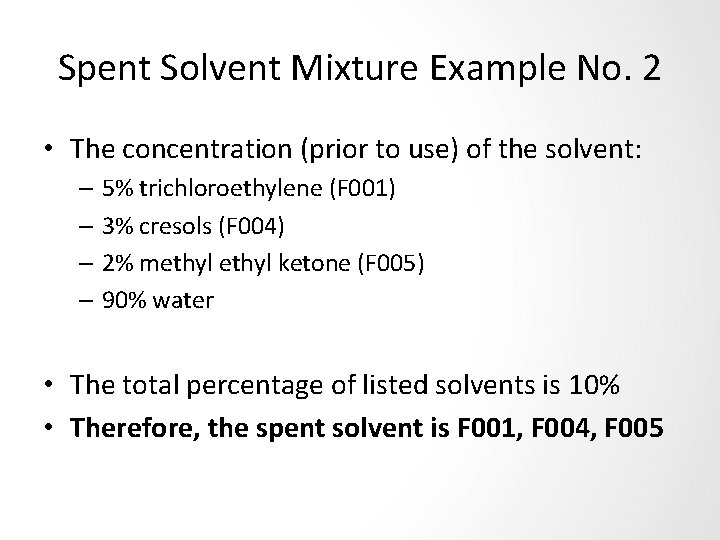
Spent Solvent Mixture Example No. 2 • The concentration (prior to use) of the solvent: – 5% trichloroethylene (F 001) – 3% cresols (F 004) – 2% methyl ketone (F 005) – 90% water • The total percentage of listed solvents is 10% • Therefore, the spent solvent is F 001, F 004, F 005
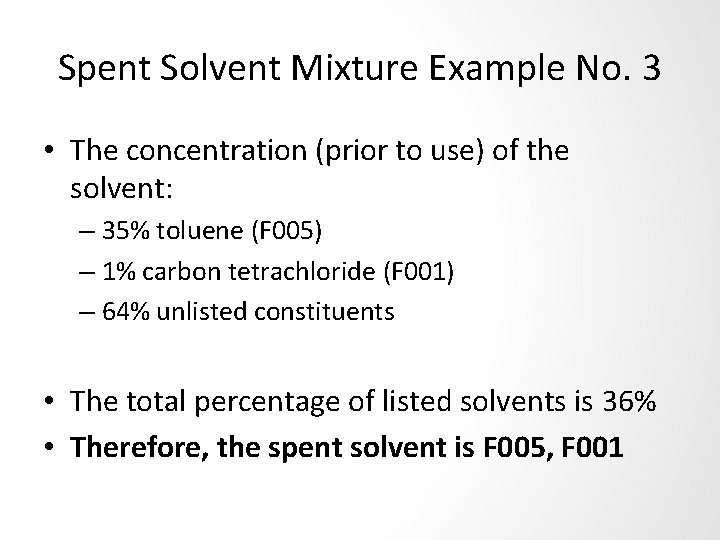
Spent Solvent Mixture Example No. 3 • The concentration (prior to use) of the solvent: – 35% toluene (F 005) – 1% carbon tetrachloride (F 001) – 64% unlisted constituents • The total percentage of listed solvents is 36% • Therefore, the spent solvent is F 005, F 001
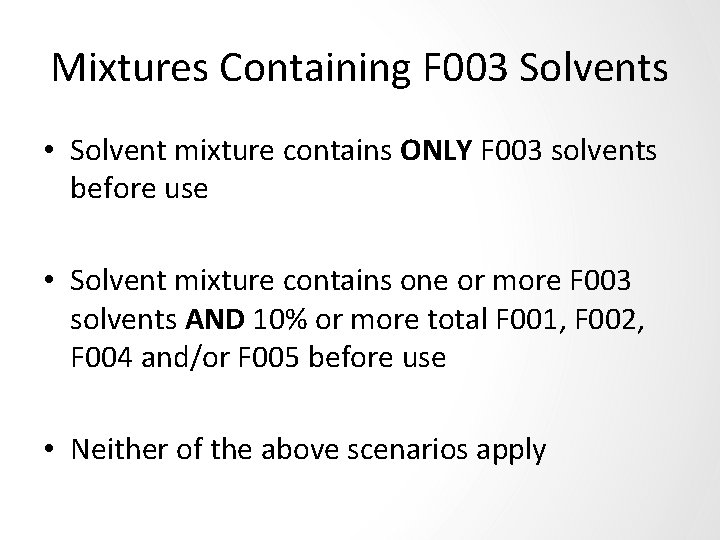
Mixtures Containing F 003 Solvents • Solvent mixture contains ONLY F 003 solvents before use • Solvent mixture contains one or more F 003 solvents AND 10% or more total F 001, F 002, F 004 and/or F 005 before use • Neither of the above scenarios apply
Spent Solvent Mixture Example No. 4 • The concentration (prior to use) of the solvent: – 100% acetone (F 003) • Therefore, the spent solvent is F 003 • The solvent can contain small percentages of chemical impurities and still be F 003
Spent Solvent Mixture Example No. 5 • The concentration (prior to use) of the solvent: – 91% xylene (F 003) – 9% tetrachloroethylene (F 002) • No spent solvent listing applies
Spent Solvent Mixture Example No. 6 • The concentration (prior to use) of the solvent: – 89% xylene (F 003) – 9% tetrachloroethylene (F 002) – 2% methyl ketone (F 005) • The spent solvent is F 003, F 002, F 005 NOTE: Additional examples of spent solvent mixtures can be found at: http: //www. epa. gov/waste/hazard/correctiveaction/curriculum/download/hwidlist. pdf
Specific Industries that Generate KListed Wastes • • Wood preservation Inorganic pigments Organic chemicals Inorganic chemicals Pesticides Explosives Petroleum refining
Specific Industries that Generate KListed Wastes • • • Iron and steel Primary aluminum Secondary lead Veterinary pharmaceuticals Ink formulation Coking
P and U-listed Wastes • Unused: – Commercial chemical products – Off-specification species – Container residues – Spilled product • The P and U list includes unused pharmaceuticals
P and U-listed Wastes • All P-listed wastes are “acutely” hazardous • Most U-listed wastes are toxic (nonacute) • Some U-listed wastes are listed because they exhibit the characteristic of ignitability (I), Corrosivity (C), or Reactivity (R) – ICR wastes
REVIEW: Hazardous Waste Determination Process • • Step 1: Is the material a solid waste? Step 2: Is the waste excluded? Step 3: Is the waste a listed waste? Step 4: Is the waste a characteristic waste? – Remember to perform these steps IN ORDER!
Generator Categories • Conditionally Exempt Small Quantity Generator (CESQG) • Small Quantity Generator (SQG) • Large Quantity Generator (LQG)
Small Quantity Generator • Generates between 220 and 2, 200 lbs. (100 and 1, 000 kg, respectively) of non-acute hazardous waste in a calendar month • Generates no more than 2. 2 lbs. (1 kg) of acute hazardous waste per calendar month • Generates no more than 220 lbs. (100 kg) of acute spill cleanup residue per calendar month • Onsite storage of hazardous waste does not exceed 13, 227 lbs. (6, 000 kg) at any one time