
Agenda Centralized Receivable System CRS Overview e Bill
Agenda • Centralized Receivable System (CRS) Overview • e. Bill • USDA-OCFO’s Implementation of CRS “FMMI-CRS” Interface • Implementation of CRS for other USDA Program Billings, using the FMMI to CRS Interface 1

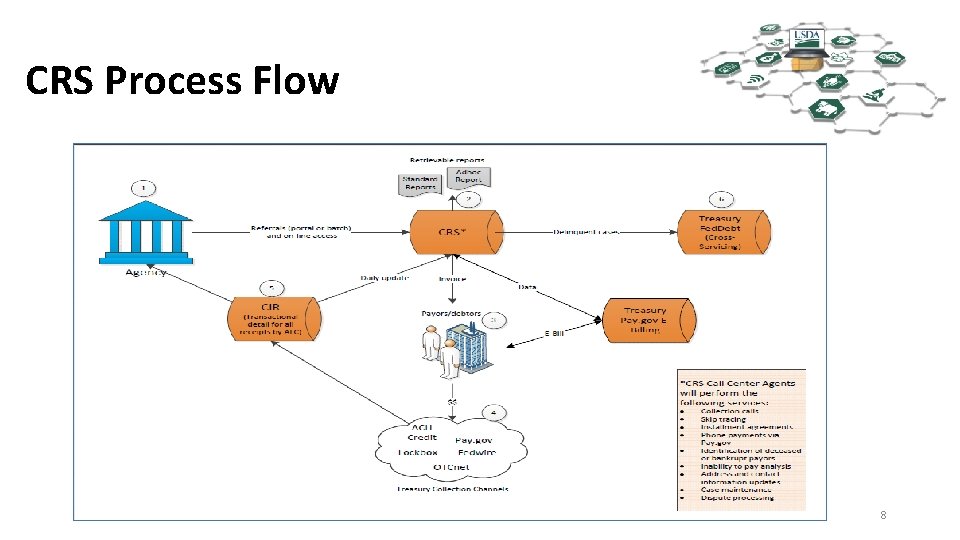
CRS Overview • CRS is a service provided by Treasury, at no charge to federal agencies to assist in the management of current, non-tax receivables • Agencies send receivables to CRS • CRS issues bills and handles debt management • CRS is operated by US Bank • US Bank call center handles inquires and follow up on delinquent debt • Collections go directly to Agency – Both CRS and agency receive collection data from the Treasury’s Collection Information Repository (CIR) • CRS performs no accounting services, but handles debt management services CRS is not an accounting system 2
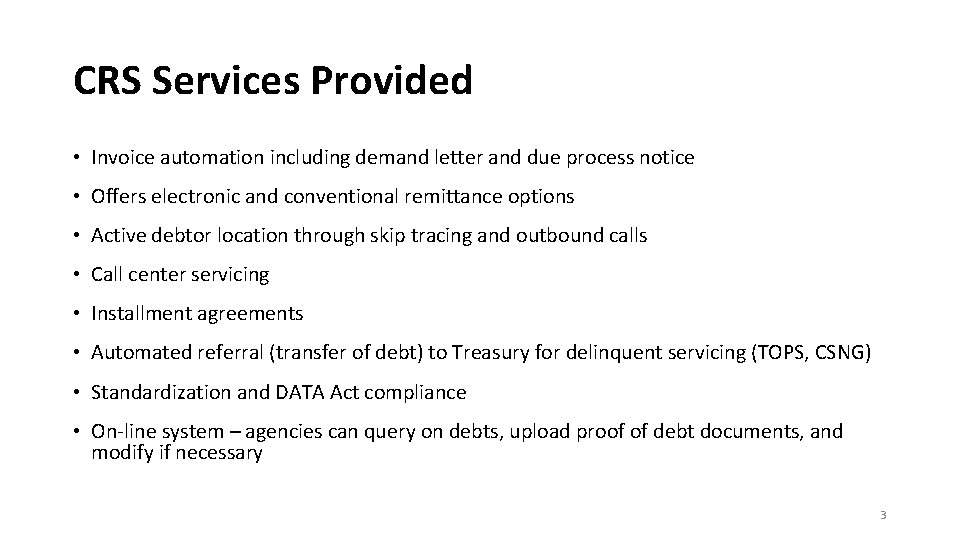
CRS Services Provided • Invoice automation including demand letter and due process notice • Offers electronic and conventional remittance options • Active debtor location through skip tracing and outbound calls • Call center servicing • Installment agreements • Automated referral (transfer of debt) to Treasury for delinquent servicing (TOPS, CSNG) • Standardization and DATA Act compliance • On-line system – agencies can query on debts, upload proof of debt documents, and modify if necessary 3
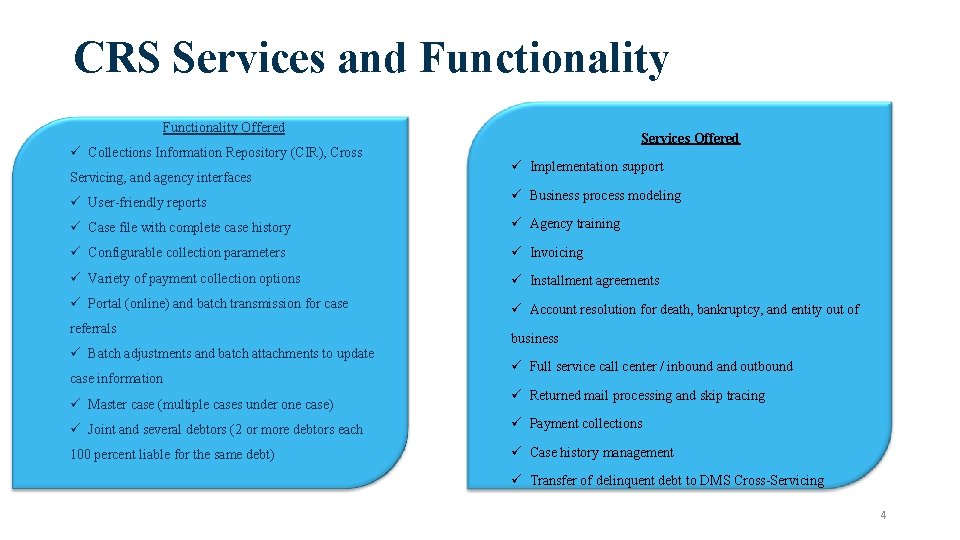
CRS Services and Functionality Offered ü Collections Information Repository (CIR), Cross Servicing, and agency interfaces ü User-friendly reports Services Offered ü Implementation support ü Business process modeling ü Case file with complete case history ü Agency training ü Configurable collection parameters ü Invoicing ü Variety of payment collection options ü Installment agreements ü Portal (online) and batch transmission for case ü Account resolution for death, bankruptcy, and entity out of referrals ü Batch adjustments and batch attachments to update case information ü Master case (multiple cases under one case) business ü Full service call center / inbound and outbound ü Returned mail processing and skip tracing ü Joint and several debtors (2 or more debtors each ü Payment collections 100 percent liable for the same debt) ü Case history management ü Transfer of delinquent debt to DMS Cross-Servicing 4
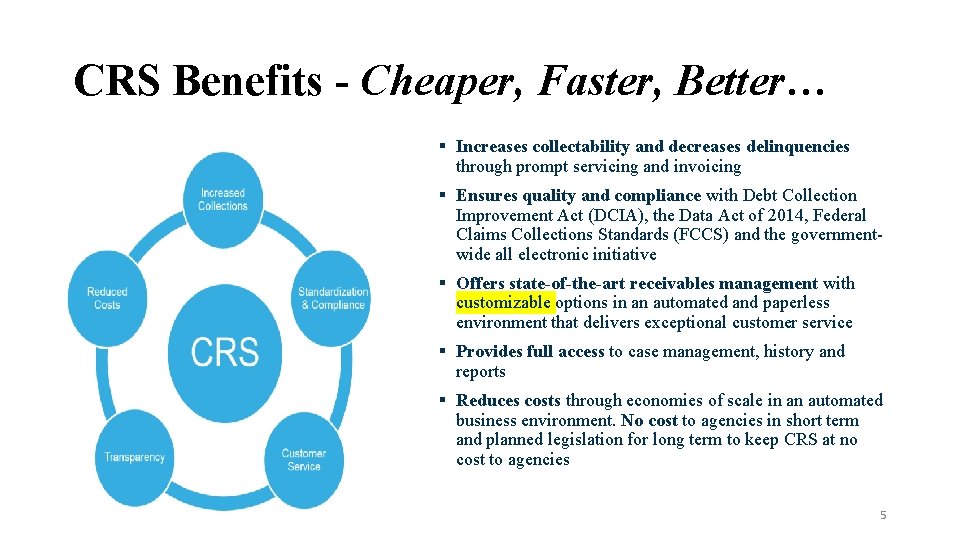
CRS Benefits - Cheaper, Faster, Better… § Increases collectability and decreases delinquencies through prompt servicing and invoicing § Ensures quality and compliance with Debt Collection Improvement Act (DCIA), the Data Act of 2014, Federal Claims Collections Standards (FCCS) and the governmentwide all electronic initiative § Offers state-of-the-art receivables management with customizable options in an automated and paperless environment that delivers exceptional customer service § Provides full access to case management, history and reports § Reduces costs through economies of scale in an automated business environment. No cost to agencies in short term and planned legislation for long term to keep CRS at no cost to agencies 5
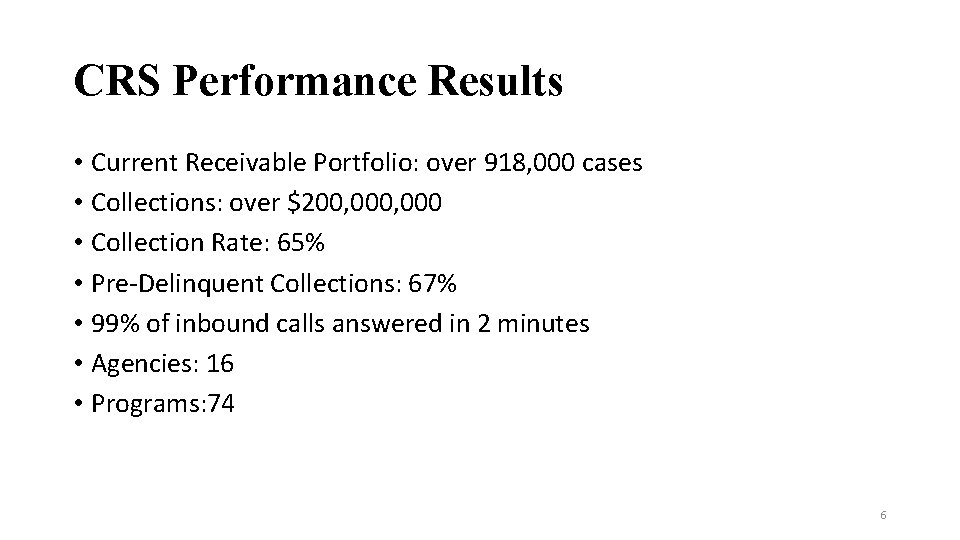
CRS Performance Results • Current Receivable Portfolio: over 918, 000 cases • Collections: over $200, 000 • Collection Rate: 65% • Pre-Delinquent Collections: 67% • 99% of inbound calls answered in 2 minutes • Agencies: 16 • Programs: 74 6

CRS Receivable Life Cycle 7
CRS Process Flow 8

CRS - Collection Options • Agency chooses collection options to use • Lockbox, OTCnet, Pay. gov Fedwire, ebill, etc. • Choose one or more options • Collection options specific to each application • For USDA Travel Relocation – e. Bill chosen as sole option 9
e. Bill’s • e. Bill • “The way to eliminate unapplied collections!” 10
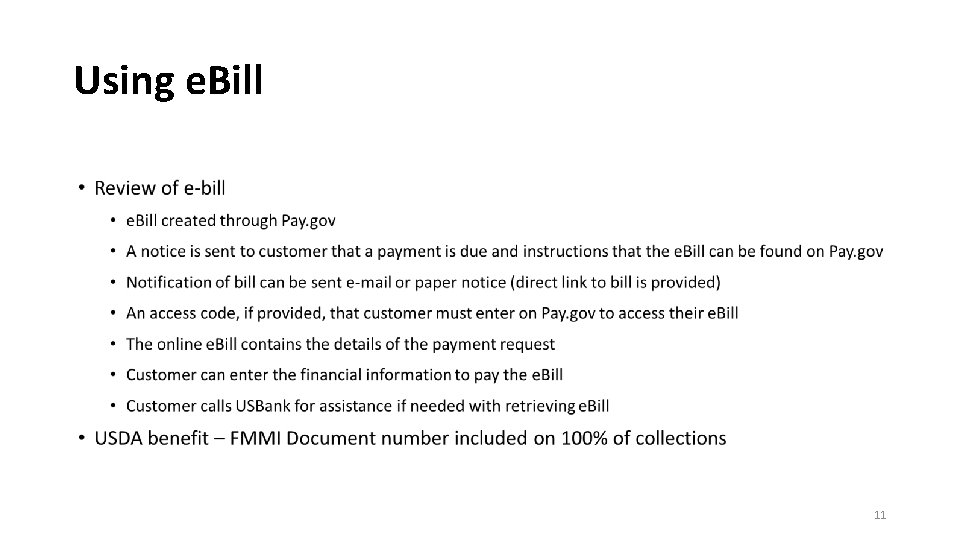
Using e. Bill 11
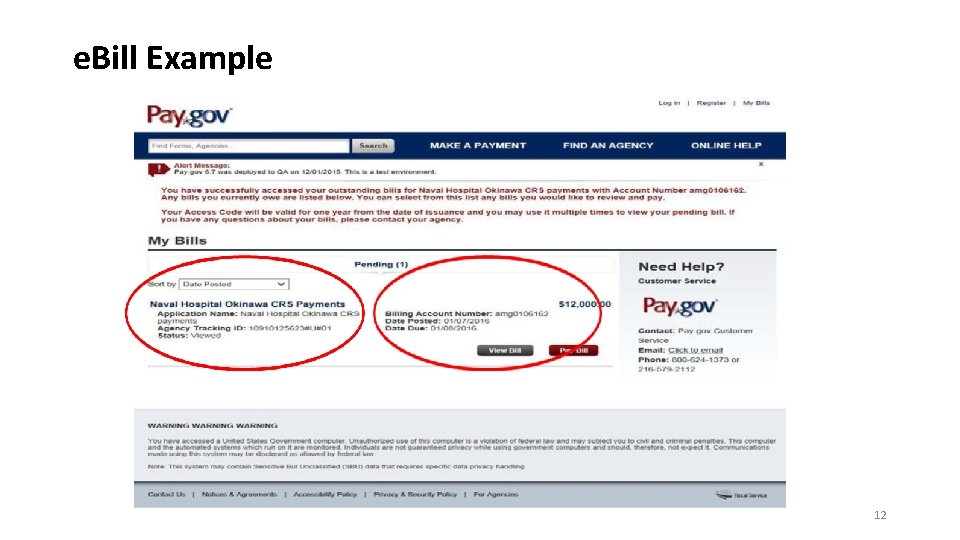
e. Bill Example 12
The FMMI-CRS Interface 13
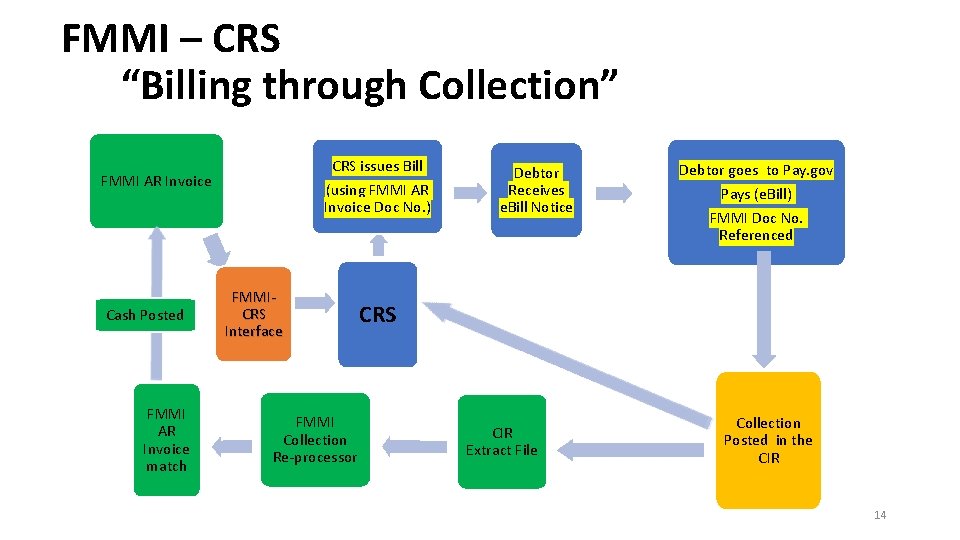
FMMI – CRS “Billing through Collection” CRS issues Bill FMMI AR Invoice Cash Posted FMMI AR Invoice match (using FMMI AR Invoice Doc No. ) FMMICRS Interface FMMI Collection Re-processor Debtor Receives e. Bill Notice Debtor goes to Pay. gov Pays (e. Bill) FMMI Doc No. Referenced CRS CIR Extract File Collection Posted in the CIR 14
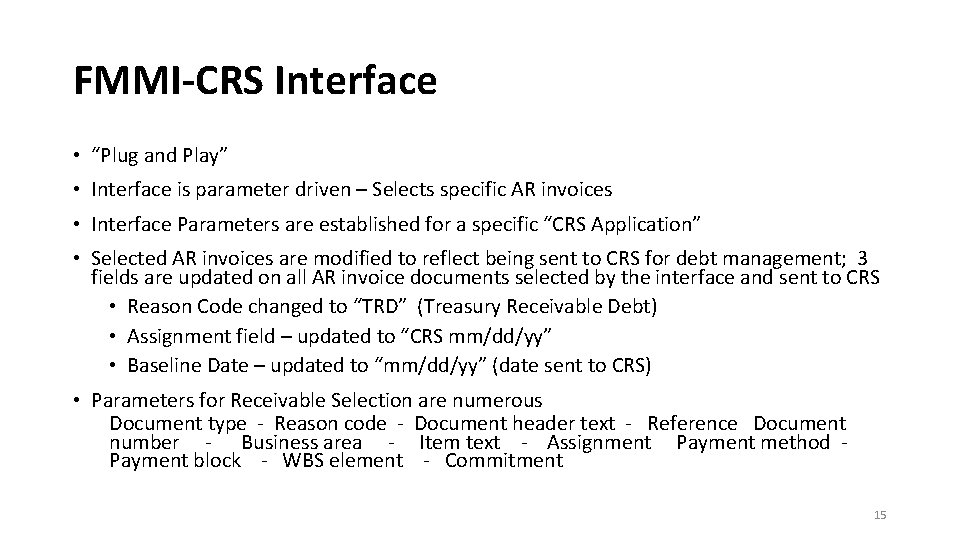
FMMI-CRS Interface • “Plug and Play” • Interface is parameter driven – Selects specific AR invoices • Interface Parameters are established for a specific “CRS Application” • Selected AR invoices are modified to reflect being sent to CRS for debt management; 3 fields are updated on all AR invoice documents selected by the interface and sent to CRS • Reason Code changed to “TRD” (Treasury Receivable Debt) • Assignment field – updated to “CRS mm/dd/yy” • Baseline Date – updated to “mm/dd/yy” (date sent to CRS) • Parameters for Receivable Selection are numerous Document type - Reason code - Document header text - Reference Document number - Business area - Item text - Assignment Payment method Payment block - WBS element - Commitment 15
FMMI-CRS Interface • Parameters allow for standard verbiage to be contained on demand letters, specific for the program/application for which interface is being run • Important FMMI Reference Numbers flow through to CRS, and contained on debt notices issued by CRS • Currently running for Travel Relocation Debts established through the “move. LINQ-FMMI Interface” • See example on following page 16
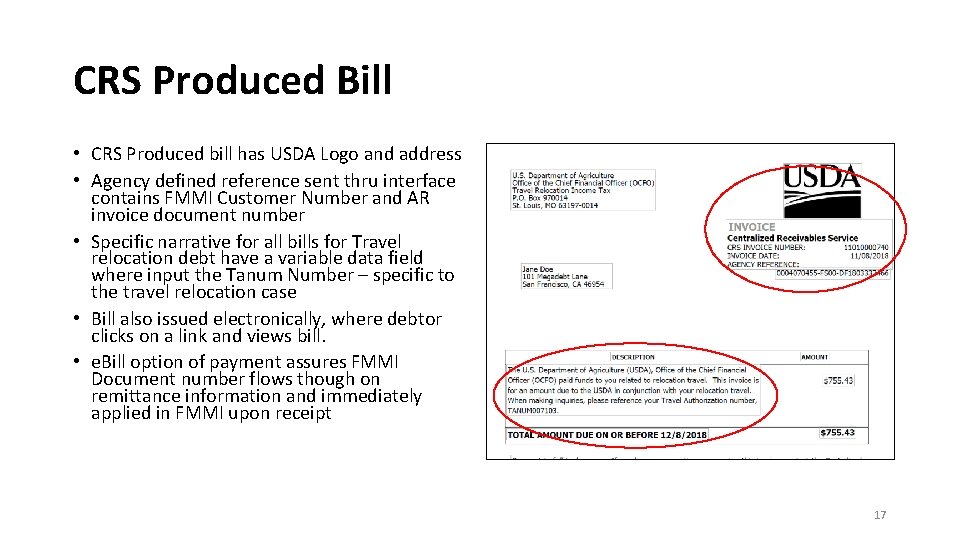
CRS Produced Bill • CRS Produced bill has USDA Logo and address • Agency defined reference sent thru interface contains FMMI Customer Number and AR invoice document number • Specific narrative for all bills for Travel relocation debt have a variable data field where input the Tanum Number – specific to the travel relocation case • Bill also issued electronically, where debtor clicks on a link and views bill. • e. Bill option of payment assures FMMI Document number flows though on remittance information and immediately applied in FMMI upon receipt 17
Questions • Next Implementation. . . • Forest Service 18
CENTRAL RECEIVABLES SERVICE (CRS) Matthews Smith July 2019 Caring for the Land Serving People.
CFO Financial Policy Responsible formulating and prescribing Agency-wide financial management policies and procedures, accounting standards and controls, and for providing assistance in their implementation and use. 20
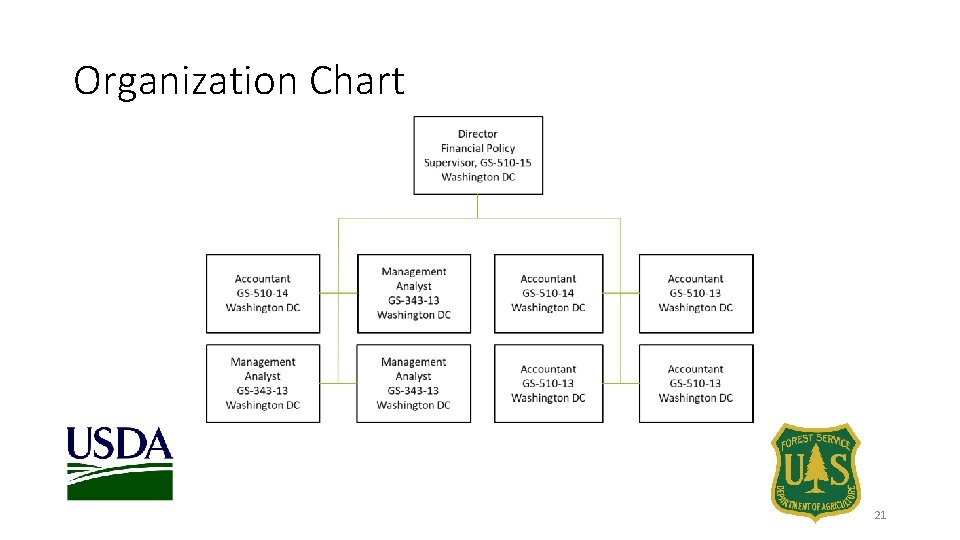
Organization Chart 21
Storyline • FY 2017: Systematic Issues • FY 2018: Strategic Working Group • FY 2019: CRS Discussions w/FMS & Treasury • FY 2020: CRS Implementation Phase I • FY 2021: CRS Implementation Phase II 22

Process • Feeder Systems → FMMI • FMMI (Batch) → CRS • Pay. Gov & OTCnet (POSS) • Automation* → FMMI 23
Misc. Bills • Individual & Commercial • 50 Receivables ($100 K) • Approx. $30 K Delinquent Debt 24
Special Uses • Individual, Commercial, Government • 48 K Receivables ($135 MM) • Approx. $7 MM Delinquent Debt 25
Phase I • Executive Buy-in June 7, 2019 • Kickoff Meeting June 27, 2019 • Technical Meetings July-October 2019 • Technical Release November 16, 2019* 26
Phase II • Kickoff Meeting Spring 2019 • Technical Meetings Summer 2019 • Technical Release Fall 2019 • Targeted Programs: Agreements & Timber 27
Questions? 28
- Slides: 28