
Agenda AP Computer Science exam Ap Exam question
![Arrays • 1 dimensional array int [] int. Arry = new int[10]; char[] char.](https://slidetodoc.com/presentation_image_h2/27c63f2d527588410a8e9d6ec9427722/image-17.jpg "Arrays • 1 dimensional array int [] int. Arry = new int[10]; char[] char.")
![Matrix Multiplication • Look at Appendix AA [ 1 2 -2 0] [-3 4](https://slidetodoc.com/presentation_image_h2/27c63f2d527588410a8e9d6ec9427722/image-21.jpg "Matrix Multiplication • Look at Appendix AA [ 1 2 -2 0] [-3 4")
- Slides: 21
Agenda • • • AP Computer Science exam Ap Exam question types Ap scores calculation Topics for the AP exam Reviews of last semester materials homework
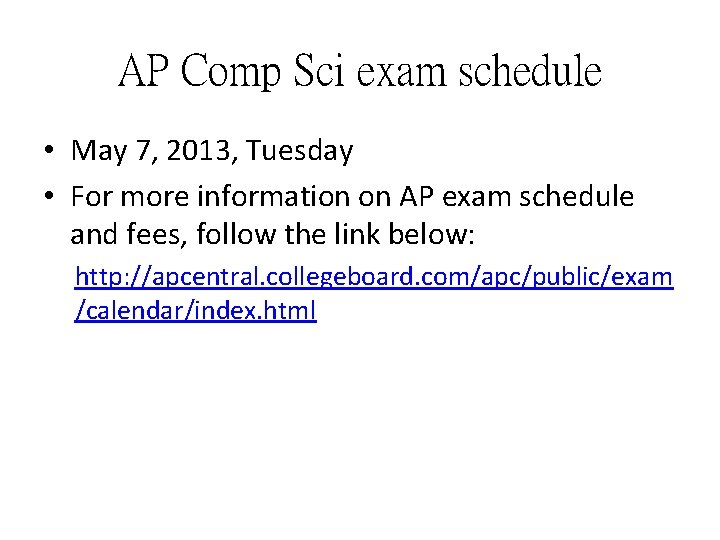
AP Comp Sci exam schedule • May 7, 2013, Tuesday • For more information on AP exam schedule and fees, follow the link below: http: //apcentral. collegeboard. com/apc/public/exam /calendar/index. html
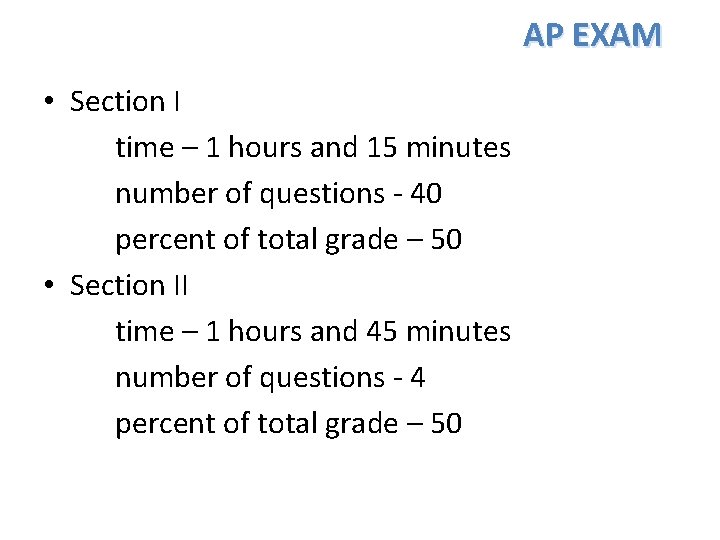
AP EXAM • Section I time – 1 hours and 15 minutes number of questions - 40 percent of total grade – 50 • Section II time – 1 hours and 45 minutes number of questions - 4 percent of total grade – 50
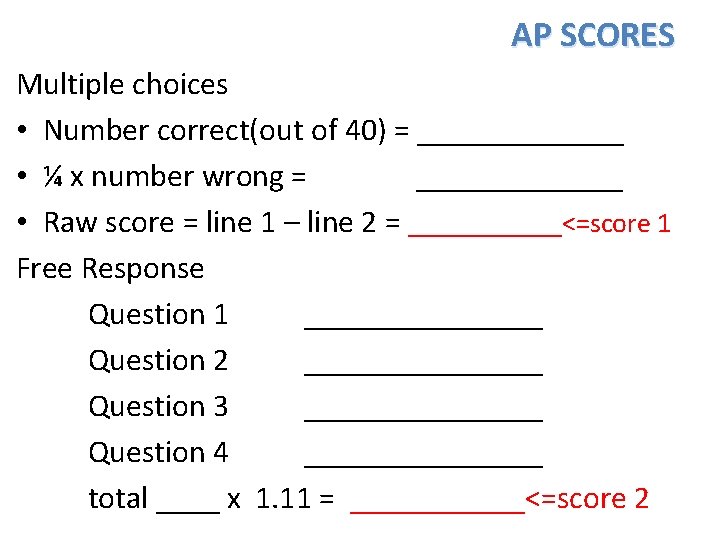
AP SCORES Multiple choices • Number correct(out of 40) = _______ • ¼ x number wrong = _______ • Raw score = line 1 – line 2 = ______<=score 1 Free Response Question 1 ________ Question 2 ________ Question 3 ________ Question 4 ________ total ____ x 1. 11 = ______<=score 2
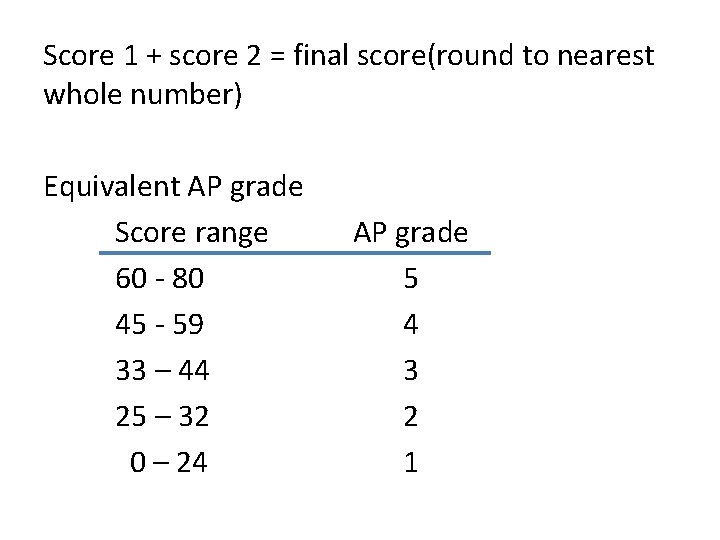
Score 1 + score 2 = final score(round to nearest whole number) Equivalent AP grade Score range 60 - 80 45 - 59 33 – 44 25 – 32 0 – 24 AP grade 5 4 3 2 1
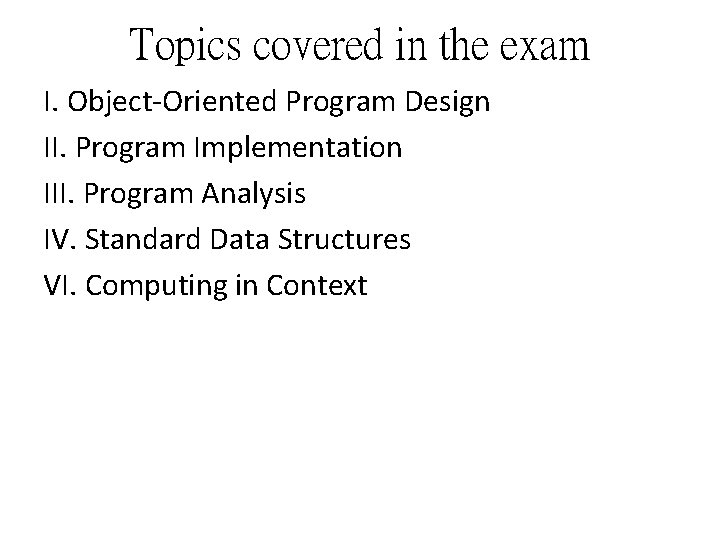
Topics covered in the exam I. Object-Oriented Program Design II. Program Implementation III. Program Analysis IV. Standard Data Structures VI. Computing in Context
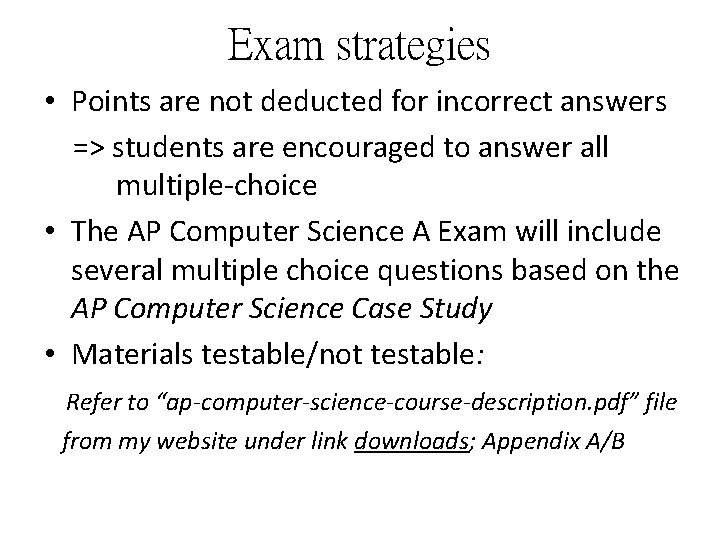
Exam strategies • Points are not deducted for incorrect answers => students are encouraged to answer all multiple-choice • The AP Computer Science A Exam will include several multiple choice questions based on the AP Computer Science Case Study • Materials testable/not testable: Refer to “ap-computer-science-course-description. pdf” file from my website under link downloads; Appendix A/B
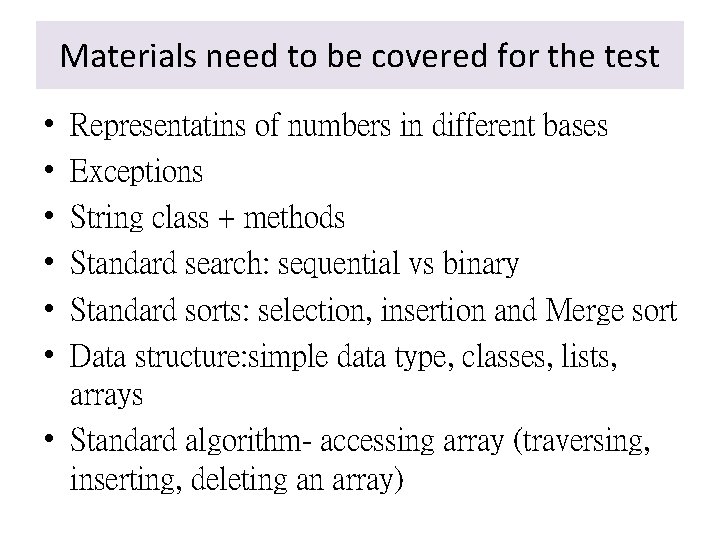
Materials need to be covered for the test • • • Representatins of numbers in different bases Exceptions String class + methods Standard search: sequential vs binary Standard sorts: selection, insertion and Merge sort Data structure: simple data type, classes, lists, arrays • Standard algorithm- accessing array (traversing, inserting, deleting an array)
IV. Standard Data Structures Data structures are used to represent information within a program. Abstraction is an important theme in the development and application of data structures. A. Simple data types (int, boolean, double) B. Classes C. Lists D. Arrays
V. Standard Algorithms A. Operations on data structures previously listed 1. Traversals 2. Insertions 3. Deletions B. Searching 1. Sequential 2. Binary C. Sorting 1. Selection 2. Insertion 3. Mergesort
Reviews • • Variable types – primitive vs reference Strings If/switch statement methods loop structures Arrays Classes/objects Grid. Wrold
Variable types • • Primitive data types? Reference data types? Where do you put the data types? What is the differences between these two types?
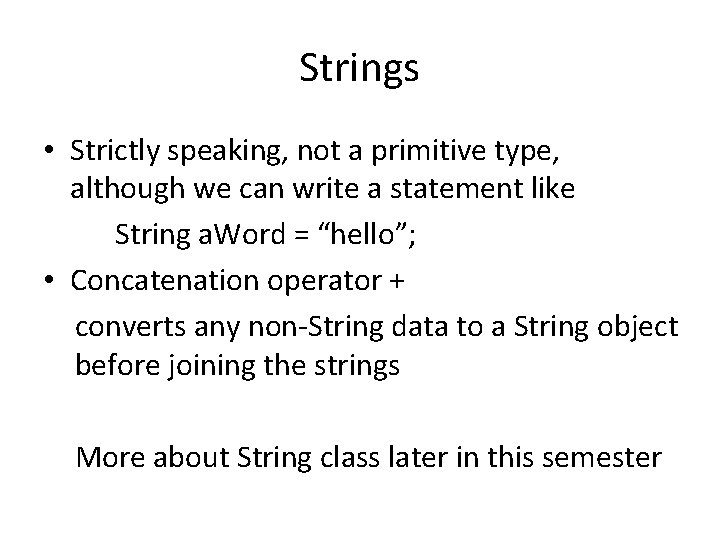
Strings • Strictly speaking, not a primitive type, although we can write a statement like String a. Word = “hello”; • Concatenation operator + converts any non-String data to a String object before joining the strings More about String class later in this semester
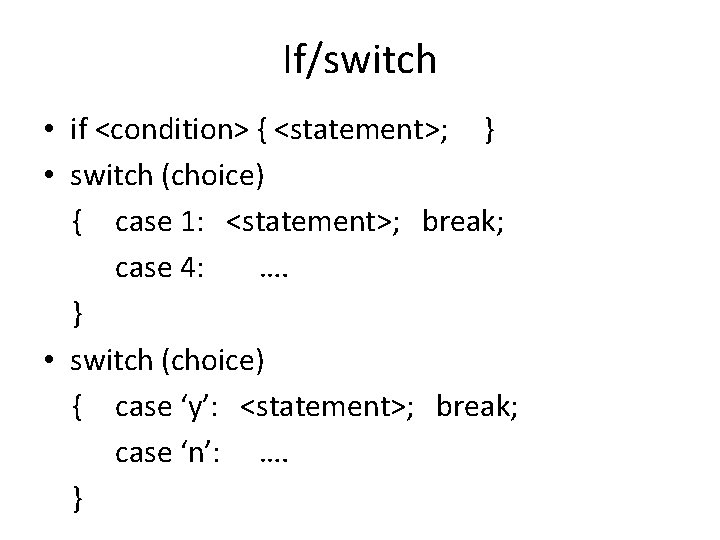
If/switch • if <condition> { <statement>; } • switch (choice) { case 1: <statement>; break; case 4: …. } • switch (choice) { case ‘y’: <statement>; break; case ‘n’: …. }
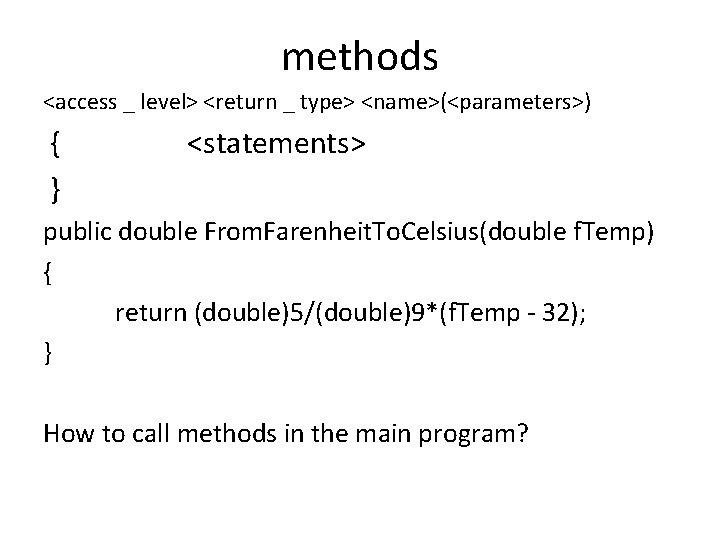
methods <access _ level> <return _ type> <name>(<parameters>) { } <statements> public double From. Farenheit. To. Celsius(double f. Temp) { return (double)5/(double)9*(f. Temp - 32); } How to call methods in the main program?
Loop structure • • while loop do while loop for loop Enhanced for loop
Arrays • 1 dimensional array int [] int. Arry = new int[10]; char[] char. Arry = new char[3]; Car[] car. Arry = new Car[2]; • 2 dimensional array int[][] int. Arry = new int[2][3]; char[][] char. Arry = new char[1][2]; Car[][] car. Arry = new Car[3][2];
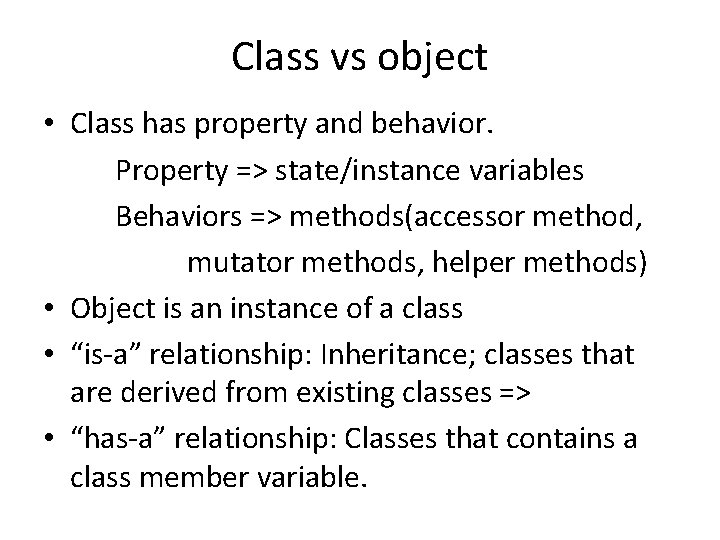
Class vs object • Class has property and behavior. Property => state/instance variables Behaviors => methods(accessor method, mutator methods, helper methods) • Object is an instance of a class • “is-a” relationship: Inheritance; classes that are derived from existing classes => • “has-a” relationship: Classes that contains a class member variable.
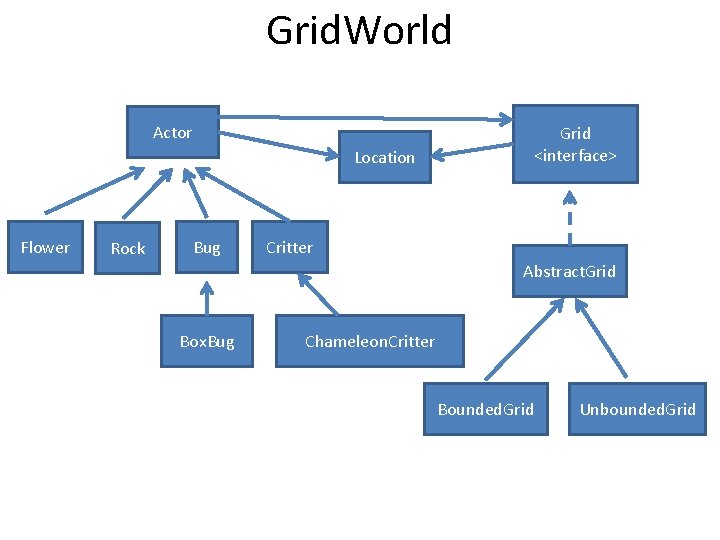
Grid. World Actor Location Flower Rock Bug Grid <interface> Critter Abstract. Grid Box. Bug Chameleon. Critter Bounded. Grid Unbounded. Grid
Homework • Preview BPJ 14, Barron’s P 54 -56 • BPJ 35 Matrix Multiplication project Level 1 – put the 3 tables into 3 2 -dimensional arrays and use two for loops to print them out. Level 2 – level 1 work + contest type problems. Level 3 – write the whole project, but you don’t need to write the class, just use main() to do everything; follow my algorithm mentioned in class to write the codes, otherwise you got only half score.
Matrix Multiplication • Look at Appendix AA [ 1 2 -2 0] [-3 4 7 2] [6 0 3 1 ] [-1 3 ] [-3 43] X [0 9 ] = [18 -60] [ 1 -11] [ 1 -5 ] [ 4 -5 ] 1*(-1) + 2*0 + (-2) * 1 + 0 * 4 = -3 c(0, 0) = a(0, 0) * b(0, 0) + a(0, 1) *b(1, 0)+a(0, 2)*b(2, 0) + a(0, 3) * b(4, 0)