
Agenda 11 12 19 Goals learn about proposing
Agenda 11 -12 -19 • Goals – learn about proposing and ratifying amendments to the Constitution, Bill of Rights and other Amendments, and Judicial Review • 3. 3 Notes – Will be turned in at end of class • Online quiz and written response • When I have you get the computers, your computer is the same number as your phone parking spot
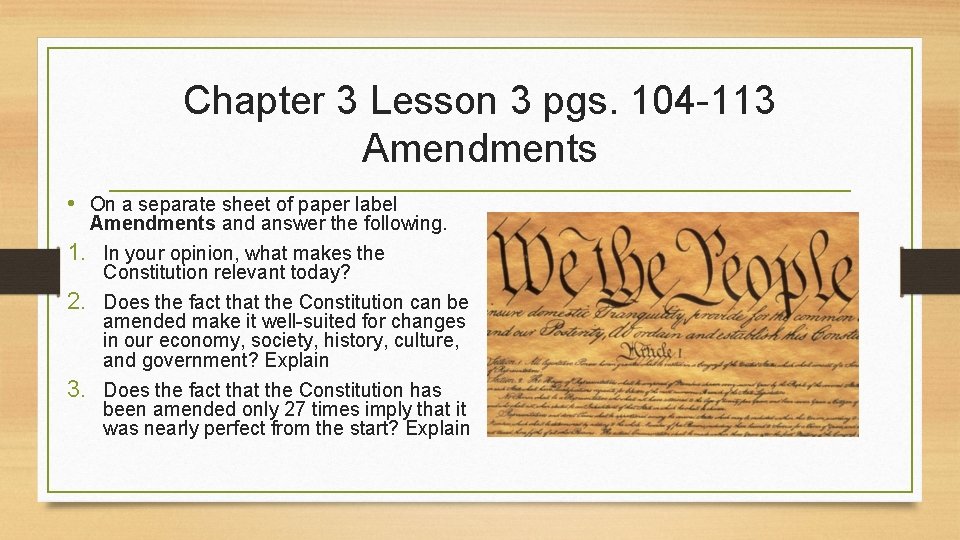
Chapter 3 Lesson 3 pgs. 104 -113 Amendments • On a separate sheet of paper label Amendments and answer the following. 1. In your opinion, what makes the Constitution relevant today? 2. Does the fact that the Constitution can be amended make it well-suited for changes in our economy, society, history, culture, and government? Explain 3. Does the fact that the Constitution has been amended only 27 times imply that it was nearly perfect from the start? Explain

Amending the Constitution • Why might we need to amend the Constitution? Talk in your quad • I will call on 3 people • Things don’t always go as expected… • 18 th amendment was thought to make people more efficient and moral. It would eliminate vices, immoral behavior and violence. • 21 st amendment created jobs and tax money
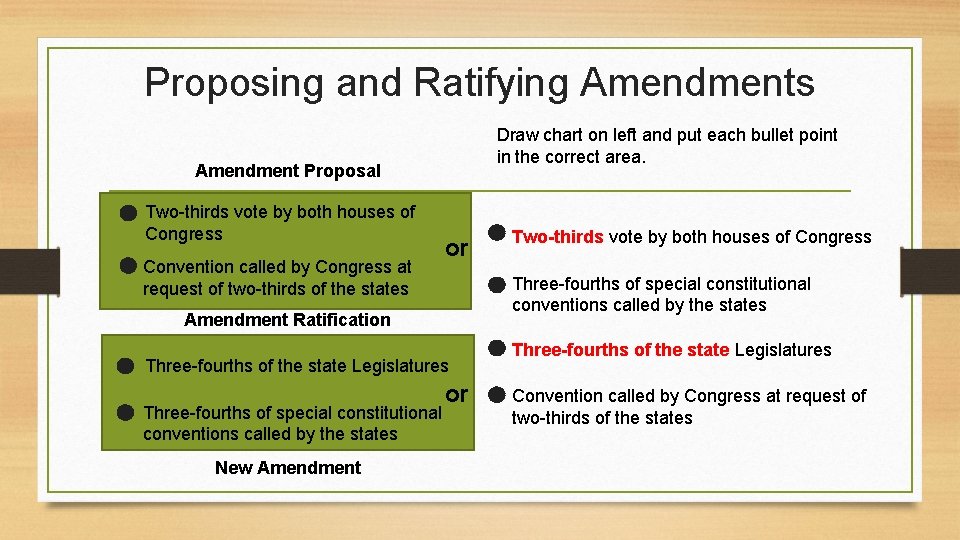
Proposing and Ratifying Amendments Draw chart on left and put each bullet point in the correct area. Amendment Proposal Two-thirds vote by both houses of Congress Convention called by Congress at request of two-thirds of the states or Three-fourths of special constitutional conventions called by the states Amendment Ratification Three-fourths of the state Legislatures Three-fourths of special constitutional conventions called by the states New Amendment Two-thirds vote by both houses of Congress or Three-fourths of the state Legislatures Convention called by Congress at request of two-thirds of the states
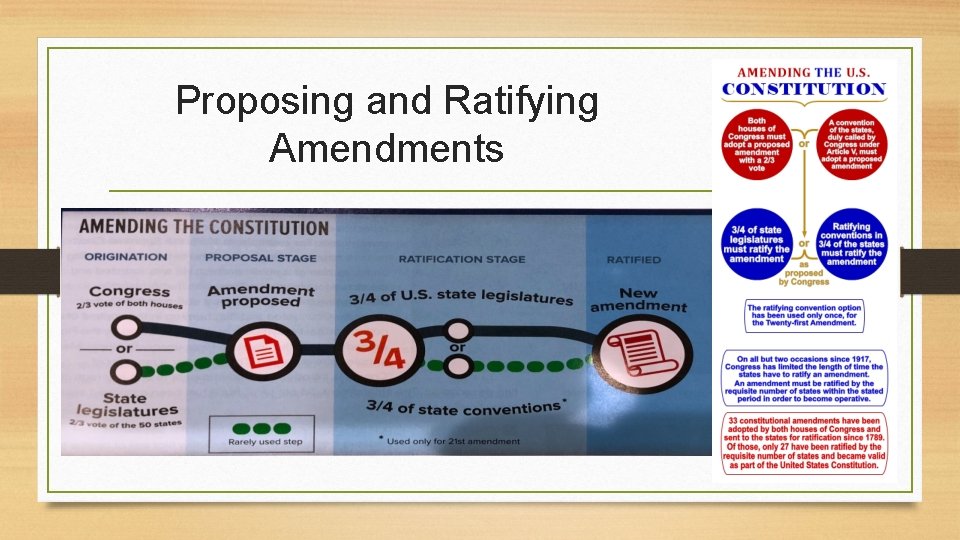
Proposing and Ratifying Amendments
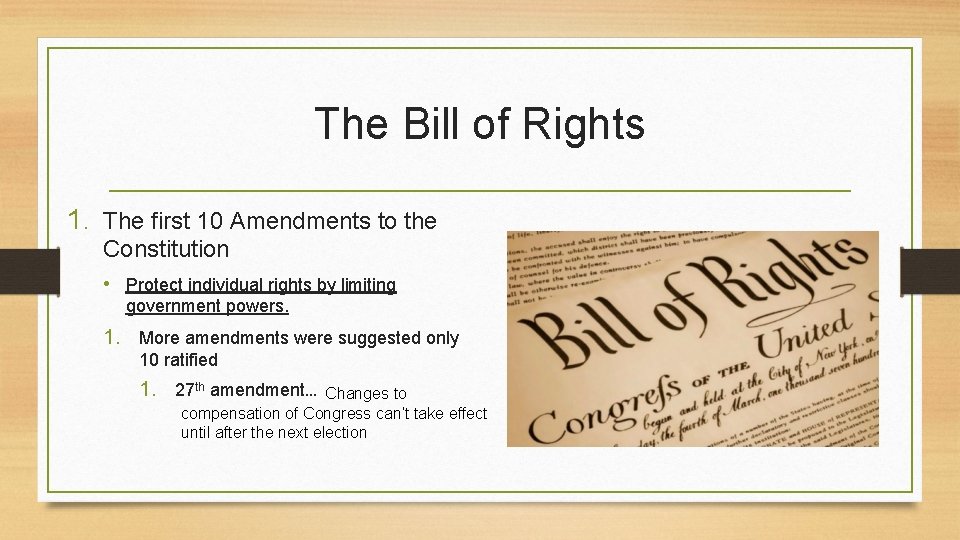
The Bill of Rights 1. The first 10 Amendments to the Constitution • Protect individual rights by limiting government powers. 1. More amendments were suggested only 10 ratified 1. 27 th amendment… Changes to compensation of Congress can’t take effect until after the next election
The Bill of Rights • 1 st Amendment: • Freedom of religion, • Take two minutes to write out your answers to the questions, • What might your life look like speech, press, assembly, • and petition without the 1 st Amendment? How might our country be different without the 1 st Amendment? • After two minutes talk to your neighbor about your answers
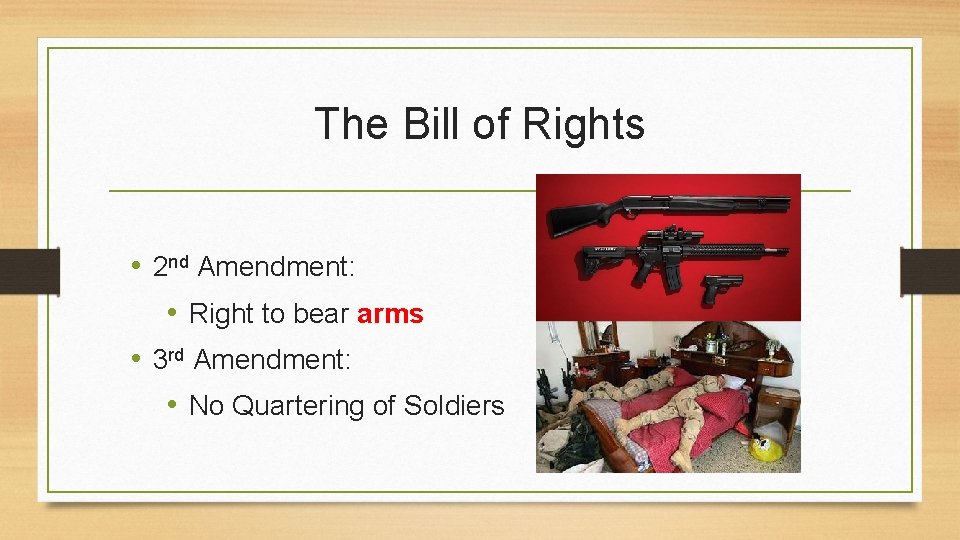
The Bill of Rights • 2 nd Amendment: • Right to bear arms • 3 rd Amendment: • No Quartering of Soldiers

The Bill of Rights • 4 th Amendment: • Freedom from unreasonable search and seizures without probable cause • In your notes take a moment to write a definition for unreasonable that applies to today • In the 4 th Amendment I think unreasonable means… • 5 th Amendment: • Due process of law, no double jeopardy, don’t have to testify against yourself or spouse • “I Plead the 5 th”
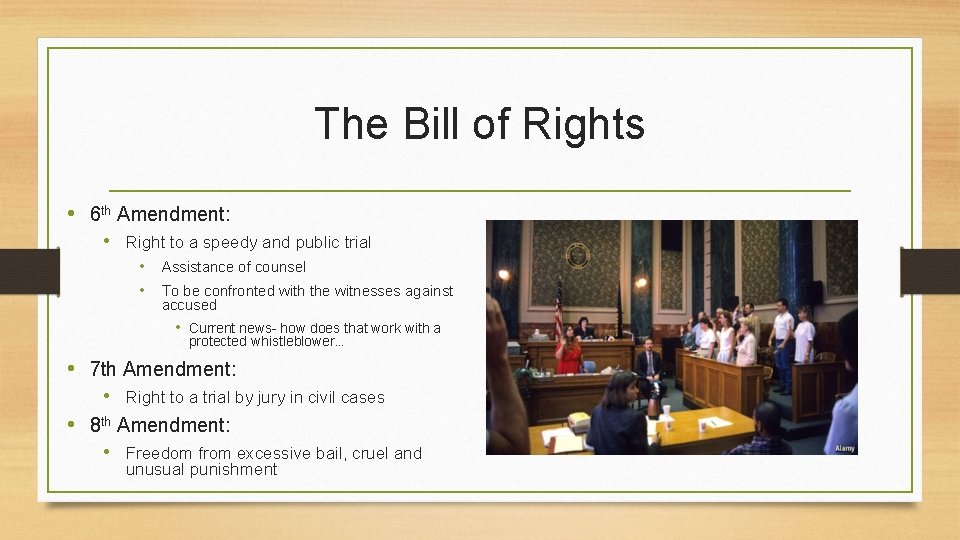
The Bill of Rights • 6 th Amendment: • Right to a speedy and public trial • Assistance of counsel • To be confronted with the witnesses against accused • Current news- how does that work with a protected whistleblower… • 7 th Amendment: • Right to a trial by jury in civil cases • 8 th Amendment: • Freedom from excessive bail, cruel and unusual punishment
The Bill of Rights • 10 th Amendment: • Powers not given to the federal • 9 th Amendment: • All rights are not spelled out in the Constitution • This limits government from over reach just because it is not explicitly listed doesn’t mean we don’t have given rights. government were retained by the states or by the people
The Later Amendments 1. Broken into 3 categories 1. Structural changes to the • 11 th – 27 th Amendments • Last Amendment made was 1992 Constitution 2. Extensions of Government Power 3. Extension of individual Rights • 11 th Amendment • States are shielded from suits brought by citizens of other states or foreign countries within Federal Courts
Structural changes to the Constitution • 12 th Electoral college procedure for voting (1804) • 17 th People not state legislature elect senators through popular vote (1913) • 20 th Set the new date for Presidential inauguration. (1933) • 22 nd Limits Presidents to two terms (1951) • 25 th Established a process for Vice President to take over if the President is disabled. (1967) • 27 th Congressional pay changes take place after the following election cycle (1992)
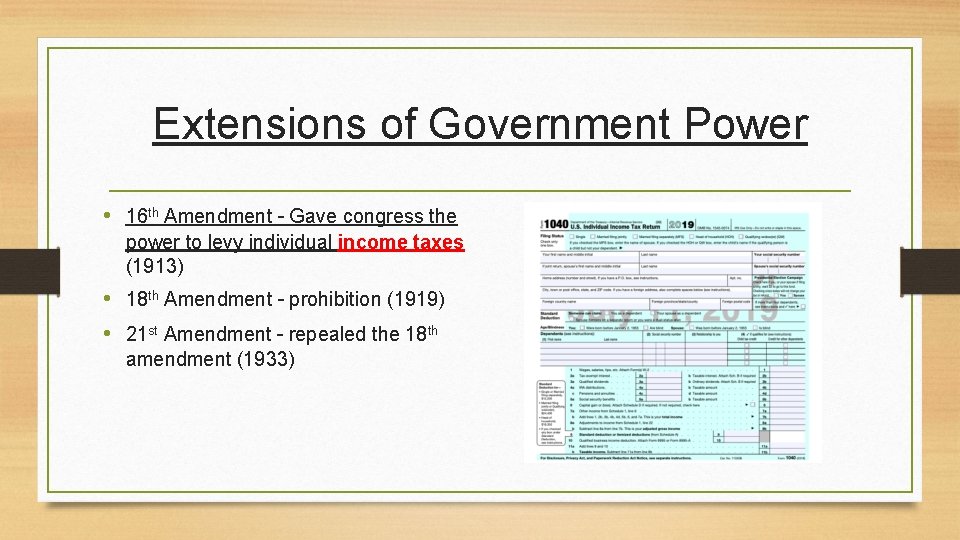
Extensions of Government Power • 16 th Amendment – Gave congress the power to levy individual income taxes (1913) • 18 th Amendment – prohibition (1919) • 21 st Amendment – repealed the 18 th amendment (1933)
Extensions of Individual Rights • 19 th – Guarantees women the right to vote • Civil War Reconstruction Amendments • 13 th – Outlaws Slavery (1865) • 14 th – Citizens have right to equal protection under the law. Prohibits states from depriving, life, liberty or property without due process. (1868) • 15 th – Right of all citizens to vote (1870) • Think of voter rights act in 1965… (1920) • 23 rd – Gave residents of the District of Columbia the right to vote. But no more electoral votes than the least populous state (1961) • 24 th – Made poll taxes illegal in federal elections (1964) • 26 th – Changed the voting age to 18 in federal and state elections (1971)
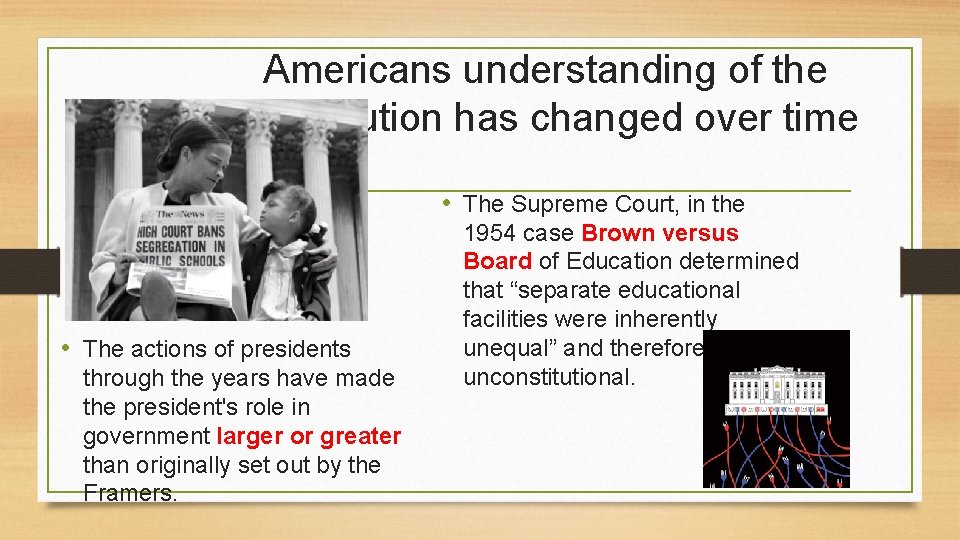
Americans understanding of the Constitution has changed over time • The Supreme Court, in the • The actions of presidents through the years have made the president's role in government larger or greater than originally set out by the Framers. 1954 case Brown versus Board of Education determined that “separate educational facilities were inherently unequal” and therefore unconstitutional.
Judicial Review • Courts have the power to review federal laws or government actions to determine whether they violate the constitution. • Recent items up for judicial review • Travel ban from some certain foreign countries • ICE enforcement methods • DACA- Heard in Supreme Court Today! • Gender identity and the meaning of the word “sex” in title VII • Three principles of Judicial Review • The Constitution is the supreme law of the country. • The Supreme Court has the ultimate authority in ruling on constitutional matters. – Court of last resort. • The judiciary must rule against any law that conflicts with the Constitution.
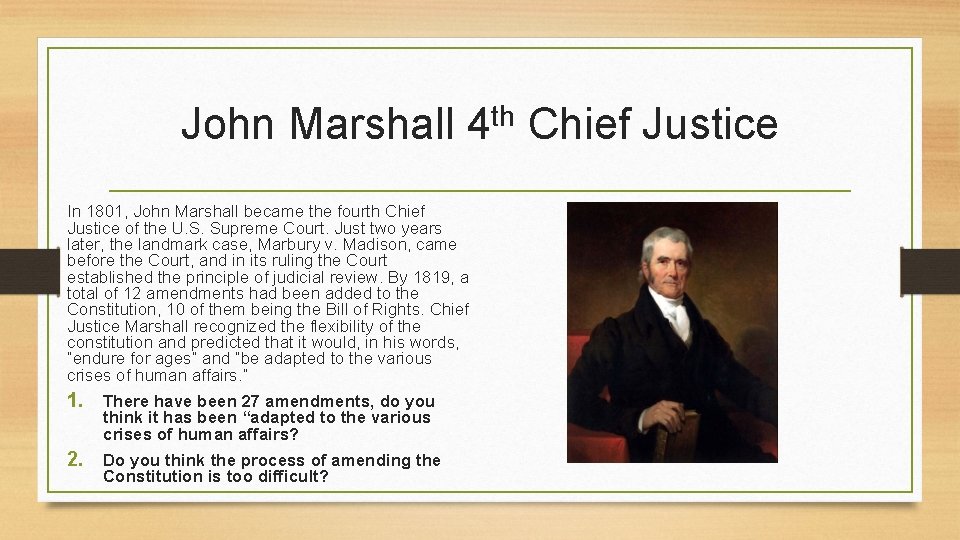
John Marshall 4 th Chief Justice In 1801, John Marshall became the fourth Chief Justice of the U. S. Supreme Court. Just two years later, the landmark case, Marbury v. Madison, came before the Court, and in its ruling the Court established the principle of judicial review. By 1819, a total of 12 amendments had been added to the Constitution, 10 of them being the Bill of Rights. Chief Justice Marshall recognized the flexibility of the constitution and predicted that it would, in his words, “endure for ages” and “be adapted to the various crises of human affairs. ” 1. There have been 27 amendments, do you think it has been “adapted to the various crises of human affairs? 2. Do you think the process of amending the Constitution is too difficult?
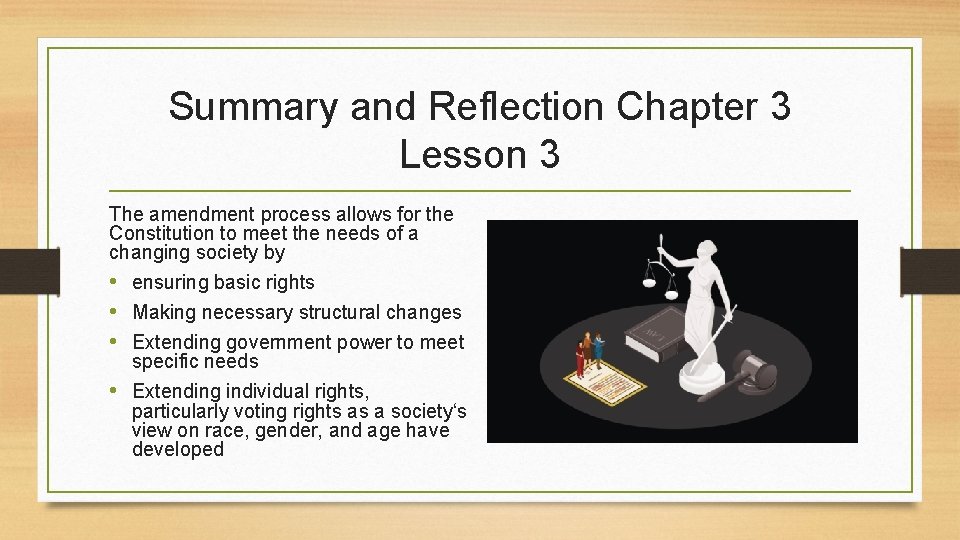
Summary and Reflection Chapter 3 Lesson 3 The amendment process allows for the Constitution to meet the needs of a changing society by • ensuring basic rights • Making necessary structural changes • Extending government power to meet specific needs • Extending individual rights, particularly voting rights as a society‘s view on race, gender, and age have developed
Online Quiz and Self Grading • On your Chrome Book please take assigned test within clever under this class. • At the end of your notes write out answers to questions you got wrong • Answer additional questions 1. What was one good question you thought of or asked today? 2. The part you found most confusing today was _____ 3. If you were teaching this lesson to another class, what area you would have spent more time teaching? • Turn in up front in alphabetical order when finished
Tomorrow • Group project starting • Please be in class on time and ready to work on your computers in small groups. • Notes will be given back to help with project • Also have bill of rights outline from last week.
- Slides: 21