
Agenda 1 Bellringer 2 Photo reaction activity 3
Agenda • • 1) Bellringer— 2 Photo reaction activity 3) NIGHT Background 4) Anticipation Guide
NIGHT Documents • Pass out… • Double Entry Journal (starts next class) • German Terms
Double Entry Journal • Every time you read, either in or out of class, you will be required to write in your double entry journal, which is a part of your workbook. • You should have 2 entries for each section listed on the first page of your journal. • Your entries will focus on THE TERMS WE STUDY THAT DAY IN CLASS!! • Double Entry Journals are due each class.
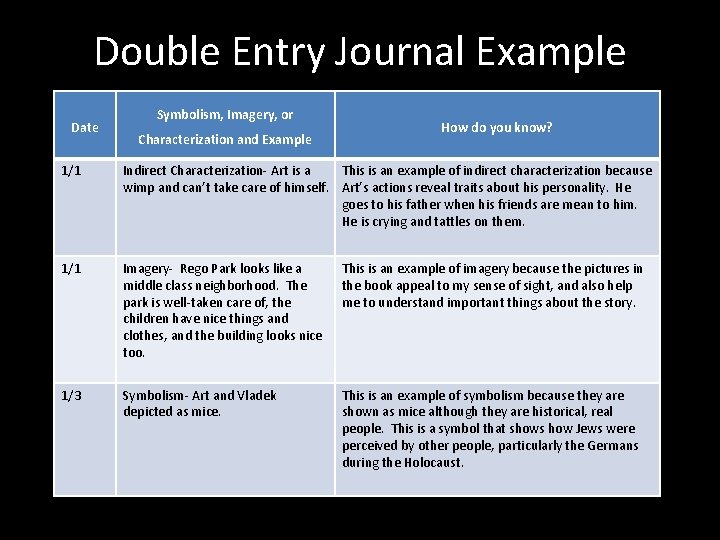
Double Entry Journal Example Date Symbolism, Imagery, or Characterization and Example How do you know? 1/1 Indirect Characterization- Art is a This is an example of indirect characterization because wimp and can’t take care of himself. Art’s actions reveal traits about his personality. He goes to his father when his friends are mean to him. He is crying and tattles on them. 1/1 Imagery- Rego Park looks like a middle class neighborhood. The park is well-taken care of, the children have nice things and clothes, and the building looks nice too. This is an example of imagery because the pictures in the book appeal to my sense of sight, and also help me to understand important things about the story. 1/3 Symbolism- Art and Vladek depicted as mice. This is an example of symbolism because they are shown as mice although they are historical, real people. This is a symbol that shows how Jews were perceived by other people, particularly the Germans during the Holocaust.
Unit Preview Activity • Study the following photographs. At your desk. Write down 1) what you think it is 2) why you think it's significant
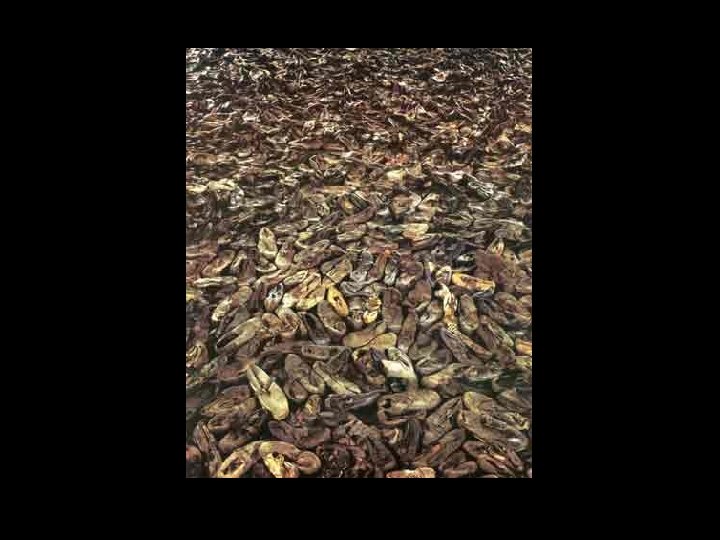
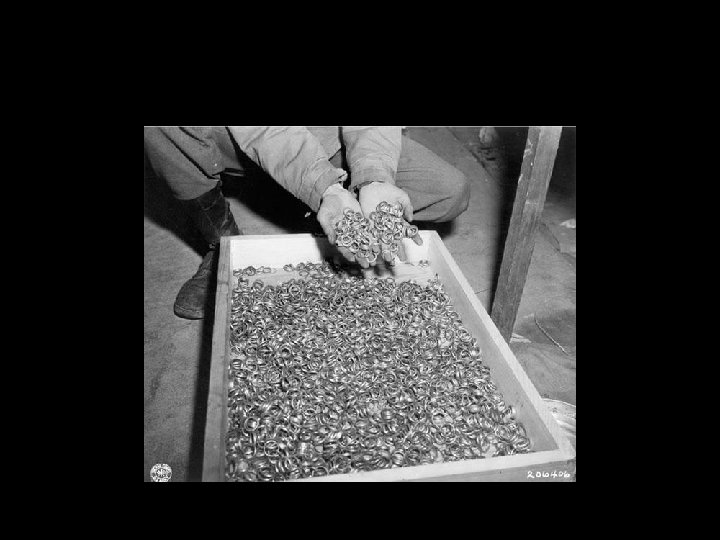
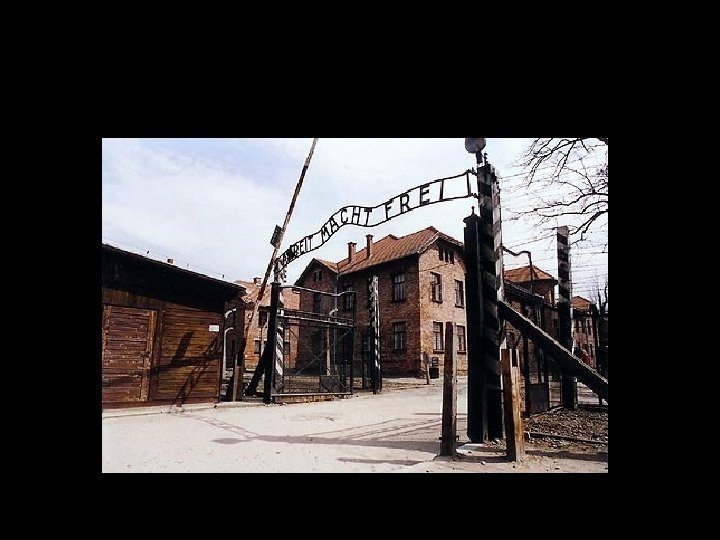
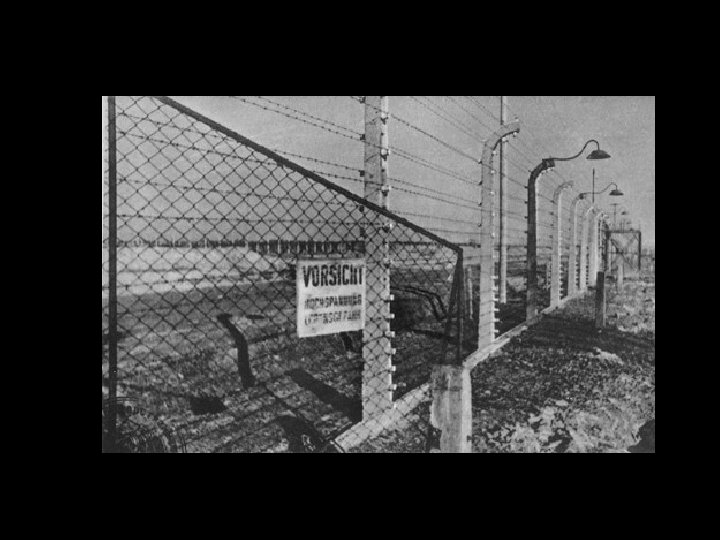
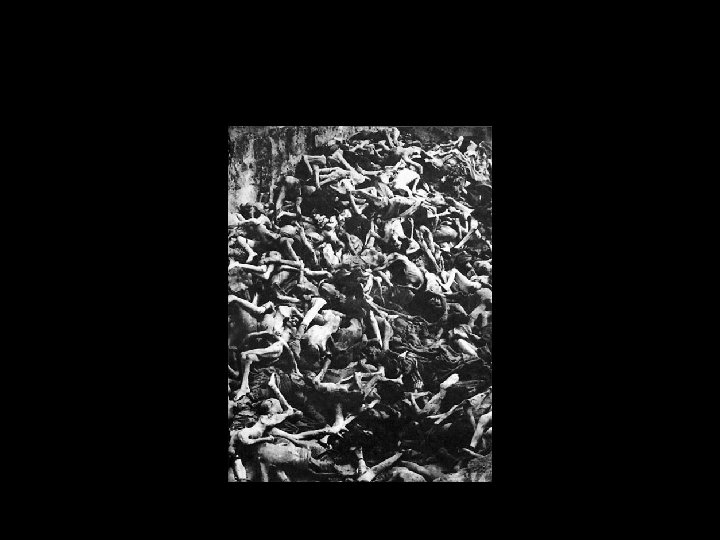
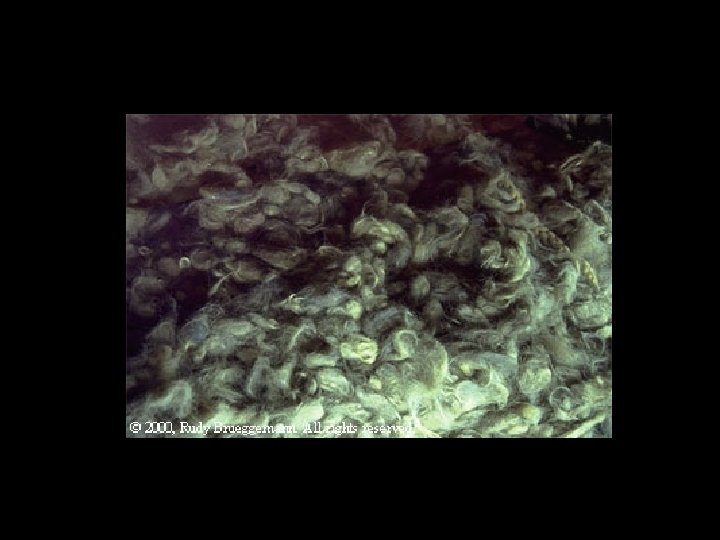
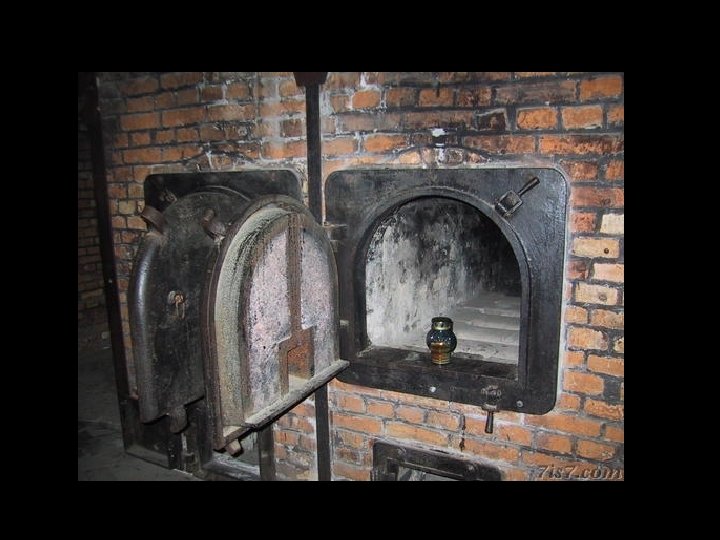
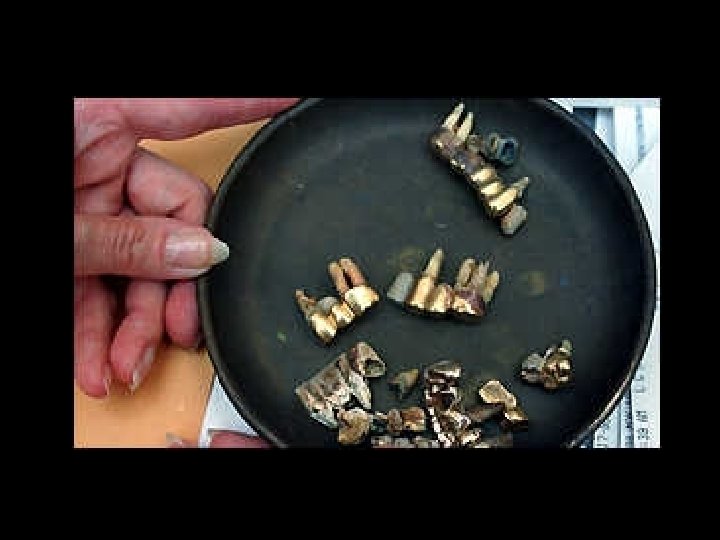
• Slide 1 -Prisoners’ Shoes from Majdanek • Slide 2 - a few of the thousands of wedding rings the Germans removed from their victims to salvage the gold. American troops found rings, watches, precious stones, eyeglasses, and gold fillings, near Buchenwald concentration camp in Germany. • Slide 3 - Entrance to main Auschwitz camp. The gate bears the motto “Arbeit Macht Frei” (Work makes one free) • Slide 4 -Picture of a Sign on the Electric Fence in Auschwitz • Slide 5 - human bodies of victims of the Holocaust • Slide 6 - When Soviet troops liberated Auschwitz in January 1945, they found seven tons of human hair, all removed from victims imprisoned and killed by Nazis. The hair was shipped back to Germany for use in the war industry as raw material for making cloth. • Slide 7 -Crematorium adjacent to the gas chamber in Auschwitz. • Slide 8 - Gold teeth were melted down for the Nazi regime
Anticipation Guide COMPLETE YOUR ANTICIPATION GUIDE. TRY TO PERSUADE YOUR GROUP OF YOUR POINT. (15 MIN. )
On your paper, write down everything you know about the Holocaust. Share. NIGHT BACKGROUND
The Holocaust: Terms to Know • Holocaust: – burnt offering; a sacrifice consumed by fire • Genocide: – The systematic annihilation of a whole people or nation • Antisemitism: – Prejudice against or hatred of all Jews • Ghetto: – a confined area of a city in which members of a minority group are compelled to live because of social, legal, or economic pressure.
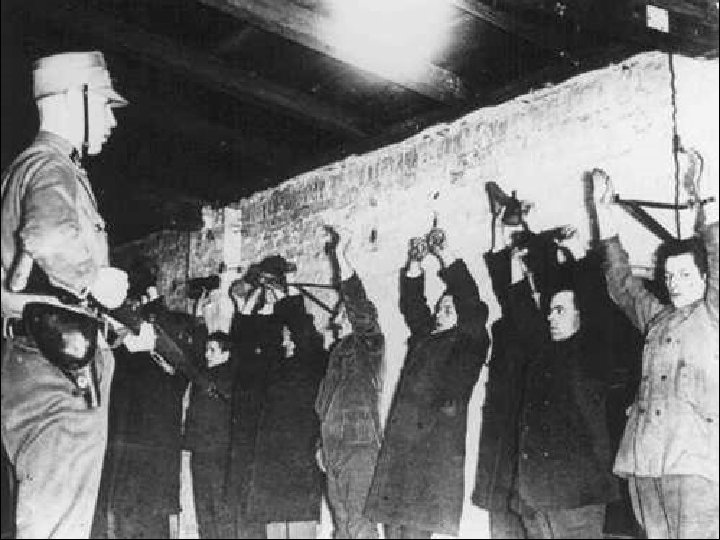
The Holocaust: Terms to Know • Totalitarianism: – is the total control of a country in the government’s hands – It subjugates individual rights. – It demonstrates a policy of aggression. • SS: – German abbreviation for Schutzstaffel (protection squads). A paramilitary formation of the Nazi party initially created to serve as bodyguard to Hitler and other Nazi leaders.
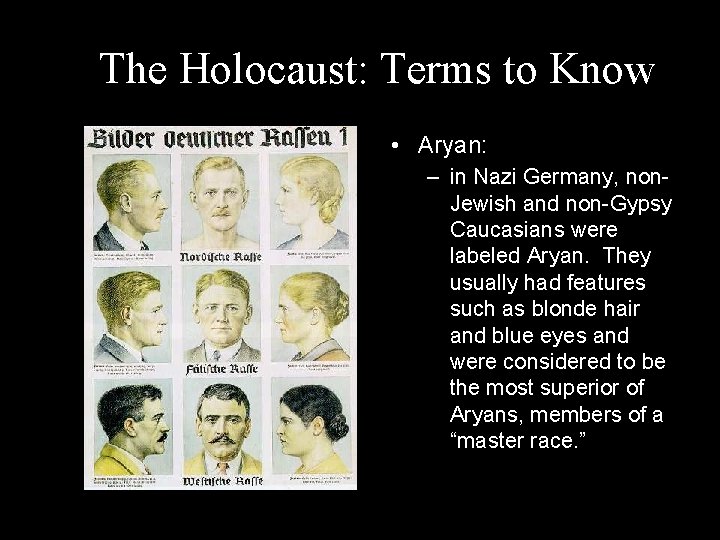
The Holocaust: Terms to Know • Aryan: – in Nazi Germany, non. Jewish and non-Gypsy Caucasians were labeled Aryan. They usually had features such as blonde hair and blue eyes and were considered to be the most superior of Aryans, members of a “master race. ”
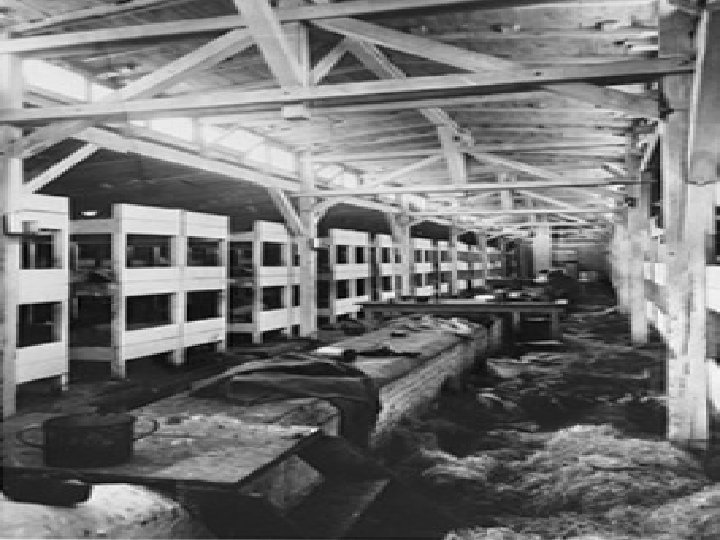
The Holocaust: Terms to Know • Concentration Camp: – Concentration Camps were established by the Nazi regime and managed by the SS to detain and, if necessary, kill so-called enemies of the state (i. e. , Jews, Gypsies, etc. ) – Living conditions in camps were extremely poor. – Prisoners slept in barracks that were small and extremely close together. – The buildings were poorly constructed and unsanitary.
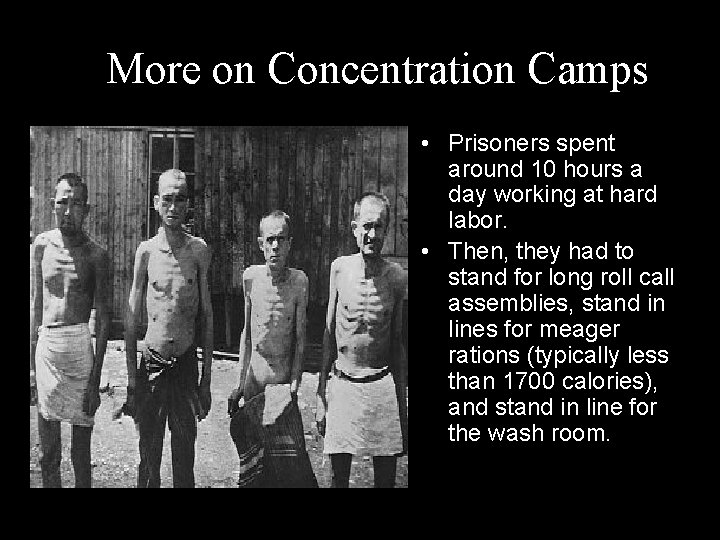
More on Concentration Camps • Prisoners spent around 10 hours a day working at hard labor. • Then, they had to stand for long roll call assemblies, stand in lines for meager rations (typically less than 1700 calories), and stand in line for the wash room.
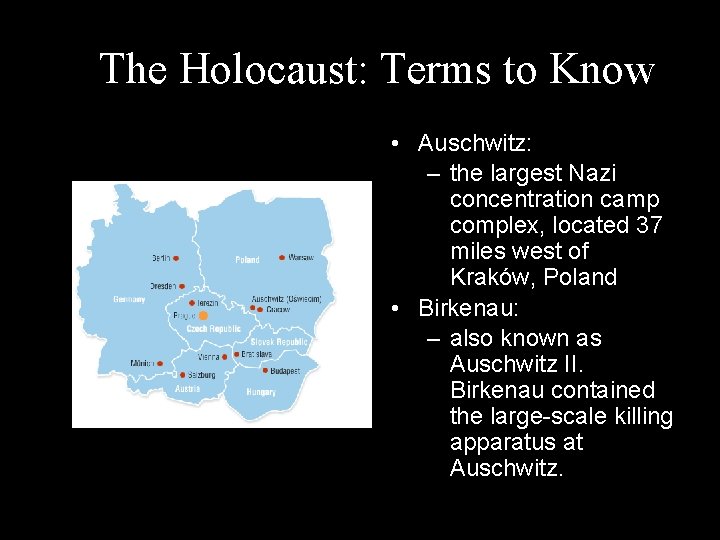
The Holocaust: Terms to Know • Auschwitz: – the largest Nazi concentration camp complex, located 37 miles west of Kraków, Poland • Birkenau: – also known as Auschwitz II. Birkenau contained the large-scale killing apparatus at Auschwitz.
Jewish Terms • Judaism: – the monotheistic religion (belief in one god) of the Jews, having its ethical, ceremonial, and legal foundation in the precepts of the Old Testament and in the teachings and commentaries of the rabbis as found chiefly in the Talmud • Talmud: – the most significant collection of Jewish oral tradition
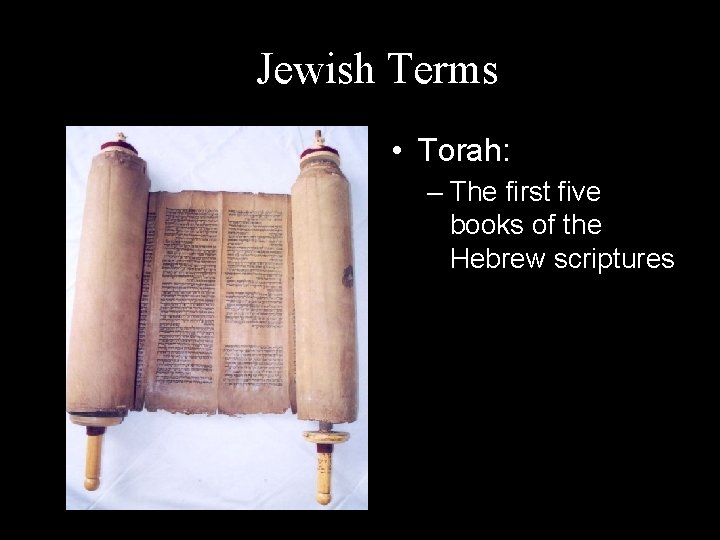
Jewish Terms • Torah: – The first five books of the Hebrew scriptures
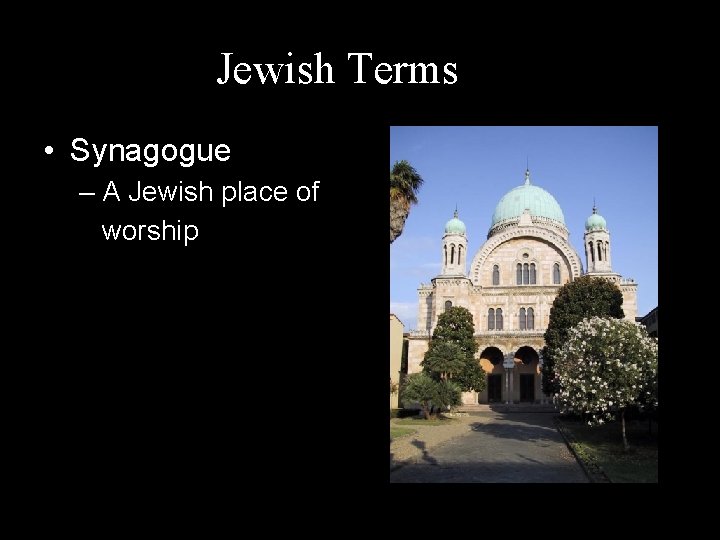
Jewish Terms • Synagogue – A Jewish place of worship
Jewish Terms • Cabbala (Kaballah) – the religious mystical system of Judaism claiming an insight into divine nature • Kaddish – A prayer recited in the daily synagogue services and by mourners after the death of a close relative.
Timeline of Holocaust Events: 1933 • Adolf Hitler's Nazi Party gains control of the German government. – Nazi: The National Socialist Workers’ Party – The Nazis decree a 3 day boycott of Jewish businesses.
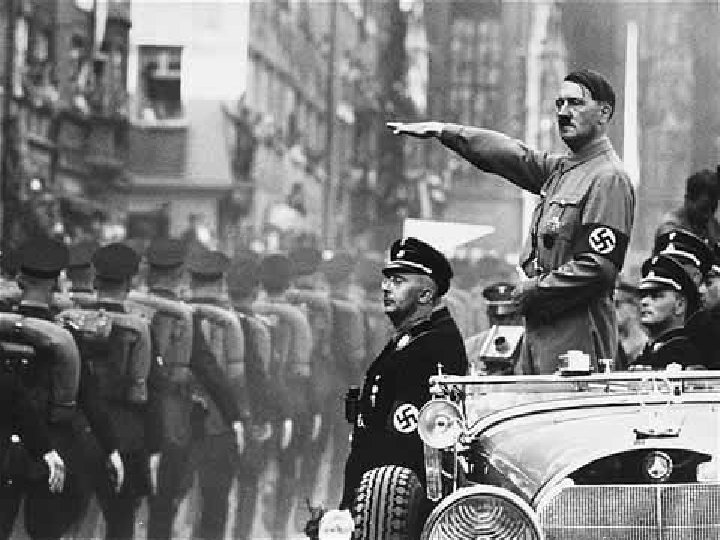
Timeline of Holocaust Events: 1933 • The Nazis establish a concentration camp at Dachau, the first of many prison camps where they will confine communists, socialists, trade unionists, homosexuals, Gypsies, Jews, Jehovah's Witnesses, and other "undesirables. " • Nazi laws remove Jews from German courts and civil service positions, limit the number of Jews who can attend German universities, remove Jews from German college faculties, and expel Jews from German cultural life (i. e. , film, theater, literature, music, journalism).
Timeline of Holocaust Events: 1933 • Jewish food preparation rituals are outlawed. • Nazi laws require involuntary sterilization of mixed race children, the physically or mentally handicapped, Gypsies, Blacks, and others deemed racially or genetically "inferior. "
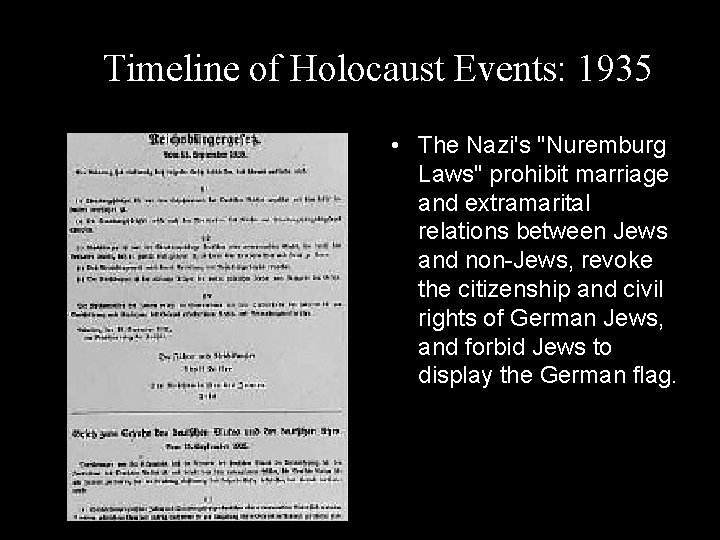
Timeline of Holocaust Events: 1935 • The Nazi's "Nuremburg Laws" prohibit marriage and extramarital relations between Jews and non-Jews, revoke the citizenship and civil rights of German Jews, and forbid Jews to display the German flag.
Timeline of Holocaust Events: 1938 • Nazi laws require Jews to report their financial assets and property. • The Nazi government assumes control of all Jewish religious institutions.
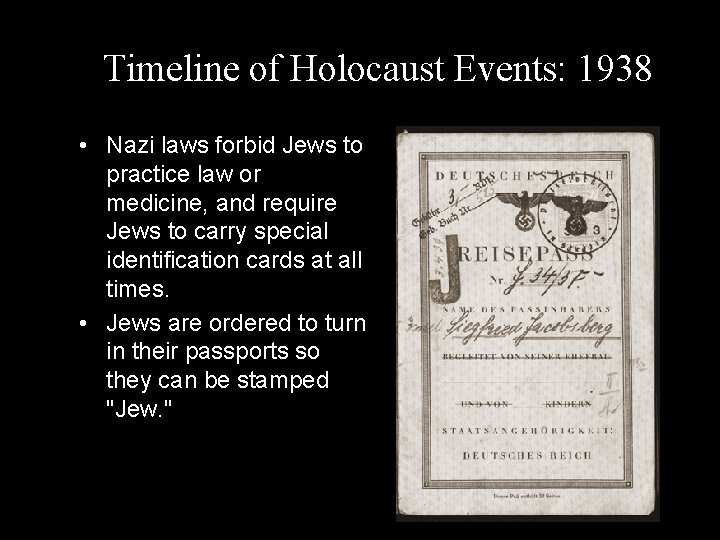
Timeline of Holocaust Events: 1938 • Nazi laws forbid Jews to practice law or medicine, and require Jews to carry special identification cards at all times. • Jews are ordered to turn in their passports so they can be stamped "Jew. "
Timeline of Holocaust Events: 1938 • Kristallnacht – ("The Night of Broken Glass, " November 9): a government-sanctioned night of anti-Jewish riots, during which synagogues are burned, Jewish homes looted, Jewish businesses destroyed, and thousands of Jews beaten, tortured, arrested, or killed.
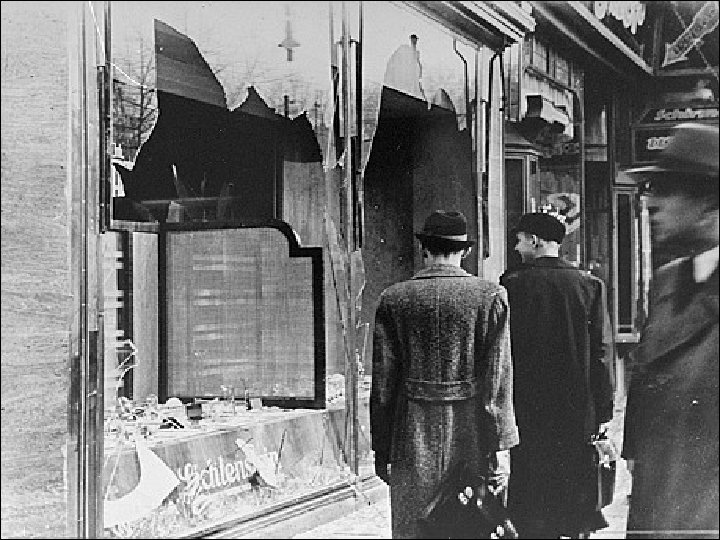

Timeline of Holocaust Events: 1938 • Nazi police arrest approximately 30, 000 Jewish men for deportation to concentration camps. • Deportation: the removal of people from their areas of residency for purposes of resettlement elsewhere. • Nazi laws ban Jewish newspapers and journals, expel Jewish children from German schools, and bar Jews from theaters, museums, and other public gathering places. • The Nazi government closes all Jewish businesses and prohibits further Jewish business activity. • The government imposes a tax on Jews to pay for Kristallnacht property damage.
Timeline of Holocaust Events: 1939 • The Nazi Gestapo assumes control of all Jewish affairs. • Gestapo: The German State Police • The Nazis establish detailed procedures for confiscating Jewish property. • Nazi Invasion of Poland (September 1): Nazi Einsatzgruppen (mobile killing squads) follow the advancing German army and execute thousands of Poles, whom the Nazis regard as "subhuman. " Thousands more are shipped to Germany as slave laborers or relocated within Poland to provide open space for German settlement.
Timeline of Holocaust Events: 1939 • Nazi forces round up approximately 3 million Polish Jews and confine them in urban ghettos. • Polish Jews are required to wear the Star of David. • In Germany, the Nazis initiate a euthanasia program to kill institutionalized and handicapped patients who are deemed incurable.
Timeline of Holocaust Events: 1940 • Nazi Conquest of Europe: Anti-Jewish policies are imposed in Nazi-occupied Denmark, Norway, Holland, Belgium, Luxembourg, France, and in other European countries under Nazi domination.
Timeline of Holocaust Events: 1941 • Nazi Invasion of the Soviet Union (June 22): Einsatzgruppen following the advancing army exterminate Jews, Gypsies, communists, and other "undesirables"; more than one million people are massacred. • Extermination camps with gas chambers for mass executions are constructed in Poland at Auschwitz-Birkenau, Chelmno, Belzec, Sobibor, Majdanek, and Treblinka.
Timeline of Holocaust Events: 1941 • Nazi leaders, meeting in Wansee outside Berlin, adopt a policy of mass execution as "the final solution of the Jewish question. " • Deportation of Jews from Nazi-occupied and Nazi-dominated countries across Europe to the extermination camps in Poland begins.
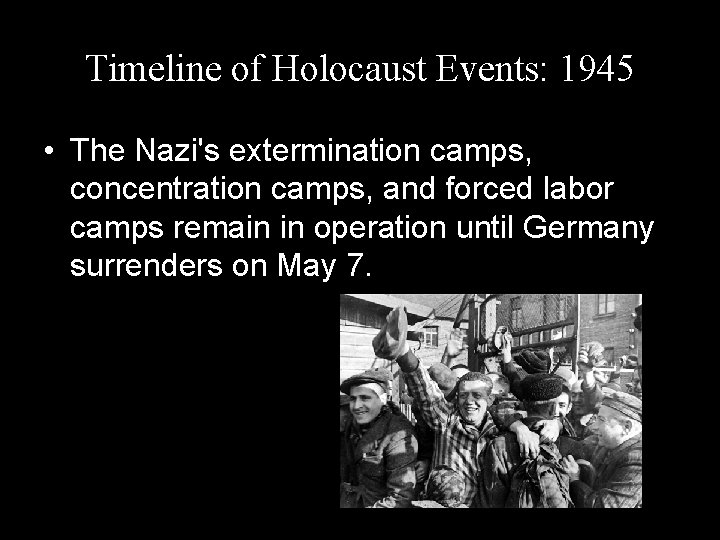
Timeline of Holocaust Events: 1945 • The Nazi's extermination camps, concentration camps, and forced labor camps remain in operation until Germany surrenders on May 7.
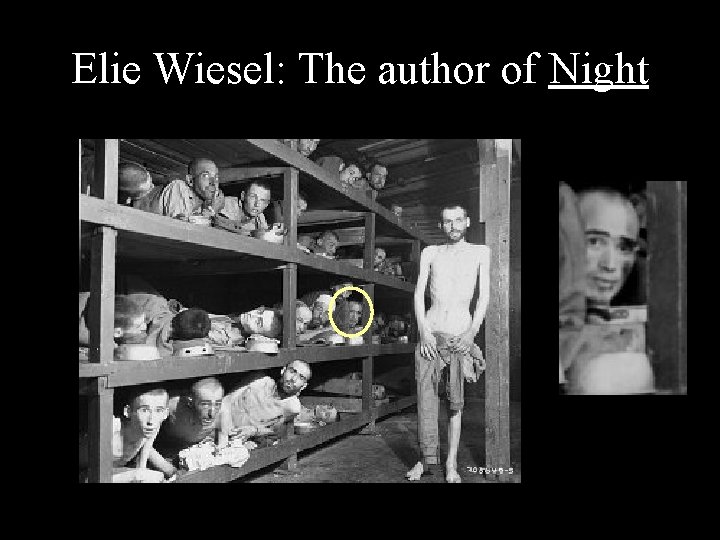
Elie Wiesel: The author of Night
Elie Wiesel • Born 1928 in Sighet, Romania • Deported to concentration camps during WWII • Survived Auschwitz, Buna, Buchenwald, and Gleiwitz • Liberated in April 1945
Elie Wiesel • 1955: published Night • 1978: appointed chair of Presidential Commission on the Holocaust (later renamed U. S. Holocaust Memorial Council) • 1985: awarded Congressional Gold Medal of Achievement • 1986: awarded Nobel Peace Prize • Died July 2, 2016

HOMEWORK • Double Entry Journals will begin next class when official reading and literary devices begin. • Reading assignment: Forward Xvii-xxi
- Slides: 49