
Agency Worker Regulations Richard Thomas 20 October 2011

Agency Worker Regulations Richard Thomas 20 October 2011 in association with capitallaw. co. uk
The right to equal treatment ‘The basic working and employment conditions of temporary agency workers shall be, for the duration of their assignment at a user undertaking, at least those that would apply if they had been recruited directly to occupy the same job’ – Article 5. 1 of the Directive Includes: • equal treatment • equal access to facilities and permanent employment • penalties for non compliance capitallaw. co. uk
Why is it important? • Came into force on 1 October 2011 with no amendments • 16, 000 employment agencies in the UK • 1. 3 million Agency Workers in the UK • 5% of the UK’s total workforce • Agency Workers provide employers with flexibility capitallaw. co. uk
Who is not covered by the Regulations • Self-employed individuals • Incorporated businesses (i. e. limited companies) • Managed service contracts • Consultants capitallaw. co. uk
Equal treatment of agency workers Agency workers will be entitled to similar basic working and employment conditions as employees who have been hired directly by the Hirer These are the ‘relevant terms and conditions’ of a ‘comparable employee’ Comparable worker: • • works for and under supervision of the same Hirer works in the same establishment similar level of skills and qualifications is an employee of the hirer capitallaw. co. uk
Basic working and employment conditions Agency Workers will be entitled to the same basic terms and conditions as those employed directly Terms ‘ordinarily included in the contracts of employees … whether by collective agreement or otherwise’ These basic terms and conditions involve: • • pay duration of time at work including overtime night work rest periods breaks annual leave holidays public holidays capitallaw. co. uk
What is included in “pay”? Pay includes basic pay together with various contractual entitlements: • holiday pay (including bank holidays and public holidays) • overtime pay • shift allowances • pay related to unsociable hours • additional pay for dangerous duties • bonus linked to individual performance • vouchers or stamps with monetary value, i. e. lunch vouchers capitallaw. co. uk
What is not included in “pay”? • occupational sick pay • occupational pensions or retirement benefits • contractual pay for maternity, paternity or adoption leave • contractual redundancy payments • share schemes and other profit sharing agreements • bonuses not related to individual performance • expenses • benefits in kind (save vouchers) such as a company car or health insurance • any payments linked to long term reward and retention capitallaw. co. uk
Basic working and employment conditions Agency workers will also be entitled to certain “Day 1” rights: • access to information regarding vacancies (but no vacancies – and therefore no breach – where hirer is carrying out internal re organisation with headcount freeze) • General Announcement in suitable place will discharge this duty • access to facilities such as Canteen, workplace crèche, transport services, mother and baby room, prayer room, car parking • agency workers must from Day 1 be given same access to these facilities as permanent staff capitallaw. co. uk
Conditions for equal treatment The right to equal treatment is subject to conditions: • ‘qualifying period’ of 12 weeks • the Worker must work in the same role for the same hirer • the Qualifying Period is broken if the Worker undertakes a new assignment that is ‘substantially different’ • guidance has been published on what this means • after 12 weeks the Agency Worker will remain a temporary worker capitallaw. co. uk
Suspending the qualifying period In calculating the 12 week Qualifying Period, it is possible to suspend (or pause) periods of time: • breaks from work of less than 6 weeks • sickness absence of less than 28 weeks • statutory or contractual time off such as maternity leave or annual leave • jury service of less than 6 weeks • temporary cessation of the hirer’s need for Workers i. e. shutdown for Christmas break • industrial action capitallaw. co. uk
Time off – No effect to qualifying period During certain types of absence the 12 week period will continue to run: • time off related to pregnancy, childbirth or maternity • subject to a protected period of 26 weeks after child birth • maternity, paternity or adoption leave capitallaw. co. uk
Anti-avoidance measures Hirers may try to rotate Agency Workers between roles to avoid equal treatment The anti avoidance provision gives Workers under a ‘structure of assignments’ the right to equal treatment Structure of assignments: • • • 2 or more assignments 2 or more roles within the same assignment hirer’s intention to avoid the Qualifying Period Anti-avoidance techniques could give rise to max £ 5, 000 fine capitallaw. co. uk
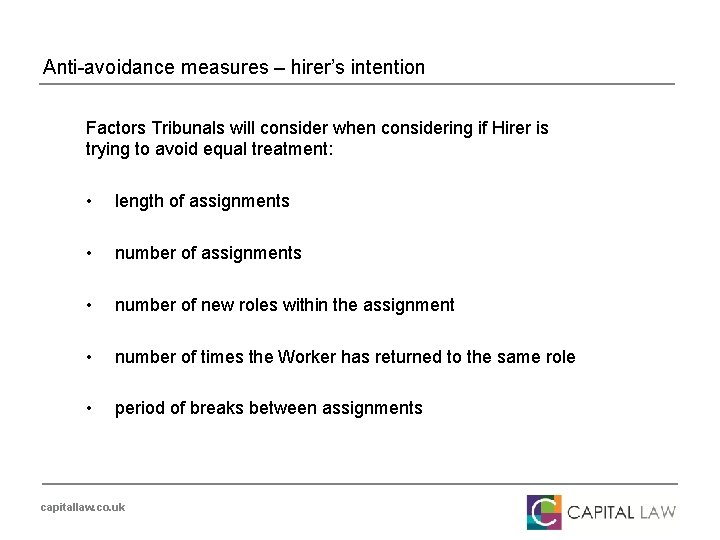
Anti-avoidance measures – hirer’s intention Factors Tribunals will consider when considering if Hirer is trying to avoid equal treatment: • length of assignments • number of new roles within the assignment • number of times the Worker has returned to the same role • period of breaks between assignments capitallaw. co. uk
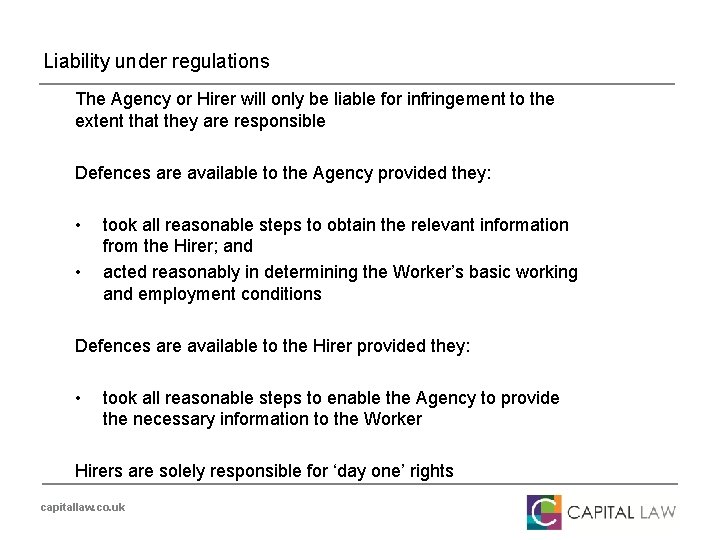
Liability under regulations The Agency or Hirer will only be liable for infringement to the extent that they are responsible Defences are available to the Agency provided they: • • took all reasonable steps to obtain the relevant information from the Hirer; and acted reasonably in determining the Worker’s basic working and employment conditions Defences are available to the Hirer provided they: • took all reasonable steps to enable the Agency to provide the necessary information to the Worker Hirers are solely responsible for ‘day one’ rights capitallaw. co. uk
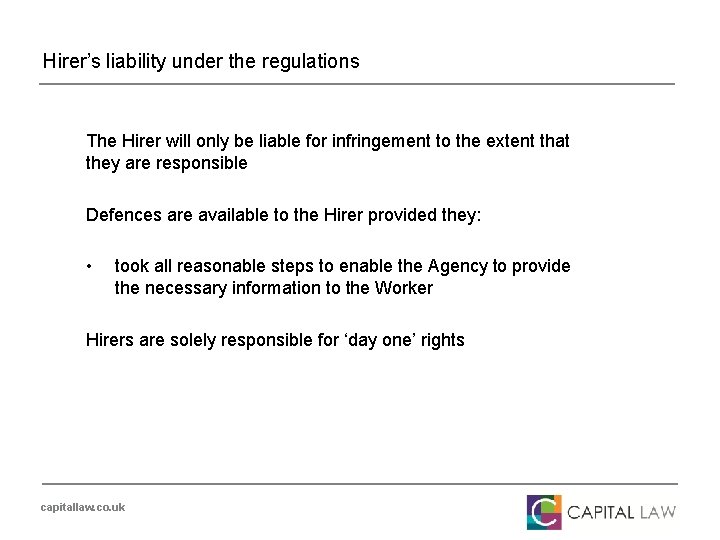
Hirer’s liability under the regulations The Hirer will only be liable for infringement to the extent that they are responsible Defences are available to the Hirer provided they: • took all reasonable steps to enable the Agency to provide the necessary information to the Worker Hirers are solely responsible for ‘day one’ rights capitallaw. co. uk
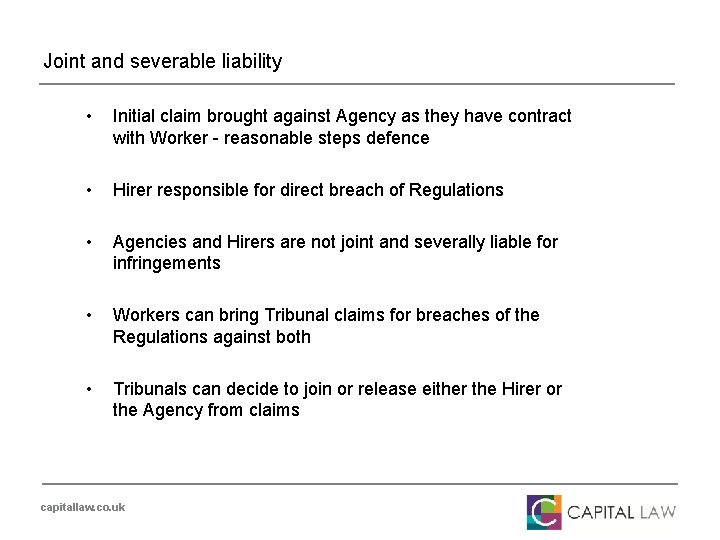
Joint and severable liability • Initial claim brought against Agency as they have contract with Worker - reasonable steps defence • Hirer responsible for direct breach of Regulations • Agencies and Hirers are not joint and severally liable for infringements • Workers can bring Tribunal claims for breaches of the Regulations against both • Tribunals can decide to join or release either the Hirer or the Agency from claims capitallaw. co. uk
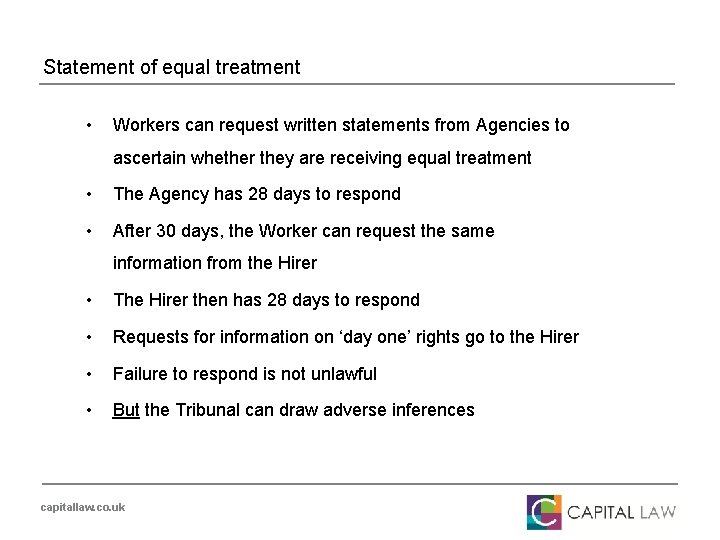
Statement of equal treatment • Workers can request written statements from Agencies to ascertain whether they are receiving equal treatment • The Agency has 28 days to respond • After 30 days, the Worker can request the same information from the Hirer • The Hirer then has 28 days to respond • Requests for information on ‘day one’ rights go to the Hirer • Failure to respond is not unlawful • But the Tribunal can draw adverse inferences capitallaw. co. uk
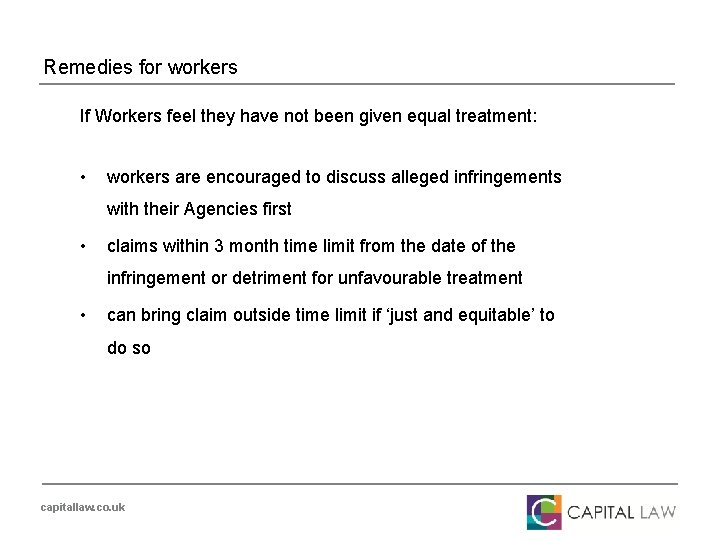
Remedies for workers If Workers feel they have not been given equal treatment: • workers are encouraged to discuss alleged infringements with their Agencies first • claims within 3 month time limit from the date of the infringement or detriment for unfavourable treatment • can bring claim outside time limit if ‘just and equitable’ to do so capitallaw. co. uk
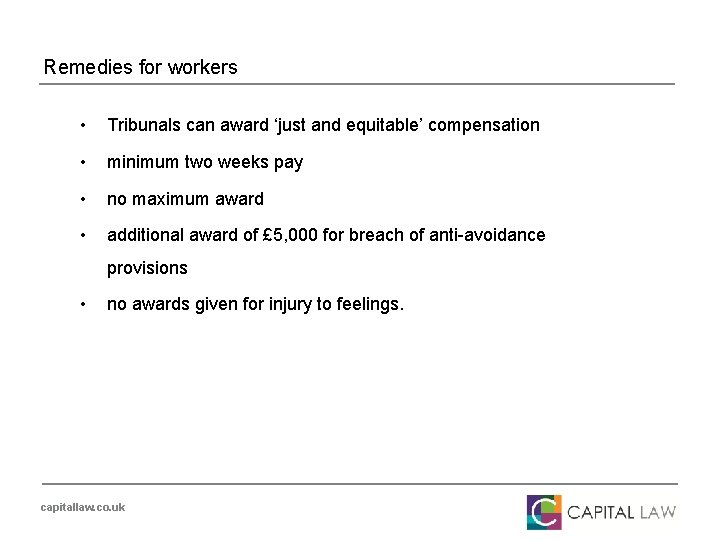
Remedies for workers • Tribunals can award ‘just and equitable’ compensation • minimum two weeks pay • no maximum award • additional award of £ 5, 000 for breach of anti-avoidance provisions • no awards given for injury to feelings. capitallaw. co. uk
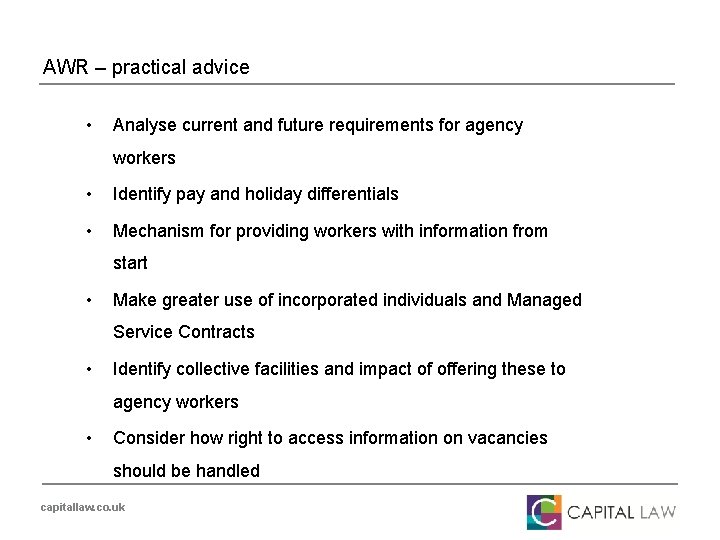
AWR – practical advice • Analyse current and future requirements for agency workers • Identify pay and holiday differentials • Mechanism for providing workers with information from start • Make greater use of incorporated individuals and Managed Service Contracts • Identify collective facilities and impact of offering these to agency workers • Consider how right to access information on vacancies should be handled capitallaw. co. uk
AWR – options for hirers • Terminate Agency contracts at 11 weeks and ensure effective break of more than 6 weeks to avoid qualifying period • Directly recruit temporary workers or set up in house “bank” of casual workers • Use Managed Service Contracts for delivery of certain services • Use Managed Service Contract Plus option – in house MSC • Make greater use of incorporated individuals or genuinely self employed individuals capitallaw. co. uk
AWR – Options for hirer’s • • Explore the “Swedish Derogation” option with Temporary Work Agency (TWA) Agency Worker must have permanent contract of employment with TWA which confirms terms and conditions that will apply across assignments and levels of pay between assignments Contract must also include the following provisions: • • • minimum pay rates and basis of calculation location of work minimum and maximum expected working hours nature of work statement that Agency Worker is foregoing entitlements to equal treatment in respect of pay capitallaw. co. uk
AWR – Options for hirer’s • Identify exclusive agency worker roles (BUT Agency Workers can seek comparators in different work locations) • Manage risk over time • Live with it! capitallaw. co. uk

capitallaw. co. uk • Q&A consultcapital. co. uk in association with Capital Building, Tyndall Street, Cardiff CF 10 4 AZ capitallaw. co. uk 99 City Road, London EC 1 Y 1 AX T: 0333 2400 489 F: 0333 2400 487
Our Services Accredited Community Governance Programmes Redundancy Programmes Commercial and Residential Development Venture Capital and Equity Investments Business Process Improvement Copyright and Design Rights Stakeholder and Reputation Management Executive Employment Terminations Planning Permission and Appeals Health and Safety Compliance Fraud and Asset Recovery Project Evaluation for Funding and Grant Aid Workforce Planning Corporate Health Standard Implementation Compulsory Purchase and Compensation Proactive Occupational Health Services Copyright Assignments Management Buy Outs and Buy Ins HR Support Accredited Community Governance Programmes International Transactions Community Leadership and Management Support Employment Tribunal Advocacy Workplace Noise Risk Assessment Sickness and Absence Management Group Reorganisations Creative Industries Bespoke Software Development Property Portfolio Management Mergers and Acquisitions Workforce Re-organisations Corporate Governance Recovery and Insolvency Health and Well Being at Work Commercial Contracts Waste Elimination Brand Protection Advising Landlords and Tenants Non-contentious Construction Contract Negotiations HR Policies & Procedures TUPE Transfers Fire Risk Assessments Reputation Management Method Statements Employment Contracts Inter-agency Development Finance Mediation Public Sector Property Advice Organisational Development Strategic Action Planning Corporate Structures Planning Agreements OHAS 18001 Intellectual Property COSHH Assessments Discrimination Law HR Improvement Strategies NEBOSH Training Change Management ISO 14001 Shareholder Disputes Compliance Audits Interim Management Due Diligence Unfair Dismissal Claims DSE Assessment Commercial Property Media Law Secured Lending Lean Operations IOSH Training Infrastructure Support Governance Reviews Talent Management Joint Ventures Probate Disputes Public Consultation Site Inspections Right to Buy Schemes Business Disputes Licensing Leadership Training Grievance Investigations Acquisitions Hosted Services Commercial Leases IT Training Risk Assessments Commissioning NVQ Training Industrial Relations CSR Audits Advocacy CIEH Training Injunctions capitallaw. co. uk
- Slides: 26