
AGENCY ISSUE Agency Theory Stewardship Theory Factors that

- Slides: 23
AGENCY ISSUE • Agency Theory ● Stewardship Theory ● Factors that Differentiate between Agency and Stewardship Theories ● Stakeholder Theory ● Property Rights Theory and Corporate Governance ● Popular Models for Governance
AGENCY THEORY Agency theory offers shareholders a preeminent position in the firm legitimized not by the idea that they are the firm’s owners, but instead its residual risk takers
irrelevance of ownership “Ownership of capital should not be confused with ownership of the firm. Each factor in a firm is owned by somebody. The firm is just the set of contracts covering the way inputs are joined to create outputs and the way receipts from outputs are shared among inputs. In this “nexus of contracts” perspective, ownership of the firm is an irrelevant concept. ” (Fama, 1980)
Risk Bearing vs Decision Making • The agency view suggests that shareholders are the “principals” in whose interest the corporation should be run even though they rely on others for the actual running of the corporation. • “We contend that separation of decision-making and risk-bearing functions survives in these organizations in part because of the benefits of specialization of management and risk bearing but also because of an effective common approach to controlling the agency problems caused by separation of decision-making and risk-bearing functions. ”
corporate governance problems from agency theory • Self-interested opportunism, • Information asymmetries, • Asset specifity and small numbers bargaining and • The problem of bounded rationality
Internal and external governance mechanisms to balance the interests of managers with those of shareholders • An effectively structured board; • Compensation contracts that encourage a shareholder orientation; • Concentrated ownership holdings that lead to active monitoring of executives; • The market for corporate control that is an external mechanism activated when internal mechanism for controlling managerial opportunism or failure have not worked
Stewardship Theory • the model of man is based on a steward whose behavior is ordered such that proorganizational, collectivistic behaviours have higher utility than individualistic, self-serving behaviours. Given a choice between selfserving behavior and pro-organizational behavior, a steward’s behavior will not depart from the interests of his or her organization.
Stewardship Theory • According to stewardship theory, the behavior of the steward is collective, because the steward seeks to attain the objectives of the organization (e. g. , sales growth or profitability).
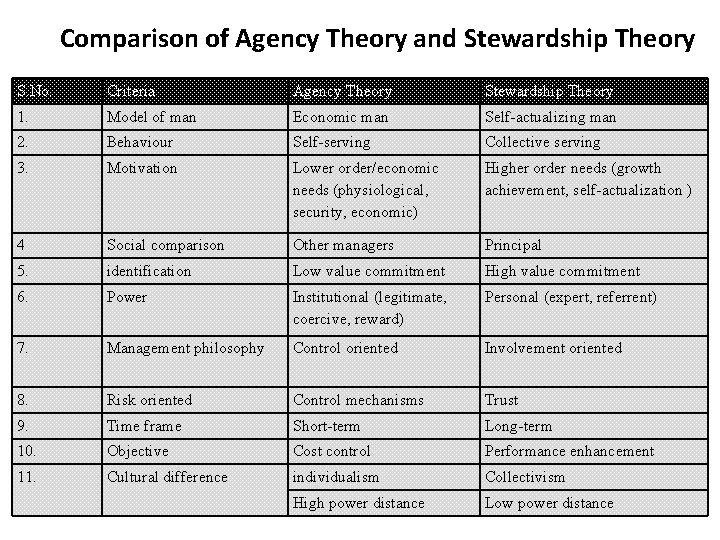
Comparison of Agency Theory and Stewardship Theory S. No. Criteria Agency Theory Stewardship Theory 1. Model of man Economic man Self-actualizing man 2. Behaviour Self-serving Collective serving 3. Motivation Lower order/economic needs (physiological, security, economic) Higher order needs (growth achievement, self-actualization ) 4 Social comparison Other managers Principal 5. identification Low value commitment High value commitment 6. Power Institutional (legitimate, coercive, reward) Personal (expert, referrent) 7. Management philosophy Control oriented Involvement oriented 8. Risk oriented Control mechanisms Trust 9. Time frame Short-term Long-term 10. Objective Cost control Performance enhancement 11. Cultural difference individualism Collectivism High power distance Low power distance
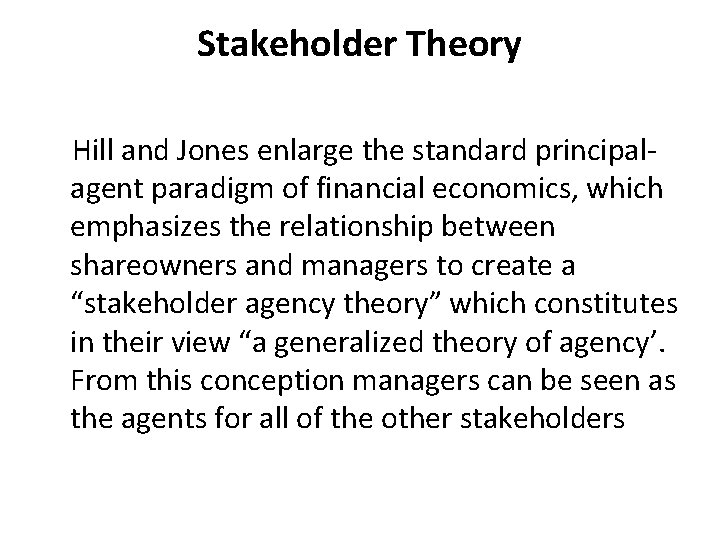
Stakeholder Theory Hill and Jones enlarge the standard principalagent paradigm of financial economics, which emphasizes the relationship between shareowners and managers to create a “stakeholder agency theory” which constitutes in their view “a generalized theory of agency’. From this conception managers can be seen as the agents for all of the other stakeholders
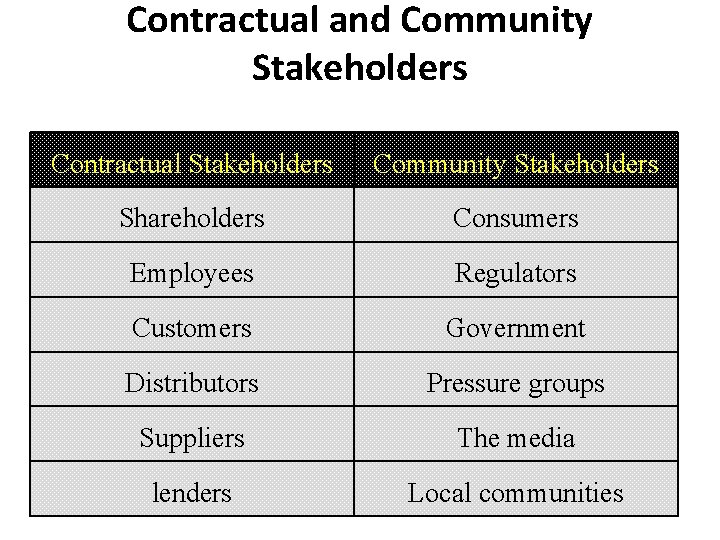
Contractual and Community Stakeholders Contractual Stakeholders Community Stakeholders Shareholders Consumers Employees Regulators Customers Government Distributors Pressure groups Suppliers The media lenders Local communities
Stakeholder Theory • It represents an important step towards a sense of corporate citizenship - an organization with a mature appreciation of its rights and responsibilities.
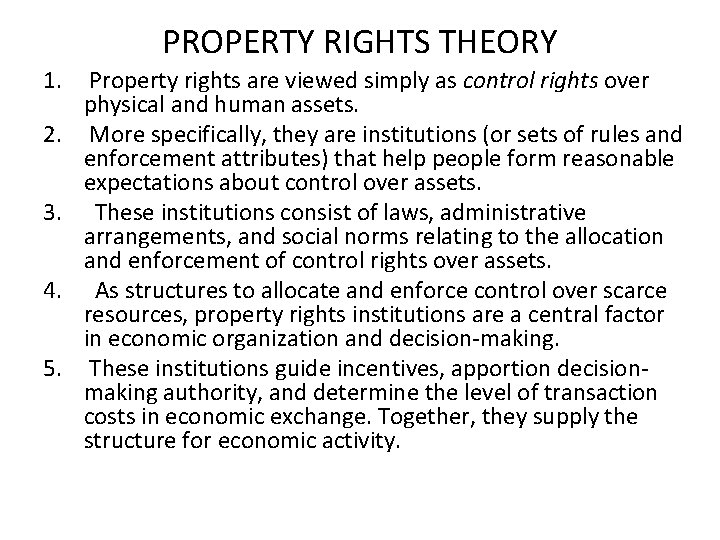
PROPERTY RIGHTS THEORY 1. 2. 3. 4. 5. Property rights are viewed simply as control rights over physical and human assets. More specifically, they are institutions (or sets of rules and enforcement attributes) that help people form reasonable expectations about control over assets. These institutions consist of laws, administrative arrangements, and social norms relating to the allocation and enforcement of control rights over assets. As structures to allocate and enforce control over scarce resources, property rights institutions are a central factor in economic organization and decision-making. These institutions guide incentives, apportion decisionmaking authority, and determine the level of transaction costs in economic exchange. Together, they supply the structure for economic activity.
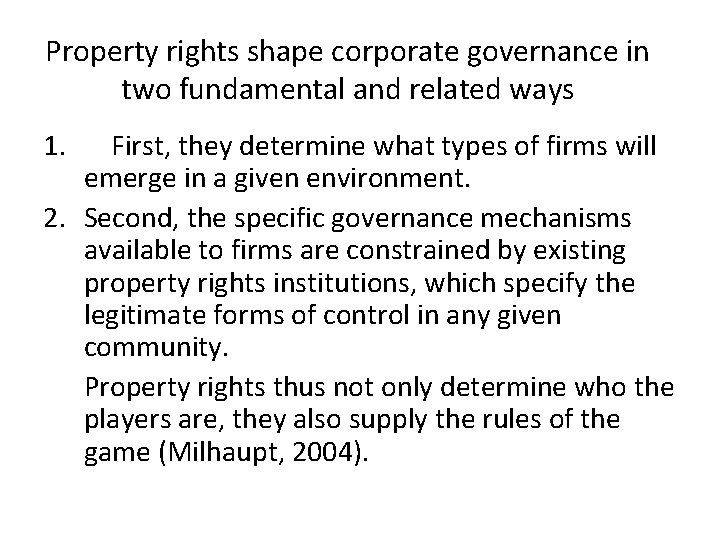
Property rights shape corporate governance in two fundamental and related ways 1. First, they determine what types of firms will emerge in a given environment. 2. Second, the specific governance mechanisms available to firms are constrained by existing property rights institutions, which specify the legitimate forms of control in any given community. Property rights thus not only determine who the players are, they also supply the rules of the game (Milhaupt, 2004).
Popular models for governance • • The Anglo-American Model The German Model The Japanese Model The Indian Perspective
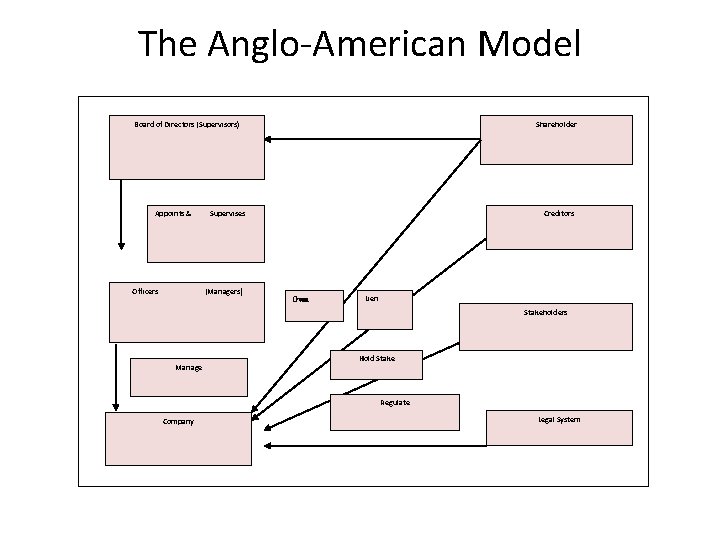
The Anglo-American Model Board of Directors (Supervisors) Appoints & Officers Shareholder Supervises (Managers) Creditors Own Lien Stakeholders Manage Hold Stake Regulate Company Legal System
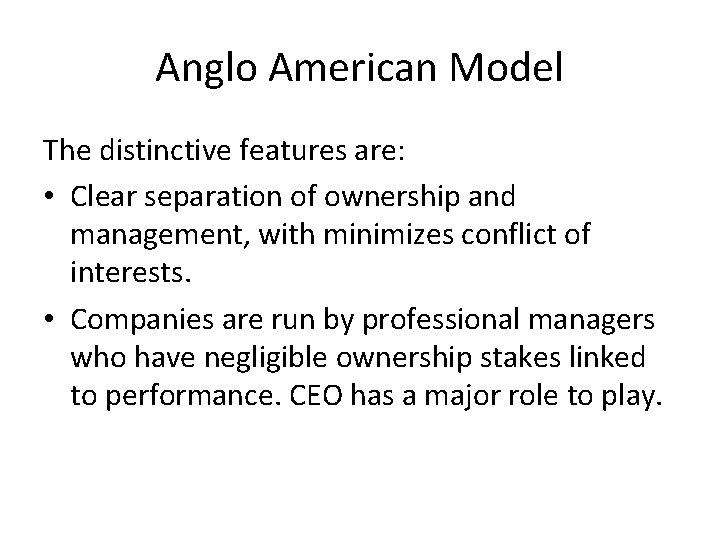
Anglo American Model The distinctive features are: • Clear separation of ownership and management, with minimizes conflict of interests. • Companies are run by professional managers who have negligible ownership stakes linked to performance. CEO has a major role to play.
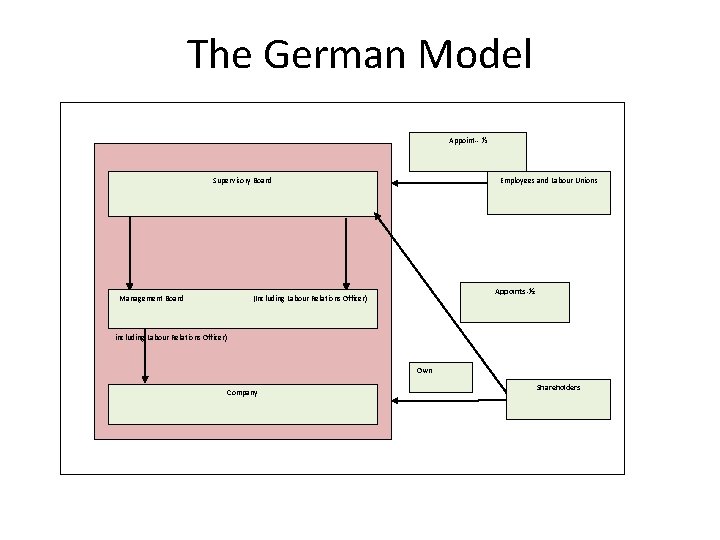
The German Model Appoint-- ½ Supervisory Board Management Board Employees and Labour Unions Appoints -½ (Including Labour Relations Officer) including Labour Relations Officer) Own Company Shareholders
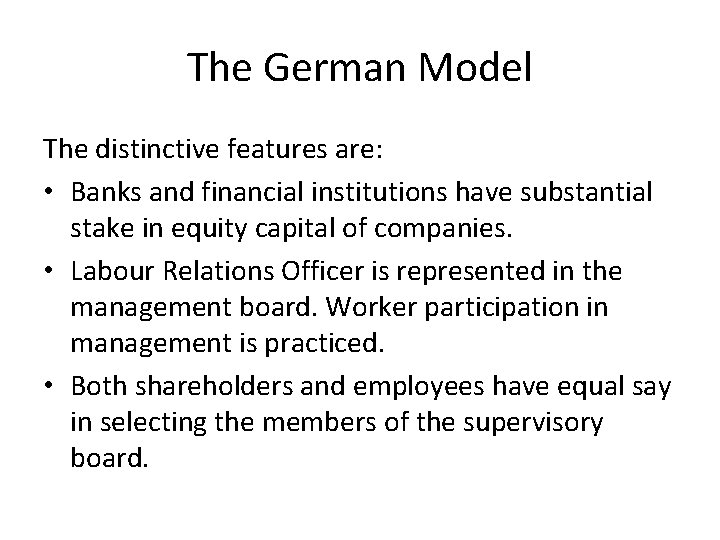
The German Model The distinctive features are: • Banks and financial institutions have substantial stake in equity capital of companies. • Labour Relations Officer is represented in the management board. Worker participation in management is practiced. • Both shareholders and employees have equal say in selecting the members of the supervisory board.
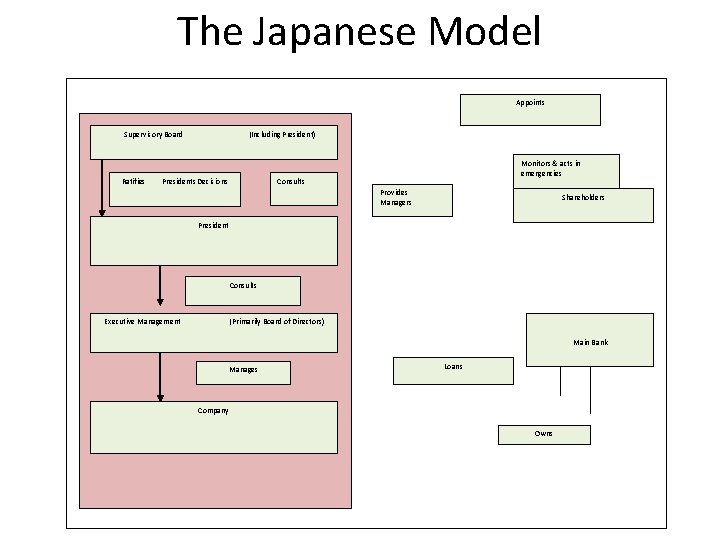
The Japanese Model Appoints Supervisory Board Ratifies (Including President) Presidents Decisions Monitors & acts in emergencies Consults Provides Managers Shareholders President Consults Executive Management (Primarily Board of Directors) Main Bank Manages Loans Company Owns
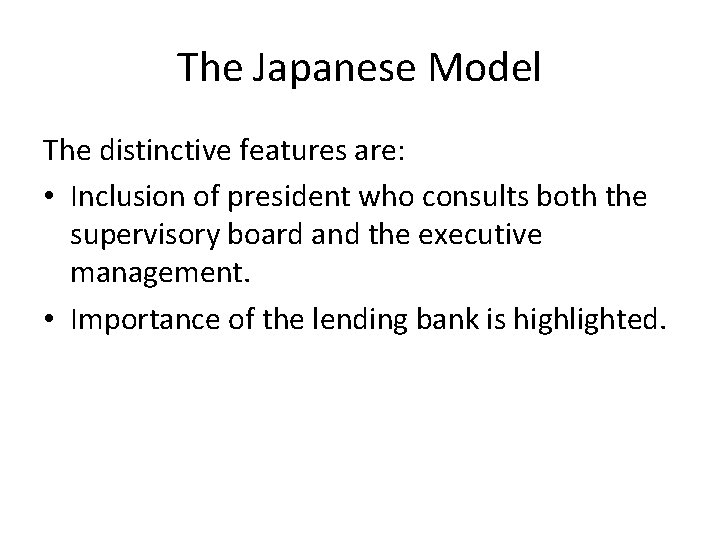
The Japanese Model The distinctive features are: • Inclusion of president who consults both the supervisory board and the executive management. • Importance of the lending bank is highlighted.
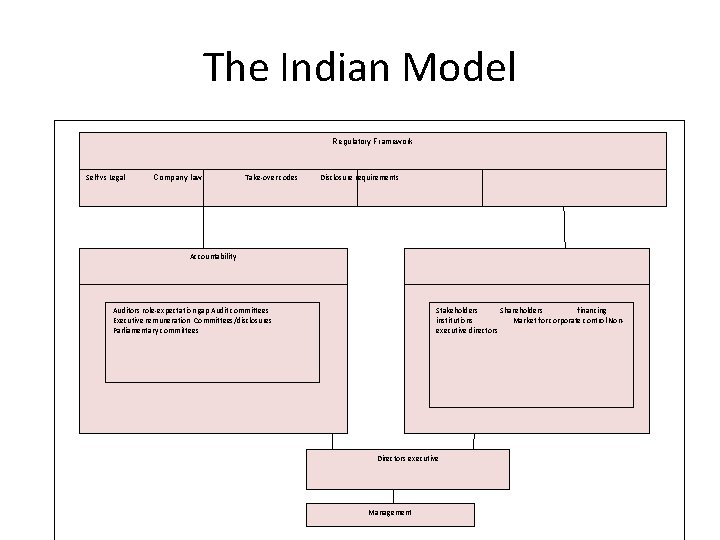
The Indian Model Regulatory Framework Self vs Legal Company law Take-over codes Disclosure requirements Accountability Auditors role-expectation gap Audit committees Executive remuneration Committees/disclosures Parliamentary committees Stakeholders Shareholders financing institutions Market for corporate control Nonexecutive directors Directors executive Management
The Indian Model The distinctive features are: • Equity shares are owned wholly or substantially (51 per cent or more) by the government. • Good deal of political and bureaucratic influence over the management. • Organization often viewed as a social entity. • The boards of directors are appointed by the controlling administrative ministry. • Excessive emphasis on observing rules. Regulations and guidelines. • Efficiency and performance are sacrificed at the altar of propriety.