
Ageing Society Changing Society Some Implications of Demographic
- Slides: 28
Ageing Society: Changing Society Some Implications of Demographic Change for Northern Ireland Dave Rogers 16 January 2016
Coverage Ø Where we are now – brief review of key demographic changes to date Ø Where we are going – future demographic change – and our ageing society Ø Challenges – some challenges that this poses, including health, labour market, housing, and inequalities
1 Things have changed. . .
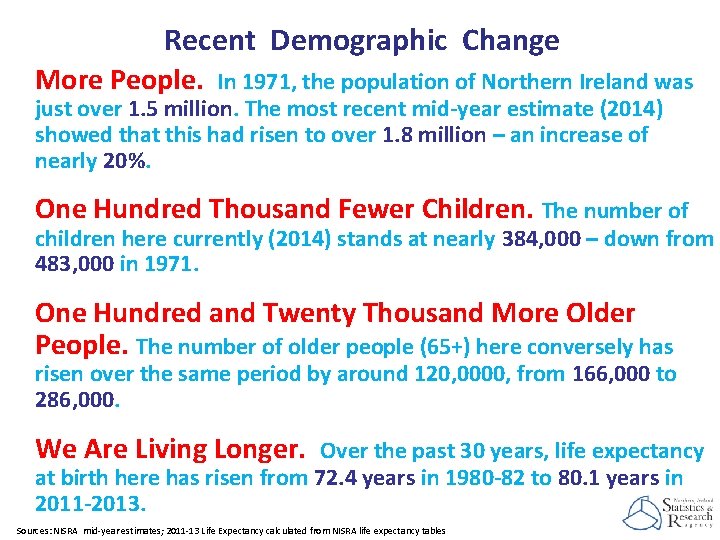
Recent Demographic Change More People. In 1971, the population of Northern Ireland was just over 1. 5 million. The most recent mid-year estimate (2014) showed that this had risen to over 1. 8 million – an increase of nearly 20%. One Hundred Thousand Fewer Children. The number of children here currently (2014) stands at nearly 384, 000 – down from 483, 000 in 1971. One Hundred and Twenty Thousand More Older People. The number of older people (65+) here conversely has risen over the same period by around 120, 0000, from 166, 000 to 286, 000. We Are Living Longer. Over the past 30 years, life expectancy at birth here has risen from 72. 4 years in 1980 -82 to 80. 1 years in 2011 -2013. Sources: NISRA mid-year estimates; 2011 -13 Life Expectancy calculated from NISRA life expectancy tables
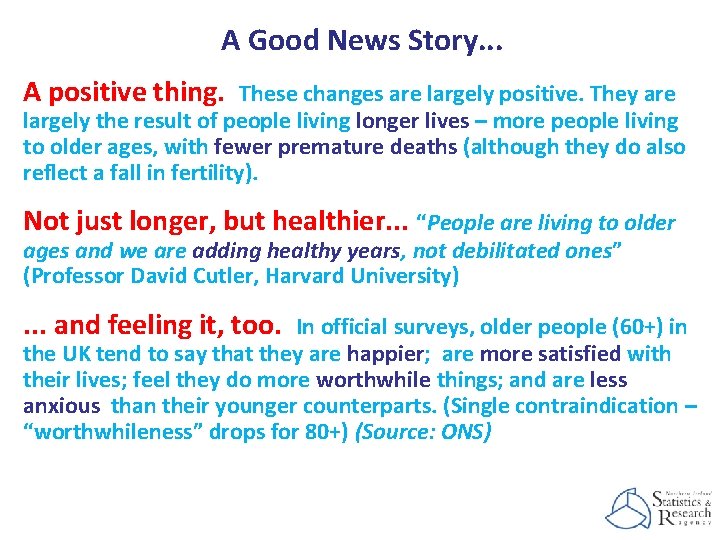
A Good News Story. . . A positive thing. These changes are largely positive. They are largely the result of people living longer lives – more people living to older ages, with fewer premature deaths (although they do also reflect a fall in fertility). Not just longer, but healthier. . . “People are living to older ages and we are adding healthy years, not debilitated ones” (Professor David Cutler, Harvard University) . . . and feeling it, too. In official surveys, older people (60+) in the UK tend to say that they are happier; are more satisfied with their lives; feel they do more worthwhile things; and are less anxious than their younger counterparts. (Single contraindication – “worthwhileness” drops for 80+) (Source: ONS)
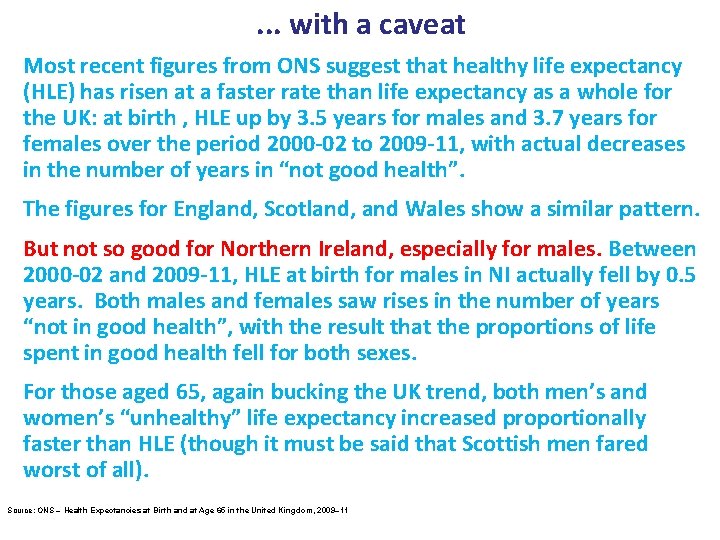
. . . with a caveat Most recent figures from ONS suggest that healthy life expectancy (HLE) has risen at a faster rate than life expectancy as a whole for the UK: at birth , HLE up by 3. 5 years for males and 3. 7 years for females over the period 2000 -02 to 2009 -11, with actual decreases in the number of years in “not good health”. The figures for England, Scotland, and Wales show a similar pattern. But not so good for Northern Ireland, especially for males. Between 2000 -02 and 2009 -11, HLE at birth for males in NI actually fell by 0. 5 years. Both males and females saw rises in the number of years “not in good health”, with the result that the proportions of life spent in good health fell for both sexes. For those aged 65, again bucking the UK trend, both men’s and women’s “unhealthy” life expectancy increased proportionally faster than HLE (though it must be said that Scottish men fared worst of all). Source: ONS – Health Expectancies at Birth and at Age 65 in the United Kingdom, 2009– 11
2 . . . but that change is accelerating
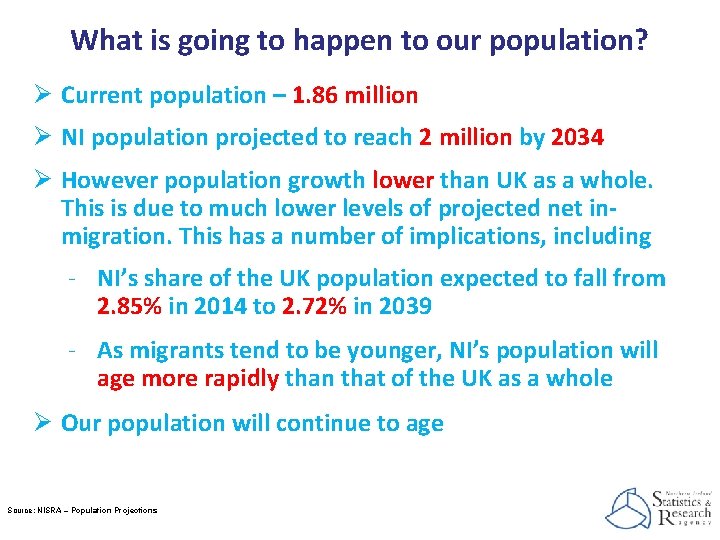
What is going to happen to our population? Ø Current population – 1. 86 million Ø NI population projected to reach 2 million by 2034 Ø However population growth lower than UK as a whole. This is due to much lower levels of projected net inmigration. This has a number of implications, including - NI’s share of the UK population expected to fall from 2. 85% in 2014 to 2. 72% in 2039 - As migrants tend to be younger, NI’s population will age more rapidly than that of the UK as a whole Ø Our population will continue to age Source: NISRA – Population Projections
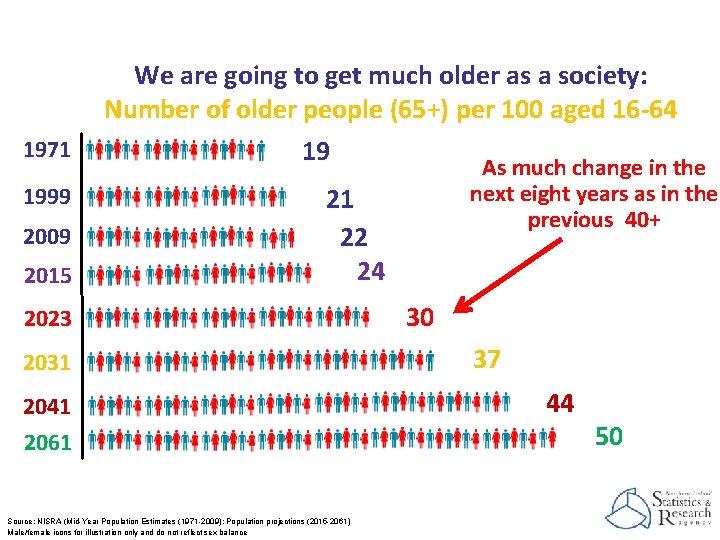
We are going to get much older as a society: Number of older people (65+) per 100 aged 16 -64 1971 1999 2009 2015 19 As much change in the next eight years as in the previous 40+ 21 22 24 2023 2031 2041 2061 Source: NISRA (Mid-Year Population Estimates (1971 -2009); Population projections (2015 -2061) Male/female icons for illustration only and do not reflect sex balance 30 37 44 50
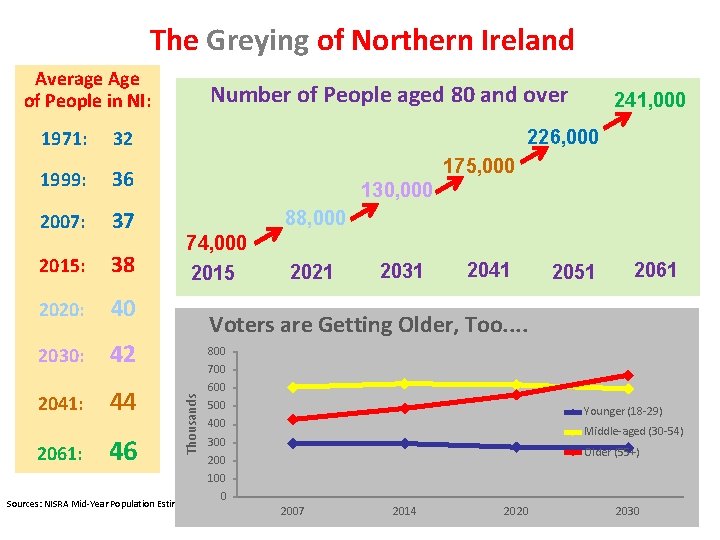
The Greying of Northern Ireland Average Age of People in NI: Number of People aged 80 and over 226, 000 1971: 32 1999: 36 2007: 37 2015: 38 2020: 40 2030: 42 800 44 600 2061: 46 175, 000 130, 000 88, 000 74, 000 2015 2021 2031 2041 2051 2061 Voters are Getting Older, Too. . 700 Thousands 2041: 241, 000 500 Younger (18 -29) 400 Middle-aged (30 -54) 300 Older (55+) 200 100 0 Sources: NISRA Mid-Year Population Estimates; Population Projections 2007 2014 2020 2030
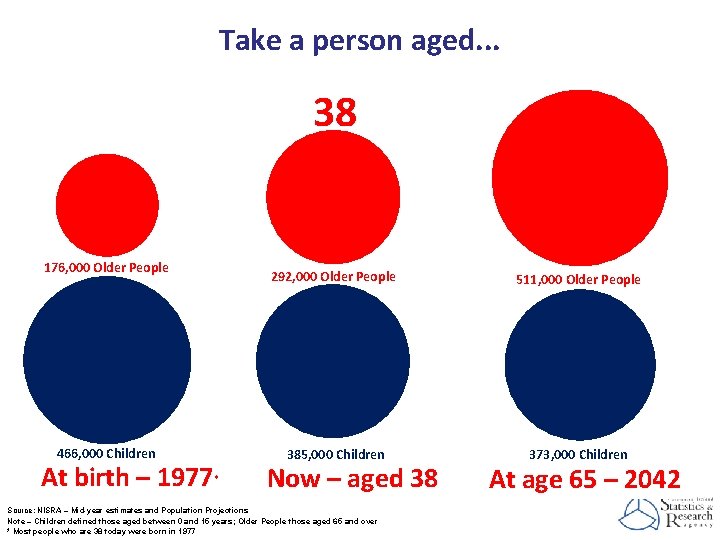
Take a person aged. . . 101 46 37 83 48 52 96 72 19 38 59 61 12 45 7 21 60 27 176, 000 Older People 466, 000 Children At birth – 1977 * 292, 000 Older People 511, 000 Older People 385, 000 Children 373, 000 Children Now – aged 38 Source: NISRA – Mid-year estimates and Population Projections Note – Children defined those aged between 0 and 15 years; Older People those aged 65 and over * Most people who are 38 today were born in 1977 At age 65 – 2042
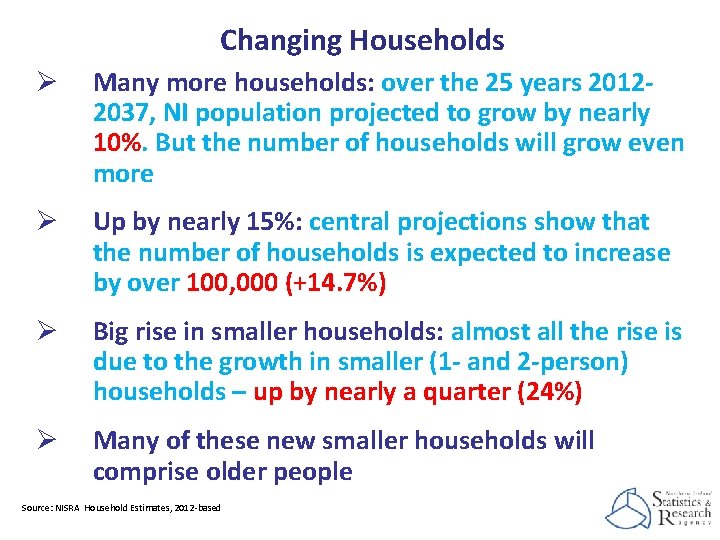
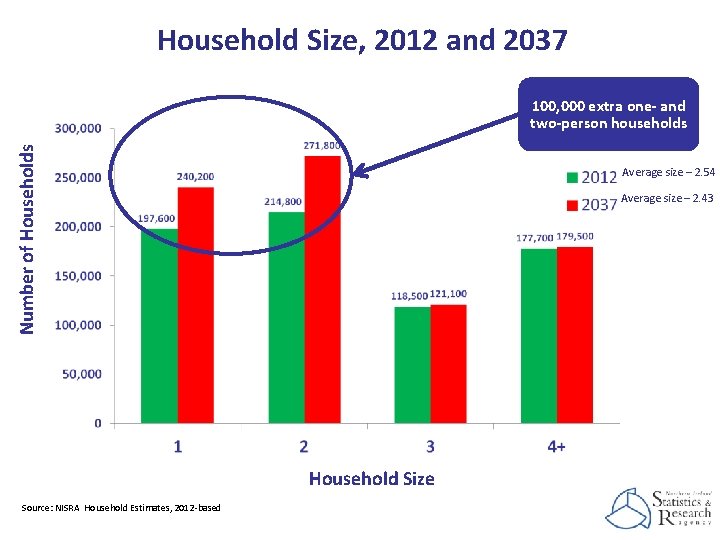
Changing Households Ø Many more households: over the 25 years 20122037, NI population projected to grow by nearly 10%. But the number of households will grow even more Ø Up by nearly 15%: central projections show that the number of households is expected to increase by over 100, 000 (+14. 7%) Ø Big rise in smaller households: almost all the rise is due to the growth in smaller (1 - and 2 -person) households – up by nearly a quarter (24%) Ø Many of these new smaller households will comprise older people Source: NISRA Household Estimates, 2012 -based
Household Size, 2012 and 2037 Number of Households 100, 000 extra one- and two-person households Average size – 2. 54 Average size – 2. 43 Household Size Source: NISRA Household Estimates, 2012 -based
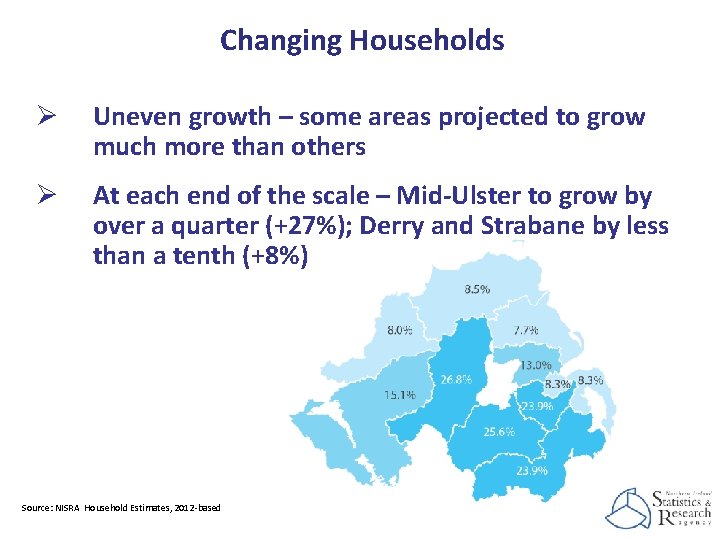
Changing Households Ø Uneven growth – some areas projected to grow much more than others Ø At each end of the scale – Mid-Ulster to grow by over a quarter (+27%); Derry and Strabane by less than a tenth (+8%) Source: NISRA Household Estimates, 2012 -based
Demographic Change – Summing Up. . . Ø Demographic change has already altered the nature of our society: we are much older than we were 30 or 40 years ago. Ø But the future will be different again… the acceleration in ageing, especially in the growth of the old and very old population, is deep-seated and inevitable. Ø …and complicated by there being many more and smaller households… Ø …and more. In addition, there will be changes flowing from other factors I have not addressed here – such as migration.
3 Challenge – Health & Social Care
Health & Social Care Ø More pressure – the one certainty. is that an ageing population will place increased pressure on health and social care budgets Ø Already rising fast – health spending rose nearly three times in the UK between 1997 and 2012 in cash terms – faster than total PE and GDP (tho’ not all down to ageing, of course) (Source: ONS) Ø Over 65 s account for more than two-fifths of HSC spending here – 42%, compared to their population share of 14%. For example, whereas the average 55 -59 year old costs £ 1, 970 per head, this rises to over £ 6, 000 for 75 -79 year olds and £ 14, 000 for the over 85 s (Source: DHSSPS) Ø Ten year horizon – in the period 2015 -2025, the 0 -65 population is projected to grow by around 1%: in contrast, the 65+ population is expected to grow by over a quarter (+27%) Ø Unhealthy ageing – this will be an even bigger problem if we continue to age unhealthily, as we saw earlier
4 Challenge – Labour Market
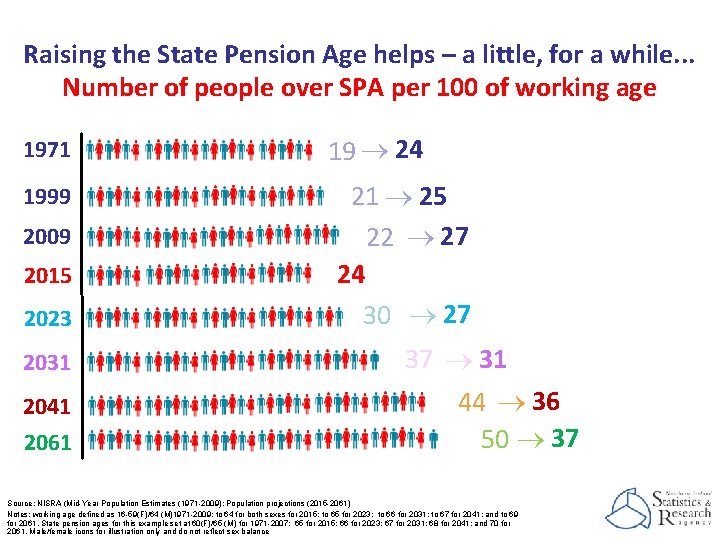
Raising the State Pension Age helps – a little, for a while. . . Number of people over SPA per 100 of working age 1971 1999 2009 2015 2023 2031 2041 2061 19 24 21 25 22 27 24 30 27 37 31 44 36 50 37 Source: NISRA (Mid-Year Population Estimates (1971 -2009); Population projections (2015 -2061) Notes: working age defined as 16 -59(F)/64 (M)1971 -2009; to 64 for both sexes for 2015; to 65 for 2023; to 66 for 2031; to 67 for 2041; and to 69 for 2061. State pension ages for this example set at 60(F)/65 (M) for 1971 -2007; 65 for 2015; 66 for 2023; 67 for 2031; 68 for 2041; and 70 for 2061. Male/female icons for illustration only and do not reflect sex balance
. . . but on its own is insufficient Growing Population: working age population to grow by around 10, 000 to 1. 2 million by 2021 – therefore more jobs needed to “stand still”. (NB growth “stalls” from then onwards) Fewer entrants to labour market: people entering working age (16 -year olds) projected to decline slightly from 24, 000 each year to 22, 000 by 2020, before staring to rise again. The total number of 16 -24 year olds is expected fall by over 6%, from 218, 000 to 204, 000 in 2023. Numbers begin to rise from middle of decade. More Older Workers: older people aged 55+ (but under state pension age) are projected to increase by nearly 70, 000 in the next decade, in part down to the increase in state pension age Ageing Workforce: these changes will produce an older workforce with its consequences. It will be vital to increase the employment rate amongst older workers aged 55+ as this group tends to have low and diminishing engagement with the labour market as we will see next Trends accelerate after 2021: the changes in relation to older workers are not temporary but are a foretaste of things to come. Source: NISRA - Population Projections
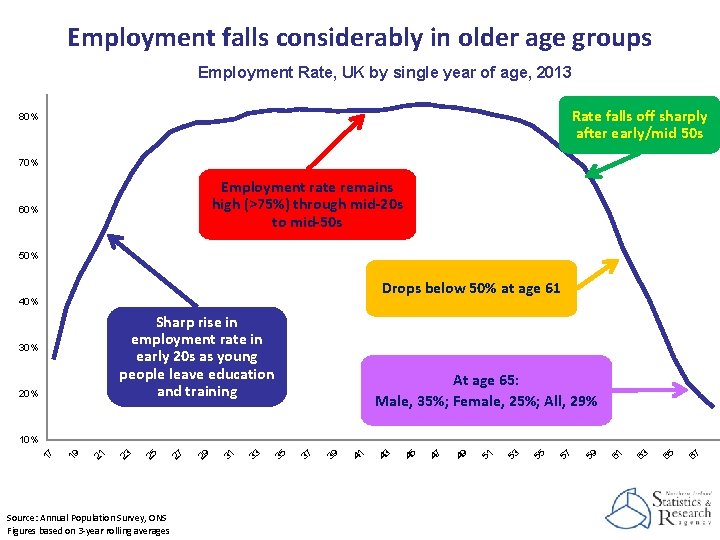
Employment falls considerably in older age groups Employment Rate, UK by single year of age, 2013 Rate falls off sharply after early/mid 50 s 80% 70% Employment rate remains high (>75%) through mid-20 s to mid-50 s 60% 50% Drops below 50% at age 61 40% Sharp rise in employment rate in early 20 s as young people leave education and training 30% 20% At age 65: Male, 35%; Female, 25%; All, 29% Source: Annual Population Survey, ONS Figures based on 3 -year rolling averages 67 65 63 61 59 57 55 53 51 49 47 45 43 41 39 37 35 33 31 29 27 25 23 21 19 17 10%
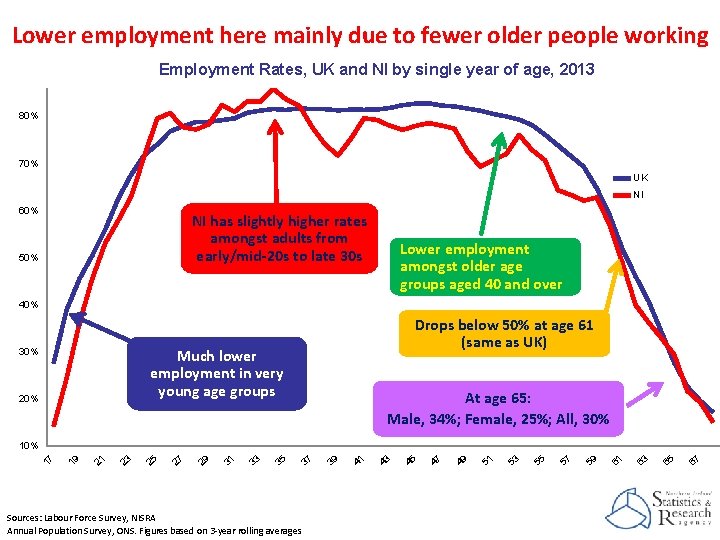
Lower employment here mainly due to fewer older people working Employment Rates, UK and NI by single year of age, 2013 80% 70% UK NI 60% NI has slightly higher rates amongst adults from early/mid-20 s to late 30 s 50% Lower employment amongst older age groups aged 40 and over 40% Drops below 50% at age 61 (same as UK) Much lower employment in very young age groups 30% 20% At age 65: Male, 34%; Female, 25%; All, 30% Sources: Labour Force Survey, NISRA Annual Population Survey, ONS. Figures based on 3 -year rolling averages 67 65 63 61 59 57 55 53 51 49 47 45 43 41 39 37 35 33 31 29 27 25 23 21 19 17 10%
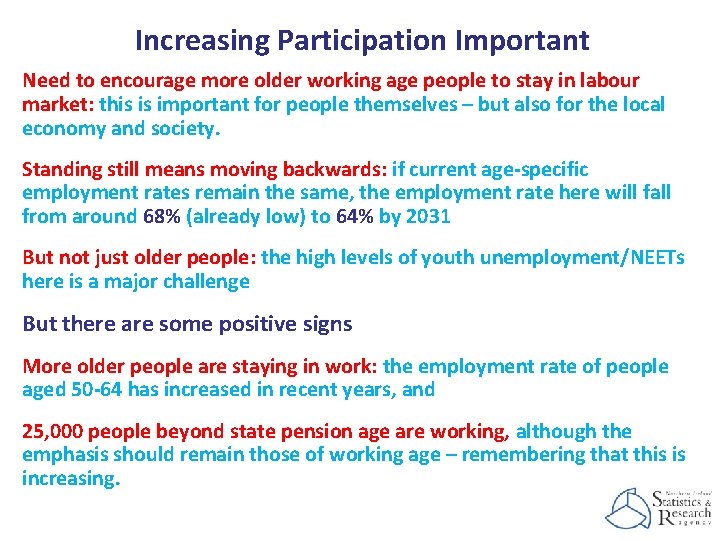
Increasing Participation Important Need to encourage more older working age people to stay in labour market: this is important for people themselves – but also for the local economy and society. Standing still means moving backwards: if current age-specific employment rates remain the same, the employment rate here will fall from around 68% (already low) to 64% by 2031 But not just older people: the high levels of youth unemployment/NEETs here is a major challenge But there are some positive signs More older people are staying in work: the employment rate of people aged 50 -64 has increased in recent years, and 25, 000 people beyond state pension age are working, although the emphasis should remain those of working age – remembering that this is increasing.
5 Other Challenges
A Few Other Challenges Changing demography throws up a number of other challenges, including Ø Fiscal issues – implicit in the sections on health and employment is that costs are going to go up, but the employment (and therefore tax) base is unlikely to keep pace. How do we continue to fund public services? Ø Fiscal double whammy? We saw earlier that NI’s proportion of the UK population is due to fall. This means we can expect less under the Barnett formula. At the same time our population is ageing at a faster rate than the UK as a whole. Therefore we can expect the pressures due to ageing to be more acute here Ø Housing – the projections discussed earlier make it clear that there will be more, and smaller, households. Many of these extra households will comprise older people. Housing stock will need to respond.
A Few Other Challenges Ø Carers – many old people act as carers (often in three directions – for their grandchildren and their parents, as well as for partners). How do we square that with increasing participation in the labour market? Ø Inequalities – the life expectancy of males in the most deprived areas is around 7½ years less than those in the least deprived – and the gap is growing (Source: DHSSPS) Ø Poverty – poverty amongst all age groups – including older people – is higher here than in the UK as a whole (Source: DSD). Fuel poverty is another associated issue, and may well interact with poor housing conditions (and people in smaller households trying to heat large dwellings) Ø Social Exclusion – including loneliness and access to transport (especially in rural areas) is also a potential issue. On the other hand, older people may provide a growing reservoir of volunteers.
Conclusions Ø First thing to remember is – things are working Ø Life expectancy is increasing here, for both sexes and all social groups. What is more those “added years” are on the whole productive and positive additions – although too many are spent in poor health and dependence Ø There is also evidence that older people tend to be happy and satisfied with their lives, more so than their younger counterparts Ø So, on the whole we are dealing with the “unintended consequences” of success. That is our key challenge Ø However, despite the fact that things have improved for all, it is undoubtedly the case that some people fare less well than others – so the other key task is to ensure that we enable as many people as possible to enjoy the benefits and rewards of life for as long as possible
Conclusions Ø Beware the fallacies of “Linear Projection” Ø For example, in the (possibly apocryphal) story, the streets of New York didn’t get completely buried under horse manure due to the rising population in the 20 th Century Ø Rathere was adaptation (the subway and the motor vehicle) Ø The population change outlined earlier will happen – more or less, and barring some dramatic and unforeseen events Ø But the consequences of these changes will be influenced by our reaction to them. Understanding them better should better help us shape that response