
AGEC 622 Overhead 1 1 INTRO TO MATHEMATICAL
- Slides: 18
AGEC 622 – Overhead 1 1 INTRO TO MATHEMATICAL PROGRAMMING
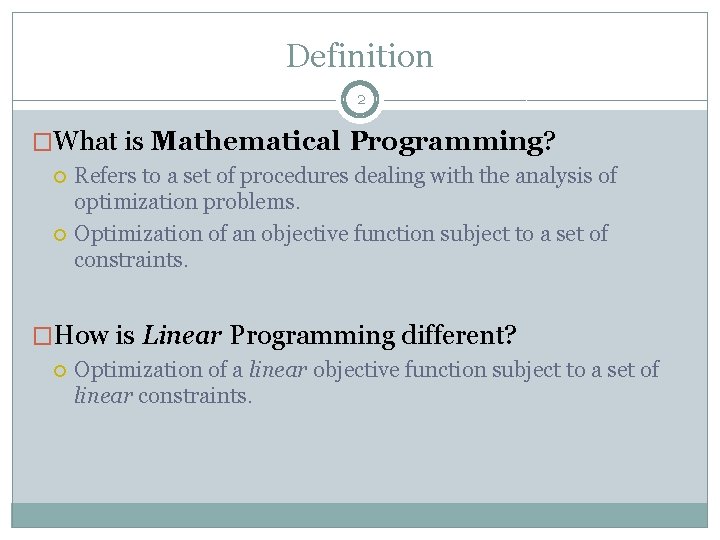
Definition 2 �What is Mathematical Programming? Refers to a set of procedures dealing with the analysis of optimization problems. Optimization of an objective function subject to a set of constraints. �How is Linear Programming different? Optimization of a linear objective function subject to a set of linear constraints.
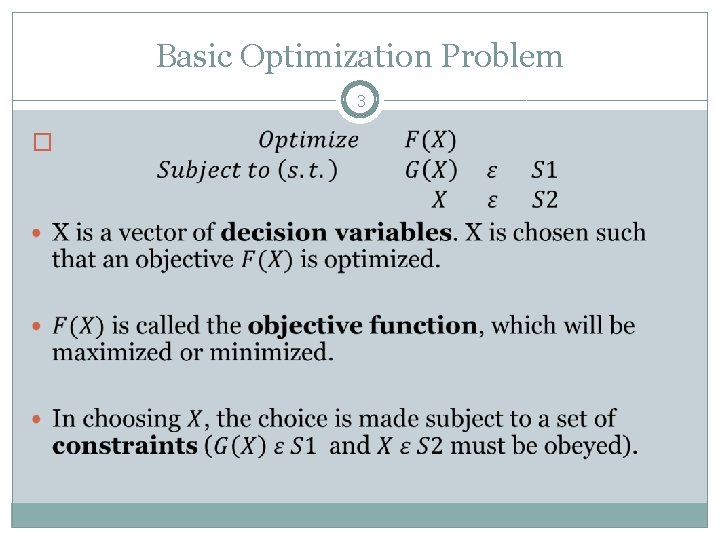
Basic Optimization Problem 3 �
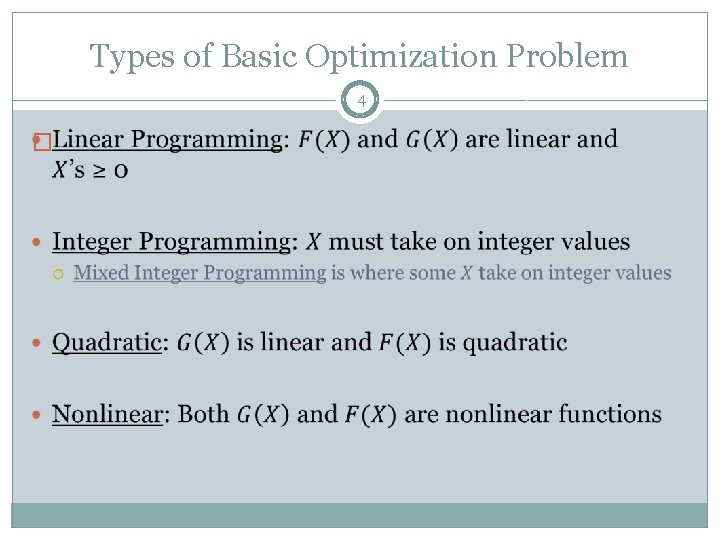
Types of Basic Optimization Problem 4 �
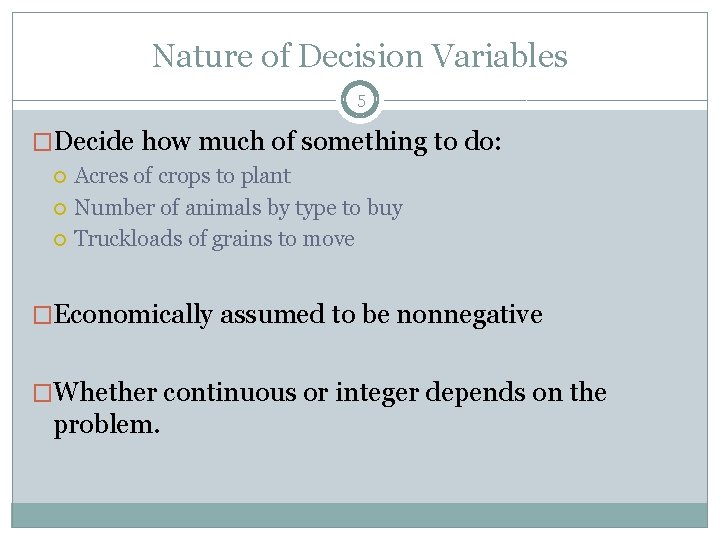
Nature of Decision Variables 5 �Decide how much of something to do: Acres of crops to plant Number of animals by type to buy Truckloads of grains to move �Economically assumed to be nonnegative �Whether continuous or integer depends on the problem.
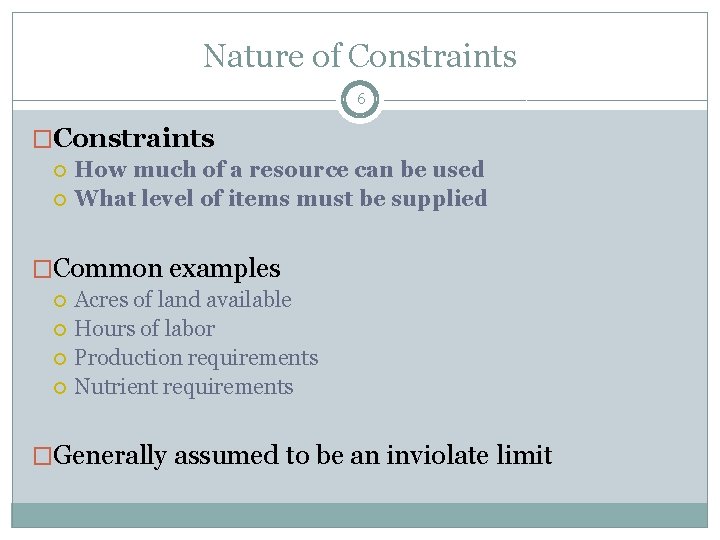
Nature of Constraints 6 �Constraints How much of a resource can be used What level of items must be supplied �Common examples Acres of land available Hours of labor Production requirements Nutrient requirements �Generally assumed to be an inviolate limit
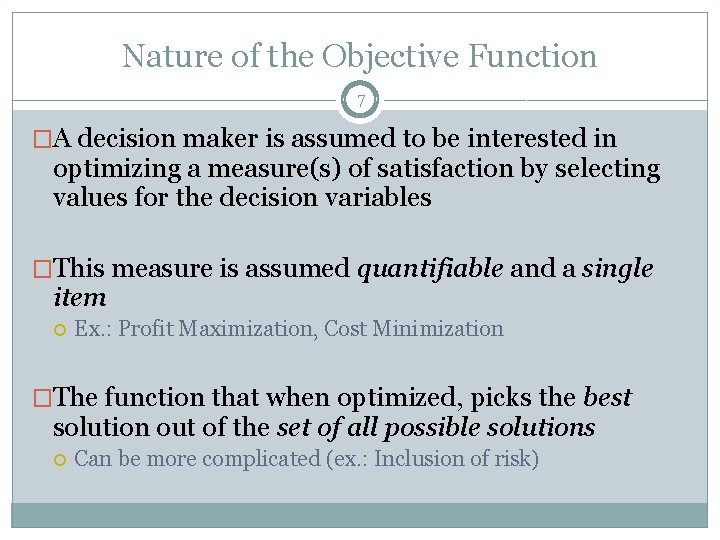
Nature of the Objective Function 7 �A decision maker is assumed to be interested in optimizing a measure(s) of satisfaction by selecting values for the decision variables �This measure is assumed quantifiable and a single item Ex. : Profit Maximization, Cost Minimization �The function that when optimized, picks the best solution out of the set of all possible solutions Can be more complicated (ex. : Inclusion of risk)
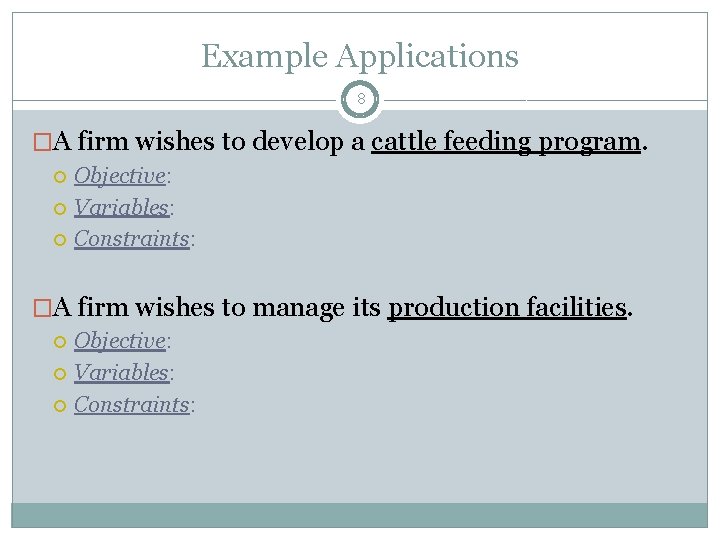
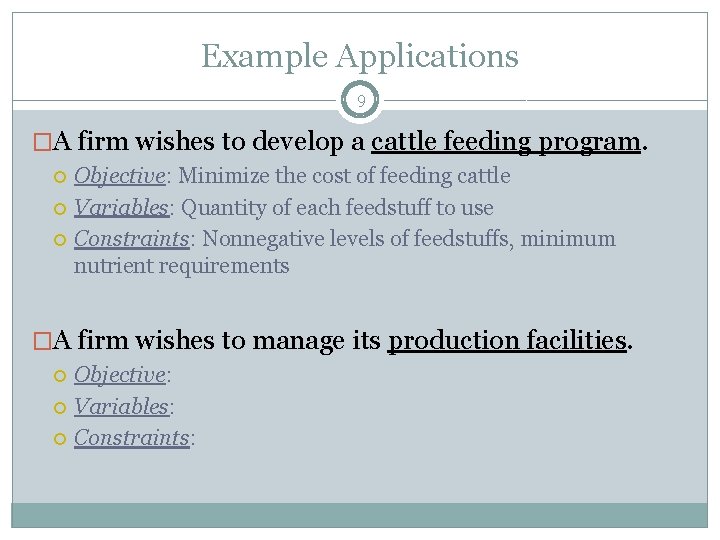
Example Applications 8 �A firm wishes to develop a cattle feeding program. Objective: Variables: Constraints: �A firm wishes to manage its production facilities. Objective: Variables: Constraints:
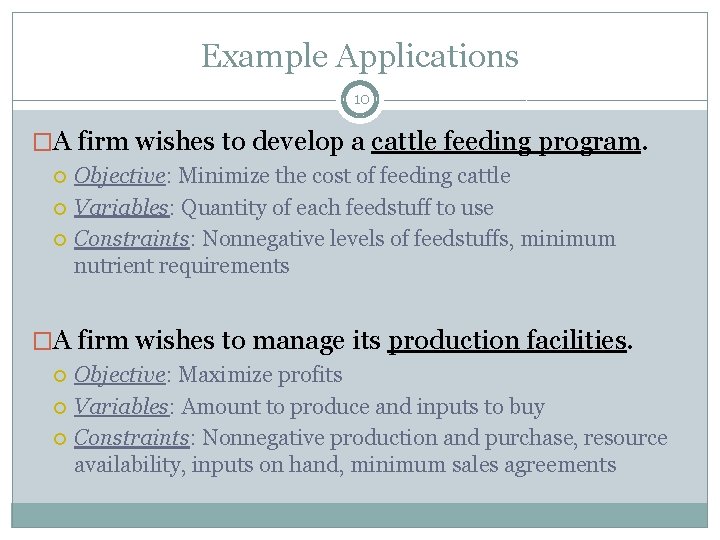
Example Applications 9 �A firm wishes to develop a cattle feeding program. Objective: Minimize the cost of feeding cattle Variables: Quantity of each feedstuff to use Constraints: Nonnegative levels of feedstuffs, minimum nutrient requirements �A firm wishes to manage its production facilities. Objective: Variables: Constraints:
Example Applications 10 �A firm wishes to develop a cattle feeding program. Objective: Minimize the cost of feeding cattle Variables: Quantity of each feedstuff to use Constraints: Nonnegative levels of feedstuffs, minimum nutrient requirements �A firm wishes to manage its production facilities. Objective: Maximize profits Variables: Amount to produce and inputs to buy Constraints: Nonnegative production and purchase, resource availability, inputs on hand, minimum sales agreements
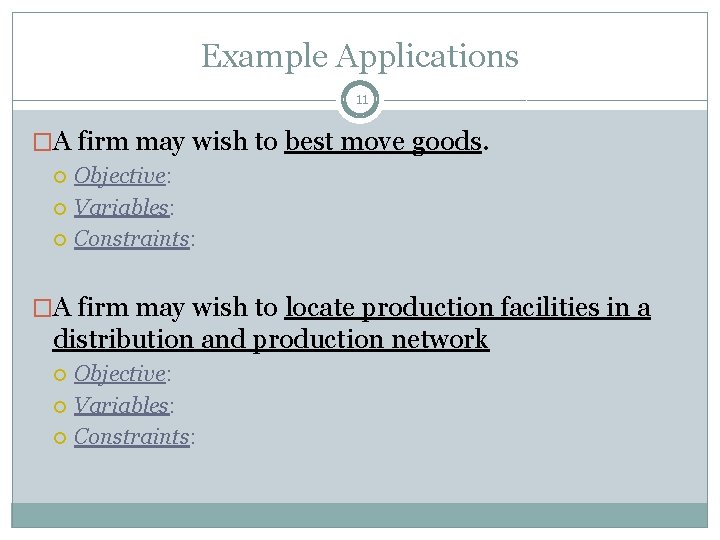
Example Applications 11 �A firm may wish to best move goods. Objective: Variables: Constraints: �A firm may wish to locate production facilities in a distribution and production network Objective: Variables: Constraints:
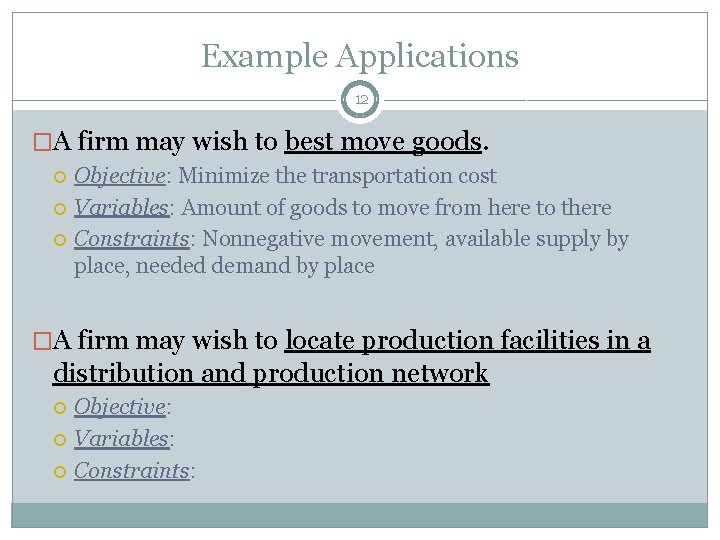
Example Applications 12 �A firm may wish to best move goods. Objective: Minimize the transportation cost Variables: Amount of goods to move from here to there Constraints: Nonnegative movement, available supply by place, needed demand by place �A firm may wish to locate production facilities in a distribution and production network Objective: Variables: Constraints:
Example Applications 13 �A firm may wish to best move goods. Objective: Minimize the transportation cost Variables: Amount of goods to move from here to there Constraints: Nonnegative movement, available supply by place, needed demand by place �A firm may wish to locate production facilities in a distribution and production network Objective: Minimize production and transportation costs Variables: Where to build, amount to move from here to there, amount to produce by location Constraints: Nonneg transport, nonneg production, nonneg building, resources available by place, needed demand by place
Problem Insights 14 �The decision maker must deeply understand the problem �One must define: Decision Variables Constraints Objective Function Linkages between variables and constraints � Must reflect complementary, supplementary, and competitive relationships among variables Consistent Data �Use your knowledge of the problem when checking if solutions make sense!
Numerical Mathematical Programming 15 �Three main Numerical Usage subclasses Prescription of solutions Prediction of consequences Demonstration of sensitivity
Numerical Usage – Prescription of Solution 16 �It usually involves prescriptive or normative questions: What decision should be made given a particular specification of objectives, variables, and constraints? �Not a common usage in the “real world” Do you think many decision makers yield decision making power to a model? �Most models used for decision guidance and predict the consequence of actions
Numerical Usage – Prediction of Consequences 17 �The model is used to predict in a conditional normative setting In a Business Setting: Models predict consequences caused by investments, acquisition of resources, market price conditions, etc. In a Government Policy Setting: Models predict consequences of policy changes, actions of foreign trade partners, etc.
Numerical Usage – Demonstration of Sensitivity 18 �Many firms, researchers, and policy makers would like to know what would happen if an event were to occur? �In these simulations, solutions are not always implemented �Rather, the model is used to demonstrate what might happen if certain factors (parameters in the model) are changed.