
Age Related Memory Loss How to Improve Memory




- Slides: 28
Age Related Memory Loss & How to Improve Memory n n n n What is memory How we remember Age related memory loss Causes of memory impairment How to prevent memory loss How to improve memory Alzheimer’s Disease NATEA Seminar March 27, 2010 Kim W. Yang
DISCLAIMER The information I am giving to you today is intended for general reference purposes only. It is not a substitute for professional medical advice or a medical exam. Always seek the advice of your physician or other qualified health professional before starting any new activity or life style change. Medical information changes rapidly and while I make efforts to update the content in my speech, some information may be out of date. Kim W. Yang
What is Memory? n n All that you remember, Information Retaining. Your Capacity for Remembering Your mind works a lot like a computer. Your brain puts information it judges to be important into "files. " When you remember something, you pull up a file. Memory doesn't always work perfectly. As people grow older, it may take longer to retrieve those files. It's normal to forget things once in a while. We've all forgotten a name, where we put our keys, or if we locked the front door. But forgetting how to use the telephone or find your way home may be signs of a more serious problem
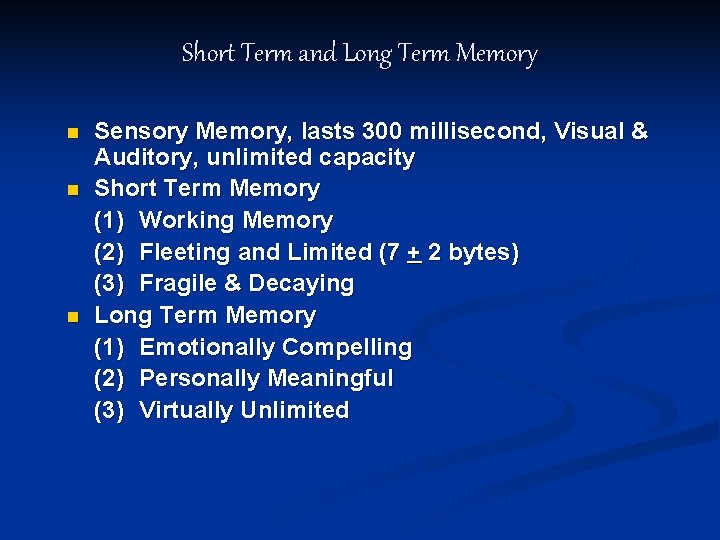
Short Term and Long Term Memory n n n Sensory Memory, lasts 300 millisecond, Visual & Auditory, unlimited capacity Short Term Memory (1) Working Memory (2) Fleeting and Limited (7 + 2 bytes) (3) Fragile & Decaying Long Term Memory (1) Emotionally Compelling (2) Personally Meaningful (3) Virtually Unlimited
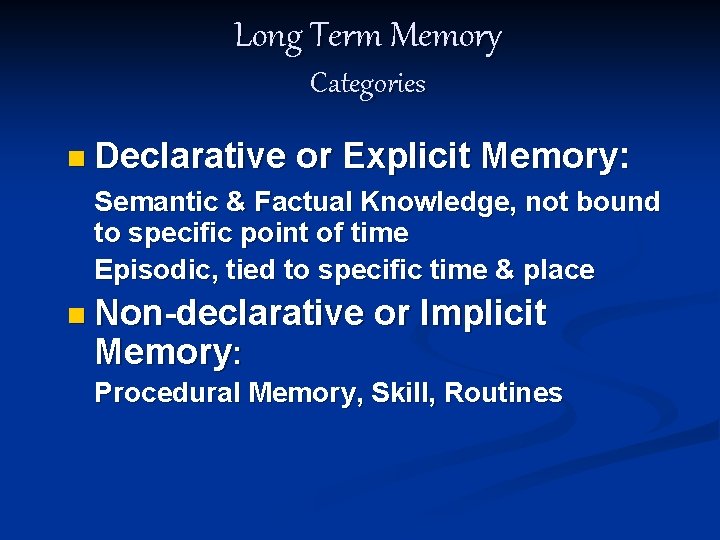
Long Term Memory Categories n Declarative or Explicit Memory: Semantic & Factual Knowledge, not bound to specific point of time Episodic, tied to specific time & place n Non-declarative Memory: or Implicit Procedural Memory, Skill, Routines
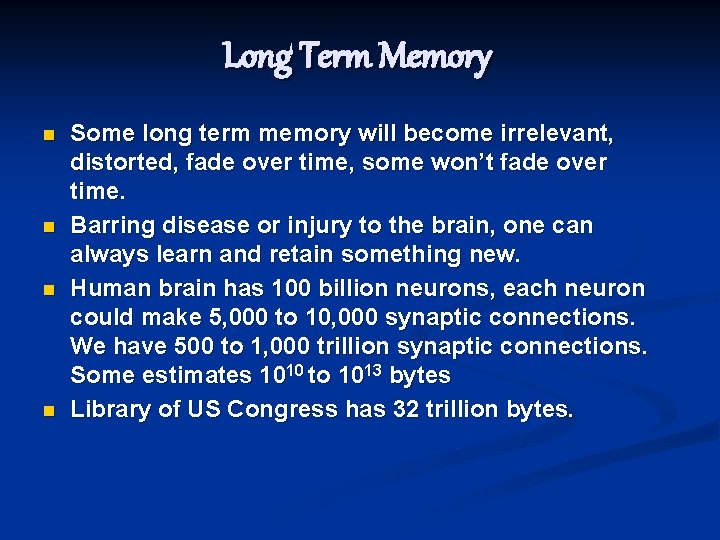
Long Term Memory n n Some long term memory will become irrelevant, distorted, fade over time, some won’t fade over time. Barring disease or injury to the brain, one can always learn and retain something new. Human brain has 100 billion neurons, each neuron could make 5, 000 to 10, 000 synaptic connections. We have 500 to 1, 000 trillion synaptic connections. Some estimates 1010 to 1013 bytes Library of US Congress has 32 trillion bytes.
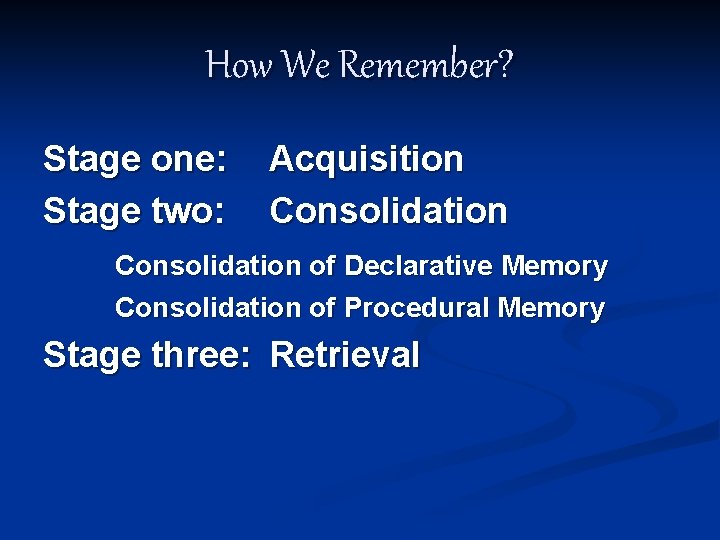
How We Remember? Stage one: Stage two: Acquisition Consolidation of Declarative Memory Consolidation of Procedural Memory Stage three: Retrieval
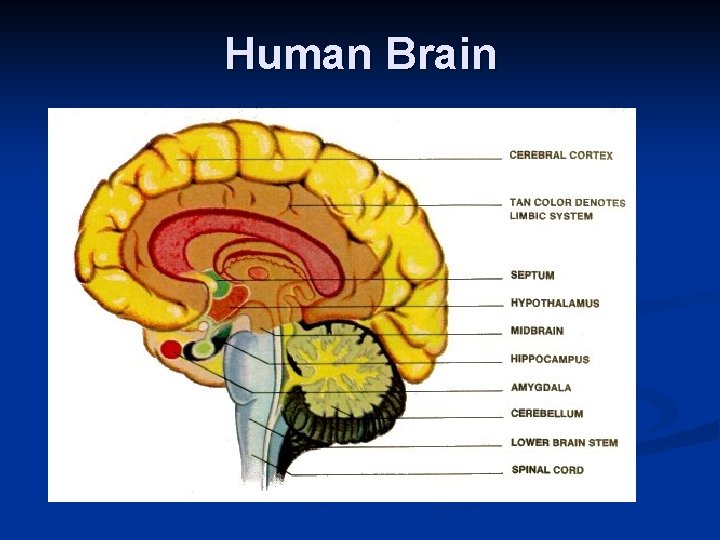
Human Brain
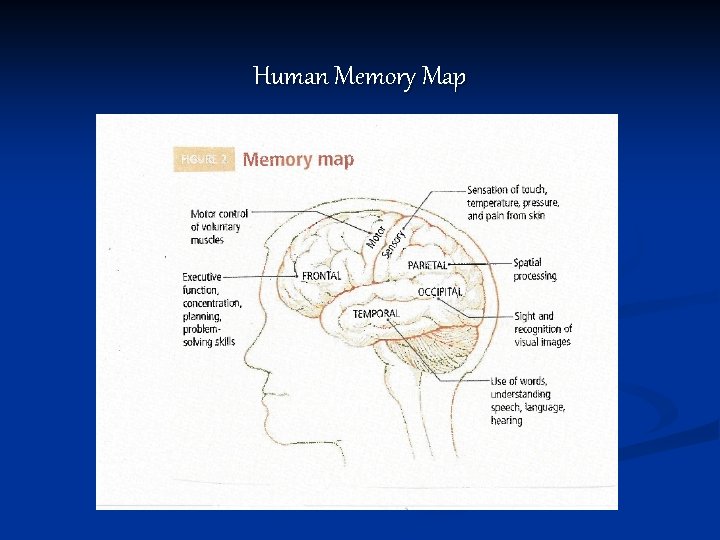
Human Memory Map
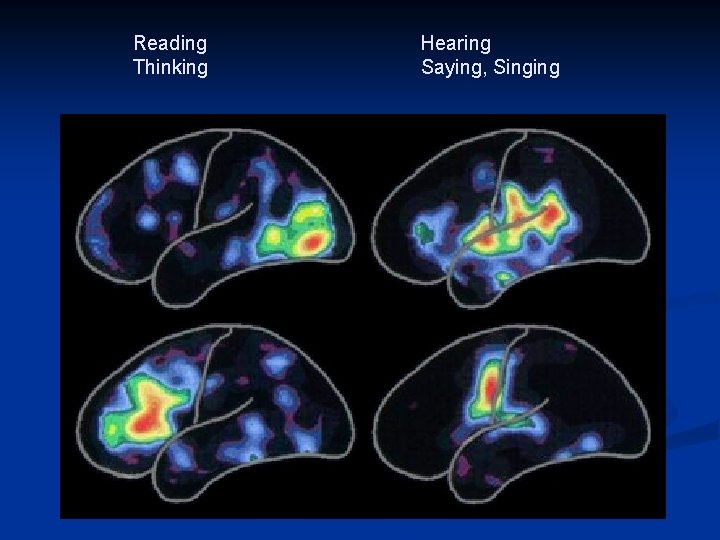
Reading Thinking Hearing Saying, Singing
Synaptic Junction
Brain and Nerves
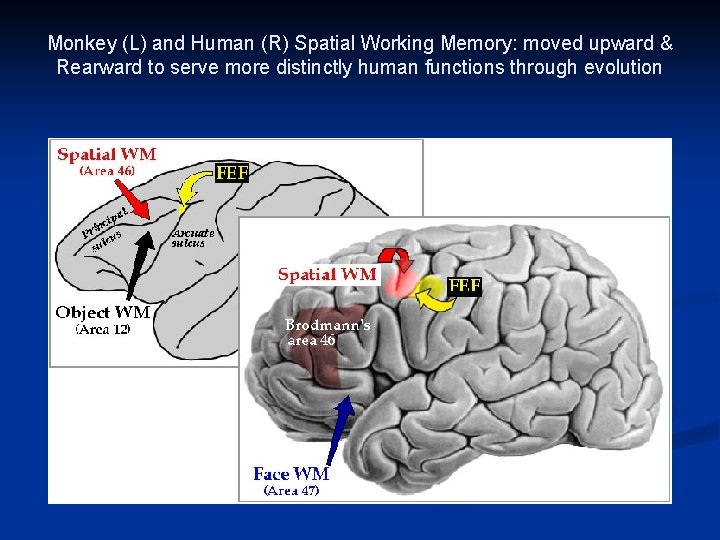
Monkey (L) and Human (R) Spatial Working Memory: moved upward & Rearward to serve more distinctly human functions through evolution
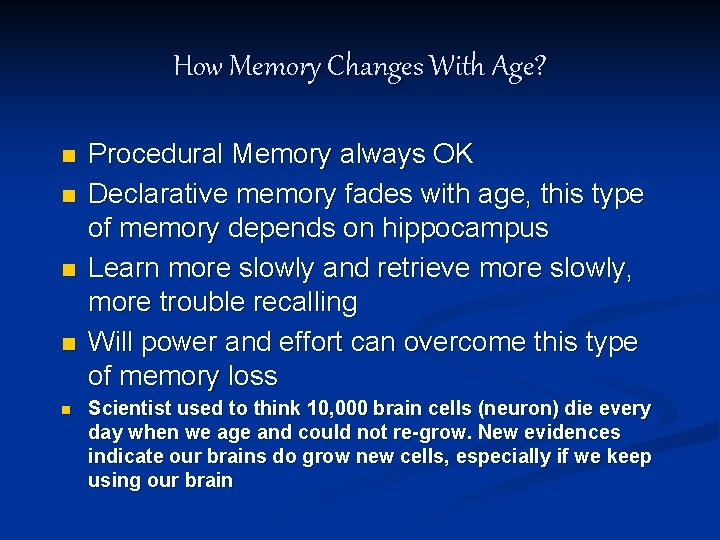
How Memory Changes With Age? n n n Procedural Memory always OK Declarative memory fades with age, this type of memory depends on hippocampus Learn more slowly and retrieve more slowly, more trouble recalling Will power and effort can overcome this type of memory loss Scientist used to think 10, 000 brain cells (neuron) die every day when we age and could not re-grow. New evidences indicate our brains do grow new cells, especially if we keep using our brain
How Memory Changes With Age? (Continued) n n n Neuro transmitters such as dopamine, acetylcholine. Serotonine, etc. reduced Harder to remember, harder to learn Would not impair our ability to remember: 1. 2. 3. We are able to make more reasonable arguments We are able to make correct judgment Our wisdom gained from experiences remain unscathed
Normal Forgetting & Dementia Seven types of Normal Forgetting: 1. 2. 3. 4. 5. 6. 7. Transience Absentmindedness Blocking (ugly stepsisters) Misattribution Suggestibility Bias Persistence Dementia: Progressive deterioration, extreme & debilitating, usually damage to the hippocampus & related structure in the brain
Mild Cognitive Impairment n n Not necessary sign of Alzheimer’s disease (81% didn’t develop to Alzheimer’s Disease (AD)) Causes: 1. Neurological disorder Alzheimer Disease, Cerebrovascular Diseases & Stroke, Head Trauma, Infectious disease to brain 2. Genes 3. Hormones 4. Vitamin (B 12) deficiency
Mild Cognitive Impairment (Causes Continued) 5. Cardiovascular Disease & its Risk Factors: Hypertension, High Cholesterol, Diabetes, Coronary artery bypass surgery 6. Depression 7. Post Traumatic Stress Disorder 8. Thyroid dysfunction 9. Hearing Loss 10. Sleep Disorders 11. Medication 12. Lifestyle Factors: Alcohol, diet, lack of intellectual stimulations, sedentary life, lack of sleep, stress, smoking, illicit drugs, toxic exposure
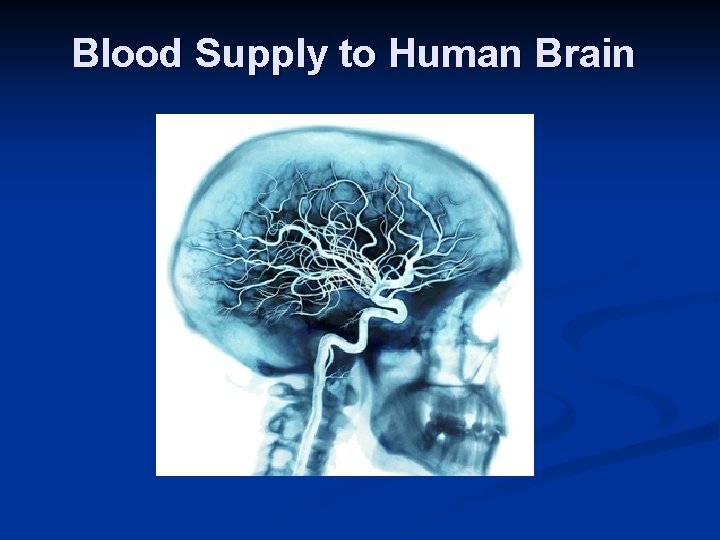
Blood Supply to Human Brain
How to Prevent Memory Loss 1. 2. 3. 4. 5. 6. 7. 8. 9. 10. Exercise Keep learning Don’t smoke Drink alcohol in moderation Healthy diet Vitamins: Multivitamins, C, D, E, B 6, B 12, Folic Acid, Fish Oil, Olive Oil Good night sleep Friends Manage stress Protect your head and brain, don’t get concussion
How to improve memory n Get organized (belongings, appointments, tasks, contacts, vital information, locations, checklists) n n n n Get Focus Repeat Ensure comprehension Make note Be patient Spaced rehearsal Professional memory training Do small tasks first
Alzheimer’s Disease n What it is? n Signs & Symptoms n Causes, Risks & Prevention n Drug Treatments & Care
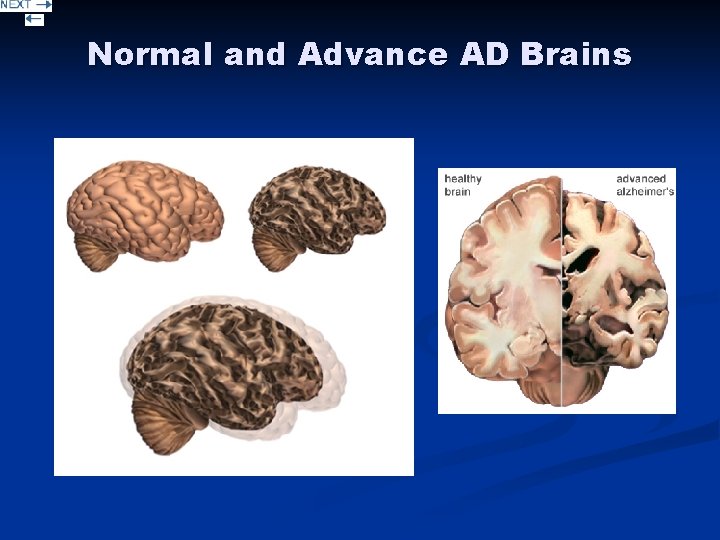
Normal and Advance AD Brains
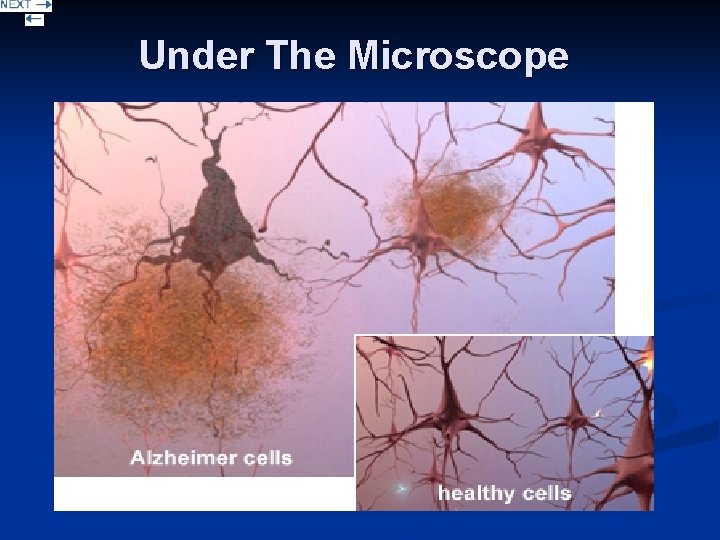
Under The Microscope
Progression Through the Brain
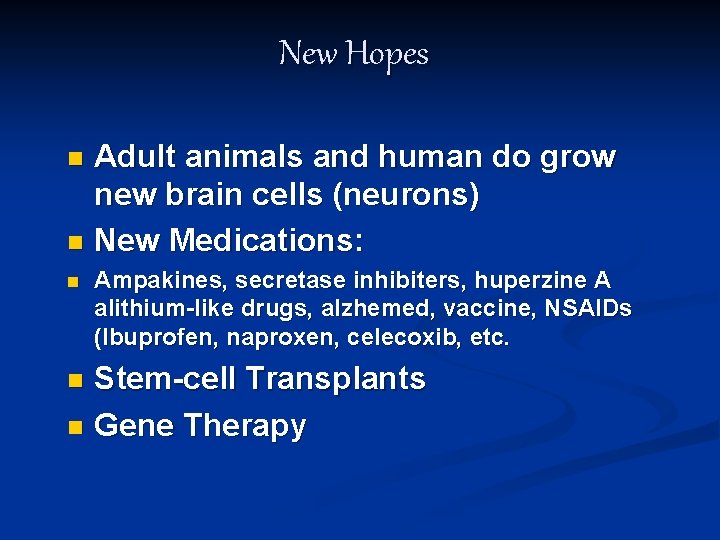
New Hopes Adult animals and human do grow new brain cells (neurons) n New Medications: n n Ampakines, secretase inhibiters, huperzine A alithium-like drugs, alzhemed, vaccine, NSAIDs (Ibuprofen, naproxen, celecoxib, etc. Stem-cell Transplants n Gene Therapy n
Thank you all
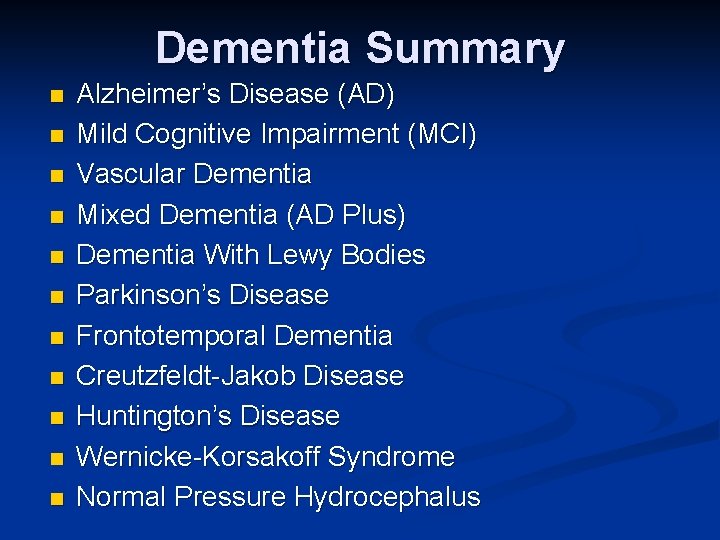
Dementia Summary n n n Alzheimer’s Disease (AD) Mild Cognitive Impairment (MCI) Vascular Dementia Mixed Dementia (AD Plus) Dementia With Lewy Bodies Parkinson’s Disease Frontotemporal Dementia Creutzfeldt-Jakob Disease Huntington’s Disease Wernicke-Korsakoff Syndrome Normal Pressure Hydrocephalus