
Age of electronic computer 1 ENIAC John Mauchly
- Slides: 46
Age of electronic computer 1) ENIAC: John Mauchly and J. P. Eckert built the first electronic computer in 1946. This Machine was called ENIAC(Electronic Numerical Integrator and Calculator). It used vacuum tube storage and could perform about 300 calculations per second. There were 18000 vacuum tube, 70000 resisters, 10000 condenser and 6000 switches. It weighed 30 tones and occupied a pace 3000 cubic feet.
2. John Von Neumann: A great mathematician john von Neumann wrote a paper in which he suggested the following things. �- Binary numbers system should be used in computers and �- Computer instructions as well as data should be stored internally and executed automatically. Since then, these two ideas have become basic parts of computer design. His second suggestion is known as the stored program
3. EDSAC(Electronic Delay Storage Automatic Computer) �It was developed by professor Maurice Wilkes in 1949. The main features of EDSAC was the first computer to implement stored program concept i. e. this computer operated with an internally stored program. It also used vacuum tubes.
4. EDVAC(Electronic Discrete Variables Automatic Computer) �It was developed by J. P. Eckert and J. Mauchly in 1952. It also implemented the stored program concept. It also used vacuum tubes. �It was a binary serial computer with automatic addition, subtraction, multiplication, pogrammed division.
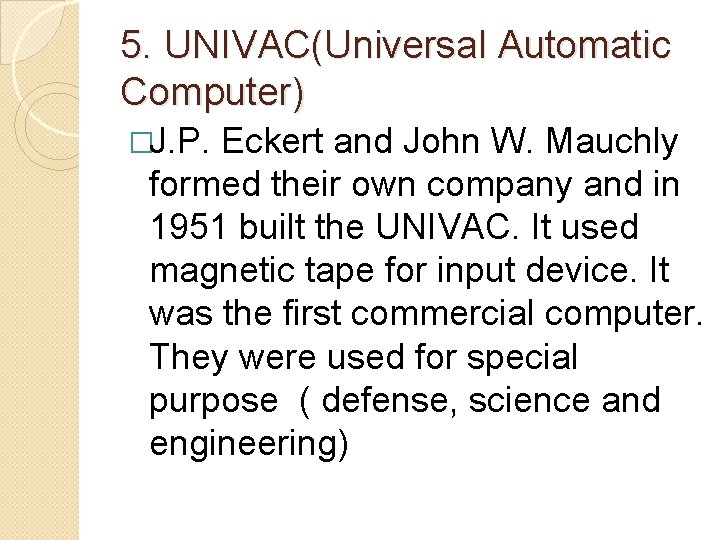
5. UNIVAC(Universal Automatic Computer) �J. P. Eckert and John W. Mauchly formed their own company and in 1951 built the UNIVAC. It used magnetic tape for input device. It was the first commercial computer. They were used for special purpose ( defense, science and engineering)
q Generation of Computer �Computer generation is the classification of computers into different groups according to their manufacturing date, memory device, other hardware and software technology used inside those computers. �Generation of computer is a step in developing (advancing) technology.
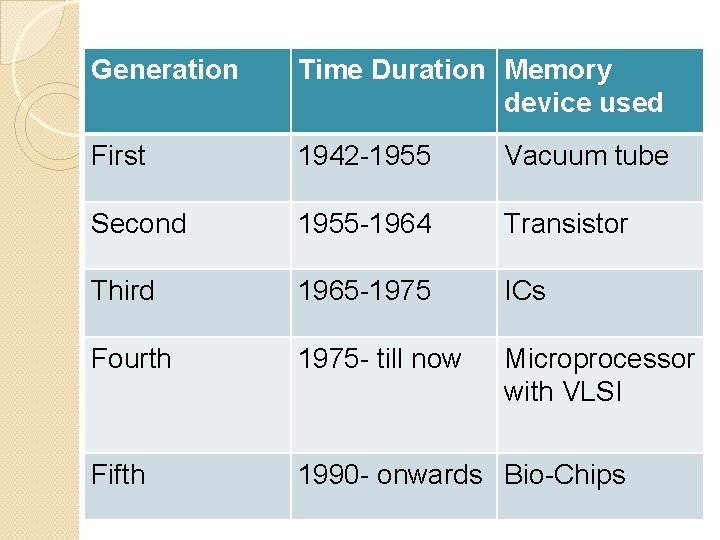
Generation Time Duration Memory device used First 1942 -1955 Vacuum tube Second 1955 -1964 Transistor Third 1965 -1975 ICs Fourth 1975 - till now Microprocessor with VLSI Fifth 1990 - onwards Bio-Chips
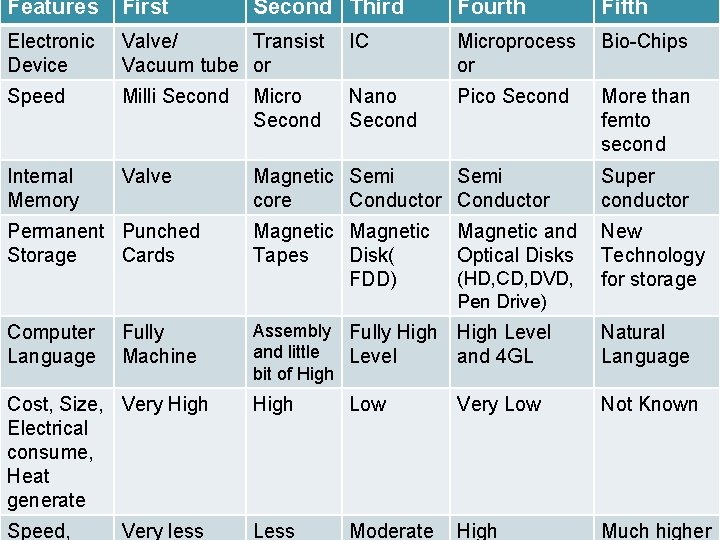
Features First Electronic Device Valve/ Transist Vacuum tube or Speed Milli Second Micro Second Internal Memory Valve Magnetic Semi core Conductor Super conductor Magnetic Tapes Disk( FDD) Magnetic and Optical Disks New Technology for storage Assembly Fully High and little Level bit of High Level and 4 GL Natural Language Cost, Size, Very High Electrical consume, Heat generate High Low Very Low Not Known Speed, Less Moderate High Much higher Permanent Punched Storage Cards Computer Language Fully Machine Very less Second Third Fourth Fifth IC Microprocess or Bio-Chips Nano Second Pico Second More than femto second (HD, CD, DVD, Pen Drive)
v. AI(Artificial Intelligence) �It is a branch of computer science which concerned with programs that solves and analyze problems intelligently. �Artificial intelligence is the science of making machines imitate human thinking and behavior.
History of computer in Nepal: �The history of computer in Nepal dates back to 2028 B. S. (1972) when a second generation IBM 1401 (International Business Machine) computer was brought in the country. To operate this computer, Electronic Data Processing Centre (EDPC) was established in 2031 B. S. (1975). Micro computer like apple, Vector and Sirus entered Nepal in the year 2039 B. S. (1983).
1) First generation Computer (1942 -1955): � The first generation computers were developed during 1942 -1955. They used vacuum tubes and valves as the memory devices. They were large in size, very slow in speed, had very low capacity but were very expensive. They consumed a lot of power and produced a lot of heat. They used machine language programs. This made programming extremely difficult and time consuming.
The main features of first generation computer are: �They used a vacuum tube as an electronic circuit and a magnetic drum as a primary storage. �They consumed a lot of power and generated a lot of heat. �They used machine level language for writing the program, which was tedious and time consuming. �They had low level of accuracy and reliability. �The examples of first generation computers are ENIAC, EDSAC, UNIVAC-I, EDVAC etc.
2) Second Generation (1956 -1964): �The second generation computers were developed during 1956 -1964. They used transistors as the electronic circuits. The transistor was developed by John Bardeen, Walter Brattain and William Shockley in 1947. They were faster, more reliable, easier to operate, less expensive, smaller, required less electricity than of the first generation computers. They used Assembly language and the high level languages such as COBOL, ALGOL, FORTRAN, etc,
The main features of the second generation computers are: � Transistors were used as electronic circuits. � These computers used Magnetic cores as primary data storage medium and Magnetic Tapes as secondary data storage medium. � These computers were smaller, faster, more reliable and more accurate than those of first generation computer. � They required less power and emitted less heat than vacuum tubes. � Their operating speed was up to the microseconds range. � They used Machine-independent "high level" programming languages such as ALGOL, COBOL, and FORTRAN etc. for programming. � The examples of second generation computers are IBM 1620, IBM 401, CDC 3600, LEO Mark III, 400 series, NCR 300 etc.
3) Third Generation (1965 -1974): �The third generation computers were developed during 1965 -1974. They used integrated circuit (IC) as electronic Circuit. IC circuit consists of a large number of electronic components placed on a single silicon chip by a photolithography process. Jack Kelly developed the integrated circuit in 1985. �This new technology made third generation of computers more reliable, faster, smaller, easier to operate, high capacity, less expensive than previous generation computers. Third generation computers included the use of an operating system for automatic processing and multi programming.
The main features of third generation computers are: �They used Integrated Circuits (IC) as electronic circuits. �They used semiconductor device as a primary storage. �They had large storage capacity. �Their operating speed was improved to nanosecond. �They were more reliable, much smaller in size, easier to operate and less expensive than previous generation computers. �They included multi programming, batch and timesharing operating systems. �They extensively used high level programming languages including Report Programming Generator (RPG) and Pascal. �The examples of third generation computers are IBM System/360, IBM 370, GE 600 series, ICT 1900
4) Fourth Generation (1975 -1990): �The fourth generation computers were developed during 1975 -1990. The present day computers are included in this generation. They use large scale integrated circuits (LSI) and very large scale integrated circuits (VLSI) known as microprocessor chip as electronic circuits. The first microprocessor called Intel 400 was developed by Intel Corporation USA in 1971. Its size is about 0. 5 cm long and less than 0. 05 cm thick. In this generation, the use of microprocessor made computer very fast, capable of very high memory, small in size and less expensive than previous computers. Data communication media also developed in this generation. Fourth generation computer used graphical devices and language interfaces to graphic system.
The main features of fourth generation computers are: �These computers use microprocessor chips as electronic circuits. �Fourth generation computers are highly reliable and accurate. �Their operating speed has been increased to Pico-seconds. �Their size has been reduced to micro computers such as desktop and laptop. �They can understand many high level languages, and they are user friendly. �The examples of fourth generation computer are IBMPC, IBM 4341, Apple/ Macintosh, DEC 10, SUPERBRAIN, etc.
5) Fifth Generation (1991 - incomplete): �The fifth generation computers were developed after 1991 and still moving towards the advanced technologies such as Artificial intelligence (AI), very high speed, parallel processing etc. �Fifth generation computers combine hardware and software to produce artificial intelligence (AI). They are able to process non-numerical information such as pictures and graphs and are able to understand natural languages. They incorporate Ultra
The main features of Fifth generation computers are: �BIO chip and ULSI are used as main components. �They have artificial intelligence. �They use a super conductor as a main storage. �They are able to understand natural languages. �They are using automatic programming computational logic.
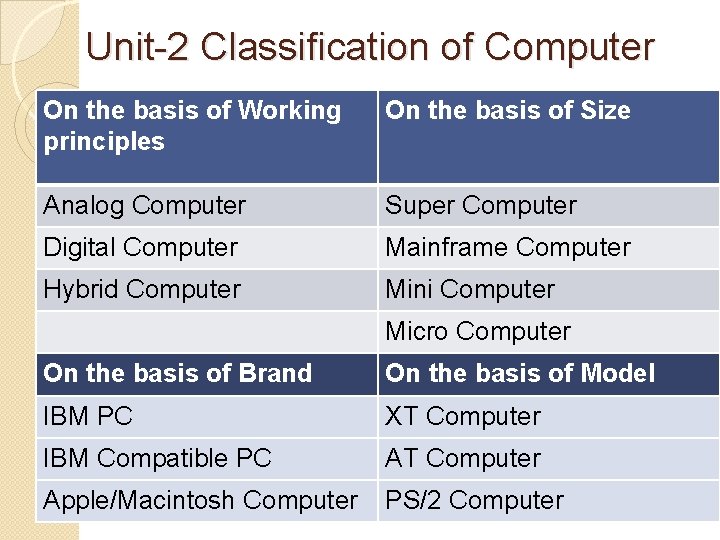
Unit-2 Classification of Computer On the basis of Working principles On the basis of Size Analog Computer Super Computer Digital Computer Mainframe Computer Hybrid Computer Mini Computer Micro Computer On the basis of Brand On the basis of Model IBM PC XT Computer IBM Compatible PC AT Computer Apple/Macintosh Computer PS/2 Computer
1. On the basis of Working principles 1) Analog Computer: �The computer, which work with the national phenomena and physical values like frequency, earthquake, volcano, water flow, current flow etc. are known as analog computers. They are based on continuous changing values or voltage levels. These types of computers are used in scientific work. �Examples: - Barometer, speedometer, thermometer, seismograph etc.
Characteristics of analog computer �Based on continuous varying data. �Measure only natural or physical values. �Used for special purpose. �Generally, no storage facility is available because they work on real time basis. If provided, then only a little amount of storage is available in it. �Accuracy of these types of computer is very less because of noise and filtering facility.
2) Digital Computer: �These computers are based on binary digits. Binary system is such system of numbering in which only 2 digits are used 0 and 1. Meaning 0 is off and 1 is on. �Examples: IBM PC, Apple/Macintosh etc.
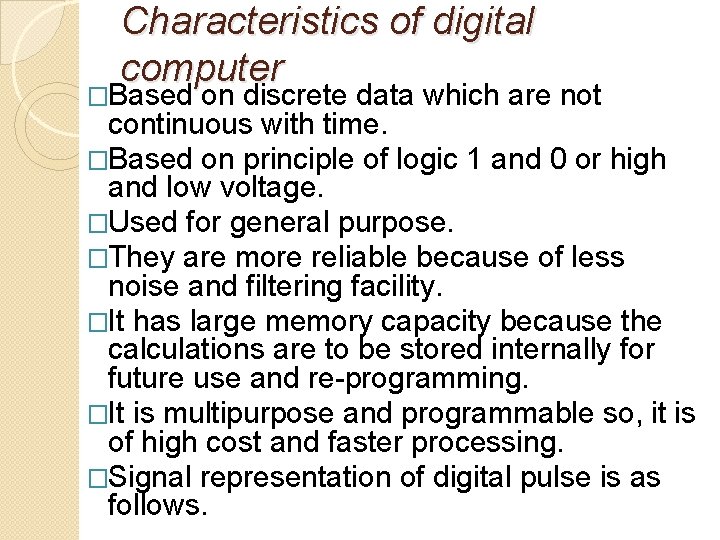
Characteristics of digital computer �Based on discrete data which are not continuous with time. �Based on principle of logic 1 and 0 or high and low voltage. �Used for general purpose. �They are more reliable because of less noise and filtering facility. �It has large memory capacity because the calculations are to be stored internally for future use and re-programming. �It is multipurpose and programmable so, it is of high cost and faster processing. �Signal representation of digital pulse is as follows.
3) Hybrid Computer: �It is combination of analog and digital computers. � It can perform the works done by analog computers � as well as by digital computers. �Example: CT Scan
Characteristics of hybrid computer �It is combination of good qualities of analog as well as digital computer. �It can process both continuous and discrete data. It has capacity to convert one type of data in to another. �These are special purpose machines. �Mostly used in aero planes, hospitals etc. �High cost.
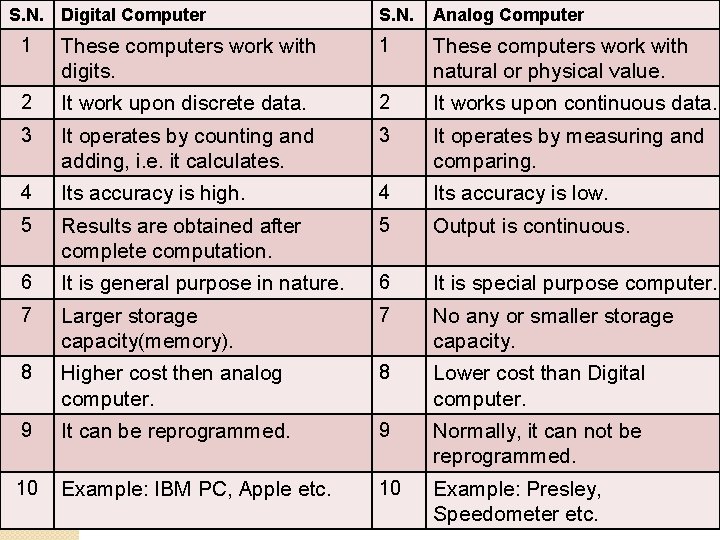
S. N. Digital Computer S. N. Analog Computer 1 These computers work with digits. 1 These computers work with natural or physical value. 2 It work upon discrete data. 2 It works upon continuous data. 3 It operates by counting and adding, i. e. it calculates. 3 It operates by measuring and comparing. 4 Its accuracy is high. 4 Its accuracy is low. 5 Results are obtained after complete computation. 5 Output is continuous. 6 It is general purpose in nature. 6 It is special purpose computer. 7 Larger storage capacity(memory). 7 No any or smaller storage capacity. 8 Higher cost then analog computer. 8 Lower cost than Digital computer. 9 It can be reprogrammed. 9 Normally, it can not be reprogrammed. 10 Example: IBM PC, Apple etc. 10 Example: Presley, Speedometer etc.
2. On the basis of Working principles 1. Super computer �Super computer is very large machine which works in MIPS. They are most powerful and expensive computers. They have extremely large storage capacities and processing speed is at least 10 times faster than other computer. �Example: CRAY, NEC Super SX 11, and CYBER 205, PARAM, CDC-STAR 100 etc. �Use: Weather Forecasting, Aircraft and Space Engineering, Scientific Research
Characteristics of super computer �It is very large and powerful computer. �It is large storage capacities and work is done by very fast. �It can calculate about 400 million numbers every second. �It can result is always exactly correct. �Super computers are used in weather forecasting petroleum engineering and medicine and for creating computer graphics. �It is used in weather research and scientific research.
2. Mainframe Computer: �These are the largest computer on the basis of the size. It has more storage capacity and fast processing speed. It takes about 100 sq. feet. At least 100 people can work at a time. A centrally located server or CPU is connected with more than 100 terminals. �Examples: - IBM 1401, ICL 2950/10 etc. �Use: large agencies and government for large scale data processing, Airlines, Banking etc.
Characteristics of mainframe computer �Largest in size with approximately 10000 sq. feet area. �Central processor, central administration �More than 100 terminals, large capacity storage devices used. �Fastest and very expensive system. �General purpose computer.
3. Mini Computer �Mini computer is medium in size it is bigger than micro and smaller than mainframe computer. A centrally located server or CPU is connected with more than 50 terminals. At a time 50 people can work with single minicomputer for data processing, Desktop publishing etc. It is linked with network and used for Bank, Business field. �Examples: PDP-11, Prime 9755, VAX 7500 etc. �Use: medium sized organizations and corporations for their database
Characteristics of mini computer �Medium sized computer occupying approximately 10 sq. feet of area. �More than 50 terminals and large capacity storage devices than micro computer. �But minicomputer is smaller than mainframe computer. �Used for general purpose.
4. Micro Computer �These are the smallest computer systems on the basis of size. These computers are based on micro chips because microprocessor is used as memory device and they are very small. These computers are also called PC (personal computer) or home computers. The smallest of this category are laptop, notebook and palmtop computers. This size is reducing day- by-day.
Characteristics of micro computer �Smallest in terms of size can be kept on top of a desk (desktop), on top of laptop and like a notebook. �Speed and cost is also smaller. �Since a single user system is used, storage devices and memory are smaller sized. �Example: IBM Pentium Pc, Apple/ Macintosh etc. �Use: Entertainment, Desktop, Business, School, College etc.
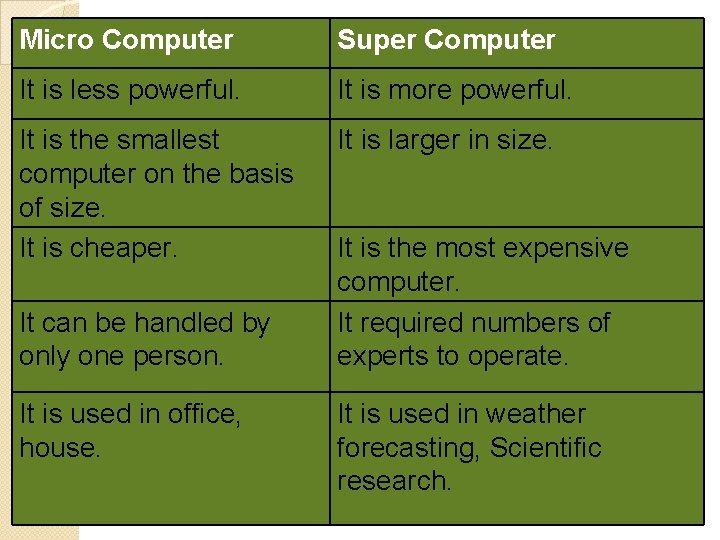
Micro Computer Super Computer It is less powerful. It is more powerful. It is the smallest computer on the basis of size. It is cheaper. It is larger in size. It can be handled by only one person. It is used in office, house. It is the most expensive computer. It required numbers of experts to operate. It is used in weather forecasting, Scientific research.
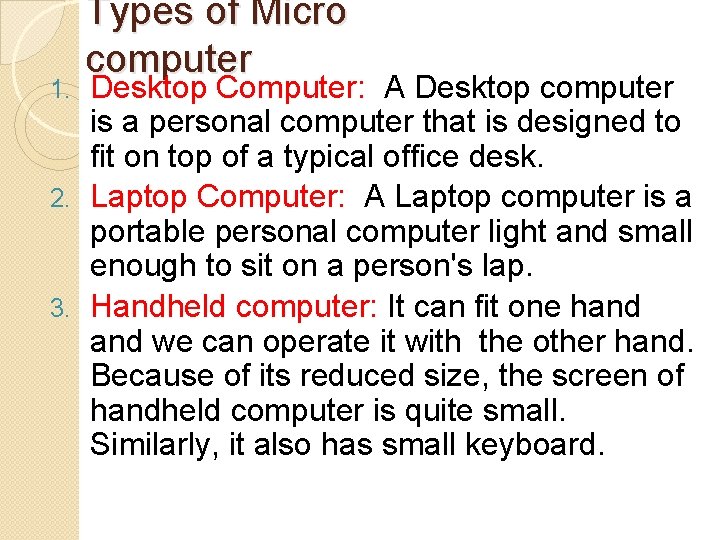
Types of Micro computer Desktop Computer: A Desktop computer is a personal computer that is designed to fit on top of a typical office desk. 2. Laptop Computer: A Laptop computer is a portable personal computer light and small enough to sit on a person's lap. 3. Handheld computer: It can fit one hand we can operate it with the other hand. Because of its reduced size, the screen of handheld computer is quite small. Similarly, it also has small keyboard. 1.
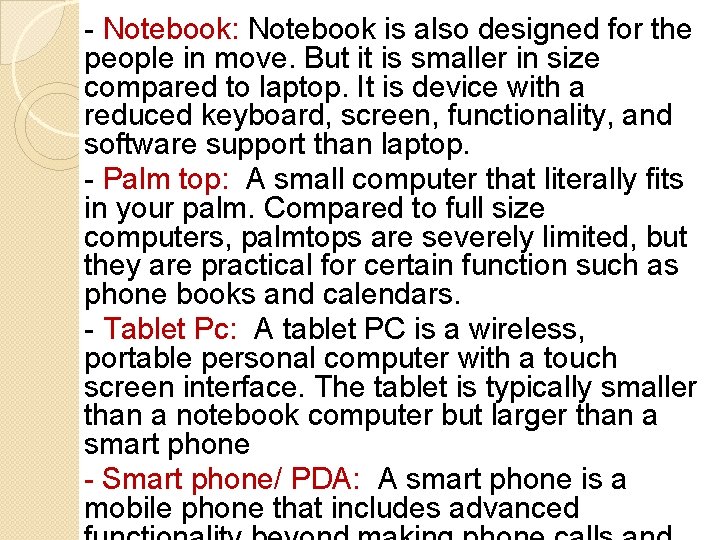
- Notebook: Notebook is also designed for the people in move. But it is smaller in size compared to laptop. It is device with a reduced keyboard, screen, functionality, and software support than laptop. - Palm top: A small computer that literally fits in your palm. Compared to full size computers, palmtops are severely limited, but they are practical for certain function such as phone books and calendars. - Tablet Pc: A tablet PC is a wireless, portable personal computer with a touch screen interface. The tablet is typically smaller than a notebook computer but larger than a smart phone - Smart phone/ PDA: A smart phone is a mobile phone that includes advanced
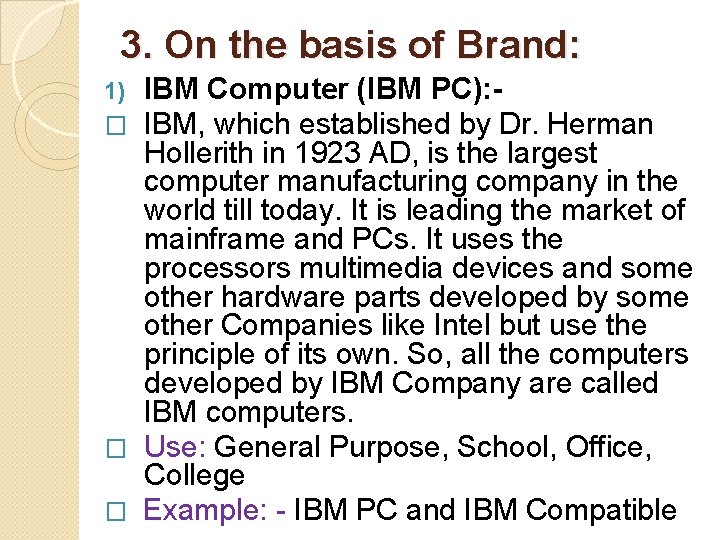
3. On the basis of Brand: IBM Computer (IBM PC): IBM, which established by Dr. Herman Hollerith in 1923 AD, is the largest computer manufacturing company in the world till today. It is leading the market of mainframe and PCs. It uses the processors multimedia devices and some other hardware parts developed by some other Companies like Intel but use the principle of its own. So, all the computers developed by IBM Company are called IBM computers. � Use: General Purpose, School, Office, College � Example: - IBM PC and IBM Compatible 1) �
2. IBM Compatible: �The computers developed by IBM company is itself are called branded or IBM PC computer which are developed or assembled by other companies using the parts and principle of IBM PCs are called IBM compatibles. So, IBM compatibles are also called duplicate of IBM PCs.
3. Apple / Macintosh Computer: �Apple Corporation was established in 1970 AD is USA. Within these 3 decades. It has gone much forward and produced PCs with good qualities and user friendly. So, the entire computers that are developed by Apple Corporation are called Apple/Macintosh (Mac) computers. These computers are architecturally totally different than that of IBM's. Not only hardware part, but their software architecture is also totally different. Software made for IBM PC can't be run in Macintosh or vice versa. Floppy disks or hard disks formatted in one can't be
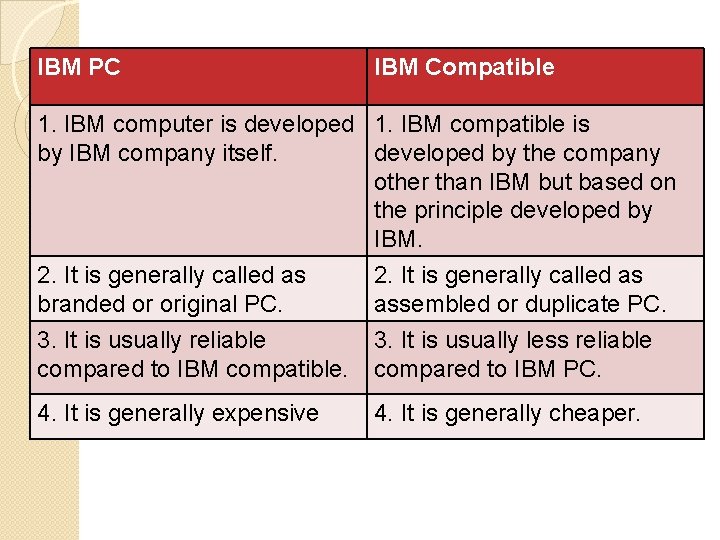
IBM PC IBM Compatible 1. IBM computer is developed 1. IBM compatible is by IBM company itself. developed by the company other than IBM but based on the principle developed by IBM. 2. It is generally called as branded or original PC. 3. It is usually reliable compared to IBM compatible. 2. It is generally called as assembled or duplicate PC. 3. It is usually less reliable compared to IBM PC. 4. It is generally expensive 4. It is generally cheaper.
On the basis of Model: 4. 1) XT Computer: � XT (Extra technology) computer are the old technology computers with much slower processing speed (not more than 4. 77 MHz. ). Advanced GUI (Graphical user interface) based software like (Windows) can't be run in these computers. Everything was based on text based system. 4. 2) AT Computer: � AT (Advanced Technology) computers are the new technology computers. They are faster in processing (more than 2 GHZ) and can run any type of software whether that is text based or GUI based. 4. 3) PS/2 Computer: � PS (personal system)/2 computers actually, these are not totally different models of computers but are refinement of AT computers. These models were built 1990 and mostly used in laptop computers. Rechargeable and battery operated systems with faster and flexible.
Mobile Computing �Mobile computing is a generic term describing one's ability to use technology while moving, as opposed to portable computers, which are only practical for use while deployed in a stationary configuration. �Many types of mobile computers have been introduced since 1990 s, including wearable computer, Personal Digital Assistant (PDA), enterprise digital assistant, smart phone, ultra mobile PC, tablet pc, internet table.
Technical and other Limitations of Mobile Computing ØInsufficient bandwidth ØSecurity standards ØPower consumption ØHuman interface with device.