
Age differences in the perception of time Gleb
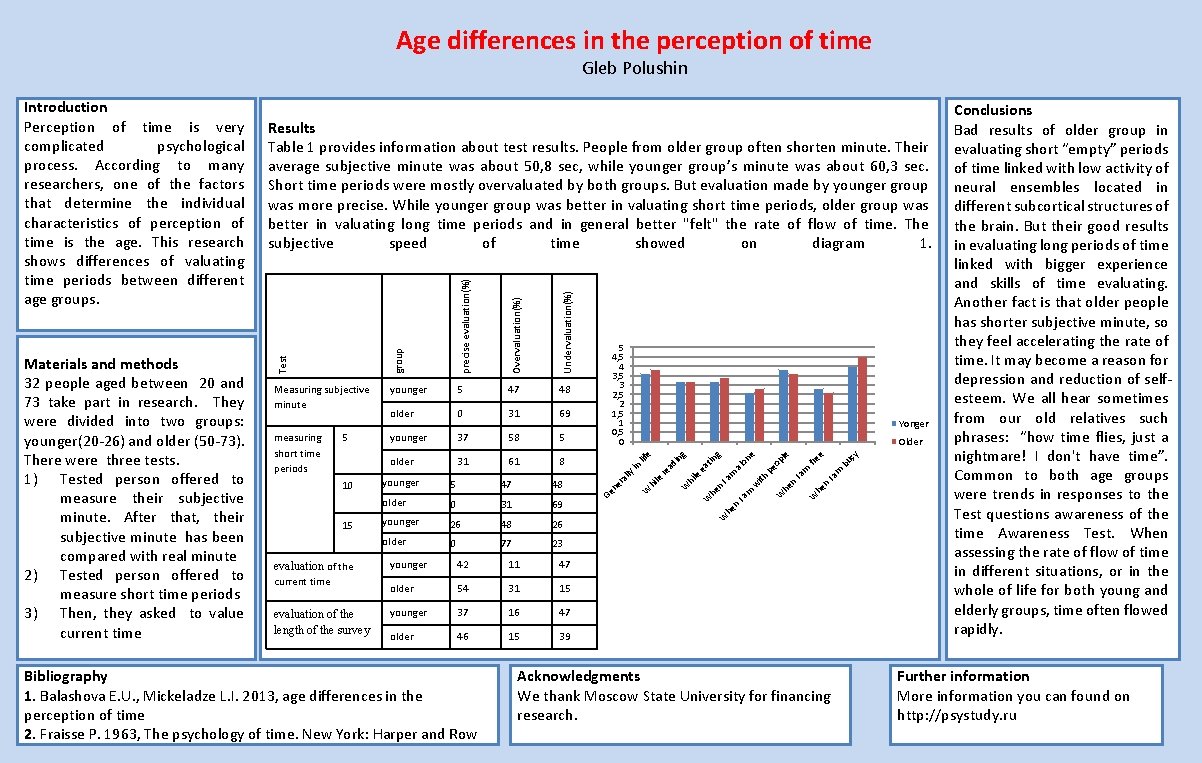
Age differences in the perception of time Gleb Polushin evaluation of the current time younger 42 11 47 older 54 31 15 (n=19) 37 of 16 younger (n=13) 37 46 15 16 39 evaluation the 47 Старшая length of the survey older 46 Bibliography 1. Balashova E. U. , Mickeladze L. I. 2013, age differences in the perception of time 2. Fraisse P. 1963, The psychology of time. New York: Harper and Row 15 sy e fre bu pe m Ia al op on le e g tin ea m n 23 he 77 W 0 Ia older he n 26 W 48 ith 26 w younger m 69 m 31 Ia 0 n older Ia 48 he n 47 le 5 W younger g 8 in 61 hi 31 W older Older ad 5 re 58 e 37 le younger Yonger lif 69 hi 31 in 0 W older lly 48 ra 47 ne 5 W he 15 younger 5 4, 5 4 3, 5 3 2, 5 2 1, 5 1 0, 5 0 Ge 10 Undervaluation(%) 5 Overvaluation(%) measuring short time periods precise evaluation(%) Measuring subjective minute group Materials and methods 32 people aged between 20 and 73 take part in research. They were divided into two groups: younger(20 -26) and older (50 -73). There were three tests. 1) Tested person offered to measure their subjective minute. After that, their subjective minute has been compared with real minute 2) Tested person offered to measure short time periods 3) Then, they asked to value current time Results Table 1 provides information about test results. People from older group often shorten minute. Their average subjective minute was about 50, 8 sec, while younger group’s minute was about 60, 3 sec. Short time periods were mostly overvaluated by both groups. But evaluation made by younger group was more precise. While younger group was better in valuating short time periods, older group was better in valuating long time periods and in general better "felt" the rate of flow of time. The subjective speed of time showed on diagram 1. Test Introduction Perception of time is very complicated psychological process. According to many researchers, one of the factors that determine the individual characteristics of perception of time is the age. This research shows differences of valuating time periods between different age groups. 47 39 Acknowledgments We thank Moscow State University for financing research. Conclusions Bad results of older group in evaluating short “empty” periods of time linked with low activity of neural ensembles located in different subcortical structures of the brain. But their good results in evaluating long periods of time linked with bigger experience and skills of time evaluating. Another fact is that older people has shorter subjective minute, so they feel accelerating the rate of time. It may become a reason for depression and reduction of selfesteem. We all hear sometimes from our old relatives such phrases: “how time flies, just a nightmare! I don't have time”. Common to both age groups were trends in responses to the Test questions awareness of the time Awareness Test. When assessing the rate of flow of time in different situations, or in the whole of life for both young and elderly groups, time often flowed rapidly. Further information More information you can found on http: //psystudy. ru
- Slides: 1