
AGE DETERMINATION INTEGRATED METHOD USES To optimise age

- Slides: 14
AGE DETERMINATION – INTEGRATED METHOD
USES • To optimise age at Lm • To use as an input data in estimating growth parameters • To use as an input data in estimating mortality parameters • To fit the growth parameters in stock assessment models • To assess the sustaining power of the fish stock from their growth and mortality parameters
Methods of age determination 1. 2. Hard parts Length Frequency Analysis • • Hard parts – Merits & Demerits – Tropical Fish Length Frequency 1) Petersen Method 2) Modal Class Progression Technique 3) Integrated Method
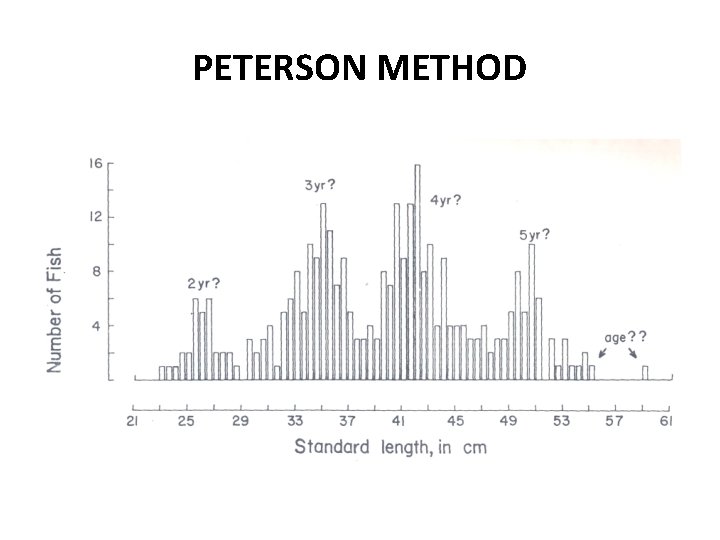
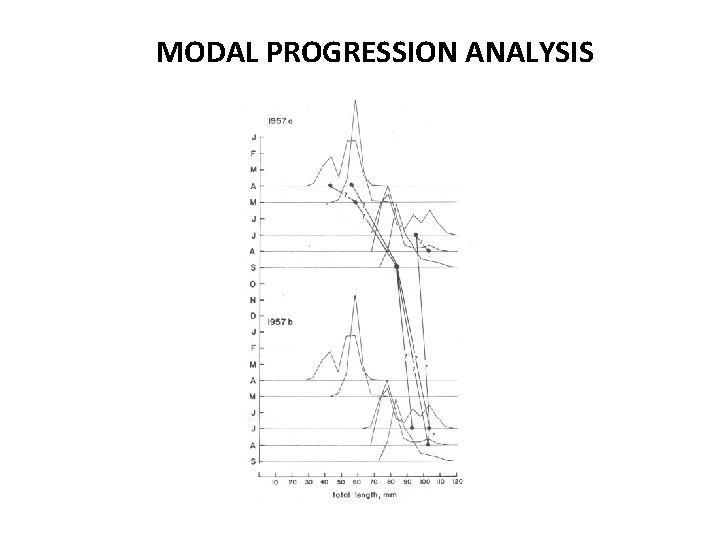
N • Peterson Method – Assumptions made to time interval separating various peks of one length frequency sample, these peaks suumed to represent distinct groups • Modal Class Progression Analysis - Assumptions made to which of the peaks can be interconnected that belong to various samples arranged sequentially in time
PETERSON METHOD
MODAL PROGRESSION ANALYSIS
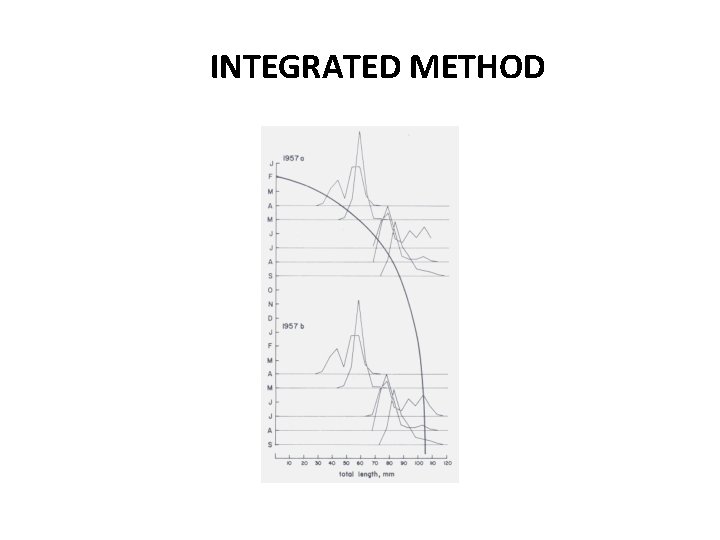
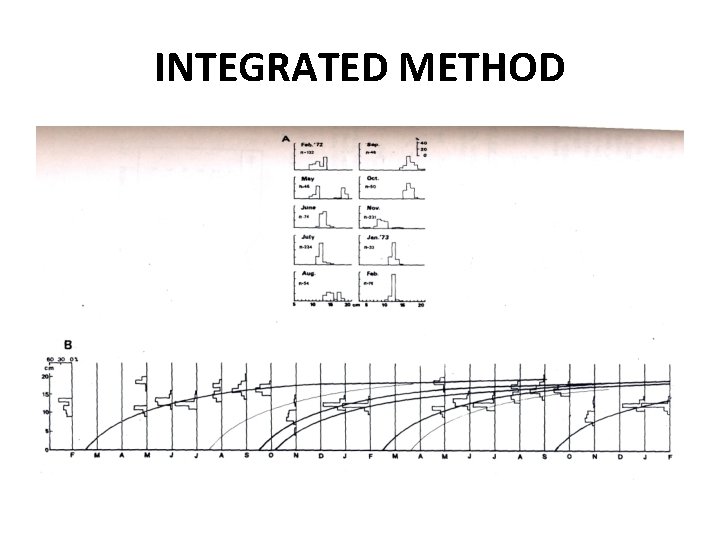
Tenets in integrated method • Length growth in fishes is rapid at first – decreases smoothly – continuous curve – several short– straight segments • Single smooth curve connecting – majority of peaks – sequentially arranged – length frequency samples – average growth of the stock • Growth patterns repeat themselves from yr to yr (which is also assumed when annuli or otoliths are counted)
INTEGRATED METHOD
INTEGRATED METHOD
Steps to be taken to draw curves • Proportional to the time • Plotting of original data twice or more along time axis – longer and stabilised growth curves - all relevant age groups • Growth curves drawn – variations – same shape - vary only as to their origin • Scale of ordinate (length) should start at Zero – to allow approximate spawning periods • Growth curves must connect majority of peaks – more peaks connect – actual growth of population • Modal length – corresponding to various age groups – read – at regular time intervals
Steps to be taken to draw curves • Length frequency distribution tend to group themselves around a central value called the mode from which the curves are to be drawn • The progression of the modes – successive interval of time indicate growth
Scatter diagram techniques 1. Collection of data for 12 / 24 months 2. Plotting the data month-wise (percentage) 3. Peaks of all months – plotted – and drawn by curves 4. Plotting the age with length data
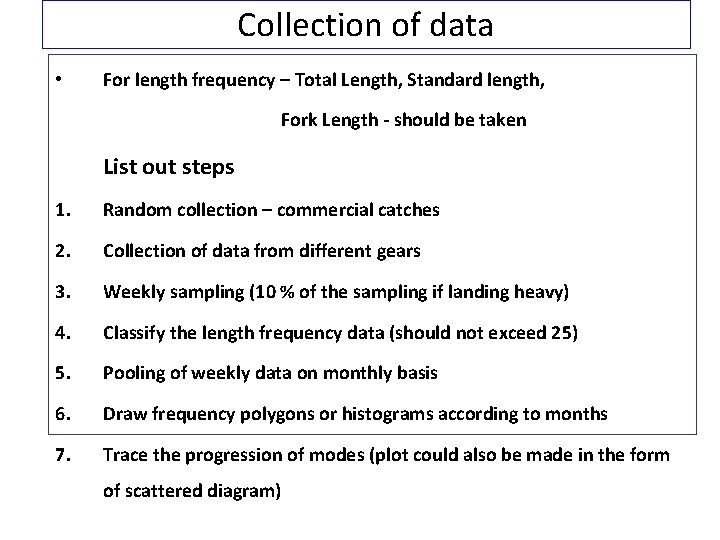
Collection of data • For length frequency – Total Length, Standard length, Fork Length - should be taken List out steps 1. Random collection – commercial catches 2. Collection of data from different gears 3. Weekly sampling (10 % of the sampling if landing heavy) 4. Classify the length frequency data (should not exceed 25) 5. Pooling of weekly data on monthly basis 6. Draw frequency polygons or histograms according to months 7. Trace the progression of modes (plot could also be made in the form of scattered diagram)
END