
Age at Initiation Deformity Magnitude and ASA Classification


- Slides: 20
Age at Initiation, Deformity Magnitude and ASA Classification Influence Complication Rates of Surgical Treatment with Dual Growing Rods in Early Onset Scoliosis Vidyadhar V. Upasani, MD Kevin C. Parvaresh, MD Jeff B. Pawelek, BS Patricia E. Miller, MS George Thompson, MD David Skaggs, MD John B. Emans, MD Michael P. Glotzbecker, MD Growing Spine Study Group
Disclosures • No relevant disclosures • Disclosures in the program book
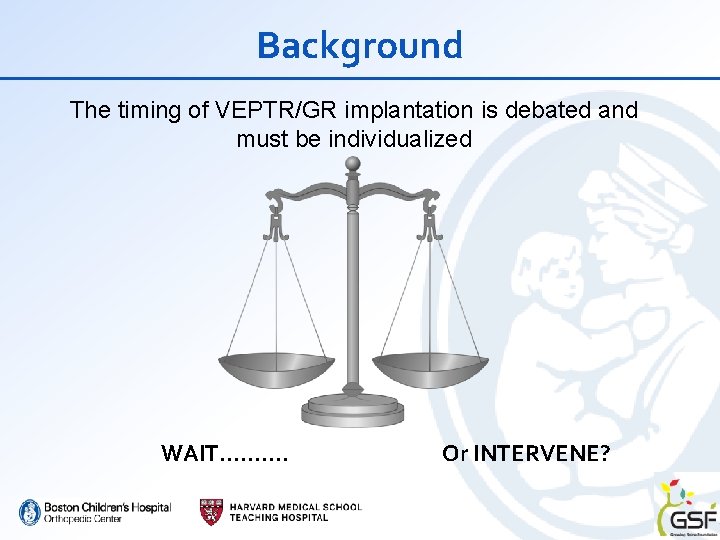
Background The timing of VEPTR/GR implantation is debated and must be individualized WAIT………. Or INTERVENE?
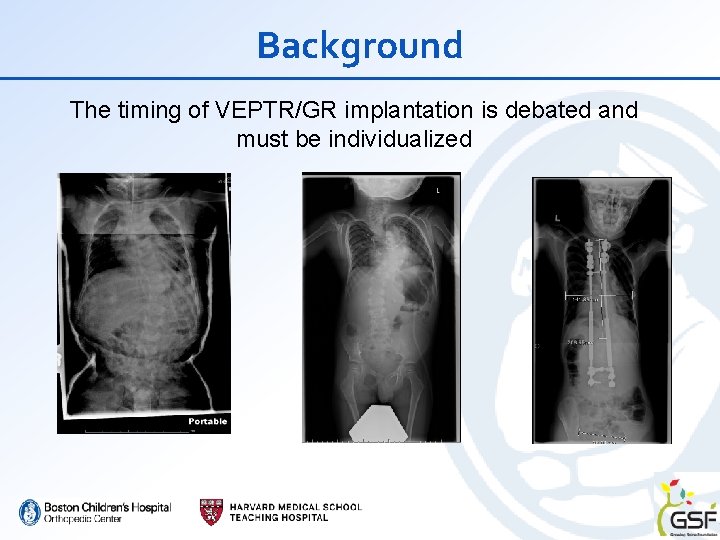
Background The timing of VEPTR/GR implantation is debated and must be individualized
Background Early intervention: – Milder deformity • Device implantation easier – Facilitates symmetric chest growth? • Improve pulmonary function • Greater spine growth and pulmonary function values when VEPTR was initiated earlier • Most favorable when less than 2 – Vital capacity (58% vs 36%)
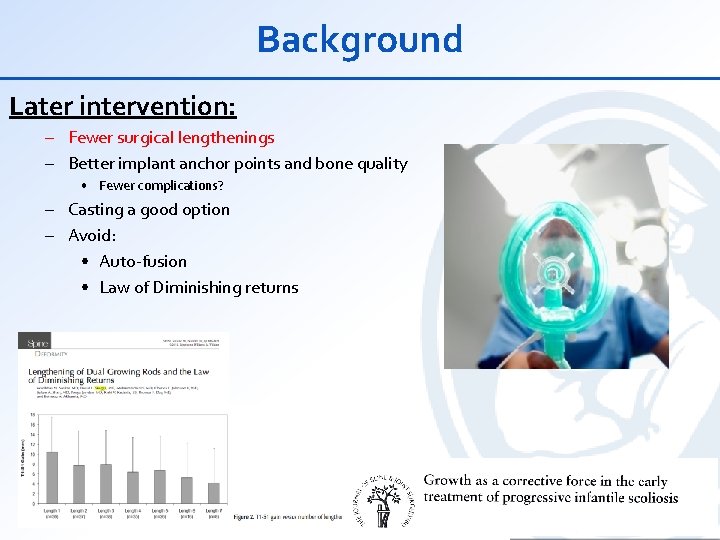
Background Later intervention: – Fewer surgical lengthenings – Better implant anchor points and bone quality • Fewer complications? – Casting a good option – Avoid: • Auto-fusion • Law of Diminishing returns
Background Later intervention: – Fewer surgical lengthenings – Better implant anchor points and bone quality • Fewer complications? – Casting a good option – Avoid: • Auto-fusion • Law of Diminishing returns
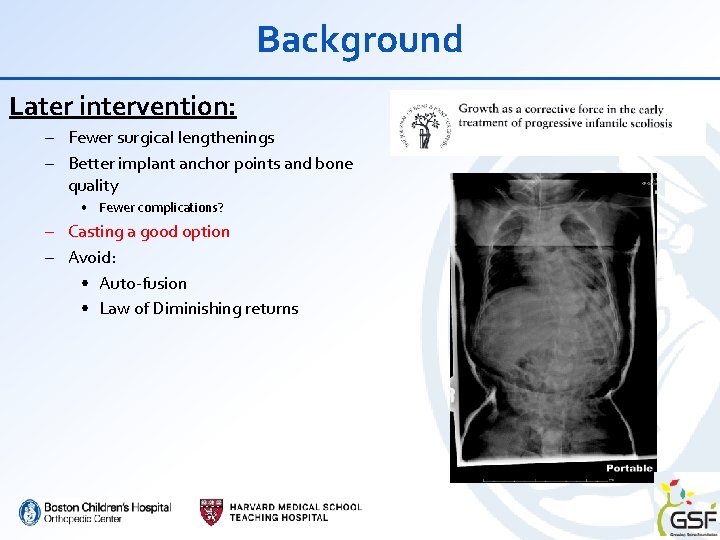
Background Later intervention: – Fewer surgical lengthenings – Better implant anchor points and bone quality • Fewer complications? – Casting a good option – Avoid: • Auto-fusion • Law of Diminishing returns
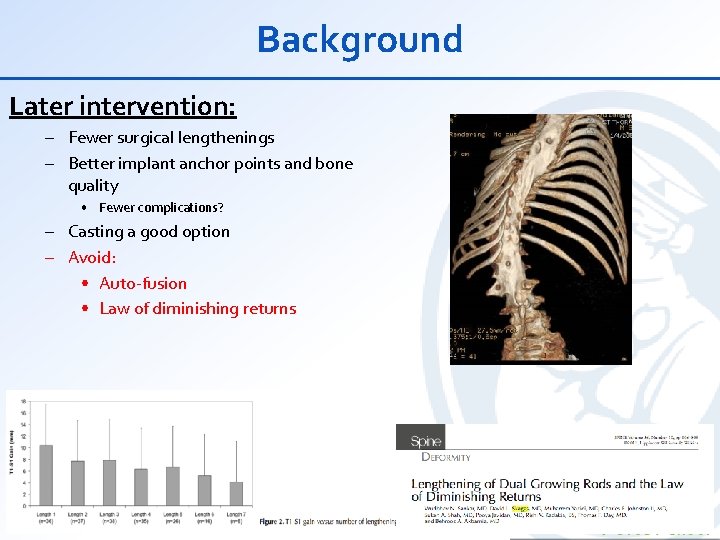
Background Later intervention: – Fewer surgical lengthenings – Better implant anchor points and bone quality • Fewer complications? – Casting a good option – Avoid: • Auto-fusion • Law of diminishing returns
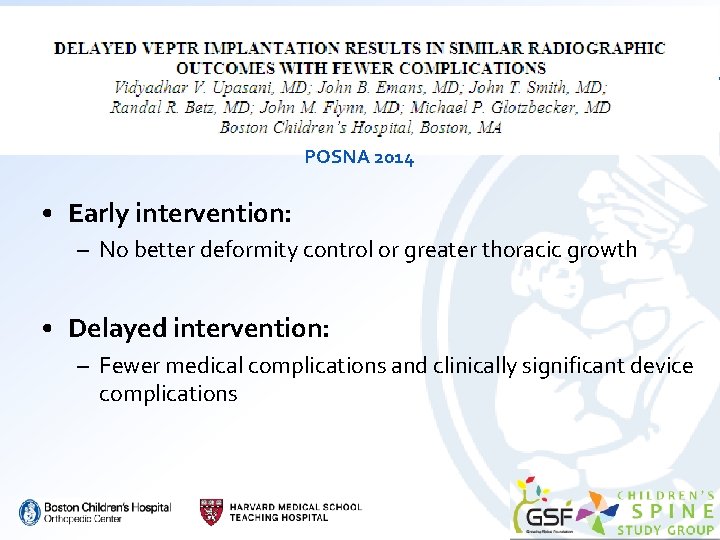
POSNA 2014 • Early intervention: – No better deformity control or greater thoracic growth • Delayed intervention: – Fewer medical complications and clinically significant device complications
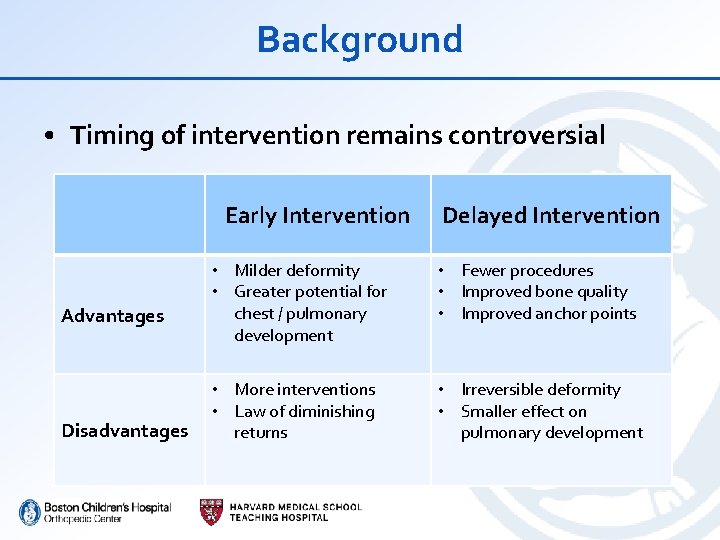
Background • Timing of intervention remains controversial Early Intervention Advantages Disadvantages Delayed Intervention • Milder deformity • Greater potential for chest / pulmonary development • Fewer procedures • Improved bone quality • Improved anchor points • More interventions • Law of diminishing returns • Irreversible deformity • Smaller effect on pulmonary development
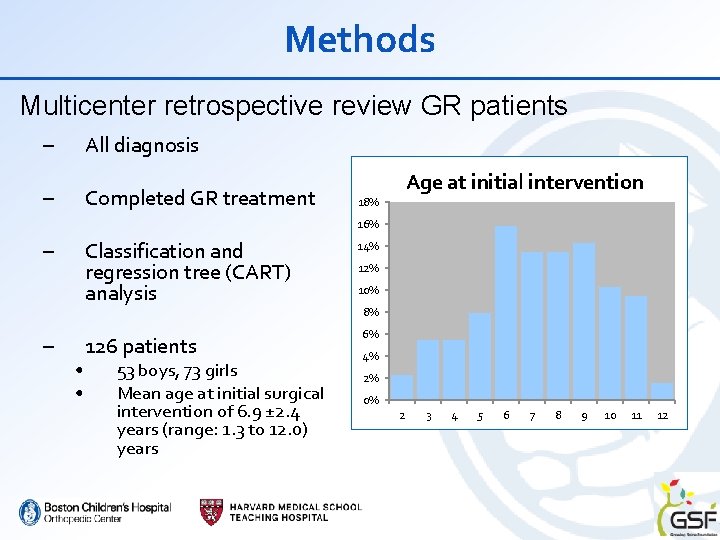
Methods Multicenter retrospective review GR patients – All diagnosis – Completed GR treatment Age at initial intervention 18% 16% – – Classification and regression tree (CART) analysis • • 126 patients 53 boys, 73 girls Mean age at initial surgical intervention of 6. 9 ± 2. 4 years (range: 1. 3 to 12. 0) years 14% 12% 10% 8% 6% 4% 2% 0% 2 3 4 5 6 7 8 9 10 11 12
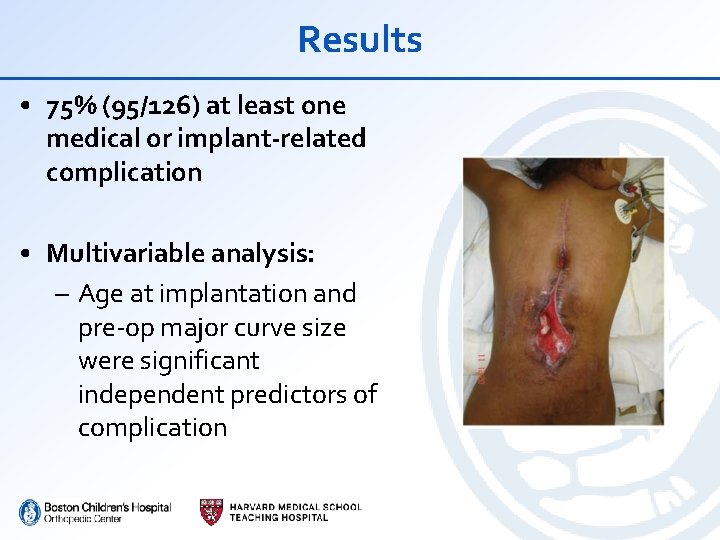
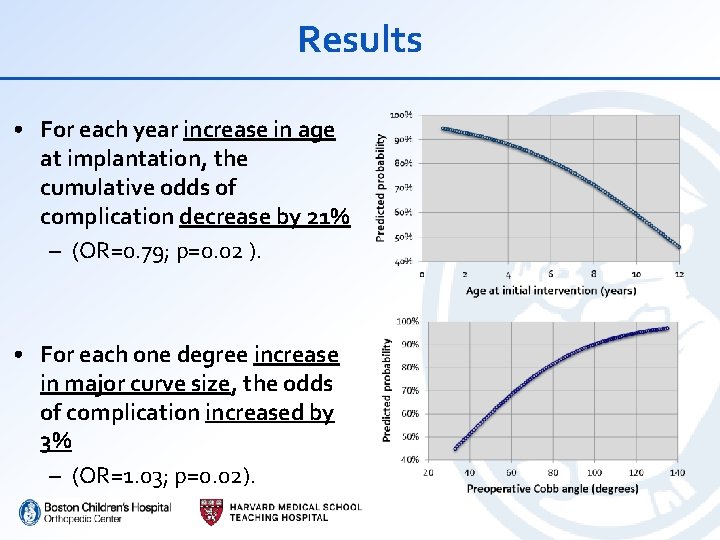
Results • 75% (95/126) at least one medical or implant-related complication • Multivariable analysis: – Age at implantation and pre-op major curve size were significant independent predictors of complication
Results • For each year increase in age at implantation, the cumulative odds of complication decrease by 21% – (OR=0. 79; p=0. 02 ). • For each one degree increase in major curve size, the odds of complication increased by 3% – (OR=1. 03; p=0. 02).
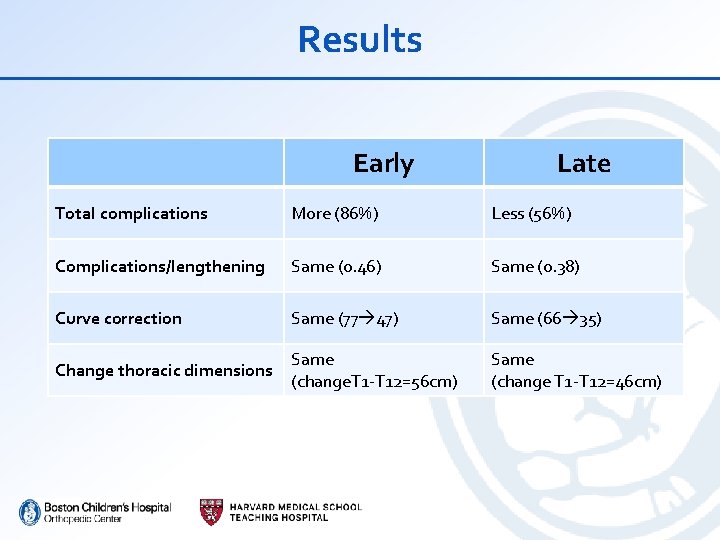
Results Early Late Total complications More (86%) Less (56%) Complications/lengthening Same (0. 46) Same (0. 38) Curve correction Same (77 47) Same (66 35) Change thoracic dimensions Same (change. T 1 -T 12=56 cm) Same (change T 1 -T 12=46 cm)
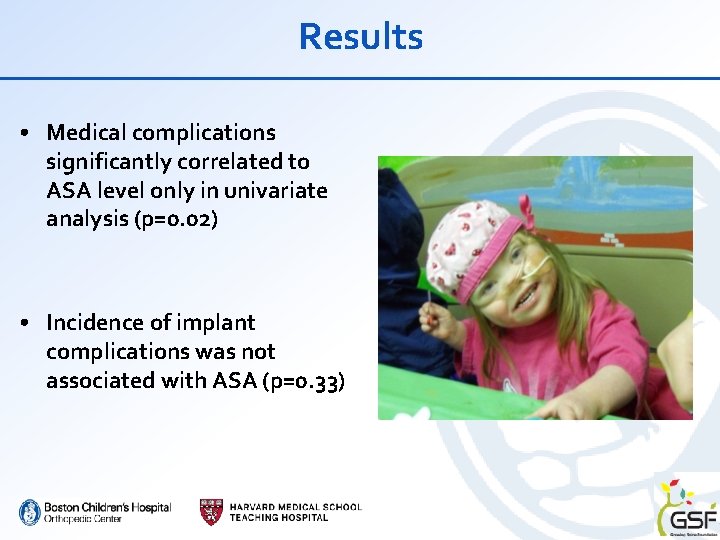
Results • Medical complications significantly correlated to ASA level only in univariate analysis (p=0. 02) • Incidence of implant complications was not associated with ASA (p=0. 33)
Conclusions • Patients with GR surgery earlier accumulate more complications – More surgical events – NO cutoffs or treatment recommendations – No difference in outcome measures • Ultimate change in Cobb, thoracic dimensions – More information on early vs late debate but does not provide treatment recommendation
Limitations • Are we using the right outcome measures? • Selection bias (do sicker kids get operated on earlier? ) • No other outcome data • Pulmonary function, quality of life, controls
Summary • Early intervention: – More complications • Based on radiographic outcome measures: – No difference in outcome early vs late • Worsening space for the lungs may demand earlier intervention – We don’t know what the right trigger is • Need to know how early vs late impacts pulmonary function and quality of life to complete picture
Michael. glotzbecker@childrens. harvard. edu