
AGC DSP Hilbert Spaces Linear Transformations and Least
AGC DSP Hilbert Spaces Linear Transformations and Least Squares: Hilbert Spaces Professor A G Constantinides© 1
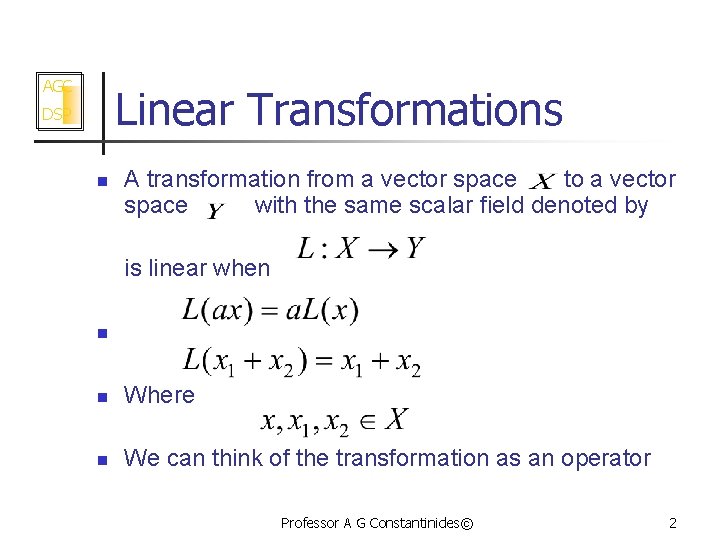
AGC Linear Transformations DSP n A transformation from a vector space to a vector space with the same scalar field denoted by is linear when n n Where n We can think of the transformation as an operator Professor A G Constantinides© 2
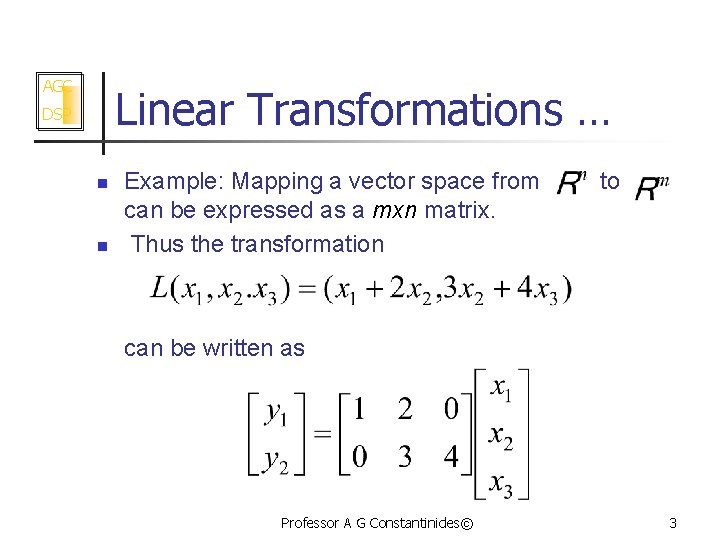
AGC Linear Transformations … DSP n n Example: Mapping a vector space from can be expressed as a mxn matrix. Thus the transformation to can be written as Professor A G Constantinides© 3
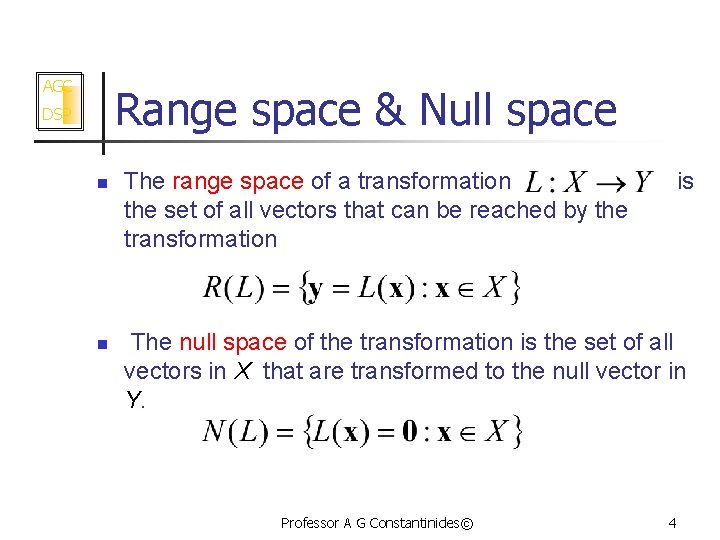
AGC Range space & Null space DSP n n The range space of a transformation the set of all vectors that can be reached by the transformation is The null space of the transformation is the set of all vectors in X that are transformed to the null vector in Y. Professor A G Constantinides© 4
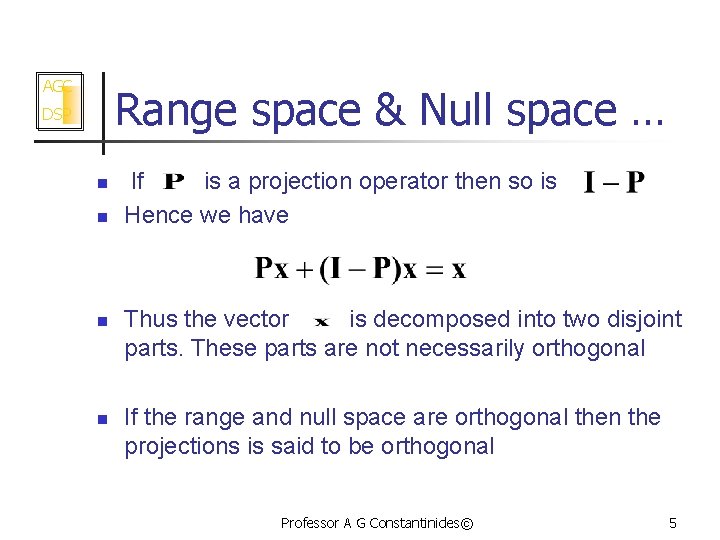
AGC Range space & Null space … DSP n n If is a projection operator then so is Hence we have Thus the vector is decomposed into two disjoint parts. These parts are not necessarily orthogonal If the range and null space are orthogonal then the projections is said to be orthogonal Professor A G Constantinides© 5
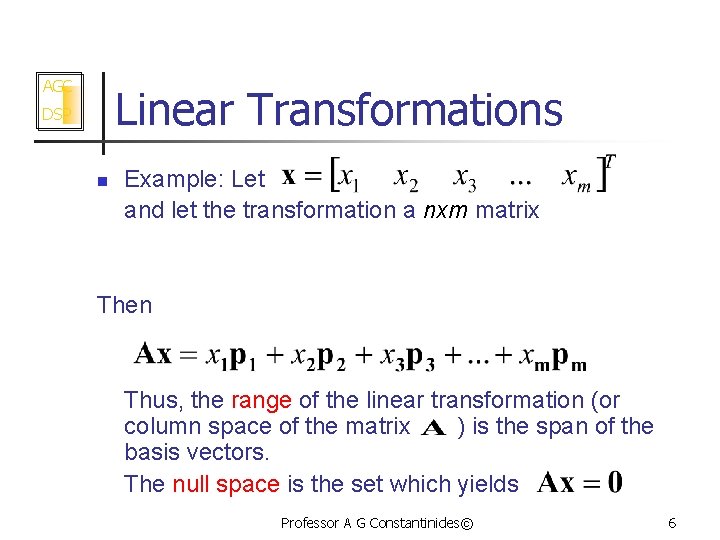
AGC Linear Transformations DSP n Example: Let and let the transformation a nxm matrix Then Thus, the range of the linear transformation (or column space of the matrix ) is the span of the basis vectors. The null space is the set which yields Professor A G Constantinides© 6
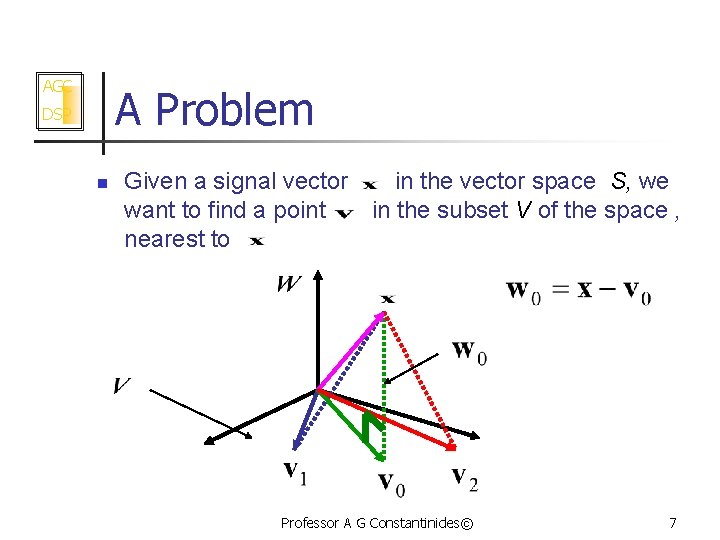
AGC A Problem DSP n Given a signal vector in the vector space S, we want to find a point in the subset V of the space , nearest to Professor A G Constantinides© 7
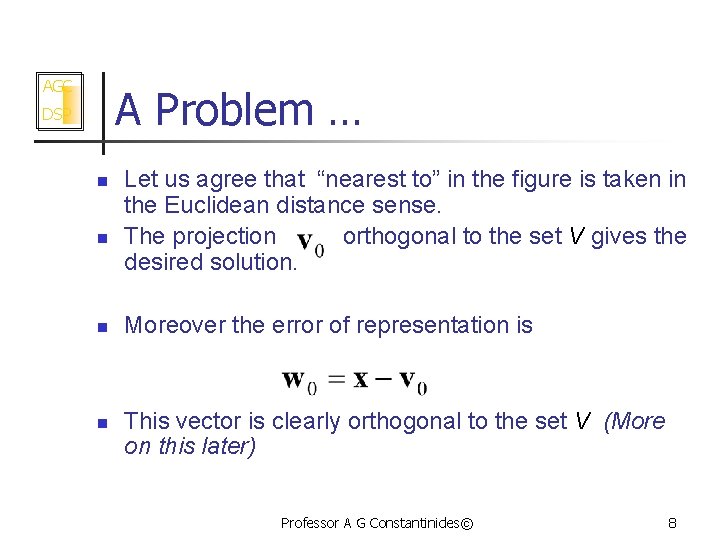
AGC A Problem … DSP n n Let us agree that “nearest to” in the figure is taken in the Euclidean distance sense. The projection orthogonal to the set V gives the desired solution. Moreover the error of representation is This vector is clearly orthogonal to the set V (More on this later) Professor A G Constantinides© 8
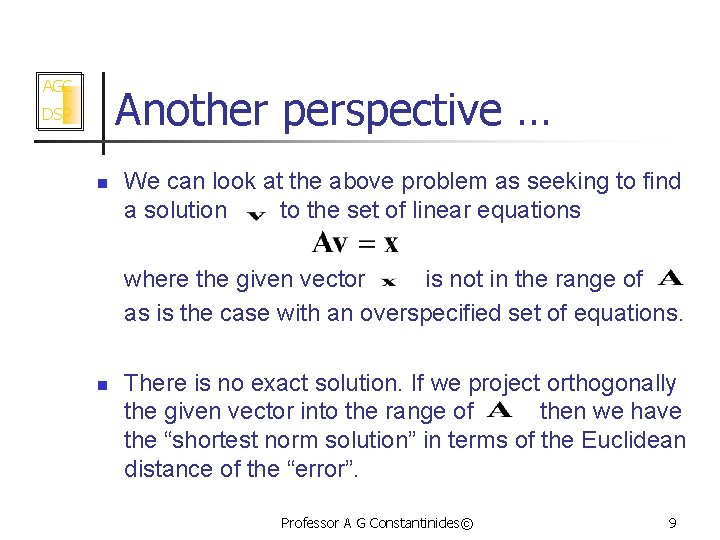
AGC Another perspective … DSP n We can look at the above problem as seeking to find a solution to the set of linear equations where the given vector is not in the range of as is the case with an overspecified set of equations. n There is no exact solution. If we project orthogonally the given vector into the range of then we have the “shortest norm solution” in terms of the Euclidean distance of the “error”. Professor A G Constantinides© 9
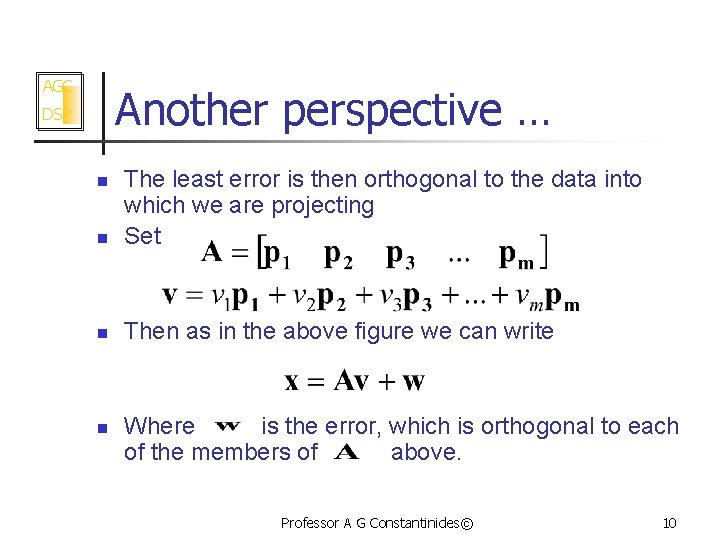
AGC Another perspective … DSP n The least error is then orthogonal to the data into which we are projecting Set n Then as in the above figure we can write n n Where is the error, which is orthogonal to each of the members of above. Professor A G Constantinides© 10
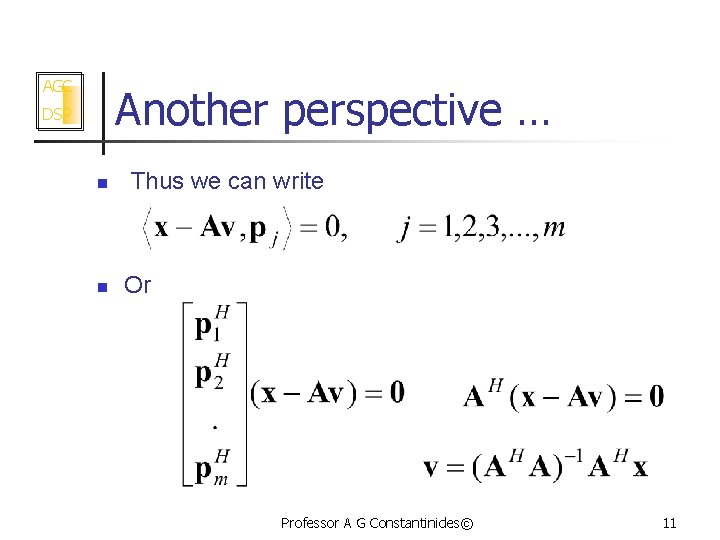
AGC Another perspective … DSP n n Thus we can write Or Professor A G Constantinides© 11
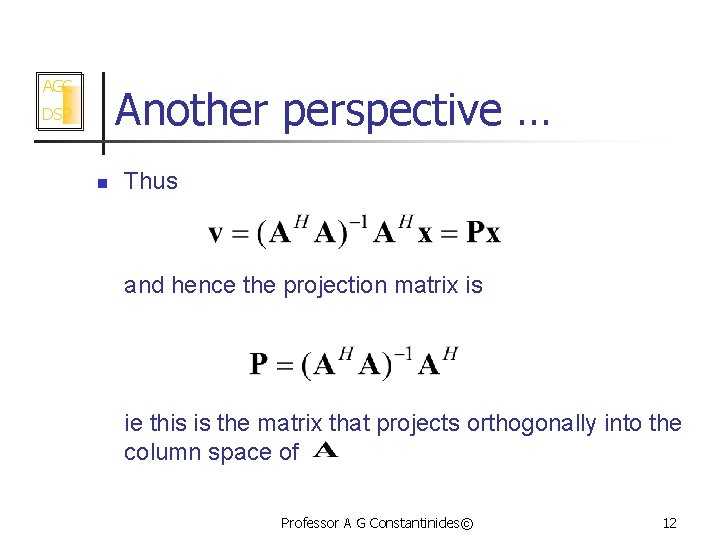
AGC Another perspective … DSP n Thus and hence the projection matrix is ie this is the matrix that projects orthogonally into the column space of Professor A G Constantinides© 12
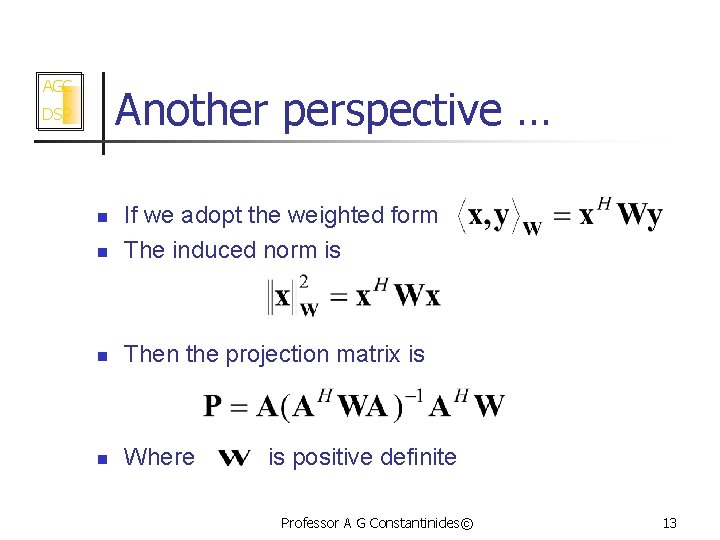
AGC Another perspective … DSP n If we adopt the weighted form The induced norm is n Then the projection matrix is n Where n is positive definite Professor A G Constantinides© 13
AGC DSP Least Squares Projection PROJECTION THEOREM In a Hilbert space the orthogonal projection of a signal into a smaller dimensional space minimises the norm of the error, and the error vector is orthogonal to the data (ie the smaller dimensional space). Professor A G Constantinides© 14
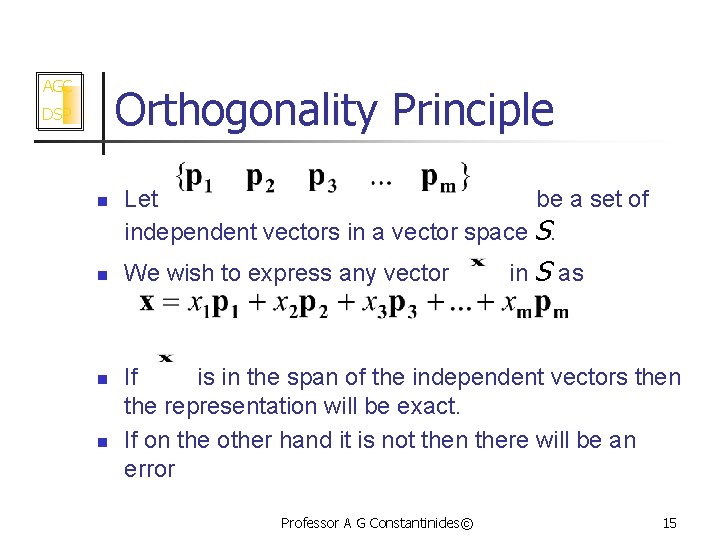
AGC Orthogonality Principle DSP n n Let be a set of independent vectors in a vector space S. We wish to express any vector in S as If is in the span of the independent vectors then the representation will be exact. If on the other hand it is not then there will be an error Professor A G Constantinides© 15
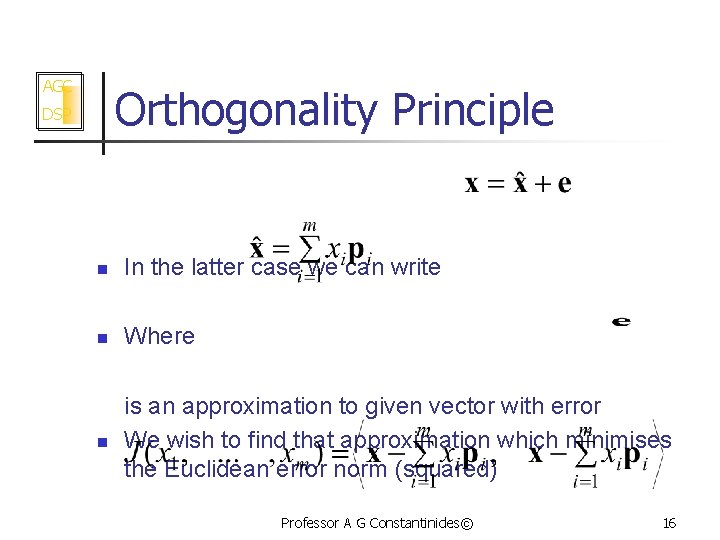
AGC Orthogonality Principle DSP n In the latter case we can write n Where n is an approximation to given vector with error We wish to find that approximation which minimises the Euclidean error norm (squared) Professor A G Constantinides© 16
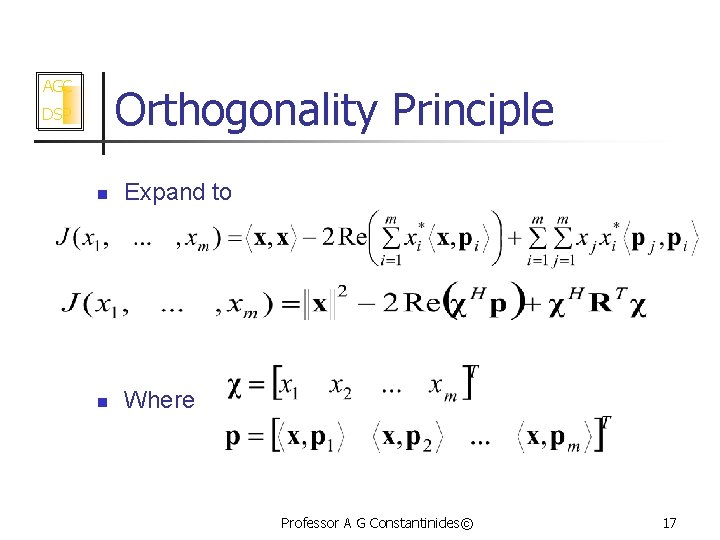
AGC Orthogonality Principle DSP n Expand to n Where Professor A G Constantinides© 17
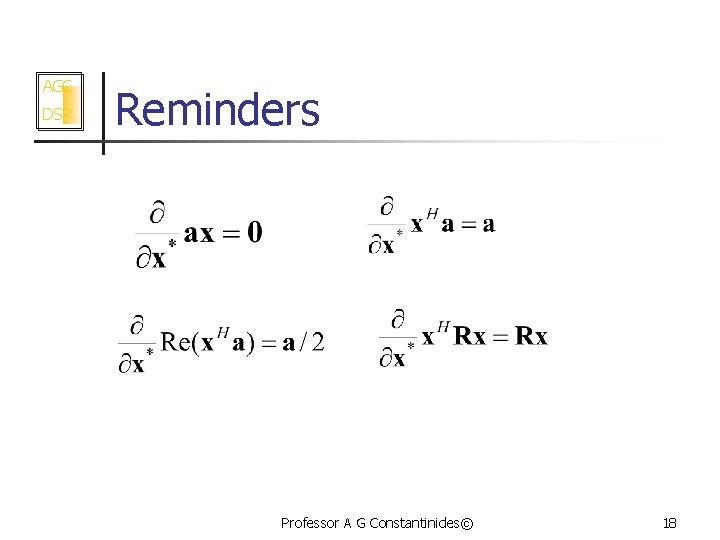
AGC DSP Reminders Professor A G Constantinides© 18
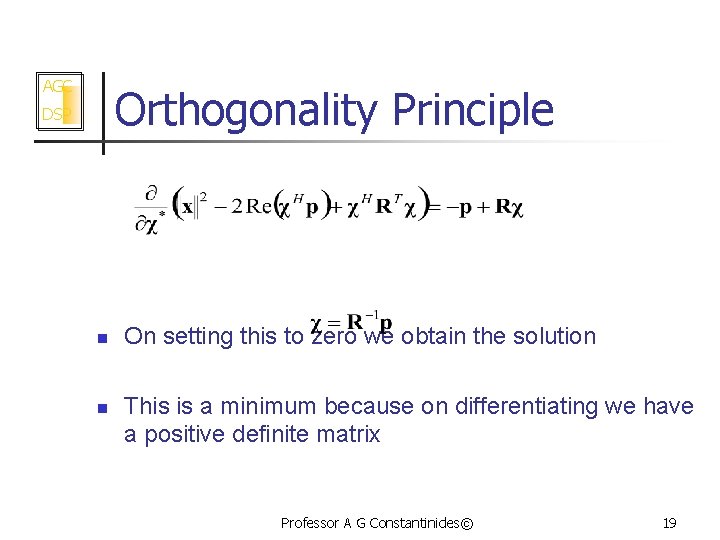
AGC Orthogonality Principle DSP n n On setting this to zero we obtain the solution This is a minimum because on differentiating we have a positive definite matrix Professor A G Constantinides© 19
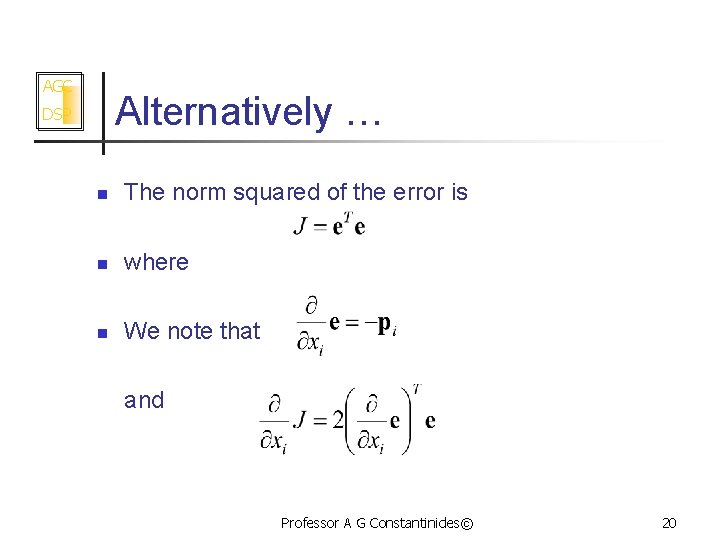
AGC Alternatively … DSP n The norm squared of the error is n where n We note that and Professor A G Constantinides© 20
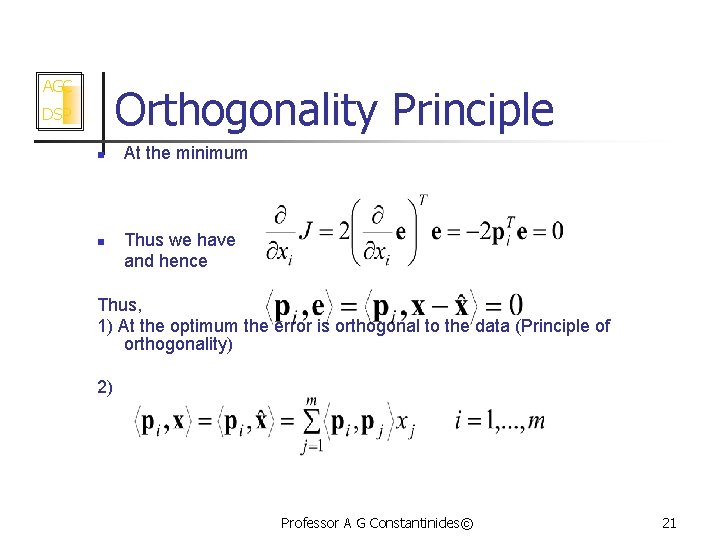
AGC Orthogonality Principle DSP n n At the minimum Thus we have and hence Thus, 1) At the optimum the error is orthogonal to the data (Principle of orthogonality) 2) Professor A G Constantinides© 21
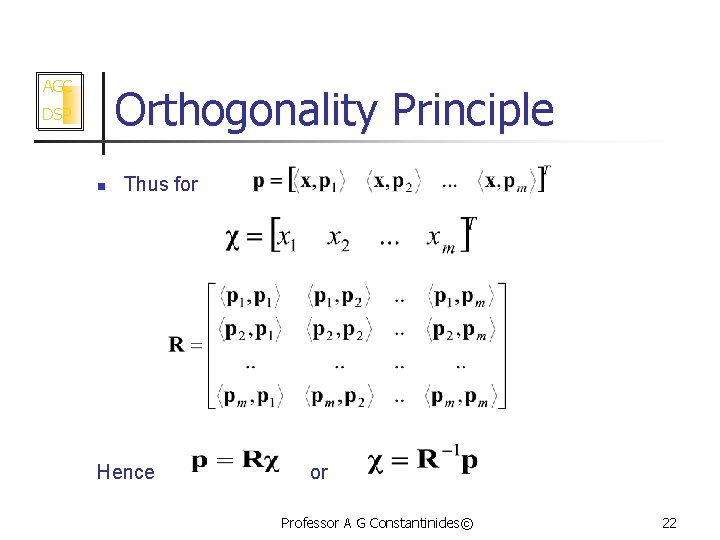
AGC Orthogonality Principle DSP n Thus for Hence or Professor A G Constantinides© 22
AGC Orthogonalisation DSP n n A signal may be projected into any linear space. The computation of its coefficients in the various vectors of the selected space is easier when the vectors in the space are orthogonal in that they are then non-interacting, ie the evaluation of one such coefficient will not influence the others The error norm is easier to compute Thus it makes sense to use an orthogonal set of vectors in the space into which we are to project a signal Professor A G Constantinides© 23
AGC DSP Orthogonalisation § Given any set of linearly independent vectors that span a certain space, there is another set of independent vectors of the same cardinality, pairwise orthogonal, that spans the same space § We can think of the given set as a linear combination of orthogonal vectors § Hence because of independence, the orthogonal vectors is a linear combination of the given vectors § This is the basic idea behind the Gram-Schmidt procedure Professor A G Constantinides© 24
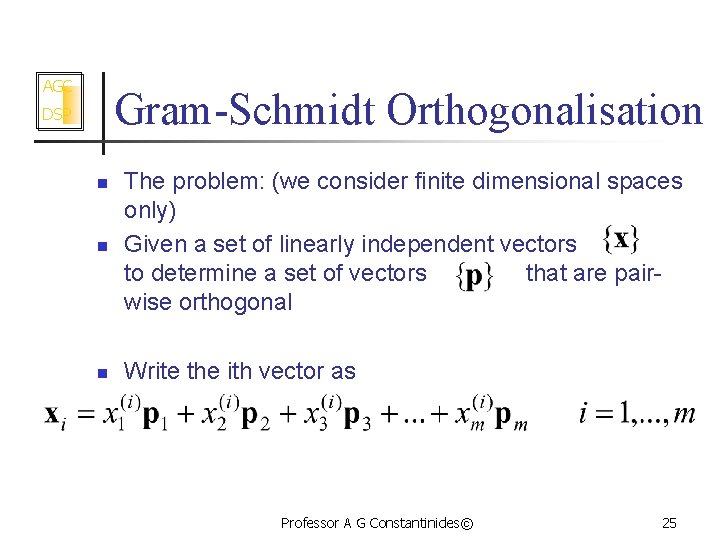
AGC Gram-Schmidt Orthogonalisation DSP n The problem: (we consider finite dimensional spaces only) Given a set of linearly independent vectors to determine a set of vectors that are pairwise orthogonal n Write the ith vector as n Professor A G Constantinides© 25
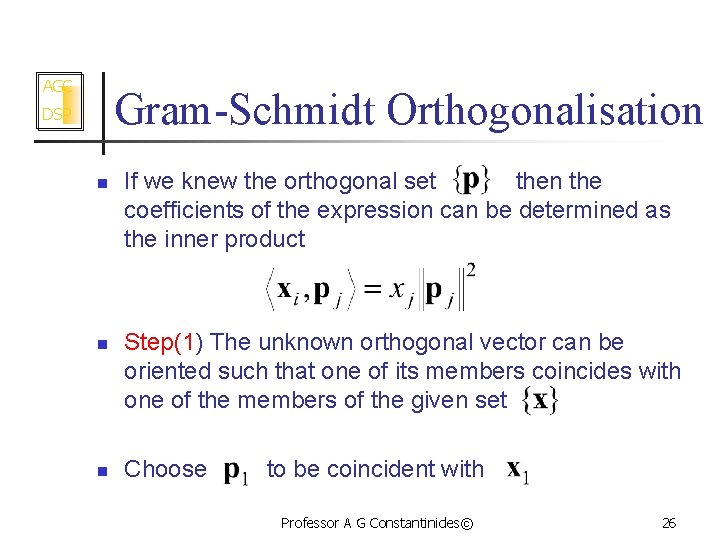
AGC Gram-Schmidt Orthogonalisation DSP n n n If we knew the orthogonal set then the coefficients of the expression can be determined as the inner product Step(1) The unknown orthogonal vector can be oriented such that one of its members coincides with one of the members of the given set Choose to be coincident with Professor A G Constantinides© 26
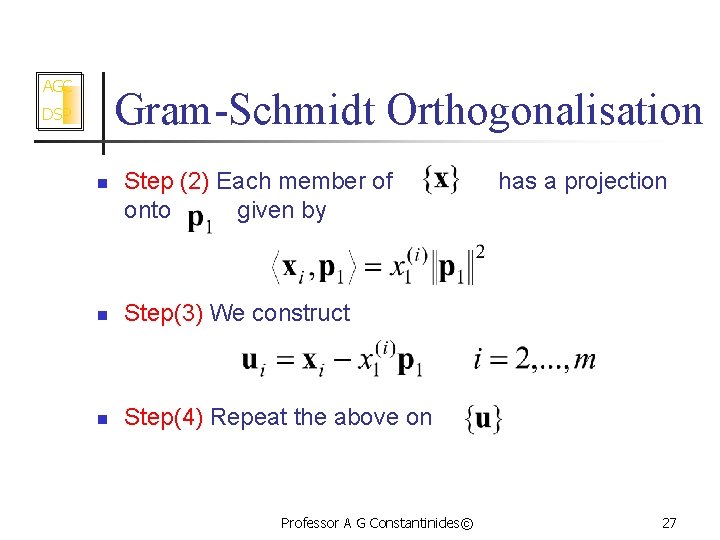
AGC Gram-Schmidt Orthogonalisation DSP n Step (2) Each member of onto given by n Step(3) We construct n Step(4) Repeat the above on Professor A G Constantinides© has a projection 27
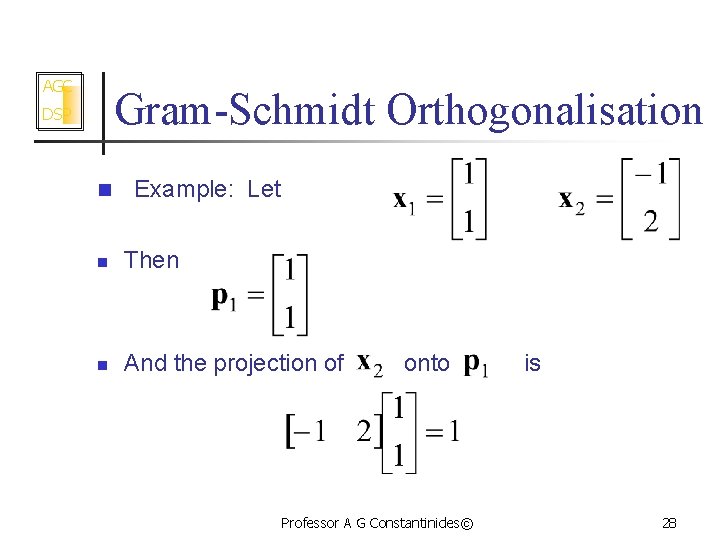
AGC Gram-Schmidt Orthogonalisation DSP n Example: Let n Then n And the projection of onto Professor A G Constantinides© is 28
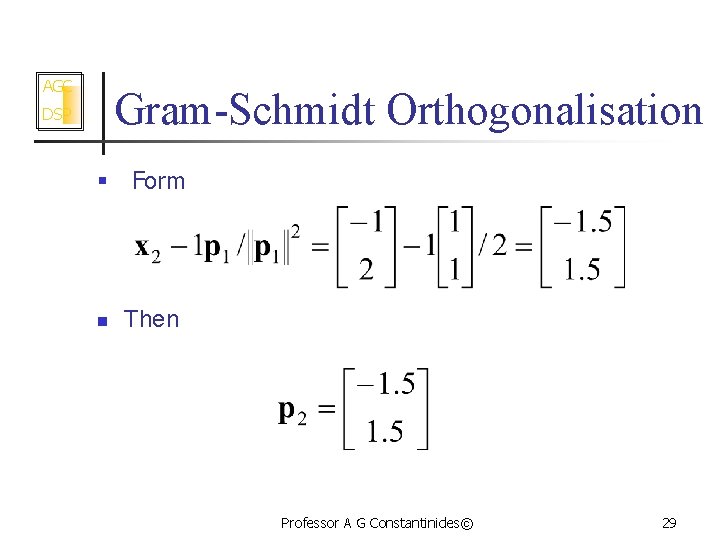
AGC Gram-Schmidt Orthogonalisation DSP § Form n Then Professor A G Constantinides© 29
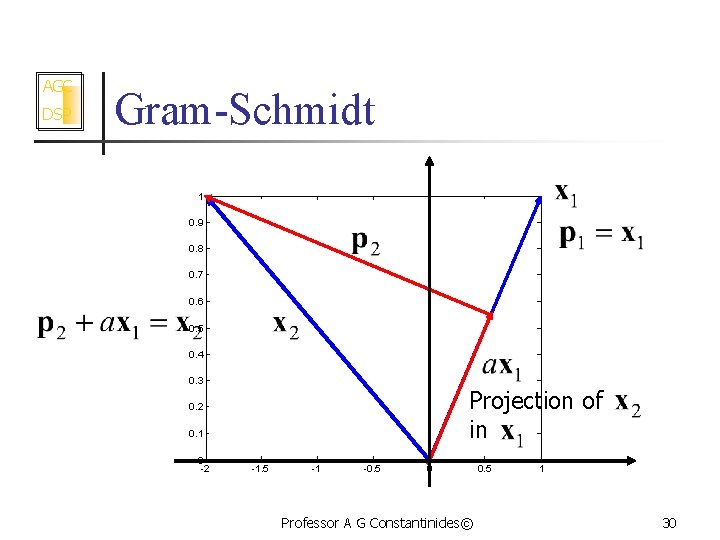
AGC DSP Gram-Schmidt 1 0. 9 0. 8 0. 7 0. 6 0. 5 0. 4 0. 3 Projection of in 0. 2 0. 1 0 -2 -1. 5 -1 -0. 5 0 Professor A G Constantinides© 0. 5 1 30
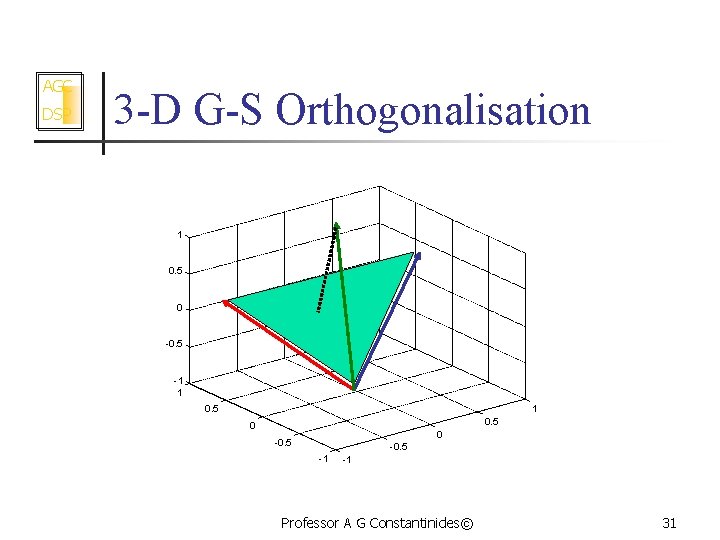
AGC DSP 3 -D G-S Orthogonalisation 1 0. 5 0 -0. 5 -1 1 0. 5 0 0 -0. 5 -1 -1 Professor A G Constantinides© 31
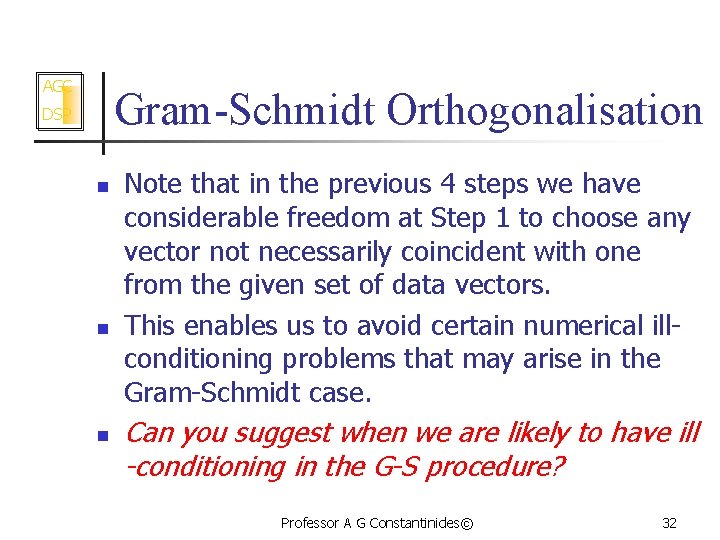
AGC Gram-Schmidt Orthogonalisation DSP n n n Note that in the previous 4 steps we have considerable freedom at Step 1 to choose any vector not necessarily coincident with one from the given set of data vectors. This enables us to avoid certain numerical illconditioning problems that may arise in the Gram-Schmidt case. Can you suggest when we are likely to have ill -conditioning in the G-S procedure? Professor A G Constantinides© 32
- Slides: 32