
AGBIZ BUSA JOINT PRESENTATION ON THE EXPROPRIATION BILL
AGBIZ & BUSA JOINT PRESENTATION ON THE EXPROPRIATION BILL 25 MARCH 2021 PORTFOLIO COMMITTEE ON PUBLIC WORKS AND INFRASTRUCTURE THEO BOSHOFF & OLIVIER SERRÃO
For today 1. Who we are; 2. Introduction; 3. Potential omissions; 4. Definition of Expropriation; 5. ‘nil’ compensation; 6. Comments on procedural aspects in the Bill; 7. Conclusion.
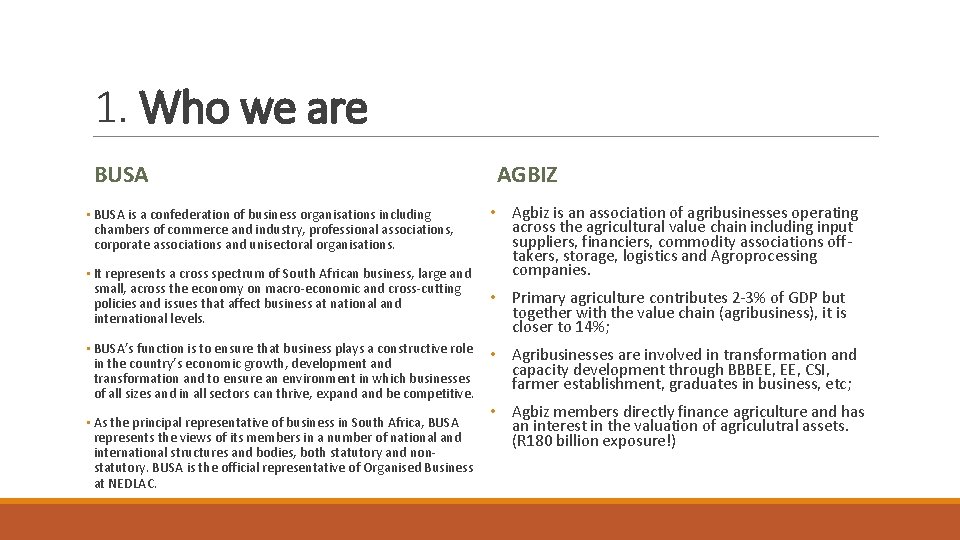
1. Who we are BUSA • BUSA is a confederation of business organisations including chambers of commerce and industry, professional associations, corporate associations and unisectoral organisations. • It represents a cross spectrum of South African business, large and small, across the economy on macro-economic and cross-cutting policies and issues that affect business at national and international levels. • BUSA’s function is to ensure that business plays a constructive role in the country’s economic growth, development and transformation and to ensure an environment in which businesses of all sizes and in all sectors can thrive, expand be competitive. • As the principal representative of business in South Africa, BUSA represents the views of its members in a number of national and international structures and bodies, both statutory and nonstatutory. BUSA is the official representative of Organised Business at NEDLAC. AGBIZ • Agbiz is an association of agribusinesses operating across the agricultural value chain including input suppliers, financiers, commodity associations offtakers, storage, logistics and Agroprocessing companies. • Primary agriculture contributes 2 -3% of GDP but together with the value chain (agribusiness), it is closer to 14%; • Agribusinesses are involved in transformation and capacity development through BBBEE, CSI, farmer establishment, graduates in business, etc; • Agbiz members directly finance agriculture and has an interest in the valuation of agriculutral assets. (R 180 billion exposure!)
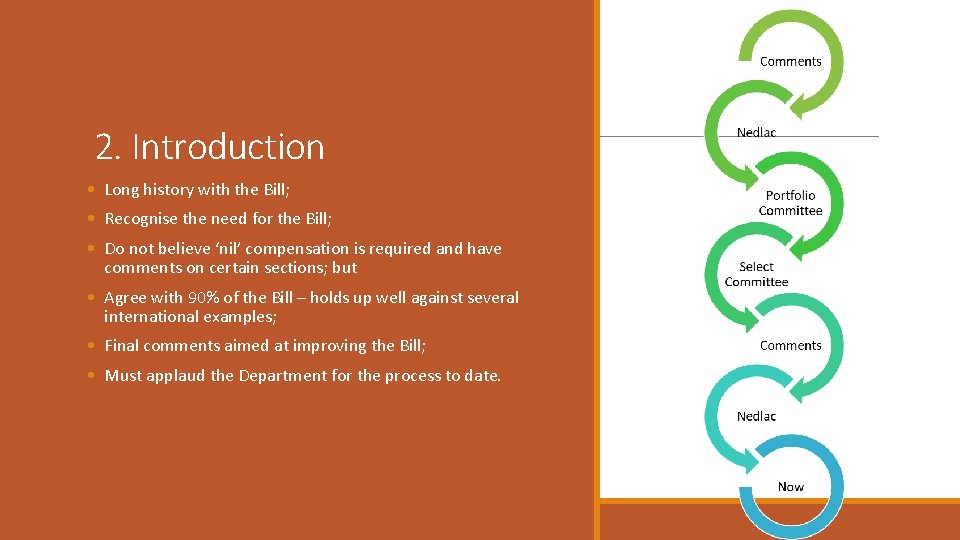
2. Introduction • Long history with the Bill; • Recognise the need for the Bill; • Do not believe ‘nil’ compensation is required and have comments on certain sections; but • Agree with 90% of the Bill – holds up well against several international examples; • Final comments aimed at improving the Bill; • Must applaud the Department for the process to date.
3. Potential Omission from the Bill • Expropriation must be in the public interest / purpose; • The purpose also affects the compensation paid. • What happens when the purpose falls away? • Could the expropriation be challenged? • What if it is used for a different public purpose? • Will the compensation paid still be correct? • S 23 (2) – cannot withdraw an expropriation after 3 months, if land is registered or where compensation has been paid. Possibility discussed at Nedlac but fell outside of To. R, recommended it be dealt with at PC level.
3. Potential Omission from the Bill Recommendation: • Not feasible to ‘reverse’ an expropriation; • Collect compensation from all owners & rights holders? • Re-instate registered rights (costs) & unregistered rights? • Alternative proposal: • Right of first refusal in favour of owner; but; • Must pay price equal to the full amount of compensation paid; • May be more than the compensation he/she received but will buy the property unencumbered; • Should be timebound – allow for 30 days and where no response is received: • Authority to dispose of property according to internal asset management policies.

4. Definition of ‘expropriation’ • No definition provided for in the Constitution; but • Expropriation an extreme form of deprivation
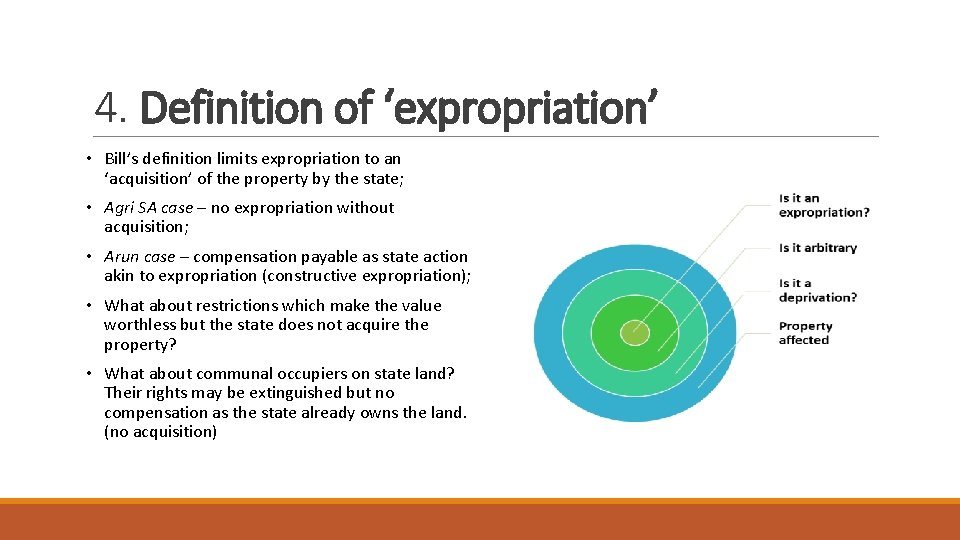
4. Definition of ‘expropriation’ • Bill’s definition limits expropriation to an ‘acquisition’ of the property by the state; • Agri SA case – no expropriation without acquisition; • Arun case – compensation payable as state action akin to expropriation (constructive expropriation); • What about restrictions which make the value worthless but the state does not acquire the property? • What about communal occupiers on state land? Their rights may be extinguished but no compensation as the state already owns the land. (no acquisition)

4. Definition of ‘expropriation’ Think of deprivation & expropriation as a continuum:

4. Definition of ‘expropriation’ Proposal: “expropriation” means the compulsory acquisition of property, or a right in property, by an expropriating authority or an organ of state upon request to an expropriating authority including a deprivation of ownership or a right in property that is materially equivalent a compulsory acquisition, and “expropriate” has a corresponding meaning;
Clause 2 – Application of the Act • S 2 (2) – consent of administrative authority required to expropriate land from a state entity; • Read with s 12 (3) (b) – land not required for organ of state’s own purposes; • Double standards – no consent required from private owners; • Should resolve disputes ito Intergovernmental Relations Framework Act opposed to legislating a hierarchy; • Automatically places the purpose of the expropriation in an inferior position;
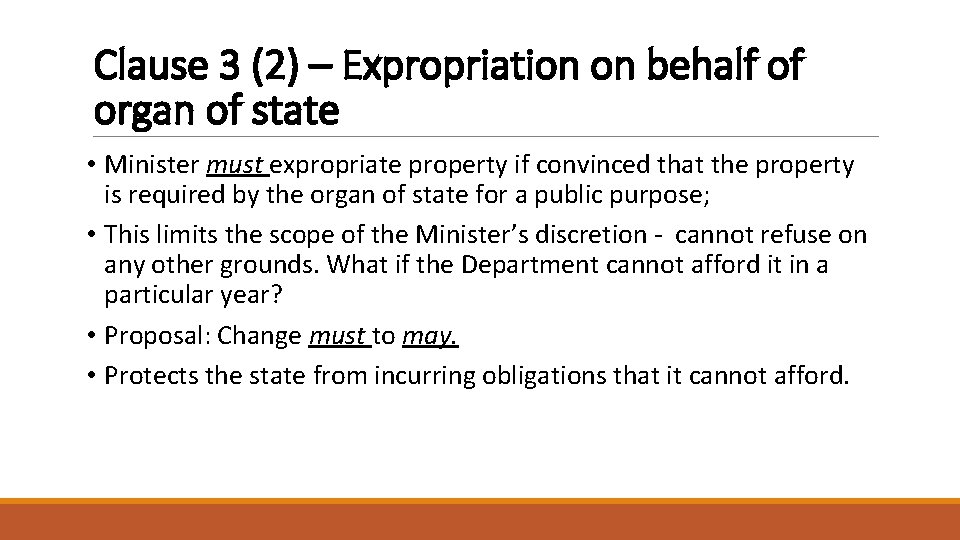
Clause 3 (2) – Expropriation on behalf of organ of state • Minister must expropriate property if convinced that the property is required by the organ of state for a public purpose; • This limits the scope of the Minister’s discretion - cannot refuse on any other grounds. What if the Department cannot afford it in a particular year? • Proposal: Change must to may. • Protects the state from incurring obligations that it cannot afford.
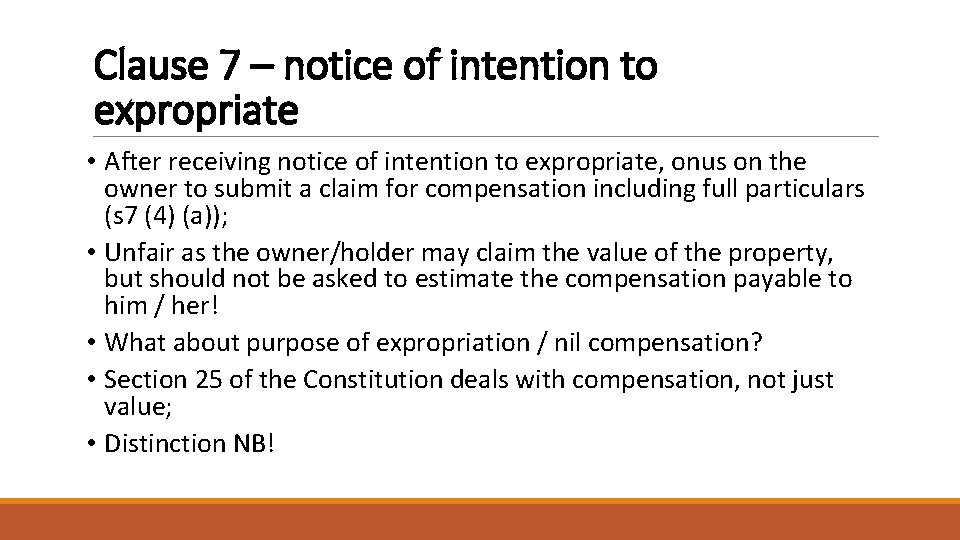
Clause 7 – notice of intention to expropriate • After receiving notice of intention to expropriate, onus on the owner to submit a claim for compensation including full particulars (s 7 (4) (a)); • Unfair as the owner/holder may claim the value of the property, but should not be asked to estimate the compensation payable to him / her! • What about purpose of expropriation / nil compensation? • Section 25 of the Constitution deals with compensation, not just value; • Distinction NB!
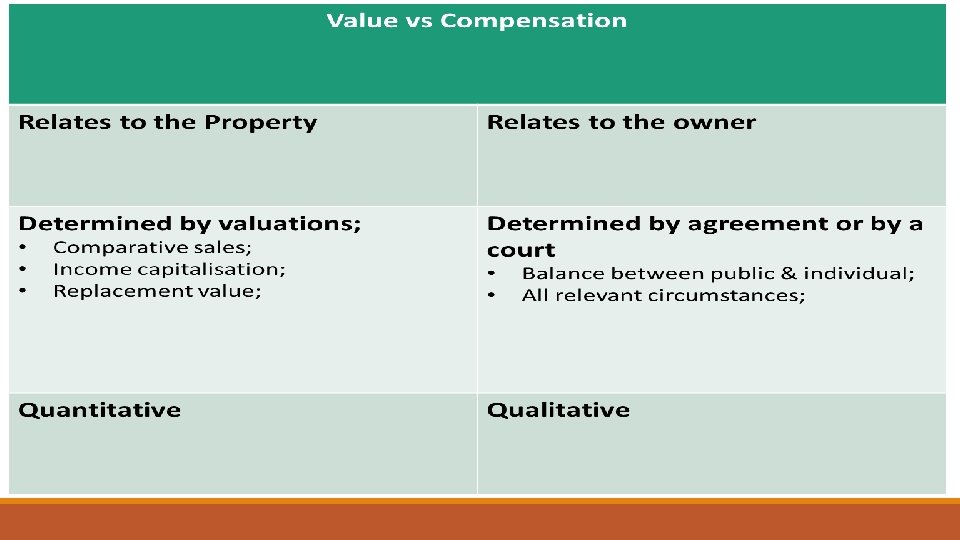
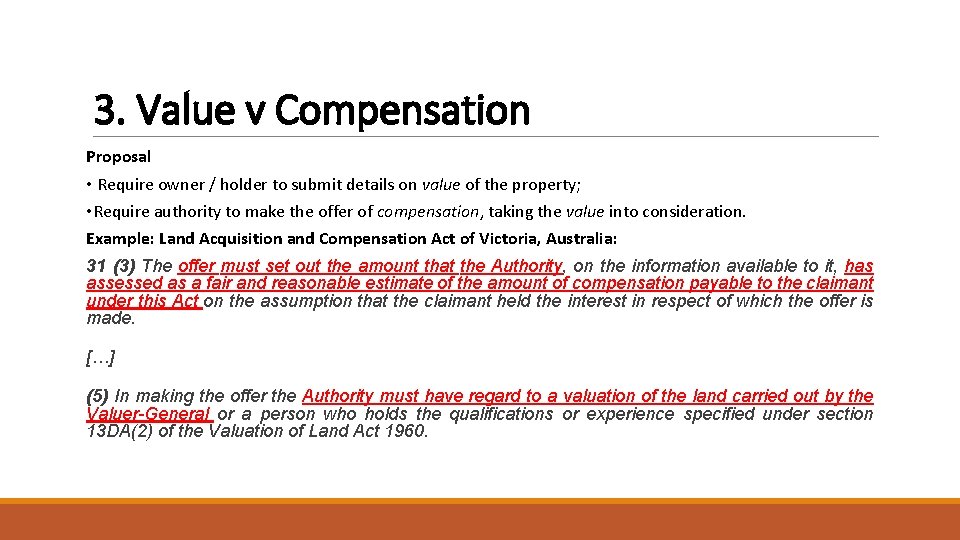
3. Value v Compensation Proposal • Require owner / holder to submit details on value of the property; • Require authority to make the offer of compensation, taking the value into consideration. Example: Land Acquisition and Compensation Act of Victoria, Australia: 31 (3) The offer must set out the amount that the Authority, on the information available to it, has assessed as a fair and reasonable estimate of the amount of compensation payable to the claimant under this Act on the assumption that the claimant held the interest in respect of which the offer is made. […] (5) In making the offer the Authority must have regard to a valuation of the land carried out by the Valuer-General or a person who holds the qualifications or experience specified under section 13 DA(2) of the Valuation of Land Act 1960.
Expropriation at ‘nil’ compensation Opposed to the inclusion of ‘nil’ compensation • Unsure why certain properties are singled out; • Land reform can be achieved without resorting to ‘nil’ compensation; • • • Disagree with premise – land reform too expensive with compensation; Budget siphoned off for different projects over the years; Improve valuations for purchase; and Use just & equitable compensation to acquire land; Business developing a ‘blended finance’ scheme to mix grant funding with loan funding from the private sector to co-finance
Expropriation at ‘nil’ compensation • s 12 (3) does not prescribe a list of properties where nil compensation will be applied but rather lists circumstances that a court must consider; • However, concerned that it may lead to offers of nil compensation and place the onus on owners to litigate; • Unintended consequences: • Affect the collateral value of listed land; • Listed properties ‘branded’ as no-go areas for fixed investment; • Can affect access to credit & cost of credit.
Specific comments on listed circumstances 12 (3) (a) – land not being used and he main purpose is to benefit from its appreciation in market value • Rationale unclear: • Shares on the JSE are held with the intention of increasing value – why is land treated differently? • Hording of natural resources or scarcity of land? • May have justifications why property is not developed; • Waiting for permits or permissions from municipality; • Lack of finance; etc. 12 (3) (b) – land not required by an organ of state for its main purposes • Covered above – double standards for state & private citizens.
Specific comments on listed circumstances 12 (3) (c) – owner abandoned land by failing to exercise control • Both control & intention must be relinquished in law for ownership to be lost; • May be legitimate reasons why you cannot exercise control – e. g. Modderklip Boerdery case – damages awarded as municipality failed to assist with land invasions; • Owners intention linked to nil compensation – what about holders of rights in the property? 12 (3) (d) – subsidies exceed market value • Subsidies already catered for in s 12 (1); • Land reform beneficiaries?
Specific comments on listed circumstances 12 (3) (e) – property poses a health risk • Must not confuse compensation with reason for expropriation – bylaws exist to rectify these properties; • Where the property is acquired for a different purpose the actual costs to repair should apply; 12 (4) – Labour tenants • Latest version an improvement; but • Slow pace of labour tenants claims down to 20 000 claims that were not processed (AFRA case);
Clause 17 – payment of amount offered as compensation • S 17 (3) states that a delay in the payment of compensation will not prevent possession from passing; • S 25 requires the amount as well as the time and manner of payment to be just & equitable; • Haffejee case: payment of compensation post acquisition may be just and equitable but depends on the circumstances of each case; • S 17 (3) currently favours the state in all instances, should be qualified by “…where it is just and equitable to do so” • S 17 (3) also refers to a delay in payment “…by virtue of subsection (2) or any other dispute”; • Delay in payment due to ss 18, 19 or 20 understandable but there should not be a catch-all phrase permitting a delay in payment of the amount offered.
Clause 29 – Regulations, legal document & steps valid under certain circumstances • Expropriation Bill in essence about procedure; • Not opposed to condonation where there is no prejudice or where it is immaterial but who makes this decision? Proposal: • Non-compliance with procedure should not invalidate a step in the process where; • There is agreement between affected parties; or • When condoned by a court on application.
Conclusion • Current expropriation legislation does not adequately provide for procedural guarantees; • New Bill is therefore critical & needed; • Broadly supportive of the Bill but concerned about the impact which ‘nil’ compensation provision may have on investor confidence & finance; • Trust that our comments will assist the committee in its deliberations.

THANK YOU theo@agbiz. co. za www. Agbiz. co. za Olivier. serrao@busa. org. za www. busa. org. za
- Slides: 24