
Against the Heuristicsand Biases Strategy My Aim To
Against the Heuristics-and. Biases Strategy
My Aim • To respond to a particular argument from Blanchard & Schaffer’s “Cause Without Default”. • They argue that we shouldn’t incorporate normative concepts into our analysis of causation. • In other words, our account of causation should be non-normative. • By responding to this argument, I hope to defend the view that causation is normative.
A Response to Blanchard & Schaffer’s • Blanchard & Schaffer present three arguments for their conclusion: • Normative concepts like normality and default/deviant events are unclear, heterogenous concepts. • Many of the examples that are given to motivate a normative account of causation rely on non-apt causal models. • The psychological evidence given in support of normative accounts of causation can be better explained using heuristics and biases. • I will respond to the third argument.
The Structure • Some background on the arguments for and against a normative account of causation. • A point in favour is the psychological evidence. Specifically a study by Knobe & Fraser. • Blanchard & Schaffer’s response to this evidence by appealing to Kahneman & Tversky’s heuristics framework. • Finally, I will respond to this argument by showing how Blanchard & Schaffer fail to provide sufficient reason for accepting the premises.
Normative Causation • What does it mean to claim that causation is normative. • Roughly speaking: A complete account of causation should include reference to certain normative concepts. • To understand “c caused e” we need to appeal to certain concepts like normality or default/deviant events. • So, the truth-values of causal statements will be affected by norms.
Normative Causation • Why might we think that causation is normative? • To fix a problem with accounts of causal modelling – The Problem of Isomorphs. • Mc. Grath also thinks that it can be used to solve a problem found in cases of causation by omission. E. g. the gardener and the Queen. • The view also seems to be supported by the results of several psychological studies on the topic.
Normative Causation • The most well-known of these studies was done by Knobe & Fraser. • Subjects were presented with the following vignette: The receptionist in the philosophy department keeps her desk stocked with pens. The administrative assistants are allowed to take pens, but faculty members are supposed to buy their own. The administrative assistants typically do take the pens. Unfortunately, so do the faculty members. The receptionist repeatedly e-mails them reminders that only administrators are allowed to take the pens. On Monday morning, one of the administrative assistants encounters Professor Smith walking past the receptionist’s desk. Both take pens. Later that day, the receptionist needs to take an important message … but she has a problem. There are no pens left on her desk.
Normative Causation • The subjects were then asked, on a scale of -3 to 3, whether they agreed or disagreed with each of the following statements: 1) Professor Smith caused the problem. 2) The administrative assistant caused the problem. • Responses: o (1) – Mean average answer of 2. 2. o (2) – Mean average answer of -1. 2 • Explained by the fact that it is normal for the administrative assistant to take a pen, but normal for Professor Smith to do the same. • Normative considerations affect the acceptability of certain causal statements.
Normative Causation • The results of this study create a puzzle for counterfactual accounts of causation. • In both statements the alleged effect is counterfactually dependent on the alleged cause. • Why there is a difference in acceptability between the two statements.
The Competence Strategy vs Heuristics-and. Biases Strategy • Two strategies for responding to the puzzle: • The Competence Strategy – The subject’s judgements about the case are the result of a competent application of the concept of causation. This is the strategy taken by those who believe causation is normative. • The Heuristics-and-Biases Strategy – The subject’s judgements about the case are mistaken and the result of a bias in one of our cognitive heuristics. This is the route taken by those who believe that causation is non-normative. • Blanchard & Schaffer pursue the second strategy.
The Heuristics-and-Biases Strategy • The subjects made a mistake. Both statements have the same truthvalue, the difference in acceptability is explained by a bias. • The reason for pursuing this strategy is that it conforms to an intuition we have that causation is a natural relation. • This use of the term “natural relation” comes from Menzies drawing from Strawson’s “Causation and Explanation”: We sometimes presume, or are said to presume, that causality is a natural relation which holds in the natural world between particular events or circumstances, just as the relation of temporal succession does or that of spatial proximity. (Strawson, 1992)
Heuristics • Blanchard & Schaffer need to explain the difference in acceptability between (1) and (2). • They appeal to Kahneman & Tversky’s heuristics framework. • Heuristics are “cheap and dirty” ways of arriving at beliefs about things which are uncertain. • They allow us to make complex judgements (e. g. judgements about probability) by reducing them to much simpler judgements.
The Availability Heuristic • One example of a heuristic is the availability heuristic. • Used to make judgements about the likelihood of possible future events. • “Availability” refers to the ease at which something can be brought to mind. • This can be affected by the frequency that events of the same type have occurred in the past. • E. g. The sun rising tomorrow morning comes easily to mind, whilst the possibility that we will be abducted by aliens does not.
The Availability Heuristic • This heuristic suffers from a bias. • When we are shown a dramatic image, we tend to judge the event depicted in the image as being more likely. • E. g. When people are shown a picture of a car accident, they judged it to be more likely that they would be involved in a car accident in future. • So heuristics often systematically produce errors.
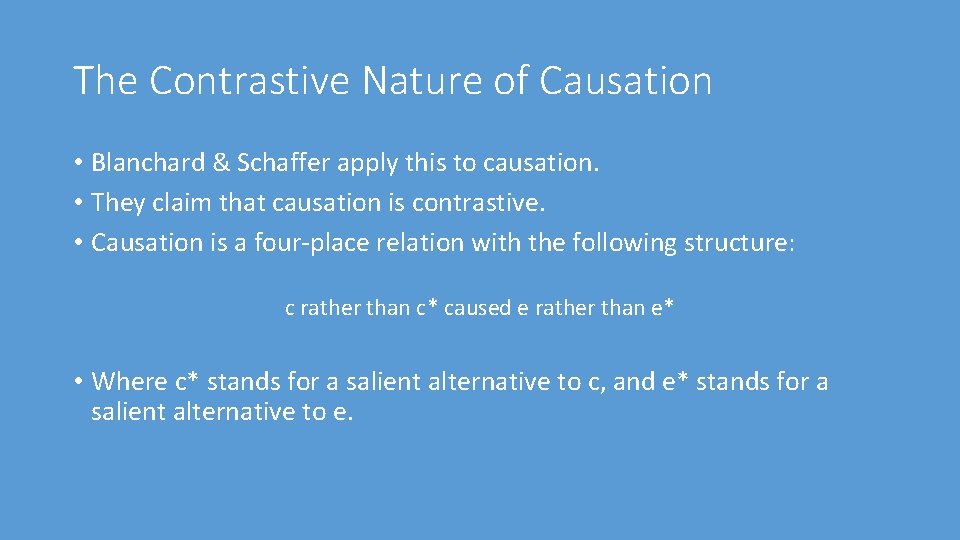
The Contrastive Nature of Causation • Blanchard & Schaffer apply this to causation. • They claim that causation is contrastive. • Causation is a four-place relation with the following structure: c rather than c* caused e rather than e* • Where c* stands for a salient alternative to c, and e* stands for a salient alternative to e.
Making Causal Judgements • We make causal judgements using a specific kind of counterfactual reasoning. • When assessing “c caused e”, we consider a counterfactual scenario where c* obtains and then we try to determine whether e* would have also obtained. • This is a two-step process – first we select the contrasts, then we consider whether the counterfactual dependence relation obtains.
Making Causal Judgements • Like the availability heuristic, there is a bias here. • “‘Deviant’ events tend to leap out as especially salient to people and tend to trigger thoughts of the more normal alternative, while ‘default’ events tend to duck out of view and not trigger thoughts about alternatives at all” (Blanchard & Schaffer, 2017) • Salient alternatives to deviant/abnormal events are more available than salient alternatives default/normal events. • We have a bias towards assigning causal status to abnormal events because it is easier to imagine how they could have been otherwise.
Returning to the Pen Vignette • Reminder - the puzzle is to explain the difference in acceptability between: 1) Professor Smith caused the problem. 2) The administrative assistant caused the problem. • Professor Smith taking the pen is an abnormal event. • So when we are considering what caused the problem, we are more likely to chose that event because the normal alternative where he doesn’t take the pen is more available to us.
Returning to the Pen Vignette • By comparison, the normal event of the administrative assistant’s taking a pen “will not tend to leap to mind so readily, and will not so readily tend to trigger thoughts of the deviant alternative of the assistant’s not taking any pen”. • The subjects are biased towards events with more normal/available contrasts. • They are more likely to say that Professor Smith’s action was the cause.
Returning to the Pen Vignette • Blanchard & Schaffer’s account seems to solve the puzzle, without committing them to the view that causation is normative. • The difference in acceptability between (1) and (2) is merely the result of a bias in our counterfactual heuristic. • (1) and (2) can have the same truth-value. • This doesn’t guarantee Blanchard & Schaffer’s conclusion. • It might still be the case that the Competence Strategy can provide a better explanation.
A Better Explanation • Blanchard & Schaffer also need to demonstrate that their account provides a better explanation of the results of the pen vignette than the Competence Strategy. • Their account is preferable because it “best explain[s] the generality and systematicity of availability effects”. • Availability has been shown to affect our judgements in a number of different domains outside of causation (including probability).
A Better Explanation • Blanchard & Schaffer’s account is part of a more general explanation of these availability effects. • They claim that a follower of the Competence Strategy will need to give a different explanation of the occurrence of availability effects for each domain that they occur in. • It would just be an accident that all of these different concepts happen to be such that they generate availability effects. • This is implausible, and so we ought to prefer Blanchard & Schaffer’s account.
Blanchard & Schaffer’s Argument • We can summarise Blanchard & Schaffer’s argument in the following way: I. The results of the psychological studies can be explained using heuristics and biases. II. This heuristics-and-biases account, offers a better explanation of the results than we would get from an account on the Competence Strategy. III. We ought to prefer the heuristics-and-biases account over any account on the Competence Strategy.
Responding to the First Premise • Blanchard & Schaffer’s account fails to adequately explain the results of Knobe & Fraser’s study. • There account would be successful if the subjects were presented with the open-ended question of “who caused the problem? ”, but this is not the case. • Rather, they were first asked whether they agreed or disagreed with a sentence which claimed that Professor Smith caused the problem. • Then they were asked whether they agreed or disagreed with a statement which claimed that the administrative assistant caused the problem.
Responding to the First Premise • The issue comes from trying to define the role that the availability heuristic plays in the account. • Suppose that it was an open-ended question – there would be a clear disanalogy with the case of probability, because availability isn’t being used to directly pick out an answer. • Rather, it is being used to indirectly pick out the cause based on the ease at which certain alternatives to those events can be brought to mind.
Responding to the First Premise • The problem with this becomes obvious once we consider how it might work when we are presented with a closed question. • They were asked whether they agreed or disagreed with specific causal statements. • They were asked to use the process of counterfactual reasoning to make a judgement about whether these statements were true or false.
Responding to the First Premise • This raises the question of what role availability plays in this process of counterfactual reasoning. • The only plausible answer seems to be that it affects the first step, that of contrast selection. • What this means is that availability is used as a cheap and dirty way to determine which possible alternatives are salient in a given context. • So, possible alternatives that are more easily brought to mind will be selected as contrasts.
Responding to the First Premise • Consider how the subjects might have reasoned about the statements they were presented with. • Firstly, they were asked whether they agreed or disagreed with the following: 1) Professor Smith caused the problem. • If they are selecting the most available alternatives, then the complete causal statement would plausibly be: Professor Smith’s taking the pen rather than his not taking the pen caused the problem rather than everything running smoothly. • This is true.
Responding to the First Premise • The problem becomes more apparent when we consider the second statement: 2) The administrative assistant caused the problem. • The effectual contrast will be the same as the first statement. • It is less obvious what the causal contrast should be. • If we are going for the most available alternative, then the assistant’s not taking the pen seems like the most plausible candidate. • But then the complete causal statement is: The administrative assistant’s taking the pen rather than not taking the pen caused the problem rather than everything running smoothly. • This is also true, so where does the difference in acceptability come from.
Responding to the First Premise • The causal contrast can’t be the assistant’s not taking the pen. • It seems absurd to claim that this alternative is not available. • Blanchard & Schaffer could argue that the subjects have selected some other alternative as the causal contrast, but what alternative is more available than the assistant’s not taking the pen. • It seems that Blanchard & Schaffer have to say that the subjects don’t select a causal contrast at all. • This is a very strong and difficult to defend claim.
Responding to the Second Premise • Blanchard & Schaffer’s account is superior because it fits neatly into the existing work on availability effects. • On the Competence Strategy, the wide ranging occurrence of availability effects is just an accident. • Response in two parts: o Blanchard & Schaffer’s account doesn’t give us a unified explanation of the occurrence of availability effects. o The “accidental” uniformity is not as problematic as Blanchard & Schaffer claim.
Responding to the Second Premise • Blanchard & Schaffer’s account does not offer a unified explanation of availability effects because it has availability playing different roles in different domains. • Let’s compare causation with probability. • There at least three differences in how the heuristic gets deployed in each domain.
Responding to the Second Premise • Probability (the car-crash case): o The heuristic directly determines how likely we judge a future car-crash to be. o There is a clear source of error that interferes with the use of the heuristic (being presented with a dramatic image). o The heuristic is a cheap and dirty alternative to a more ideal process that would guarantee the correct answer. I. e. if we are in possession of all the relevant facts, we could reach a judgement that is guaranteed to be true. • Causation (the pen vignette): o The heuristic indirectly affects the subject’s judgements of the truth or falsity of the statements they are presented with. o There is no source of error that interferes with the use of the heuristic. o There is no more ideal process, the use of the heuristic is simply a part of the process of counterfactual reasoning. The subjects already have all the information they need to reach a true judgement.
Responding to the Second Premise • These differences are a result of the fact that, in the domain of causation, availability isn’t being used to help us find a true answer. • In probability, the heuristic has a direct effect on our judgements because it is being used as a somewhat reliable substitute for a more ideal process. • In causation, the heuristic is most plausibly understood as a means for speeding up the process of counterfactual reasoning, to give us an answer as quickly as possible, whether true or false.
Responding to the Second Premise • Regarding the Competence Strategy, the “accidental” unity is not as much of a problem as Blanchard & Schaffer make it seem. • Their description makes it seem that, if the Competence Strategy were right, we would be surprised to discover that the content of all these different concepts (causation, probability, frequency, etc. ) are such that they all produce availability effects. • This is exactly what we ought to expect when we consider the roles these concepts play in our decision making process, where we need to make judgements quickly.
Conclusion • Here I have demonstrated that Blanchard & Schaffer have failed to properly motivate the two main premises of their argument. • Therefore, we have no reason to believe their conclusion that their account is superior to one which follows the Competence Strategy.
- Slides: 36