
Ag Biogas Energy Lesson 7 Methane capture on
Ag & Biogas Energy Lesson 7
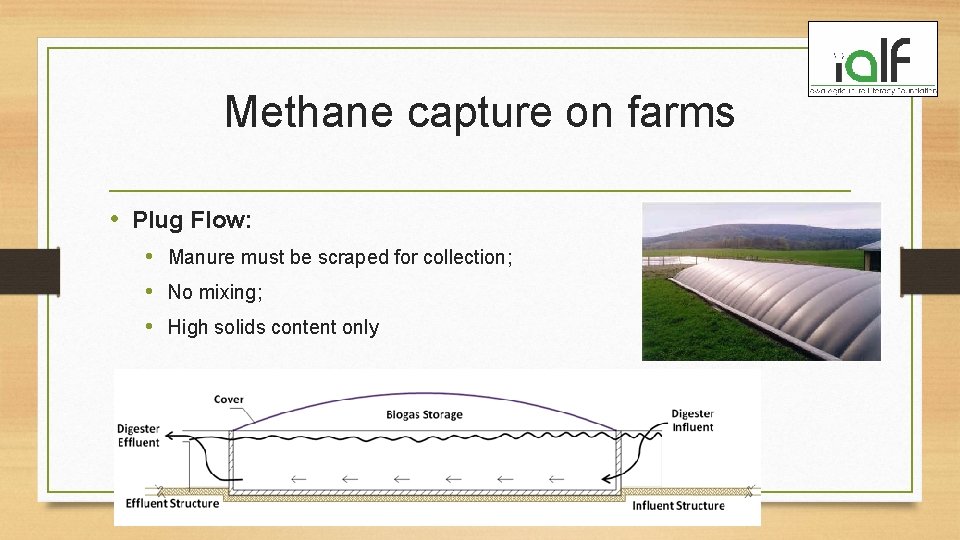
Methane capture on farms • Plug Flow: • Manure must be scraped for collection; • No mixing; • High solids content only
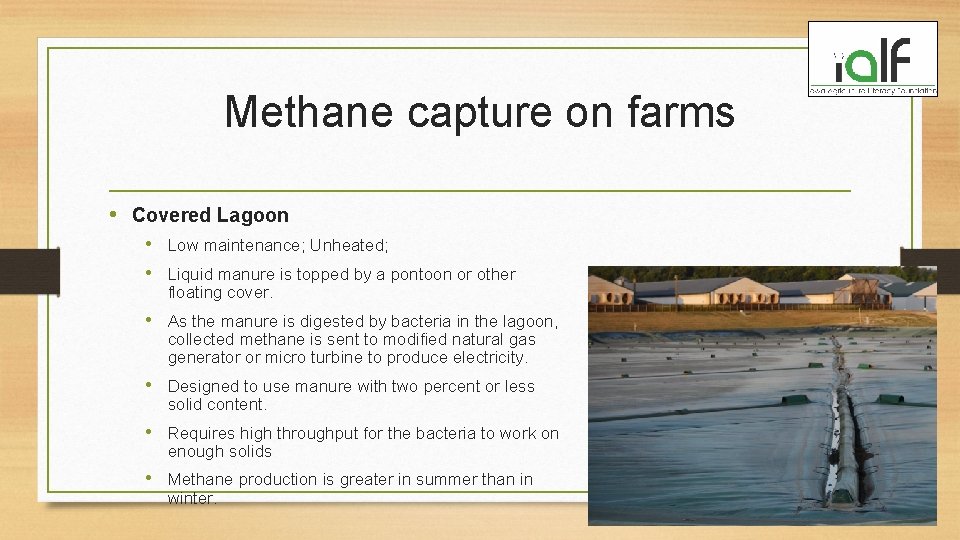
Methane capture on farms • Covered Lagoon • Low maintenance; Unheated; • Liquid manure is topped by a pontoon or other floating cover. • As the manure is digested by bacteria in the lagoon, collected methane is sent to modified natural gas generator or micro turbine to produce electricity. • Designed to use manure with two percent or less solid content. • Requires high throughput for the bacteria to work on enough solids • Methane production is greater in summer than in winter.

Methane capture on farms • Complete Mix • Heated tank with mixing system; • High moisture content acceptable
Methane capture on farms • Capital costs of an anaerobic digester can be very high and may range from a few hundred thousand to a few million dollars, depending on the size. • Payback periods can range from 5 to 16 years, depending on the conditions of operation. • Value of the biogas from the digester will vary depending on the type of fuel that it is replacing. • In general, an anaerobic digester will not be cost effective for a farm with fewer than 300 head of livestock. • For smaller farms, a cooperative operation used by multiple farms may be an option.
Biological and chemical stages of biogas fermentation processes Is dependent on the kinds of microorganisms used as well as processing conditions. 1. Carbohydrates, proteins, lipids, and cellulose are degraded by many kinds of microorganisms. 2. Converted into organic acids (i. e. butyric acid or propionic acid) by acid 3. 4. 5. 6. producing microorganisms. Conversion of these organic acids into acetic acids as well as hydrogen. Methane can be recovered by the methane-producing bacteria. Since some of the hydrogen produced cannot be converted, the final product of biogas usually contains methane (CH 4) and hydrogen (H 2). These products can be used in combustion systems or in fuel cell system to generate electricity.
Application on farms • • Each year, 81 million tons of manure is created by Iowa’s confined livestock With methane capture, this could meet the energy needs of 325, 000 homes Anaerobic digesters are site-specific, site studies are needed to assess potential Methane is one of the most potent greenhouse gases, trapping 25 times as much heat as carbon dioxide • ~65% of atmospheric methane is generated from agriculture, with over 1/4 of that coming from livestock • If half of Iowa’s dairy operations had anaerobic digesters, 100 million pounds of methane could be captured each year ( • Methane produces more heat per mass unit than other complex hydrocarbons
Economic Benefits • Minimizes time/labor in handling waste • Income from anaerobic digester byproducts & disposal fees • Income from power generation, tax credits & carbon markets energy produced • Reduced on-farm costs for electricity, heat, livestock bedding and water • Increases overall self-sufficiency of farms • At ~$1. 13/therm for natural gas, using biogas on-farm can provide a costeffective replacement. • At ~$1. 82/therm for propane, biogas can be a cost-effective replacement with profit potential.
Review 1. Anaerobic bacteria help biomass decompose in the absence of oxygen. A. True B. False
Review 2. Covered lagoon anaerobic digesters produce more methane in the A. B. C. D. Winter Spring Summer Fall
Review 3. Anaerobic digesters are cost effective for small scale farms with fewer than 300 head of livestock. A. True B. False
Review 4. Iowa’s livestock produce ________ tons of manure and could create enough biogas energy to supply 325, 000 homes. A. 51 million B. 81 million C. 84 million D. 104 million
Review 5. Which of the following are economic benefits of anaerobic digesters? A. Reduced on-farm costs for electricity, heat, livestock bedding and water B. Minimizes time/labor in handling waste C. Increases overall self-sufficiency of farms D. All of the above
- Slides: 13